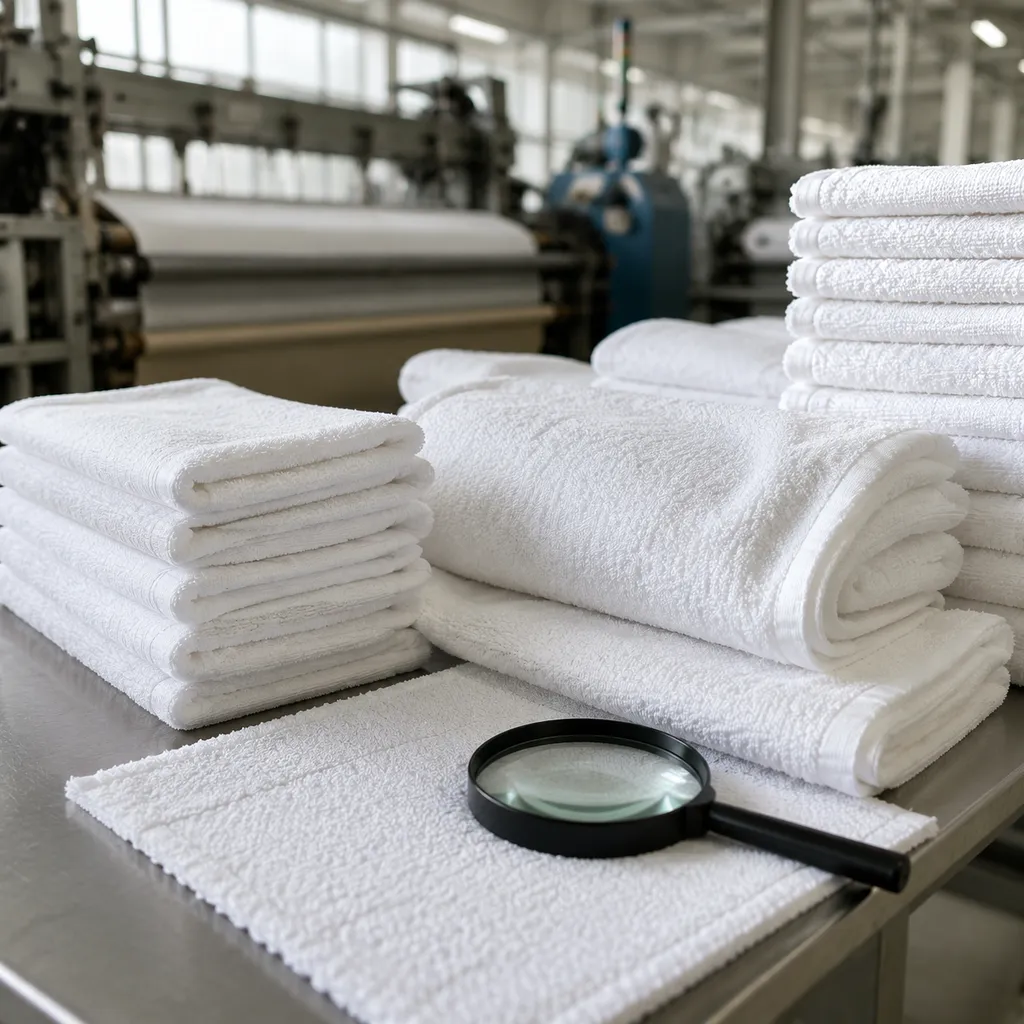
Start With the Laundry Reality, Not the Shelf Feel
Retail bath towels are often judged by handfeel during unpacking. Hotel towels are judged by what survives extraction, tumble drying, guest use, stain treatment, and folding. In our client base, city hotels and serviced apartments commonly report 2 to 3 laundering rounds per week for active-room bath towels. Resort pool and spa properties can run higher during peak occupancy. That does not mean every towel is washed exactly 104 or 156 times per year; it means the construction must be selected for the laundry pattern the buyer actually runs.
For a defensible specification, we ask buyers to separate three targets: the first 5 wash cycles, the first 30 commercial-style cycles, and the expected replacement window. A towel that loses lint aggressively in the first 10 cycles may pass a showroom review but create housekeeping complaints. A towel that shrinks unevenly after 20 cycles can still absorb water but look badly sized when stacked beside newer inventory.
| Hotel use case | Typical construction we quote | Why this range is used | Risk if under-specified |
|---|---|---|---|
| Economy hotel bath towel | 450-520 GSM, 16s/1 or 21s/2 cotton terry | Controls drying time and replacement cost | Thin handfeel, edge curling, faster pile flattening |
| Midscale hotel bath towel | 530-620 GSM, combed cotton or cotton-rich terry | Balances absorbency with laundry throughput | Linting if yarn twist and finishing are not controlled |
| Upper-upscale bath towel | 630-720 GSM, combed cotton, reinforced border | More loft and guest perception without excessive weight | Longer drying time and higher freight cost |
| Spa or suite bath towel | 700-780 GSM, low-twist or soft-twist options | Soft touch for treatment rooms or suites | Loop snagging if used in rough commercial laundry |
These GSM bands are not a universal industry law. They are the ranges we most often see quoted and approved for OEM hotel programs from our Gaoyang production floor. We still adjust them by towel size, laundry temperature, dryer type, and whether the property uses chlorine, peroxide, or outsourced tunnel washing.
Our Hotel Bath Towel Wash Durability Standard
For bulk hotel programs, we define the hotel bath towel wash durability standard as a written set of test conditions and acceptance limits. The important part is not only the limit. The buyer and mill must agree on the wash procedure, drying procedure, sample count, and measurement method. Otherwise, one party tests a gentle home wash while the other tests a commercial laundry simulation, and both results look technically correct.
Below is the baseline protocol we use for hotel bath towels unless the buyer has its own laundry standard. It is designed for cotton terry towels from 450 to 750 GSM. Microfiber, waffle, peshtemal, and decorative towels need different limits.
| Test item | Method we define in the PO or QC file | Standard acceptance limit | Stricter limit for upper-upscale |
|---|---|---|---|
| Dimensional change | ISO 5077 measurement after ISO 6330 wash and tumble dry procedure, 5 specimens | Length and width within -6.0% to +2.0% after 5 cycles | Within -4.5% to +1.5% |
| GSM loss after washing | Condition 24 hours, weigh and calculate mass per square meter before and after 10 cycles | Maximum 7.5% mass reduction | Maximum 5.5% mass reduction |
| Lint mass loss | Dryer lint collected in pre-weighed 80 mesh stainless screen bag; balance resolution 0.01 g; report lint as % of initial towel mass after cycles 1-5 and 6-10 | Cycle 1-5: max 1.2%; cycle 6-10: max 0.45% | Cycle 1-5: max 0.85%; cycle 6-10: max 0.30% |
| Colorfastness to washing | ISO 105-C06, staining and color change by grey scale | Grade 4 minimum for white and light shade; grade 3-4 minimum for dark shade | Grade 4 minimum for all approved shades |
| Loop-pull inspection | AQL visual check after laundering under D65 light; count pulled loops longer than 8 mm inside a 30 cm x 30 cm template at 5 towel locations | Average max 2.0 pulled loops per template; no single pull above 25 mm | Average max 1.0 per template; no single pull above 18 mm |
| Edge and hem integrity | Visual and manual check after 10 wash cycles; seam slippage, skipped stitches, fraying, label detachment | No open seam over 5 mm; no loose label corner over 8 mm | No open seam; no label lifting over 4 mm |
Two details matter here. First, lint loss must be measured by mass, not by someone saying the dryer filter looked heavy. Second, loop-pull inspection must define length, area, lighting, and sampling location. Terry towels naturally have loops. The defect is not the existence of loops; it is long, unstable, or excessive pulled loops after washing.
The Defects We See After Wash Testing
Most failed hotel towels do not fail in one dramatic way. They age unevenly. One towel shrinks more than the others. Another keeps the body but develops a wavy border. Another leaves lint on dark uniforms during folding. Our QC team sorts these defects into production causes because the corrective action is different.
- High lint mass in cycles 1-5: often linked to insufficient shearing, weak yarn strength, aggressive brushing, or poor loose-fiber removal before packing.
- Lint that continues after cycle 10: more serious than first-wash lint; it may indicate unstable yarn twist, under-controlled pile formation, or fiber damage during dyeing.
- Uneven shrinkage: usually comes from unstable ground yarn tension, border density mismatch, or heat setting that does not match the laundry temperature.
- Pulled loops near the border: can come from high-low pile transitions, loose terry tension, or rough hemming needles cutting adjacent loops.
- Hard handfeel after washing: often appears when softener choice masks a harsh construction during sampling, then washes out in hotel laundry.
A buyer should not accept a report that only says "wash passed." The useful report tells you what changed. For example: original weight, post-wash weight, lint collected, shrinkage by direction, visible loop-pull count, and edge condition. That is why our internal QC form has numeric boxes rather than a single pass/fail line.
Completed Case: 540 GSM Bath Towel for a 312-Room Hotel
In March 2026, we completed a white bath towel order for a 312-room business hotel group in the Gulf region. The buyer initially requested 500 GSM to reduce freight and laundry drying time. Their outsourced laundry used 60°C washing, peroxide spotting for makeup marks, and high-temperature tumble drying. After reviewing their replacement complaint history, we proposed a 540 GSM combed cotton towel with a tighter ground construction and a narrower decorative dobby border to reduce border waviness.
The approved size was 70 x 140 cm. At 540 GSM, one towel calculates to about 529 g before finishing tolerance: 0.70 m x 1.40 m x 540 g/m². Bulk weight was controlled at 515-550 g after conditioning. MOQ was 500 pcs per design and per color, but the buyer ordered 4,800 pcs to cover rooms, laundry circulation, and opening stock. We packed 24 pcs per export carton, with carton gross weight held below 14.2 kg for safer warehouse handling.
QC report excerpt, lot HB-26-0311: 10-cycle wash simulation completed. Average dimensional change length -3.8%, width -2.9%. Lint mass loss cycles 1-5: 0.64%; cycles 6-10: 0.22%. Average pulled loops per 30 cm x 30 cm template: 0.7. Longest pulled loop observed: 12 mm. Hem opening: none. Result: accepted for bulk packing.
This is not a guarantee that every hotel will get the same result. Change the yarn, border, wash chemistry, dryer heat, or towel size, and the result can move. But it shows how a durability standard becomes practical: one construction, one laundry simulation, one acceptance table, and one recorded outcome before shipment.
How Yarn, Pile, and Border Choices Affect Wash Life
A hotel towel is a woven structure, not only a weight number. Two towels can both be 600 GSM and behave differently after laundering. The ground yarn stabilizes the fabric. The pile yarn provides absorbency and touch. The border controls appearance and folding line, but it can also be the first place to distort.
| Spec choice | Better for wash durability | Watch point | Factory comment |
|---|---|---|---|
| Combed cotton pile | Lower loose short-fiber content than basic carded yarn | Higher yarn cost | Useful for midscale and above when lint complaints are expensive |
| 21s/2 ground yarn | Stable body and better resistance to distortion | Can feel firmer than lighter constructions | Often selected for commercial laundry towels |
| Long decorative dobby border | Strong shelf identity | Can shrink differently from terry body | Keep border height controlled if tunnel laundry is used |
| Low-twist pile | Soft handfeel and fast absorbency | More vulnerable to snagging and lint if over-softened | Better for suites and spas than heavy-duty housekeeping circulation |
| Double-stitched hem | Improves edge hold after repeated drying | Adds sewing time and small cost | Worth specifying for 600 GSM and above |
One construction quirk we watch closely is the transition between the terry body and dobby border. If loom tension is not balanced, the body relaxes differently from the border after washing. The towel may still measure within shrinkage tolerance, but the border develops rippling. For hotels, a rippled border creates a poor stack presentation even when absorbency is acceptable.
Another factory-floor issue is shearing depth. If the towel is sheared too aggressively to create a neat surface, some pile tips become weak and lint rises during early drying. If shearing is too light, loose fibers remain and the first laundry load looks dirty. We usually run a small inline shake-out and visual lint check before lab wash testing for hotel programs above 2,000 pcs.
Sample Approval Should Include a Laundry Trial
A hand sample sent by courier is not enough for hotel towel approval. It confirms size, weight, border, label, and touch. It does not confirm how the towel behaves after repeated wash and dry. For hotel bath towel wash durability standard signoff, we recommend three sample stages when time allows.
- Desk sample review: confirm size, GSM target, yarn, border height, label placement, and packaging. This usually takes 5-8 days after yarn and color are available.
- Pre-production wash test: test 3-5 towels from pilot weaving or first loom output. Run 5 or 10 wash cycles and record shrinkage, lint, loop pulls, and handfeel change.
- Bulk inline confirmation: after bulk weaving and finishing start, pull random towels before packing and compare against the approved washed sample.
If the buyer skips the pre-production wash test to save one week, the risk moves into the container. For repeat hotel programs, we can shorten the process because the same yarn, loom setting, dyeing route, and finishing formula are already known. For a new hotel towel construction, we prefer to spend the extra days before bulk cutting and packing.
Related reads: if your team is still building the base specification, start with building a towel tech pack mills can quote and our towel GSM decision framework. For size planning across room types, use the complete towel size guide.
Pricing Impact of a Stronger Durability Spec
Durability is not free, but it is usually cheaper than early replacement. The cost drivers are yarn grade, GSM, dyeing route, sewing reinforcement, testing time, and packing density. A 480 GSM towel with basic yarn may look attractive in a tender, but if it is replaced months earlier, housekeeping and purchasing costs rise.
| Order volume | Typical FOB China price, 70 x 140 cm white towel | Typical FOB China price, dyed hotel color | Notes |
|---|---|---|---|
| 500-999 pcs | USD 3.35-4.65 | USD 3.70-5.20 | MOQ starts at 500 pcs per design per color; lab test cost spread is high |
| 1,000-2,999 pcs | USD 2.95-4.20 | USD 3.25-4.75 | Better yarn purchasing efficiency and carton utilization |
| 3,000-7,999 pcs | USD 2.62-3.85 | USD 2.92-4.38 | Good range for hotel opening stock or annual replenishment |
| 8,000 pcs and above | USD 2.38-3.55 | USD 2.68-4.05 | More stable dye lot planning and lower unit testing overhead |
For a simple cost-per-use comparison, take two realistic options from recent quotation work. A 500 GSM basic bath towel at USD 2.78 may survive a property’s standard before replacement for 55 usable laundry cycles. That is about USD 0.0505 per cycle before freight and duty. A 590 GSM combed cotton towel at USD 3.46 may reach 88 usable cycles under the same laundry process, or about USD 0.0393 per cycle. The higher unit price can still be the lower operating cost.
We do not recommend paying for 750 GSM if the hotel laundry is designed for fast turnaround and low dryer dwell time. A heavier towel can increase energy use and slow circulation. The better spec is the one that matches the property’s laundry system.
Certifications and QC Standards to Put in the PO
Certifications do not replace wash testing, but they reduce sourcing risk. For hotel groups, we normally include OEKO-TEX Standard 100 Class I or Class II depending on product positioning, BSCI social compliance, and ISO 9001 quality management documentation. LUMA & CO. TEXTILE holds OEKO-TEX 100 Class I, BSCI, and ISO 9001 certification, and we can attach valid documents during supplier approval.
- OEKO-TEX Standard 100: chemical safety screening for textile products and components, including sewing thread and labels when specified.
- ISO 9001: quality management system control; useful for traceability, corrective action records, and inspection discipline.
- BSCI: social compliance audit framework requested by many European and international buyers.
- ISO 105-C06: colorfastness to domestic and commercial laundering; useful for dyed bath towels and border yarns.
- ISO 5077 and ISO 6330: dimensional change measurement and washing/drying procedures for textile testing.
The PO should also state the inspection level. For export hotel towels, we commonly use ANSI/ASQ Z1.4 or ISO 2859-1 sampling logic, with critical defects at 0, major defects at AQL 2.5, and minor defects at AQL 4.0. If the towel is for a luxury property or opening project with no time for rework, buyers often tighten major defects to AQL 1.5.
Related reads: for supplier evaluation, see evaluating hotel towel manufacturers and how to read an OEKO-TEX certificate. If your purchasing team is comparing supplier offers, our hotel towels wholesale supplier guide explains the commercial side.
Timeline, MOQ, and What We Need From the Buyer
Our standard MOQ is 500 pcs per design per color. For hotel bath towels, that MOQ is workable for a boutique property, but wash testing is more cost-efficient from 1,500 pcs upward. If the same towel is used across multiple properties, we can keep the construction constant and split cartons by destination, subject to label and packing requirements.
| Step | Normal timing | Buyer input needed | Risk if unclear |
|---|---|---|---|
| Specification confirmation | 1-3 days | Size, GSM, yarn preference, color, logo or border request | Factory quotes a towel that feels right but fails laundry needs |
| Sample weaving and finishing | 7-12 days for white; 10-16 days for dyed color | Approved Pantone or physical reference, label artwork | Color and label delays push the full schedule |
| Wash durability test | 4-7 days for 5 to 10 cycles including conditioning | Laundry temperature target and chemical restrictions | Test may not reflect real hotel operation |
| Bulk production | 22-35 days after deposit and sample approval | Final PO, carton marks, certification request | Late carton mark changes slow packing |
| Pre-shipment inspection and loading | 2-4 days | Inspection booking and shipping documents | Missed vessel or air-freight upgrade |
- Tell us whether towels are washed in-house or by an outsourced laundry.
- Confirm normal wash temperature, drying temperature, and whether chlorine or peroxide is used.
- State the target replacement window in months or expected laundry cycles if your housekeeping team tracks it.
- Provide the approved size tolerance, not only the nominal size.
- Decide whether the washed sample or unwashed sample is the final handfeel reference.
For standard white hotel bath towels, a realistic total production window is 35-50 days from clear specification to ready shipment. Dyed programs, custom borders, or monogramming can add 5-15 days. If a hotel opening date is fixed, we prefer to approve the towel construction at least 75 days before required arrival, especially for sea freight.
Checklist for a Defensible Approval File
A good approval file protects both sides. It tells the hotel what it bought and tells the mill what it must reproduce. If there is a complaint later, the file gives us something measurable to compare against, instead of relying on memory or subjective feel.
- Attach the approved unwashed and washed sample photos, including border and hem close-ups.
- Record original towel weight, post-wash weight, and calculated GSM change.
- Record ISO 5077 dimensional change after the agreed ISO 6330 wash/dry procedure.
- Measure lint mass loss using a pre-weighed collection screen or bag and a 0.01 g balance.
- Inspect loop pulls under defined lighting with a 30 cm x 30 cm template and length limit.
- Confirm colorfastness by ISO 105-C06 for dyed shades or colored border yarn.
- Keep carton packing, barcode, care label, and certification documents in the same file.
This is the practical purpose of a hotel bath towel wash durability standard: fewer arguments, fewer surprises, and a towel that matches the laundry reality of the property. We manufacture about 2.4 million towels per year for brand and institutional buyers, and the hotel programs that run smoothly are usually the ones that approve numbers first and softness second.
For broader hotel linen planning, read our hotel towel sourcing guide and the 90-day hotel linen program roadmap. If decoration is part of the program, compare options in embroidery vs sublimation vs jacquard.
Build a Wash-Tested Hotel Towel Spec
Send us your towel size, GSM target, laundry process, and annual volume. We will quote a construction with wash durability limits, MOQ from 500 pcs per design per color, and realistic timing. WhatsApp: +86 13205717266. Email: [email protected].
Request a durability-based quote →