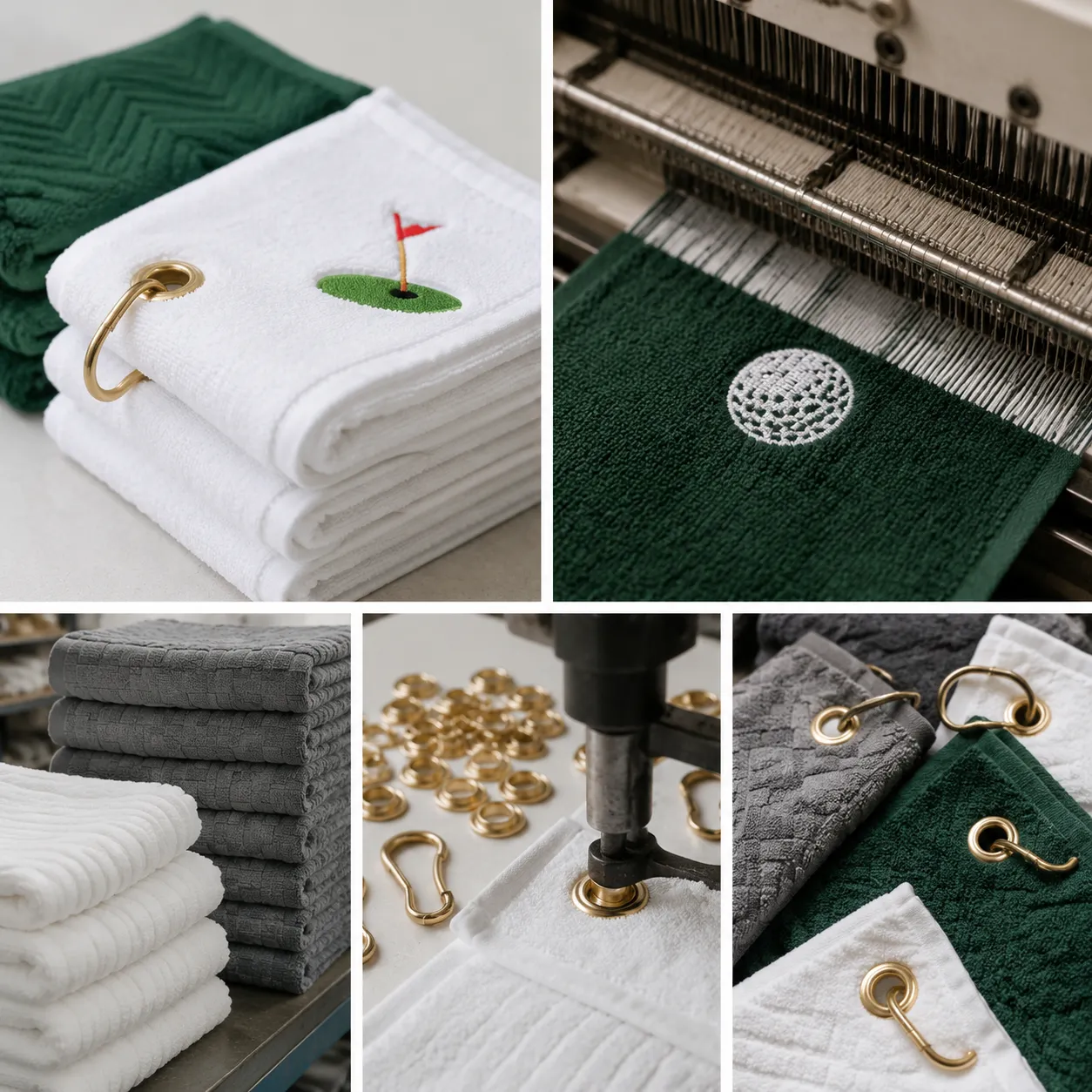
Start with the use case, not the towel photo
We normally separate golf programs into three buckets before quoting. Pro shop retail wants a towel that feels substantial in hand and carries decoration cleanly. Tournament giveaway programs need cost control, fast packing, and consistent logo placement across larger runs. Private clubs and hospitality groups often need names, membership tiers, or event dates added without turning the order into a customization mess.
That first sorting step changes almost every downstream choice: whether a tri-fold construction makes sense, whether to use a center grommet or corner hook, and whether embroidery, jacquard, or print is the right method. Buyers who skip this step often request a construction that looks right in a catalog but fails on the course because it drags on wet grass, loads too much sand, or becomes too stiff once the logo area is backed.
- Retail club shops usually perform best at 420-520 GSM in cotton or cotton-rich terry because the towel must feel giftable but still hang properly on a bag.
- Tournament handouts typically work in the 320-430 GSM range where freight stays under control and logos still read cleanly.
- Caddie and bag-use towels benefit from ribbed or terry velour face plus loop back so the front can decorate well and the back still cleans clubs.
What personalized golf towels bulk usually means in production
On the buyer side, the word "personalized" can mean several different things. Sometimes it means one club logo on the full run. Sometimes it means the same towel body with twelve player names for a member-guest event. Sometimes it means serial personalization by team, sponsor, or tee package. We quote those as different production models because setup, inspection time, and packing labor change materially.
| Personalization model | Typical MOQ | Best decoration | Production effect |
|---|---|---|---|
| Single logo across full run | 500 pcs/design/color | Embroidery or jacquard | Lowest unit cost and fastest approval cycle |
| Logo plus event date | 800-1,500 pcs | Embroidery, screen print, or woven label add-on | Minor artwork revision, manageable carton sorting |
| Logo plus individual names | 1,200 pcs and up | Name embroidery or heat transfer patch | Higher handling cost and stricter packing control |
| Mixed sponsor or team versions | 1,500 pcs combined | Shared body with variable artwork | Needs barcode-based assortment packing |
For individually named orders, we build an approval sheet that locks name spelling, capitalization, thread color, and pack breakdown before bulk sewing starts. If that data arrives late, production does not really begin late; it begins twice. The line may sew the towel body on time, but decoration and assortment turn into the bottleneck.
Embroidery is still the safest route for club identity
Embroidery remains the most common request for golf because it reads as permanent and works across cotton terry, velour, and microfiber blends. We usually recommend keeping the embroidered area within 7-9 cm width on standard bag towels. Larger logos are possible, but stitch density starts to harden the panel and can cause edge draw, especially on lighter bases below 380 GSM.
There is also a construction detail many buyers miss: if the towel face is lofty loop terry, the logo edge can look fuzzy unless the panel is sheared or velour-finished first. That is why many golf towels use a velour front and terry back. The front gives a cleaner stitch bed; the back still provides absorbency and wiping performance. We also test embroidery pull using a simple after-wash flatness check after ISO 6330 domestic laundering so the logo area does not tunnel.
- Good embroidery base: cotton velour front, 400-480 GSM, logo width under 90 mm.
- Higher-risk base: open loop terry under 360 GSM where underlay stitches can show through.
- Cleaner retail look: tone-on-tone thread on dark navy, forest, black, and charcoal bodies.
- Higher readability for events: white or metallic-look polyester thread on solid dark grounds.
| Decoration method | Where it fits | Advantages | Common failure mode |
|---|---|---|---|
| Embroidery | Club logos, monograms, member gifts | Durable, premium perception, low artwork distortion | Puckering if stitch count is too high for fabric weight |
| Jacquard weave | Large-run branded programs | Logo integrated into structure, no extra hand-feel stiffness | Fine details can blur below 3 mm line width |
| Screen print | Budget events and flat graphics | Lower setup cost on simple artwork | Cracking or poor coverage on textured terry |
| Sublimation on microfiber | Photo or gradient artwork | Sharp color and low unit weight | Not ideal for traditional cotton-club positioning |
For a side-by-side overview of decoration tradeoffs, see embroidery-vs-sublimation-vs-jacquard.html and pantone-color-matching-custom-towels.html. Buyers mixing sponsor logos and club identity on one towel usually need that comparison early.
Hardware choices change how the towel behaves on the bag
A golf towel is not just a small towel with a logo. The hardware assembly matters because the towel swings, rubs, and loads unevenly during play. We see the highest complaint rate on poorly reinforced grommet areas, not on the body fabric itself. If the towel will be tri-folded and clipped to a bag, the center reinforcement must match the finished weight and fold geometry.
On cotton terry constructions above 430 GSM, we normally specify an extra reinforcement patch behind the brass or black-finish grommet to avoid oval deformation after repeated clipping. On lighter microfiber or waffle constructions, the issue is different: the grommet may hold, but the towel can spiral because the grain line was not squared before cutting. That is why our QC checks finished hanging angle after steaming and why we reject towels that torque visibly when suspended.
- Use a corner carabiner when the buyer wants simple attachment and lower sewing complexity.
- Use a center grommet on tri-fold when the towel must present the logo outward in a neat retail display.
- Specify hardware finish in writing: brass, gunmetal, matte black, or plated silver can all alter final visual matching.
- Ask for a pull test standard; we typically inspect hardware attachment against internal tension thresholds before packing.
The right size is the one that fits the bag and the role
Oversized sounds attractive until the towel starts dragging or bunching. Most successful golf programs stay within compact formats that clean clubs, hands, and balls without becoming awkward. The most repeatable sellers are tri-fold formats around 40 x 50 cm or 40 x 60 cm finished, while caddie styles can go longer if the buyer accepts more swing and more water retention.
| Finished size | Typical use | Weight at common GSM | Comment |
|---|---|---|---|
| 30 x 50 cm | Tournament giveaway | About 50-70 g at 340-460 GSM | Compact and cost-efficient but limited logo real estate |
| 40 x 50 cm tri-fold | Club bag towel | About 80-105 g at 400-520 GSM | Most balanced format for logo visibility and handling |
| 40 x 60 cm | Retail and member gift | About 95-125 g at 400-520 GSM | More presence on shelf, slightly higher freight |
| 50 x 80 cm | Caddie or resort crossover | About 145-185 g at 360-460 GSM | Useful only when the program wants more cleaning surface |
If a buyer is still deciding between gift-style and utility-style dimensions, towel-sizes-dimensions-complete-guide.html is the best internal reference. We often pair that with country-club-golf-towel-program.html when a club is building a full pro shop assortment.
Pricing moves more on decoration and packing than on cotton alone
Buyers sometimes expect towel cost to be driven mostly by fabric weight. In golf, that is only half true. A 440 GSM terry towel with one clean embroidery can price better than a lighter towel with complex individual names, custom hooks, barcode stickers, and split pack assortments. The moment the project becomes a personalized fulfillment exercise, labor starts competing with material cost.
| Program type | Spec example | Volume | EXW USD/pc |
|---|---|---|---|
| Event basic | 30 x 50 cm, 360 GSM cotton terry, one-position embroidery, carabiner | 1,500-2,999 pcs | USD 1.42-1.78 |
| Club standard | 40 x 50 cm tri-fold, 430 GSM velour/terry, center grommet, embroidery | 1,000-2,499 pcs | USD 2.08-2.72 |
| Retail upgraded | 40 x 60 cm, 480 GSM combed cotton velour, custom header card, embroidery | 800-1,499 pcs | USD 2.86-3.74 |
| Named event set | 40 x 50 cm, 420 GSM cotton, logo plus individual names, sorted packs | 1,200-2,000 pcs | USD 2.94-4.10 |
Those ranges assume standard carton export packing, one body color, and normal thread counts. If you add woven hem labels, retail belly bands, hang tags, or mixed sponsor versions, the price shifts. For buyers comparing cotton and microfiber constructions, microfiber-vs-cotton-towel-comparison.html helps frame the tradeoff correctly.
Sampling and timeline mistakes usually happen at artwork stage
Our normal development flow for golf towels is shorter than for bath programs, but the schedule still breaks when artwork is not production-ready. Vector cleanup, thread-color approvals, and placement sign-off matter more than buyers expect because the decoration area is small and highly visible. A one-millimeter shift on a compact logo is noticeable once the towel is folded for bag presentation.
- Lab dip or thread color confirmation: 2-4 days depending on shade complexity.
- Pre-production sample with hardware and decoration: 5-8 days.
- Bulk production for standard logo runs: 18-28 days after sample approval and deposit.
- Bulk production for individually personalized runs: 24-35 days because naming, sorting, and final inspection take longer.
- Sea booking buffer in peak periods: add 7-10 days beyond sewing completion if the order targets a fixed tournament date.
If the buyer only sends a JPEG logo and a rough towel idea, we normally redirect them to build-towel-tech-pack-that-mills-can-quote.html. It saves at least one revision cycle. On time-sensitive events, container-vs-air-freight-towel-orders.html is also worth reading before approval drifts into the shipping window.
QC points that matter specifically for golf towels
Golf towels fail differently from hotel or gym towels. We inspect the usual metrics like size tolerance, color consistency, and seam integrity, but there are golf-specific checks we do not skip. One is folded presentation: on a tri-fold towel, the logo must stay visible and centered after folding, not disappear into the panel overlap. Another is clip orientation: the hook or carabiner must sit in a way that lets the towel hang naturally off a bag ring.
We also pay attention to lint behavior after the first wash. A towel used on clubs and balls should not shed loose surface fibers aggressively, especially on darker embroidery fields. For cotton-based programs we typically monitor dimensional change after ISO 6330 washing and color change with reference to ISO 105-C06 style laundering assessments. For compliance, buyers normally ask us to provide OEKO-TEX Standard 100 Class I, BSCI, and ISO 9001 documentation in the file set.
- Finished size tolerance should be written clearly, especially for tri-fold formats where even 1.5 cm skew is visible.
- Embroidery back finish should be checked by hand so the reverse does not scratch hands when the towel is used wet.
- Grommet and clip area needs visual inspection for burrs, loose setting, and fabric tearing around the reinforcement.
- Carton assortments for named orders should be scanned against the packing list before sealing, not after palletizing.
How we advise buyers choosing between club retail and event giveaway
The same logo can support two very different towel programs. For club retail, we usually push buyers toward better hand-feel, richer navy or black grounds, cleaner embroidery, and stronger packaging discipline. For event use, we focus on speed, legibility, and budget-per-player. That may mean reducing size slightly, simplifying the logo area, or switching from an elaborate gift-ready fold to standard export packing.
The cheapest golf towel is rarely the one with the lowest unit price. If it hangs badly, loses shape around the hardware, or forces expensive hand-sorting before the event, the program cost goes up fast.
A useful midpoint is a 40 x 50 cm tri-fold at 410-450 GSM with one-position embroidery and a reliable center grommet. It is not the lowest-cost build, but it covers most club and tournament needs without introducing too many production variables. When buyers want to reduce spend further, we usually cut packaging complexity before we cut the construction to a level that damages perceived value.
Related reads before you lock the PO
Buyers working on personalized golf towels bulk programs usually review custom-golf-towels-oem-program.html, blank-golf-towels-oem-decoration-readiness.html, and country-club-golf-towel-program.html before freezing decoration and packing details.
If your order sits inside a broader merchandise launch, add pantone-color-matching-custom-towels.html and negotiate-towel-moq-without-killing-margin.html to the review list. They answer most of the early sourcing questions we see from club shops and event agencies.
Quote a personalized golf towel program
Send artwork, target size, decoration method, and event date. Our MOQ is 500 pcs per design per color, and we can advise on embroidery, jacquard, hardware, and packing. Contact us at [email protected] or WhatsApp +86 13384590853.
Request Quote →