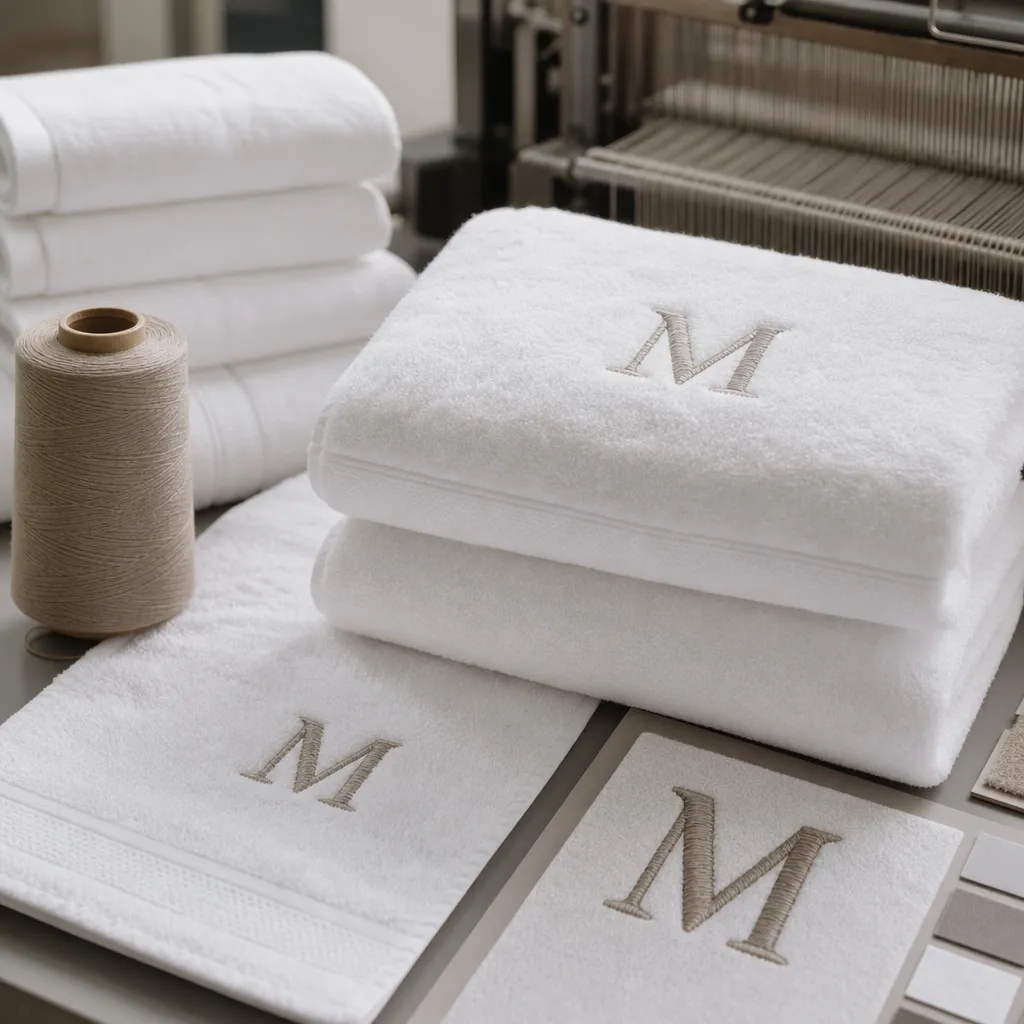
Where a monogram bath towel succeeds or fails
The first decision is not the letter style. It is the towel surface. A clean monogram needs enough pile to feel like a hotel bath towel, but not so much loose loop that the stitches sink after washing. For most hotel monogram towels we make, the stable range is 500-650 GSM in 16s/1 or 21s/2 cotton yarn. Below 450 GSM, the towel may look thin beside the embroidery. Above 700 GSM, the pile can push against the thread and make fine serifs look uneven.
We treat embroidery as part of construction, not an add-on at the packing table. The towel body, hem width, border height, needle size, thread count, backing, and washing test all affect the result. A bath towel that is excellent without decoration can still be wrong for embroidery if the border is too narrow or the pile is too open.
| Towel body spec | Works well for monogramming | Risk to watch |
|---|---|---|
| 450-500 GSM ring-spun cotton | Good for guest rooms and rental programs where cost per wash matters | Can feel light if the embroidery is large or dense |
| 520-600 GSM combed cotton | Most balanced for custom embroidered bath towels | Needs controlled shrinkage before placement approval |
| 620-680 GSM zero-twist or low-twist cotton | Soft handfeel for spa or suite programs | Loops can swallow thin script letters |
| 700-750 GSM dense terry | Strong retail feel and good absorbency | Longer drying time and higher freight cost |
Start with the towel face, then draw the monogram
Buyers often send us a monogram artwork before the base towel is fixed. We prefer to reverse that order. The same 72 mm crest can look crisp on a flat dobby border, heavy on 650 GSM terry, and too small on a 90 x 180 cm bath sheet. Before digitizing, we ask for towel size, GSM, yarn type, border layout, wash temperature, and whether the towel is for hotel, spa, retail, or gifting.
- For hotel rooms: 70 x 140 cm or 76 x 152 cm, 520-600 GSM, embroidery on the lower third or dobby border.
- For spa suites: 76 x 152 cm, 600-680 GSM, softer pile, smaller monogram to avoid a stiff patch against skin.
- For retail gifting: 70 x 140 cm, 550-650 GSM, initials centered 80-110 mm above the hem.
- For resort villas: 80 x 160 cm or bath sheet sizes, 600-700 GSM, larger crest but fewer fill stitches.
On terry cloth, a very thin script line is usually the weakest design choice. We normally keep satin strokes above 1.2 mm finished width and avoid internal gaps smaller than 0.8 mm. If a brand insists on hairline lettering, we may recommend a flat woven border or a small applique label instead of direct embroidery.
Placement rules buyers should lock before sampling
Towel embroidery placement is a production control issue. If the position moves 12 mm from towel to towel, the guest may not notice one piece, but a housekeeping shelf will show the drift. We mark placement from the finished hem, not from the raw cut panel, because cotton shrinkage changes after pre-wash and tumble drying.
| Placement option | Typical position | Best use |
|---|---|---|
| Lower center on terry field | 90-130 mm above bottom hem | Classic luxury bath towel monogram for hotel suites |
| On dobby border | Centered inside 45-75 mm border height | Sharper lettering and lower pile interference |
| Lower corner | 70-100 mm from side hem and bottom hem | Retail initials, his-and-hers sets, boutique programs |
| Vertical side placement | 120-180 mm from lower corner | Spa towels folded lengthwise on treatment beds |
For a monogram bath towel, we ask buyers to approve a folded-view photo as well as a flat-view photo. Hotels do not display towels flat like a catalog. They roll them, tri-fold them, stack them on a shelf, or hang them over a rail. If the mark disappears in the usual fold, the placement is wrong even if the spec sheet looks tidy.
Digitizing for pile, not for paper
Embroidery files made for shirts usually need revision for towels. Terry loops create shadow and movement under the needle. We use a water-soluble topping over the embroidery area so pile loops stay under the stitches during sewing. For most bath towel monograms, we pair that with a tear-away backing in the 35-45 g/m2 range; heavier backing can make the towel feel like it has a hard plate behind the decoration.
Our decoration team normally starts with 40 wt polyester thread for hospitality work because it handles chlorine residue, peroxide laundry, and tumble heat better than rayon. A common stitch density for satin areas is 0.35-0.45 mm, but we adjust by letter thickness and towel pile. Too dense, and the embroidery puckers after ISO 6330 washing. Too loose, and pile breaks through the face after 10-15 laundry cycles.
- Use underlay stitches to hold terry loops down before the visible satin layer.
- Reduce tiny internal details in crests before sampling; they rarely survive commercial laundry cleanly.
- Avoid large solid fill blocks above 25,000 stitches on a bath towel unless the buyer accepts stiffness.
- Keep metallic thread for gift packaging, not hotel circulation, unless the wash program is mild.
One defect we watch closely is edge tunneling, where the monogram border lifts slightly and creates a ridge. It often comes from too much top tension or insufficient underlay. Another is shadowing, where dark pile shows through pale thread. For white-on-navy or ivory-on-charcoal, we usually sample two densities before bulk approval.
GSM, yarn, and shrinkage after embroidery
A monogram bath towel must be judged after washing, not only after sewing. Cotton terry relaxes, hems tighten, and embroidery thread behaves differently from the towel body. In our sample process, we measure size change after a warm wash and tumble dry based on ISO 6330 principles, then check appearance against the approved gold sample.
| Spec point | Factory target | Why it matters |
|---|---|---|
| GSM tolerance | Usually +/-5% after conditioning | Keeps handfeel and unit weight consistent |
| Dimensional change | Within 3-5% after wash for most hotel programs | Prevents monogram drift and uneven folded stacks |
| Colorfastness to washing | ISO 105-C06, target grade 4 or above | Protects thread and towel shade in repeated laundering |
| Colorfastness to rubbing | ISO 105-X12, target grade 4 dry and 3-4 wet | Reduces transfer from dark towels and thread |
For white towels with colored embroidery, we also check whether thread dye bleeds into the pile after washing. This is more common with low-cost threads than with certified polyester embroidery thread. For dark towels with pale embroidery, the issue is usually lint and loose fiber sitting on the thread face after tumble drying; tighter pile and proper finishing reduce that.
The towel base should match the use case. A 560 GSM combed cotton bath towel may last 90-120 hotel laundry cycles in a controlled program. A 680 GSM zero-twist towel can feel richer in a showroom, but if the property has short drying windows, the higher retained moisture can raise laundry cost and cause odor complaints. Decoration does not fix the wrong base fabric.
Costing: stitch count changes the quote quickly
Embroidery pricing is more sensitive to stitch count than many buyers expect. A three-letter monogram at 6,500 stitches is a different production job from a hotel crest at 18,000 stitches. Needle time, thread consumption, backing, topping, trimming, and quality inspection all move with the artwork.
| Order volume | Example spec | Estimated FOB China price |
|---|---|---|
| 500-999 pcs | 70 x 140 cm, 540 GSM cotton, 1-position 7,000-stitch monogram | USD 4.35-5.20 per pc |
| 1,000-2,999 pcs | 70 x 140 cm, 580 GSM combed cotton, 9,000-stitch crest | USD 3.95-4.85 per pc |
| 3,000-7,999 pcs | 76 x 152 cm, 600 GSM combed cotton, 10,000-stitch embroidery | USD 4.80-5.90 per pc |
| 8,000+ pcs | Custom size, 560-620 GSM, embroidery optimized for line speed | USD 4.10-5.40 per pc |
Our MOQ is 500 pcs per design per color. That minimum is not just a sales rule; it protects dyeing, embroidery setup, inspection, and packing efficiency. For a small boutique hotel, 500 pcs may still be practical if the towel pool is planned across rooms, spa, and replacement stock.
A cheap towel with a beautiful monogram still becomes expensive when guests reject the handfeel or laundry removes it from circulation early.
Here is a realistic cost-per-use comparison from a recent hospitality quote. One buyer considered a 470 GSM towel with a 5,500-stitch mark at USD 3.55. The better option was 570 GSM combed cotton with a revised 8,200-stitch monogram at USD 4.68. If the lower-cost towel survives 52 washes, its towel cost is about USD 0.068 per wash before laundry. If the stronger towel reaches 112 washes, the towel cost drops to about USD 0.042 per wash. The higher invoice price can be the lower operating cost.
Compliance and certificates to request
For decorated towels, certification needs to cover more than the towel body. Thread, dyes, washing auxiliaries, and finishing chemicals should fit the buyer's market requirements. We manufacture under OEKO-TEX Standard 100 Class I capability for infant-contact safety level, BSCI social compliance, and ISO 9001 quality management. Not every project needs Class I, but asking early avoids trouble when retail or hospitality compliance teams review documents.
- Ask whether the towel body and embroidery thread can be supported by OEKO-TEX documentation.
- For EU and UK buyers, confirm azo dye and restricted substance requirements before lab dips.
- For hotel groups, align colorfastness tests with the laundry chemicals actually used on property.
- For retail packs, confirm fiber content labeling and country-of-origin marking before carton artwork.
We also recommend keeping an approved sample with a signed embroidery sheet. The sheet should include thread brand or equivalent, thread color code, finished embroidery width and height, placement tolerance, backing type, stitch count, and packing method. Without those details, a reorder six months later can look slightly different even if the artwork file is unchanged.
Sampling and production timeline
A normal embroidered towel timeline is shorter when the buyer has a clean tech pack. The slow points are usually artwork correction, lab dip approval for the towel color, and wash review after embroidery. Rush programs can be done, but they leave less room to correct density or placement.
- Day 1-2: Review towel size, GSM, yarn, artwork, placement, and compliance target.
- Day 3-5: Digitize embroidery file and prepare thread color options against Pantone or physical standard.
- Day 6-10: Produce strike-off or proto sample on the selected towel base.
- Day 11-14: Wash test, measure shrinkage, photograph flat and folded views, then revise if needed.
- Day 15-35: Bulk towel weaving, dyeing, embroidery, inspection, packing, and export preparation after approval.
For new yarn-dyed borders, custom towel colors, or very large crest embroidery, add 5-12 days. Sea freight then depends on route. A consolidated LCL shipment to the US or EU often needs 28-40 days port to port, while air freight can move cartons in 5-9 days but usually costs more than the towel margin allows for bulky bath programs.
Inspection points before cartons close
Embroidery inspection is slower than plain towel inspection because the defect may be small but visible. We check towel weight, dimensions, shade, pile defects, embroidery placement, thread tails, missed stitches, puckering, backing residue, and carton ratio. For hospitality buyers, we also open folded towels randomly to confirm the decoration faces the correct direction after standard folding.
- Placement tolerance: normally +/-5 mm for center marks and +/-7 mm for corner marks after finishing.
- Loose threads: trimmed close without cutting the terry pile or satin edge.
- Backing residue: no hard corners, scratchy patches, or visible paper after light handling.
- Shade grouping: dark towel colors packed by dye lot when needed to avoid shelf variation.
- Needle damage: no holes or laddering around dense stitch areas after wash test.
For darker hotel monogram towels, lint control is part of inspection. A black or charcoal towel can pass weight and size checks but still look poor if pale lint sits on the embroidery. We use controlled brushing and final cleaning before packing, but the yarn selection and finishing route matter earlier in the process.
Related reads: for broader decoration choices, see embroidery vs sublimation vs jacquard and our guide to monogrammed bath towels for luxury brands. If your buyer team is still choosing the towel base, compare towel GSM decisions and bath towel dimensions.
For sourcing documents, we recommend starting with how to build a towel tech pack. Color work is covered in Pantone color matching for custom towels, and hotel program planning is detailed in our hotel towel sourcing guide. Buyers planning freight should also read container vs air freight for towel orders.
What to send us for an accurate quote
For a monogram bath towel quote, the most useful file is not only the logo. We need the towel construction and the decoration intent together. If you have no final spec, send the target market, room count or retail channel, expected wash process, and reference towel weight. We can then propose a practical range instead of quoting a piece that looks good only in a sample photo.
- Towel size, GSM target, cotton type, and color requirement.
- Artwork in AI, PDF, EPS, or high-resolution PNG, plus any Pantone or thread reference.
- Preferred embroidery size and placement, or a photo of the intended fold/display.
- Order quantity by design and color; our MOQ is 500 pcs per design per color.
- Certification needs such as OEKO-TEX Standard 100, BSCI, ISO 9001 documentation, or buyer-specific testing.
Our team at LUMA & CO. TEXTILE has made custom embroidered bath towels for hotels, clubs, spas, retail gifting, and private-label programs since 2007. We operate a 220-person factory, supply 80+ brand clients in 47 countries, and produce about 2.4 million towels annually. For current sampling slots, contact us by WhatsApp at +86 13205717266 or email [email protected].
Quote a monogram bath towel program
Send towel size, GSM, artwork, placement, quantity, and target market. We will return a factory quote with embroidery assumptions clearly listed.
Request a quote →