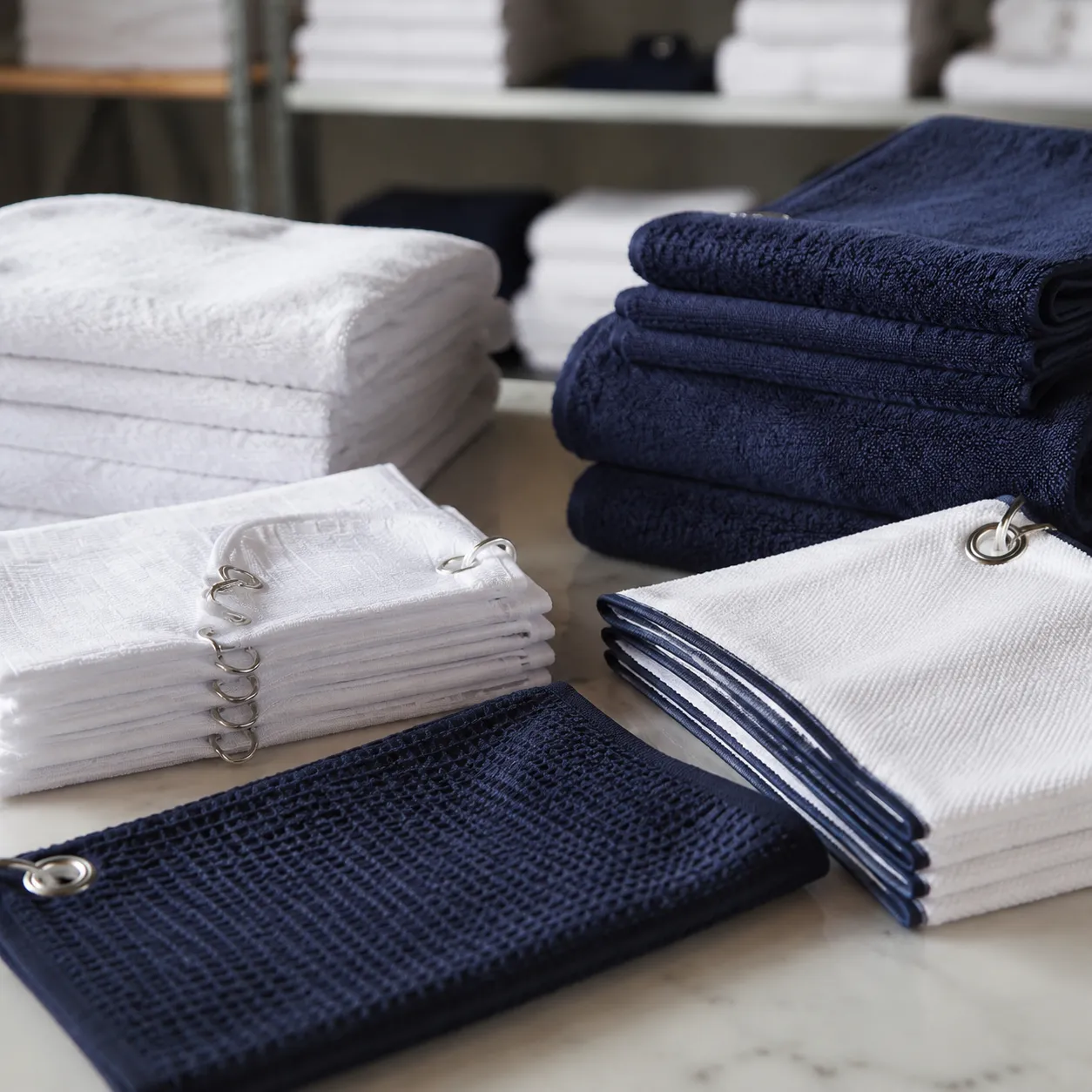
The blank fails long before the logo does
For golf programs, decoration usually gets the attention first: crest size, stitch count, or whether the tournament sponsor wants a woven label. In practice, blank construction decides whether any of that works. A towel that loses more than 5% in length after home laundering can pull an embroidery field off-center. A corner patch that is too light can tear out around the eyelet after repeated cart vibration. We normally ask buyers to lock four things before artwork review: fabric type, finished size tolerance, hanging hardware, and the exact area reserved for decoration.
Our MOQ is 500 pcs per design per color. For most club, resort, and event orders, that is enough to split into pro-shop stock and tournament packs if the base towel is standardized. If you try to run three fabrics, two hardware styles, and separate fold formats in one first order, the blank becomes harder to control than the branding.
| Decision point | What we ask the buyer | Why it matters on the mill side |
|---|---|---|
| Fabric | Cotton terry, velour, waffle microfiber, suede microfiber | Decoration behavior, absorbency, drying time, unit cost |
| Finished format | Flat rectangle or tri-fold | Fold line affects logo placement and carton density |
| Hardware | Metal grommet, carabiner, hook, or no hardware | Reinforcement method and corrosion risk differ |
| Wash target | Promo use, member use, or retail resale | AATCC test thresholds and yarn choice change |
Start with the use case, not the shape
We see three common blank programs. Tournament giveaways need a low-risk blank that looks tidy on day one and survives a few washes. Country clubs need repeatable color and clip performance because reorders happen by season. Retail or DTC brands want cleaner handfeel and decoration detail because the towel is judged next to gloves, caps, and bag accessories.
- Tournament issue towel: usually 320-420 GSM microfiber or 380-480 GSM cotton terry, sized for easy bag attachment and lower freight cost
- Club program towel: often 420-520 GSM cotton or blended performance fabric, with a stable grommet corner and reorder color control
- Retail accessory towel: frequently 360-430 GSM velour face cotton or fine-denier microfiber where logo sharpness matters more than lowest FOB
If the buyer only says "standard golf towel," we still need the real job description. A caddie program, member gift, and checkout-counter impulse item should not share the same blank. That is where cost mistakes usually begin.
Cotton or microfiber: pick based on decoration stress
Cotton blanks feel familiar and clean up clubs well, but they move more in wash and need better control around embroidery zones. Microfiber holds size better and dries faster, though cheap filament blends can go limp after repeated laundering and make the towel feel thin even when GSM looks acceptable on paper.
| Base fabric | Typical GSM | Best decoration fit | Main risk to manage |
|---|---|---|---|
| 16s cotton terry | 400-500 GSM | Embroidery, woven label, simple screen print on sheared panel | Shrinkage and torque if loop density is uneven |
| Cotton velour face / terry back | 360-430 GSM | Embroidery and cleaner front-face branding | Velour face can show needle tracks if backing is wrong |
| Waffle microfiber | 280-360 GSM | Sublimation, small woven label | Edge waviness after heat finishing if tension is not balanced |
| Suede microfiber / terry back | 300-390 GSM | Sublimation, heat transfer, light embroidery | Face can glaze if press temperature is too high |
For cotton pieces we normally review shrinkage by AATCC 135 after one home-laundering cycle and ask for a target of within 5% in both length and width for club-grade programs. For microfiber we focus more on dimensional stability after heat processing and color migration on printed panels. If the blank is for embroidery, we also look at needle resistance on the face so the logo field does not tunnel or pucker.
If you are still deciding between constructions, our articles on microfiber-vs-cotton-towel-comparison.html and embroidery-vs-sublimation-vs-jacquard.html go deeper without interrupting the sourcing flow here.
The corner hardware is where cheap blanks reveal themselves
On a golf towel, the grommet corner behaves like a stress point, not a trim detail. The failure modes are specific: eyelet spin, frayed patch edge, ring plating wear, and fabric rupture radiating from the punched hole. We reinforce that area differently depending on fabric weight and clip style. A light microfiber towel with a spring hook should not use the same patch build as a dense cotton terry towel with a brass clip.
- For cotton blanks above 430 GSM, we usually add an internal reinforcement patch at the hardware corner to spread pull load
- For microfiber below 320 GSM, we prefer a folded corner build with hidden backing instead of a single-layer punch-through
- If the buyer requests black metal fittings, we flag abrasion early because matte coatings can show edge wear after bag contact
- For salt-air resort courses, stainless hardware or coated aluminum performs better than low-cost iron fittings
We generally run a simple attachment pull check on pre-production samples. The acceptance line we use for most club orders is no tear-out, no hardware separation, and no visible patch cracking under a 7 kg static pull held for 10 seconds. That is not a laboratory standard, but it is a practical factory gate because golf bags swing, carts vibrate, and members do not treat clips gently.
| Hardware style | Best use | What to inspect before approval |
|---|---|---|
| Plain grommet only | Buyer adds hook locally | Inner diameter consistency, burr-free edge, plating adhesion |
| Carabiner clip | Tournament and retail packs | Spring return, clip gate gap, coating rub mark risk |
| Towel ring + hook | Traditional club programs | Ring weld seam, swivel freedom, corner patch distortion |
| No hardware | Folded pro-shop stock or later personalization | Flatness, edge straightness, stackability |
Size tolerances matter more on tri-fold than on flat towels
A blank sold for later decoration must fold the same way every time. Tri-fold golf towels exaggerate any length or edge variation because the folds stack on each other. We normally hold finished size tolerance tighter on tri-folds than on flat rectangles, especially when a logo needs to sit on the exposed outer panel.
For example, a 40 x 60 cm tri-fold can still look wrong if one panel is 6 mm longer than the others after finishing. That is why we discuss fold mapping early: which panel shows at retail, where the hook sits relative to the crest, and whether the towel hangs portrait or landscape. Those details would not matter much on a beach towel, but they decide shelf appearance here.
- Confirm the finished flat size in centimeters and inches
- Mark the visible panel once folded for store display
- Reserve a hardware exclusion zone so embroidery does not crowd the corner
- Set tolerance on length, width, and panel alignment before sample sign-off
If your team is comparing golf sizing against other categories, towel-sizes-dimensions-complete-guide.html is useful background. For a complete quoting file, build-towel-tech-pack-that-mills-can-quote.html helps prevent missing details.
What makes a blank embroidery-ready
Embroidery-ready does not just mean the face looks smooth. On cotton terry, we often shear a logo window or switch to a velour face so the stitch edge stays readable. On loop terry, dense fill stitches can sink into the pile unless the underlay is adjusted. On microfiber, light logos can look crisp, but the backing choice matters because a stiff backing can telegraph through and create a boardy patch.
- Keep embroidered logos away from the grommet zone by at least 35 mm on standard club towels
- For cotton velour blanks, we prefer logo areas with face height kept even after shearing to avoid halo around satin stitches
- For terry embroidery, a water-soluble topping can reduce stitch sink, but the fabric itself still needs a stable base density
- If the crest is under 45 mm wide with fine serif detail, embroidery on high-loop terry usually loses clarity
One process detail buyers often miss: after shearing a velour face, loose surface fibers must be cleaned thoroughly before embroidery sampling. If not, the stitched sample can look neat in the sample room but fuzzy after first use. Another specific issue is needle heat on dark microfiber; if machine speed runs too high, shiny track lines can appear around tight fills. Those are production-floor problems, not artwork problems.
QC checkpoints worth writing into the PO
If the purchase order only says "blank golf towel, good quality," inspection becomes subjective. We prefer to write acceptance points directly into the order and into the pre-production approval sheet. That reduces argument later, especially when the buyer will decorate the goods in another country.
| Checkpoint | Suggested acceptance level | Why it matters later |
|---|---|---|
| Colorfastness to washing | Grade 4 minimum color change and staining by agreed method | Club or event reorders need shade stability |
| Size shrinkage | Within 5% after agreed wash test | Protects fold layout and logo placement |
| Skew / bow | Not more than 3% on finished towel | Prevents twisted hang and poor folding |
| Seam and edge condition | No missed stitches, no raw edge exposure, no corner grin | Stops early fray during bag use |
| Hardware inspection | No burrs, no plating flake, no loose setting | Prevents user complaints and returns |
For cotton blanks we also watch mass variation lot to lot. A towel nominally sold at 450 GSM that lands at 414 GSM in one lot and 468 GSM in the next will not feel consistent in a pro shop. Our internal release window for many repeat programs is narrower than the sales spec because handfeel matters almost as much as measured weight.
Real price bands for undecorated programs
Blank cost depends heavily on fabric, hardware, and folding format. A buyer trying to compare "blank golf towels wholesale" across suppliers should separate truly undecorated stock from semi-finished goods with eyelet, hook, band, or barcode already installed. Those are not the same SKU from a costing standpoint.
| Program type | MOQ | Indicative FOB USD/pc | Typical lead time |
|---|---|---|---|
| Microfiber flat towel, no hardware, 300-330 GSM | 1,000 pcs | 0.86-1.18 | 18-24 days |
| Microfiber towel with grommet and clip | 1,000 pcs | 1.12-1.54 | 22-28 days |
| Cotton terry towel with grommet | 1,000 pcs | 1.48-2.06 | 26-34 days |
| Cotton velour face towel, hardware installed, retail fold band | 2,000 pcs | 1.92-2.74 | 30-38 days |
Smaller runs at our standard MOQ of 500 pieces per design per color are possible, but unit cost usually rises by 12% to 21% because setup, dye lot control, and hardware procurement do not scale down cleanly. Freight also changes the picture. A low-FOB towel with thick clip packaging can cost more landed than a cleaner bulk-packed alternative.
On volume planning, negotiate-towel-moq-without-killing-margin.html explains where MOQ flexibility is real and where it only creates hidden cost. For shipping mode, container-vs-air-freight-towel-orders.html is the practical follow-up.
Compliance is basic, but it still needs to be stated
For most B2B buyers, certification is not the differentiator; it is the minimum threshold. We manufacture under OEKO-TEX Standard 100 Class I, BSCI, and ISO 9001 systems. If your blank will later be embellished by a decorator in-market, ask for the fabric and finished good records to stay linked by lot so there is no confusion after goods are split.
- Confirm the fiber declaration on carton and item labels before mass packing
- Keep hardware finish records tied to the same lot as the sewn towel body
- If the order is for junior golf or family club retail, Class I documentation is easier to pass downstream
- For reorder programs, archive approved shade swatches and hardware samples together
Buyers who need a refresher on certificate language can check how-to-read-oeko-tex-certificate.html. It saves time during vendor onboarding.
A workable sampling and production calendar
Golf accessories often get compressed into event calendars, but the blank still needs proper sequencing. The safest route is to approve the towel body before final decoration placement, especially if a third-party embroiderer or screen printer is involved after import.
- Day 1-3: confirm tech pack, fabric, size, hardware, and packing format
- Day 4-10: lab dips or material handfeel approval if dyed program
- Day 11-18: pre-production sample with fold, edge, and hardware details
- Day 19-22: buyer comments and revision if needed
- Day 23-35: bulk weaving or knitting, dyeing, sewing, hardware assembly
- Day 36-41: final inspection, carton marking, booking preparation
For straightforward repeat orders, we can often ship inside 20-28 days. New developments with custom hardware, private-label packaging, or multiple colorways usually need 30-45 days. If the goods must then move to a domestic decorator, add that leg into your launch date instead of treating decoration as an afterthought.
What we would put on the first RFQ
A clean RFQ for golf towels blank is short, but it must be precise. We would specify fabric type and GSM, finished size with tolerance, fold format, edge finish, hardware style or no hardware, reserved decoration zone, packing method, target wash performance, and compliance requirements. That is enough for a mill to quote honestly and enough for your downstream decorator to understand the base they will receive.
- Example club spec: cotton velour face / terry back, 390-420 GSM, 40 x 60 cm, tri-fold, antique brass grommet and hook, crest area reserved on outer panel
- Example tournament spec: waffle microfiber, 300-330 GSM, 30 x 50 cm, flat towel, black clip, simple bulk pack in dozens
- Example retail blank: cotton terry, 430-470 GSM, hangtag ready, no decoration applied, barcode sticker placement defined
If you need category context beyond this article, country-club-golf-towel-program.html covers program planning from the club side, while pantone-color-matching-custom-towels.html helps if exact team or club color is part of the brief.
Need a golf towel blank spec check
Send us your size, fabric idea, hardware preference, and target price. We can review whether the blank is stable enough for later decoration and quote realistic FOB options.
Request a quote →For quote requests, contact us at [email protected] or WhatsApp +86 13384590853. We are a 220-employee mill in China producing about 2.4 million towels per year for more than 80 brand clients across 47 countries.