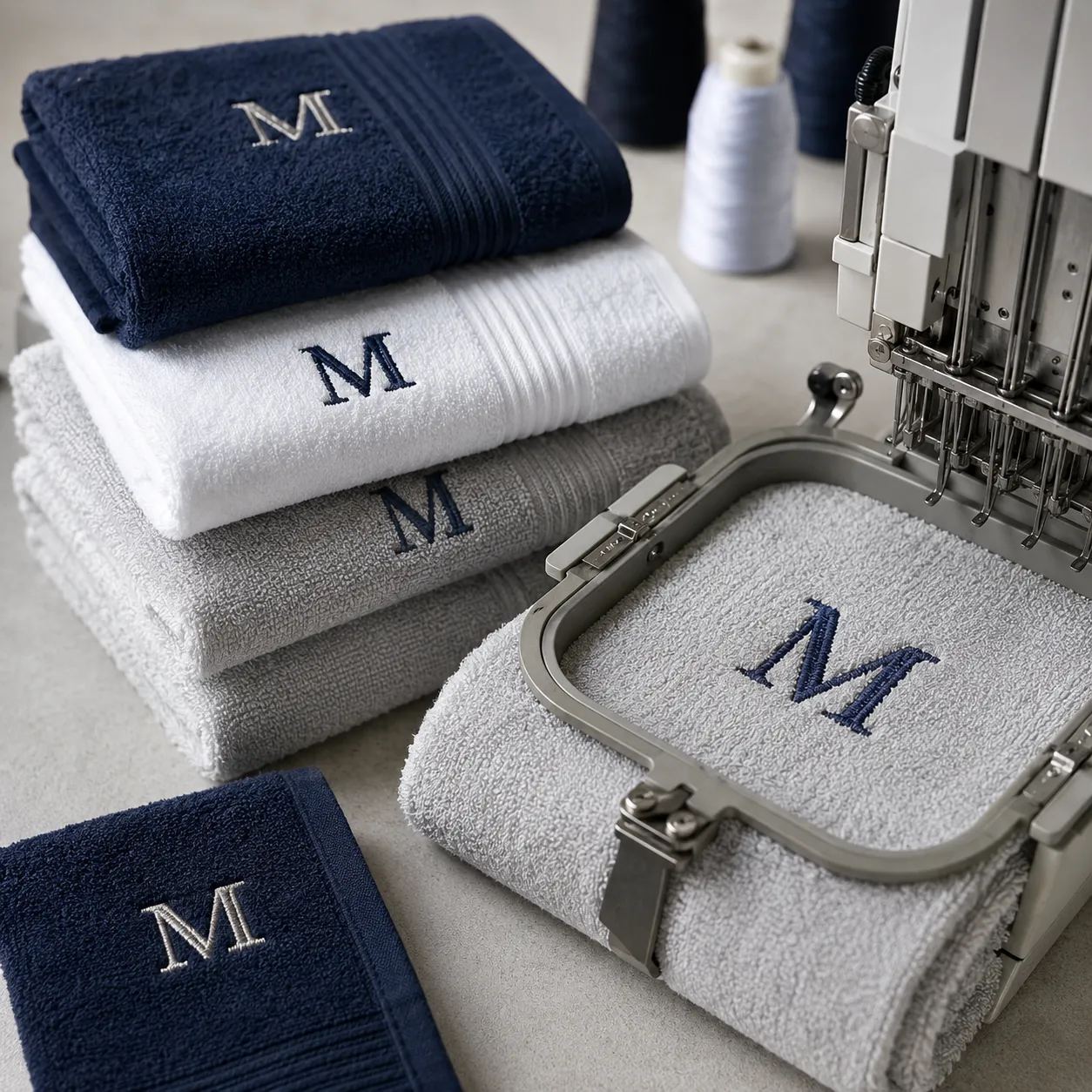
Why small towels make monograms harder
On bath towels, a 75 mm monogram can sit comfortably above the dobby border. On a washcloth, the same mark may dominate the whole piece, distort the fabric, or feel abrasive on the skin. We see this most often with hotel welcome sets, baby gift bundles, spa amenity trays, and DTC brands selling personalized face towel packs.
Our embroidery team treats monogrammed washcloths differently from bath towels because the usable decoration field is smaller and the towel is washed more aggressively. A guest may use a bath towel once per stay, but a washcloth can see cleanser, makeup remover, peroxide acne wash, chlorine traces, and hot tumble drying in the same laundry cycle.
For factory costing, the main drivers are towel construction, stitch count, stabilizer type, thread specification, initials handling, and whether each piece needs individual polybagging. Our MOQ is 500 pcs per design per color, but personalization logic can change labor time sharply if every piece carries different letters.
| Buyer program | Common washcloth size | Recommended GSM | Typical monogram size | Factory note |
|---|---|---|---|---|
| Hotel amenity tray | 30 × 30 cm | 420-500 GSM | 32-45 mm high | Keep stitching above 2,800 stitches only if pile is compact |
| Spa facial room | 32 × 32 cm | 450-550 GSM | 25-38 mm high | Soft handfeel matters more than raised satin density |
| Retail gift set | 33 × 33 cm | 500-620 GSM | 40-55 mm high | Presentation can justify higher embroidery cost |
| Baby washcloth monogram | 25 × 25 or 28 × 28 cm | 360-450 GSM | 20-32 mm high | Use OEKO-TEX 100 Class I inputs and avoid metallic thread |
Monogrammed washcloths spec decisions before artwork
Before we digitize initials, we ask buyers to lock the washcloth itself. If the base towel changes after embroidery sampling, the old stitch file may no longer work. A 430 GSM ring-spun washcloth and a 580 GSM combed cotton washcloth absorb stitches differently. The same satin column can sink into one pile and sit too stiff on another.
- Size tolerance: for 30 × 30 cm washcloths, we normally control finished size within ±1.0 cm after pre-shrink finishing.
- Pile height: long pile looks plush but can swallow fine serifs and thin script letters.
- Border location: dobby borders reduce decoration space; terry-to-border transition areas are unstable for embroidery.
- Color base: navy, charcoal, and forest green hide shadowing better than white but need higher-contrast thread.
- End use: face-contact towels need softer back-side handling than golf towels or promotional towels.
For most custom washcloths with initials, we prefer 21s/2 or 32s/2 cotton yarn depending on target handfeel. A compact 480-520 GSM terry cloth gives enough body for embroidery without feeling like a small bath mat. Below 380 GSM, the needle can pull the fabric into a ripple around curved letters. Above 650 GSM, the initials can disappear unless the file includes adequate underlay.
If the washcloth is part of a larger towel family, match the yarn and color first, then adjust the decoration scale by item. A monogram that is 62 mm on a hand towel may need to drop to 36 mm on a washcloth to avoid looking crowded. For broader size planning, our towel sizes and dimensions guide explains how finished measurements shift after dyeing and drying.
Embroidery placement: center, corner, or border
Placement changes both the look and the reject risk. Center placement is easy for gift photography, but it puts stitches where the user rubs their face. Corner placement is more practical for hotel and spa use, yet it needs tighter folding standards so the mark appears consistently on shelf displays.
| Placement | Best use | Recommended distance | Risk to control |
|---|---|---|---|
| Lower corner | Spa, hotel, retail bundle | 22-28 mm from hem edges | Hoop marks near thick side seam |
| Center face | Gift set photography | Centered within ±3 mm | Stiff touch during face use |
| Above dobby border | Coordinated bath set | 8-12 mm above border line | Needle deflection at pile transition |
| Hanging-loop side | Gym or wellness kit | 18-25 mm from loop stitch | Logo hidden when folded incorrectly |
We use a hooping jig for repeat orders so the operator is not measuring every piece by eye. For small towels, even a 4 mm placement drift is visible. During pre-production, we mark the zero point from the sewn hem, not from the cut edge, because terry panels can relax unevenly after washing.
A specific defect to watch is corner tunneling. This happens when the stabilizer is too light or the satin column is too wide, causing the terry to pull into a raised channel beside the letter. Another is pile trapping, where loops are caught under the top thread and create fuzzy shadows around the monogram. Both are avoidable with correct topping film and underlay.
- Confirm finished towel size and hem direction before digitizing.
- Choose one standard fold method for shelf or room presentation.
- Approve a placement diagram with distances from two sewn edges.
- Run embroidery on washed production fabric, not only on greige trial cloth.
- Check the back side by touch, because face towels fail when the reverse side feels scratchy.
Stitch file rules that prevent puckering
A monogram file for terry cloth is not the same file used for poplin, cap twill, or robe fabric. Terry loops need support. We normally add edge-run or zigzag underlay to hold pile down before the satin stitch forms the visible letter. On very plush washcloths, we may also use water-soluble topping film to stop loops from poking through the thread.
For embroidered face cloths, our safe starting point is 1,800-3,600 stitches for a single-letter monogram and 3,200-6,800 stitches for a three-letter format. Script styles often look elegant on a screen but create thin hairlines that sink into terry. Block, diamond, interlock, and simple serif initials are more stable at washcloth scale.
| Monogram format | Usual height | Estimated stitch count | Recommended thread | Comment |
|---|---|---|---|---|
| Single initial | 28-45 mm | 1,800-3,600 | 40 wt polyester embroidery thread | Most economical for hotel and spa bulk orders |
| Three initials block | 34-50 mm | 3,200-5,600 | 40 wt polyester or rayon look polyester | Good balance of recognition and softness |
| Script name | 45-70 mm wide | 4,500-8,500 | Fine polyester with reduced density | Needs sample approval because thin strokes can disappear |
| Logo plus initials | 50-80 mm wide | 6,000-11,000 | Polyester, 1-3 colors | Higher labor time and more thread trimming |
We also limit satin width. Above roughly 7 mm, a satin column can snag or feel hard after tumble drying. If a buyer wants a large filled letter, we often convert part of the fill to tatami stitching and reduce density. The result is not as raised, but it washes better and weighs less on the small towel.
Thread selection matters. We use colorfast polyester embroidery thread for most hospitality and baby programs because it resists industrial laundering better than standard rayon. If the buyer requests a rayon sheen, we flag the risk during sampling. Metallic thread is rarely suitable for face-contact washcloths because it can irritate skin and fails abrasion checks faster.
Cotton, GSM, and softness after decoration
A washcloth can pass visual inspection and still fail in use if the decorated area is too stiff. For this reason, our merchandising team does not quote the cheapest terry base for monogrammed programs unless the buyer confirms a purely promotional use. For face-contact towels, cost-per-use usually favors a stronger base cloth.
One recent hospitality buyer asked whether a 340 GSM carded cotton washcloth could carry a three-letter monogram for minibar amenity kits. The unit price looked attractive at about USD 0.46 at 8,000 pcs, while a 500 GSM combed cotton option was about USD 0.71. After our 30-cycle wash trial, the lighter cloth showed hem twist and puckering on 14 of 50 checked pieces. If a hotel replaces 18% of stock after three months, the lower unit cost disappears quickly.
- 360-420 GSM: acceptable for budget amenity or baby bundle use when the embroidery is small and light.
- 430-520 GSM: our usual range for hotel, spa, and retail monogram programs.
- 530-620 GSM: better shelf feel for gift sets, but digitizing must compensate for higher pile.
- Above 620 GSM: only use when plushness is central to the brand; small initials may need bolder thread and topping film.
Combed cotton gives a cleaner face and lower lint than open-end carded yarn. Zero-twist can feel soft, but the loose structure may not hold crisp small letters as well as buyers expect. If you are comparing yarn choices, see our combed vs zero-twist cotton explanation and the broader towel GSM decision framework.
Testing standards we use before bulk release
For decorated washcloths, QC is split into fabric testing and embroidery testing. LUMA & CO. TEXTILE is certified to OEKO-TEX Standard 100 Class I, BSCI, and ISO 9001. Class I is relevant when buyers sell baby washcloth monogram sets or face-contact products because the chemical limits are stricter than general adult textile use.
We run wash and color checks before bulk embroidery because a thread shade can look correct before laundering and too bright afterward. For cotton washcloth bulk orders, our standard wash validation is based on ISO 6330 domestic washing procedures unless the buyer supplies an industrial laundry process. Colorfastness to washing is checked against ISO 105-C06 principles, and rubbing is evaluated under ISO 105-X12 where needed.
- Dimensional change: check length and width after 3 and 10 wash cycles; tighter hem sewing reduces skew.
- Embroidery adhesion: inspect thread breaks, loose trims, and lifted underlay after tumble drying.
- Back-side handfeel: reject sharp knots or bulky backing on face-use programs.
- Color migration: test dark towel bases with white or metallic-looking thread before approval.
- Lint control: evaluate loose fiber around the monogram because trapped lint makes initials look dirty.
One topic-specific test we like for washcloth monograms is a wet rub check directly over the letter edge. The operator wets a white cotton rubbing cloth, applies controlled hand pressure, and rubs across the satin border. We are looking for thread dye transfer and loop release beside the embroidery. This is more useful than checking only flat fabric away from the decoration.
Pricing bands and MOQ for bulk orders
Our standard MOQ is 500 pcs per design per color. For monogrammed washcloths, buyers should clarify whether the order uses one shared monogram or many personalized initials. One shared hotel crest plus room-category initial is efficient. Five hundred different names are possible, but they move closer to gift personalization workflow and require more sorting.
| Order quantity | Base spec example | Decoration | Estimated FOB China unit price | Notes |
|---|---|---|---|---|
| 500-999 pcs | 30 × 30 cm, 450 GSM cotton | Single initial, one color | USD 0.92-1.38 | Best for sampling market demand or boutique hotel launch |
| 1,000-2,999 pcs | 30 × 30 cm, 480-520 GSM combed cotton | Three initials, one color | USD 0.78-1.16 | Most common range for spa and gift programs |
| 3,000-7,999 pcs | 32 × 32 cm, 500 GSM cotton | Logo plus initials, up to two colors | USD 0.83-1.32 | Higher stitch count can offset volume savings |
| 8,000-20,000 pcs | 30 × 30 cm, 430-500 GSM cotton | Shared monogram, one color | USD 0.59-0.94 | Efficient if thread color and placement are standardized |
These are realistic FOB bands, not fixed quotations. Yarn market movement, dye color, packaging, backing removal, and stitch count can change the final number. Individual name personalization also adds handling cost because each towel must match a name list, barcode, or carton sequence. If a buyer needs retail-ready gift boxing, the packaging can cost more than the embroidery.
For budget control, the first lever is usually stitch count, not cotton weight. Dropping from a complex 8,000-stitch script to a clean 3,800-stitch three-initial file may save USD 0.08-0.17 per piece depending on volume. Dropping the base cloth too far creates more replacement cost, customer complaints, and lint around the letters.
Sampling, production timing, and approvals
A reliable timeline starts with a complete tech pack: finished size, GSM, yarn preference, towel color, thread Pantone or Madeira reference, monogram file, placement diagram, packaging, and test requirements. If initials vary by piece, we also need the personalization list in a clean spreadsheet with case sensitivity and special characters confirmed.
- Artwork and digitizing review: 2-4 days after receiving files.
- Lab dip or towel color confirmation: 5-8 days for dyed cotton colors.
- Embroidery strike-off on production-like fabric: 4-6 days.
- Pre-production sample set: 7-12 days depending on towel construction.
- Bulk weaving, dyeing, embroidery, finishing, and packing: 25-40 days after approvals.
- Sea freight planning: usually 18-35 days depending on destination port and sailing schedule.
If the order is for a fixed event, do not approve only a digital embroidery mockup. We need at least one physical strike-off because towel pile changes the apparent line weight. For thread color, Pantone matching is useful, but embroidery thread has sheen and directionality. Our Pantone color matching guide covers why a thread may read warmer or cooler under hotel bathroom lighting.
Related reads: For buyers building a full face and bath set, start with building a towel tech pack mills can quote. For decoration method comparison, review embroidery vs sublimation vs jacquard, especially if the monogram will expand into a larger logo program.
Packaging and sorting for initials
Small personalized towels create more packing risk than plain bulk towels. If the carton label says 200 pcs of letter A but includes mixed initials, the receiving team may not notice until room setup or gift fulfillment. We build the packing plan before bulk embroidery starts, not after sewing is finished.
- Bulk hotel packing: 50 or 100 pcs per inner polybag, sorted by monogram and towel color.
- Retail set packing: 3, 4, or 6 washcloths per belly band or kraft box with visible initial sequence.
- Baby gift packing: individual folded polybag, warning label if required, and OEKO-TEX documentation on file.
- E-commerce packing: barcode sticker per SKU or per name, with carton-level packing list.
- Laundry launch stock: separate reserve cartons for replacement pieces in the most common initials.
For hotels and spas, we recommend keeping the monogram system simple. One property mark or one treatment-room mark is easier to replenish than guest initials. For DTC gift brands, the opposite may be true; personalization is the product. In that case, we quote labor based on name variety, not only total quantity.
Related reads: If these washcloths sit inside a hotel linen program, our hotel towel sourcing guide gives replacement planning numbers. For luxury initials on larger towels, see monogrammed bath towels for brand buyers. Buyers comparing face towels and microfiber options can also review microfiber vs cotton towel comparison.
What we need to quote accurately
The cleanest RFQs for monogrammed washcloths do not start with only a logo file. They specify how the towel will be used, washed, packed, and replenished. A spa using hot towel cabinets needs a different handfeel and shrinkage allowance than a retail gift set that may be washed only after purchase.
Send us finished size, target GSM, cotton type if known, towel color, estimated quantity, monogram format, thread color, placement, packaging, destination country, and any required certifications. LUMA & CO. TEXTILE operates as a vertically integrated OEM towel mill in Gaoyang, Zhejiang, with 220 employees, production since 2007, about 2.4 million towels per year, and 80+ brand clients across 47 countries.
We can support OEKO-TEX 100 Class I, BSCI, and ISO 9001 documentation for qualified programs. For quick technical review, contact our merchandising team by WhatsApp at +86 13384590853 or email [email protected]. If the target price is too low for the stitch count or GSM, we will say so and suggest a construction that protects wash life instead of hiding the problem until production.
Quote monogrammed washcloths with factory specs
Send your size, GSM, artwork, initials plan, quantity, and packing method. We will return a practical OEM quote with sampling time and bulk lead time.
Request a washcloth quote →