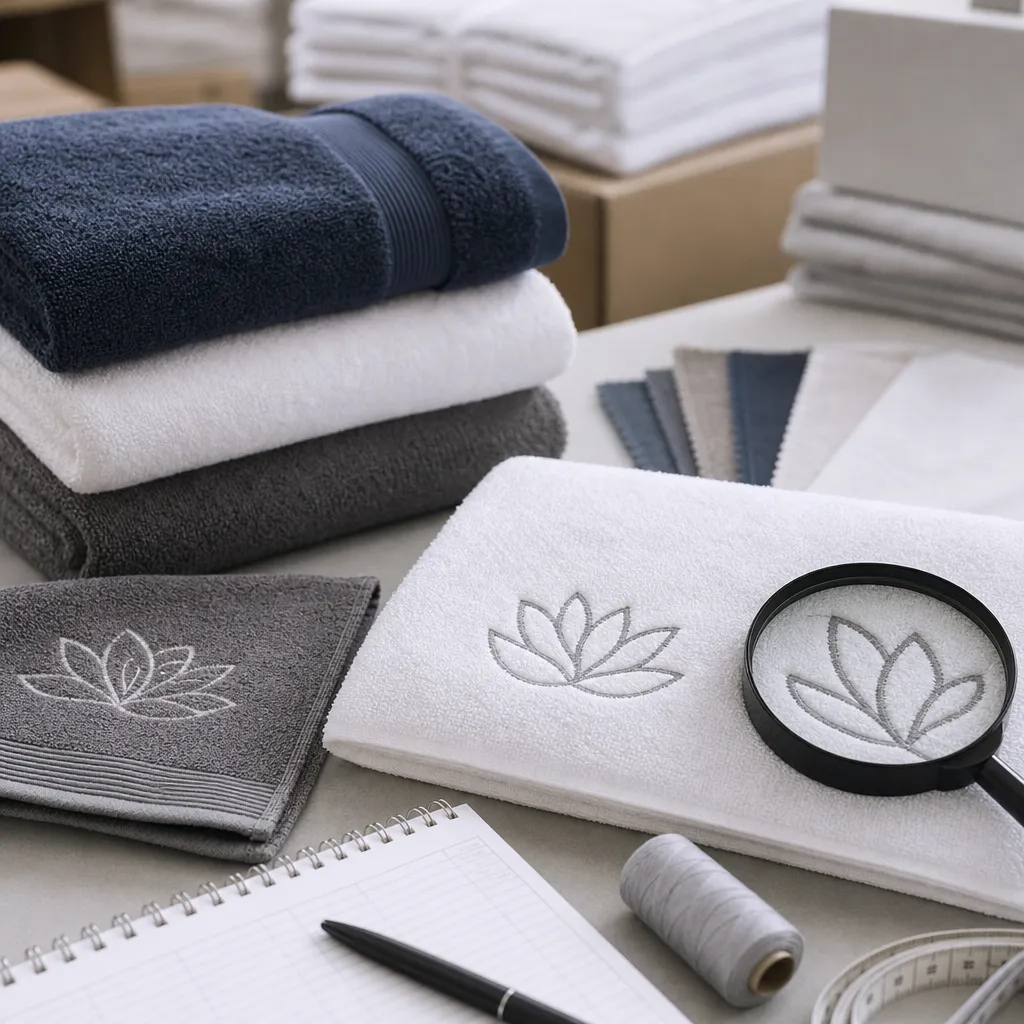
Start With the Logo Method, Not the Towel
For brand-side buyers, the towel usually looks like the main product and the logo looks like decoration. On our sewing and weaving floor, the logo method often decides the towel spec. Embroidery needs stable pile and enough border space. Jacquard needs a pattern that can be translated into yarn movement. Reactive print needs cotton that can take dye evenly. Sublimation needs a polyester or microfiber face. These are not cosmetic choices; they affect weight, handfeel, wash life, carton cube, and unit cost.
Our MOQ is 500 pcs per design per color. That MOQ applies whether the order is for hotel bath towels, gym hand towels, beach towels, golf towels, or event giveaways. For logo programs with multiple towel colors, we quote each body color separately because dyeing, decoration setup, and QC shade approval happen by color lot.
| Logo method | Best towel base | Typical GSM | Best use case | Main risk to control |
|---|---|---|---|---|
| Embroidery | Cotton terry, velour border, golf towel panel | 420-650 GSM | Hotel, spa, country club, corporate gifting | Puckering, thread snagging, hard handfeel |
| Jacquard weave | Cotton terry or velour jacquard | 380-600 GSM | Resort beach towels, retail collections, club programs | Blurred small details, long floats, high loom setup cost |
| Reactive print | Cotton velour or sheared terry | 360-520 GSM | Retail beach towels, illustrated artwork, resort merchandise | Dye bleeding, shade shift after washing |
| Sublimation print | Polyester microfiber face with cotton or microfiber back | 220-380 GSM | Promo, gym, travel, auto-detailing, full-color artwork | Lower cotton feel, heat mark, edge curl |
| Woven label or patch | Most towel constructions | 350-700 GSM | Private label towels, simple brand ID, low visual weight | Label shrinkage, rough edge, poor placement tolerance |
Custom Logo Towels: Decoration Choices That Survive Washing
Custom logo towels need to survive the same laundering cycle as the towel body. A logo that looks clean in a pre-production photo can fail after 15 washes if thread, dye, backing, or stitch density are wrong. We test decorated samples with ISO 105-C06 for washing colorfastness and ISO 105-X12 for rubbing colorfastness. For absorbency on functional towels, we also use AATCC 79 as a practical check because heavy printing can slow wet-out time.
Embroidery is still the most requested option for hotel, spa, golf, and corporate towels. For terry, we usually keep stitch density around 0.36-0.45 mm spacing depending on thread size and logo fill area. A dense 70 mm logo can add 3,500-7,000 stitches. That cost is not only thread; it is machine time, backing, trimming, needle wear, and QC inspection. On high pile towels, we often recommend a knockdown stitch under the logo so loops do not show through the letters.
- Use embroidery for logos with clean shapes, letters above 5 mm height, and limited color count.
- Use jacquard when the logo should be part of the towel structure rather than stitched on top.
- Use reactive print when artwork has gradients, illustrations, or fine outlines on cotton.
- Use sublimation when the brief needs photographic color at lower weight and fast drying.
- Use woven labels when the brand mark should be discreet and the towel must stay soft.
Why Small Logo Details Break First
The most common failure we see is not a wrong Pantone shade. It is artwork that was designed for a screen and then pushed onto pile fabric. Terry loops move. Velour still has nap direction. Jacquard edges are built from yarn paths, not pixels. A logo with hairline gaps, tiny registered marks, fine serif text, or close parallel lines will close up after washing even if the first sample passes visual review.
For embroidery, letters under 4.5 mm are risky on terry. For jacquard, we prefer line widths above 3 mm on beach towel programs and above 2 mm on tighter hand towel constructions. For reactive print on cotton velour, fine text can work, but the towel must be sheared evenly. If the velour height varies by more than about 0.4 mm across the print field, ink depth changes and the logo can look patchy.
| Logo detail | Factory recommendation | What happens if ignored |
|---|---|---|
| Text height | 5 mm or larger for embroidery on terry | Letters fill in after washing or trimming |
| Line width | 3 mm or larger for jacquard beach towels | Edges look stepped or broken on the loom |
| Color count | Embroidery works best at 1-6 thread colors | Extra trims increase time and loose-thread defects |
| Solid fill area | Avoid large dense embroidery blocks over 90 x 90 mm | Logo feels stiff and towel folds poorly |
| Print edge | Keep full-bleed print artwork 8-12 mm beyond cut line | White sliver appears after sewing tolerance |
GSM and Size Should Match the Logo Job
Buyers often ask for the lowest GSM that can still carry a logo. Sometimes that is sensible. A 280 GSM microfiber gym towel can carry a full sublimation print and ship economically. But a 280 GSM cotton terry towel with embroidery usually feels thin around the stitched area because the logo compresses the pile and makes the surrounding fabric look uneven.
For embroidered logo towels in hotel and spa use, we usually quote 500-650 GSM for bath sizes and 450-550 GSM for hand towels. Golf towels can sit at 380-480 GSM because the towel is smaller and often uses a grommet or clip. Beach towels with jacquard or reactive print usually sit at 360-520 GSM, depending on whether the buyer wants a retail shelf feel or a pool-issue towel that dries faster between guest turns.
| Program type | Common size | Recommended GSM | Logo method we quote most |
|---|---|---|---|
| Hotel bath towel | 70 x 140 cm or 76 x 152 cm | 550-680 GSM | Embroidery, woven label |
| Spa hand towel | 35 x 75 cm or 40 x 80 cm | 450-560 GSM | Embroidery, tone-on-tone label |
| Gym towel | 30 x 100 cm or 40 x 80 cm | 280-420 GSM | Sublimation, embroidery, woven label |
| Beach club towel | 80 x 160 cm or 90 x 170 cm | 380-520 GSM | Jacquard, reactive print |
| Golf towel | 40 x 60 cm or 45 x 70 cm | 380-500 GSM | Embroidery, jacquard border |
Pricing Bands Buyers Can Use Before RFQ
Pricing changes with cotton market, yarn count, dye depth, towel size, logo stitch count, carton packing, and testing requirements. Still, buyers need a realistic planning band before they build a launch calendar. The ranges below are FOB Ningbo or Shanghai estimates for normal commercial specs, not luxury oversized programs or ultra-low giveaway fabric.
| Order volume | Small towel, simple logo | Bath or beach size, single logo | Complex jacquard or full print |
|---|---|---|---|
| 500-999 pcs | USD 1.15-2.40 | USD 4.20-7.80 | USD 5.10-9.60 |
| 1,000-2,999 pcs | USD 0.98-2.05 | USD 3.65-6.90 | USD 4.55-8.40 |
| 3,000-9,999 pcs | USD 0.82-1.76 | USD 3.20-6.15 | USD 3.95-7.55 |
| 10,000+ pcs | USD 0.69-1.48 | USD 2.85-5.60 | USD 3.45-6.90 |
A cheaper towel is not always cheaper in use. For one resort client, we compared a 410 GSM pool towel at USD 3.74 with a 500 GSM version at USD 4.46. The lower GSM towel started showing edge wave and pile thinning around 32 industrial washes, while the heavier version stayed in rotation beyond 58 washes. Even before adding guest complaint cost, the lighter towel cost about USD 0.117 per completed wash, while the heavier towel landed near USD 0.077. That is why we push back when the spec is too light for the laundering plan.
Sampling, Strike-Offs, and Bulk Approval
For custom logo towels, the sample stage should answer three questions: can the logo be reproduced, does the towel still feel right, and will the result pass laundering? We do not recommend approving from a flat digital mockup only. Mockups are useful for placement, but they cannot show pile compression, thread sheen, jacquard edge clarity, or print penetration.
- Artwork review: we check vector files, Pantone references, logo size, placement, and decoration method.
- Material plan: we confirm yarn, GSM, size, border, dye shade, and whether OEKO-TEX Standard 100 Class I compliance is required.
- Strike-off or lab dip: embroidery swatch, jacquard loom trial, printed panel, or dyed fabric card is made for approval.
- Pre-production sample: finished towel with logo, label, hem, washing label, and packing method.
- Bulk production: cutting, sewing, decoration, washing or finishing, metal detection if required, inspection, and carton packing.
A normal timeline is 5-8 days for artwork and costing, 7-12 days for lab dips or logo strike-offs, 10-18 days for finished pre-production samples, and 25-40 days for bulk production after approval. Jacquard programs with custom yarn dyeing or heavy beach towel sizes can add 7-14 days. Air courier sample transit usually adds 3-6 days; sea freight depends on destination port and consolidation schedule.
Quality Control Points We Check on the Line
Our mill operates under ISO 9001 procedures, with BSCI social audit documentation and OEKO-TEX 100 Class I available for qualified materials. For logo work, the QC plan has to include decoration-specific checks, not only towel weight and size. A bath towel can meet GSM tolerance and still fail because the embroidery is 12 mm off center or the printed logo has a rubbing issue.
- Placement tolerance: usually +/-5 mm for small towels and +/-8 mm for bath or beach sizes, unless the design requires tighter control.
- Embroidery inspection: loose threads, skipped stitches, backing show-through, puckering, and thread color against approved shade card.
- Jacquard inspection: broken ends, long floats, logo distortion at borders, and pile height contrast between face and reverse.
- Print inspection: colorfastness, edge sharpness, registration, handfeel, and whether print paste blocks absorbency.
- Packing inspection: carton count, barcode, polybag warning text, care label, hangtag, and mixed-color assortment ratio.
One defect buyers rarely ask about is terry crushing during embroidery hooping. If the hoop pressure is too high, the area around the logo can form a shiny ring. It may not show in a quick photo, but it becomes obvious under hotel bathroom lighting. We reduce this by adjusting hoop tension, using suitable backing, and steaming the towel after trimming when the construction allows it.
Artwork Files and Tech Pack Details
A clean tech pack saves more time than a long email thread. For embroidery, send AI, EPS, PDF, or high-resolution vector files. For print, send layered artwork where possible and identify Pantone TCX, TPX, or coated references depending on the color standard used by your design team. For jacquard, send the logo in one-color vector form first; complex shaded artwork will need simplification before loom programming.
- Towel size, GSM target, yarn preference, and acceptable tolerance.
- Logo width and height in millimeters, not only percentage of towel width.
- Placement from hem, side edge, border, or corner, with a simple measurement diagram.
- Decoration method preference and backup option if the first method is not technically suitable.
- Packaging: bulk pack, individual polybag, belly band, FSC paper sleeve, retail carton, or master carton only.
- Compliance needs: OEKO-TEX Standard 100 Class I, BSCI, ISO 9001 records, fiber content label, and destination market care wording.
For private label towels, we also need the woven label artwork, label position, care label language, and carton mark format. US, EU, UK, Gulf, and Japan buyers often use different label wording and barcode systems. Fixing those after production is slow and expensive, especially when individual retail packing is already sealed.
Logistics and Carton Planning
Logo towels are bulky compared with apparel accessories. A buyer may negotiate a few cents out of the decoration cost and then lose more through carton inefficiency. We calculate carton cube during costing because towel thickness changes after washing and finishing. A 600 GSM bath towel with embroidery cannot be compressed the same way as a 300 GSM microfiber printed towel.
For export orders, we normally pack 24-60 pcs per carton depending on size and weight. Master cartons are checked for gross weight because many warehouse teams prefer cartons under 18-22 kg for manual handling. For beach towels and bath towels, container loading can shift the landed cost more than buyers expect, so we compare carton dimensions before finalizing the folding method.
Related reads: For towel weight decisions, see Towel GSM Decision Framework and Towel Sizes and Dimensions Complete Guide. If the logo method is still open, compare Embroidery vs Sublimation vs Jacquard.
Related reads: Hotel and resort buyers can also review Hotel Towel Sourcing Guide 2026, Beach Club Resort Towel Program, and Country Club Golf Towel Program. For certificate checking, use How to Read an OEKO-TEX Certificate.
What to Send for a Factory Quote
The fastest accurate quote is not a logo pasted into an email. It is a short specification with size, GSM, material, decoration method, order quantity, packing, delivery country, and certification requirements. With those details, we can usually return pricing in 24-48 hours for standard programs. If the project needs custom dyeing, jacquard development, retail packaging, or wash testing, we will separate sample cost and bulk unit cost so your team can see what is driving the price.
LUMA & CO. TEXTILE is a 220-employee vertically integrated towel mill founded in 2007. We produce about 2.4M towels annually for 80+ brand clients across 47 countries. Our MOQ remains 500 pcs per design per color because below that level, dyeing, decoration setup, inspection, and export packing become inefficient for OEM work.
For custom logo towels, the right question at sampling is simple: does the logo still look like your brand after washing, handling, and packing, not only under the first studio light.
Quote Logo Towels With Factory Specs
Send artwork, size, GSM target, quantity, destination, and preferred decoration method. We will review the logo for embroidery, jacquard, print, or label production before quoting. WhatsApp: +86 13205717266. Email: [email protected].
Request a Quote →