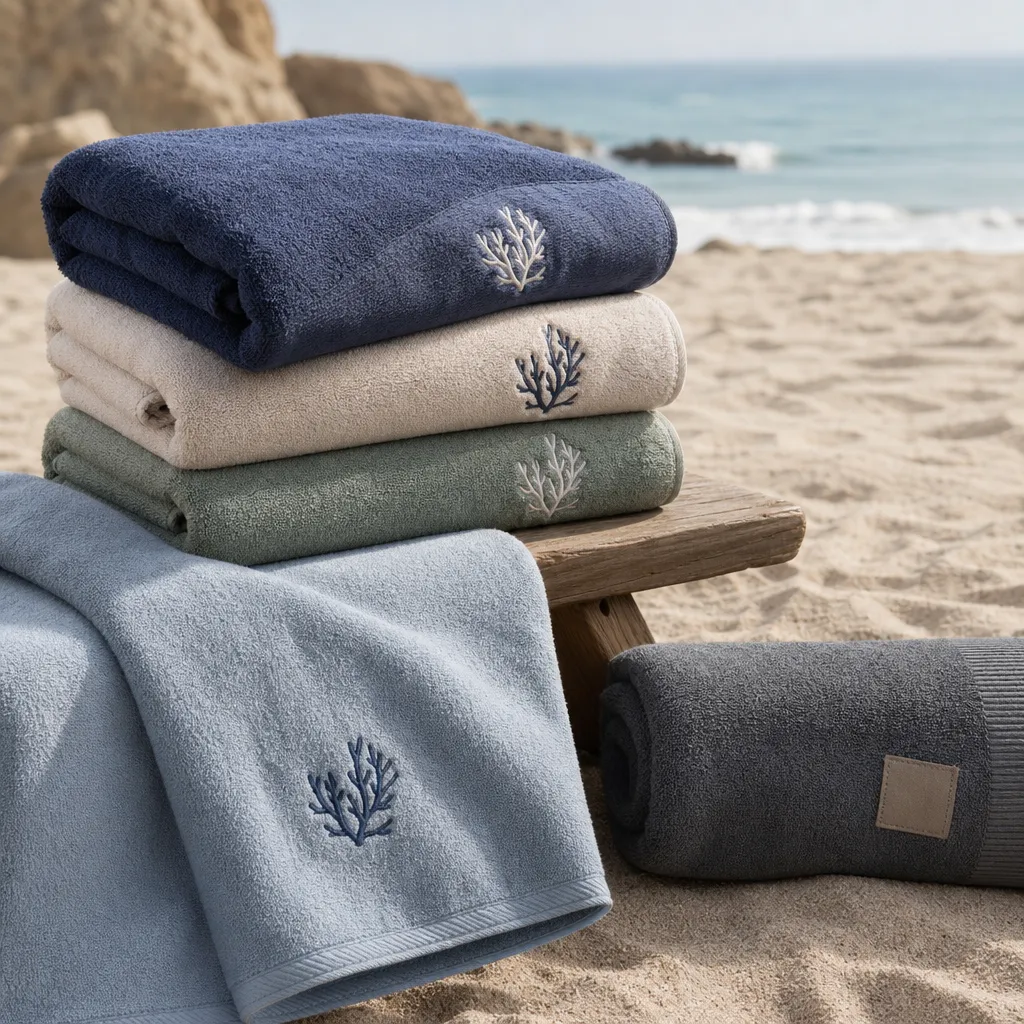
Where Personalization Usually Breaks First
The artwork is rarely the hard part. The difficult part is matching the personalization method to how the towel will be used: wet skin, sunscreen, pool chlorine, sand abrasion, hotel laundry, or retail gift packaging. A name that looks sharp on a digital proof can pucker after embroidery, bleed under reactive print, or disappear into a terry loop if the pile height is too high.
For personalized beach towels for adults, we separate orders into two groups before discussing price. The first group is individual personalization, such as names, initials, numbers, or member IDs that change piece by piece. The second group is brand personalization, where every towel carries the same logo, club crest, border artwork, woven label, or private-label packaging. They can be combined, but they should not be treated as the same production problem.
- Individual names: best handled by embroidery, applique, heat transfer on microfiber, or post-production digital print depending on quantity and wash requirement.
- Shared brand artwork: works well in jacquard, yarn-dyed stripe, reactive print, pigment print, embroidery, or woven label.
- Retail gift programs: need barcode, polybag, belly band, insert card, and carton assortment logic fixed before bulk packing.
- Resort or beach club programs: usually prioritize towel control, wash durability, and fast replacement orders over highly detailed artwork.
A common sourcing mistake is asking for the lowest GSM first. For this category, we prefer to lock the use case and decoration route first, then set GSM. Otherwise the buyer may save USD 0.35 per towel on fabric and lose USD 0.60 later because the decoration needs stabilizer, extra trimming, or rejects from uneven stitch registration.
Adult Size and GSM Choices That Actually Hold Up
Adult beach towels need enough surface area to sit or lie on, but the weight must still make sense for shipping and drying. A 90 x 180 cm towel at 520 GSM uses about 842 g of fabric before finishing loss, embroidery, label, and packing. After hem, overlock, moisture regain, and carton packing are included, one packed piece often lands around 900-970 g. That matters when a 6,000-piece order is moving by air because volume weight can become the real cost driver.
For cotton terry beach towels, adult programs usually sit between 380 and 600 GSM. Below 360 GSM, the towel can feel thin after three to five commercial washes unless the yarn and loop density are carefully controlled. Above 620 GSM, the towel feels substantial but dries more slowly, especially in humid resort laundry rooms. Microfiber beach towels usually sit much lower, often 200-320 GSM, because the construction and absorbency mechanism are different.
| Use case | Common size | GSM range | Construction note |
|---|---|---|---|
| Retail adult beach towel | 80 x 160 cm or 86 x 170 cm | 380-500 GSM cotton terry | Good balance for shelf price, parcel weight, and casual beach use |
| Oversized adult towel | 90 x 180 cm or 100 x 180 cm | 450-580 GSM cotton terry | Needs shrinkage allowance in both warp and weft before cutting |
| Resort pool and beach | 90 x 170 cm or 90 x 180 cm | 500-620 GSM ring-spun cotton | Heavier hems reduce edge curling after repeated tunnel washing |
| Travel beach towel | 80 x 160 cm | 220-320 GSM microfiber suede or waffle | Best for sublimation and low freight weight |
| Hammam-style adult towel | 95 x 180 cm | 260-380 GSM flat weave | Fringe retention and yarn slippage matter more than pile height |
Our practical rule is to test the final towel after washing, not only before. We normally evaluate dimensional change using ISO 6330 domestic washing as a reference method for lab comparison, while hotel and resort clients often request a tougher internal wash simulation at 60-75 C with alkaline detergent. Results vary by cotton, dye depth, machine load, and drying method, so any wash-cycle figure should be treated as a 2026 sourcing estimate tied to the approved sample, not a universal promise.
Decoration Route: Name, Logo, or Full Artwork
Decoration drives both appearance and failure risk. Embroidery gives a raised, durable mark, but it adds weight and can feel rough on the skin if placed where someone lies down. Jacquard is woven into the towel and suits repeated brand marks or borders, but it is less suitable for one-by-one names. Reactive printing gives rich cotton color, but it needs screen or digital setup, washing, and colorfastness checks. Sublimation is sharp on polyester microfiber, not on cotton terry.
For adult beach towels personalized with names, we usually place embroidery on the lower short edge, 7-12 cm above the hem. On a 90 x 180 cm towel, a name height of 35-55 mm reads clearly without turning the towel into a stiff plaque. Thread count also matters. A dense 130 mm script name may use 9,000-14,000 stitches; if the towel is only 380 GSM with loose loops, the embroidery can sink unevenly unless a water-soluble topping and tear-away backing are used.
| Decoration method | Best fit | Technical control point | Typical limitation |
|---|---|---|---|
| Embroidery | Names, initials, club member numbers | Stitch density, backing, topping, needle size 75/11 or 80/12 | Not ideal for photo-like gradients or very large filled areas |
| Jacquard weave | Repeated logo, border, stripe, tone-on-tone branding | Weave chart, yarn count, loop height, reverse-side readability | MOQ and setup increase when colors or patterns change |
| Reactive print on cotton | Full towel artwork with soft hand feel | Steaming, washing-off, ISO 105-C06 colorfastness check | Longer lead time and higher wastewater treatment cost |
| Pigment print | Lower-cost logo or simple repeat artwork | Binder hand feel, crocking test, curing temperature | Can feel dry on terry loops if coverage is heavy |
| Sublimation microfiber | Photo artwork, travel towels, event graphics | Polyester face fabric, transfer temperature, edge ghosting control | Not suitable for cotton terry personalization |
Two defect modes are specific to this category. First, loop shadowing happens when embroidery pulls terry loops down around letters, creating a darker halo after washing. Second, border skew appears when a printed or woven name panel is not squared before hemming; the towel may pass a flat photo inspection but look twisted when folded for retail.
Cotton, Microfiber, and Blended Options
Cotton still makes the strongest adult beach statement because buyers associate it with absorbency and comfort. Combed cotton improves yarn evenness and reduces lint compared with open-end yarn, which is useful when towels are dark navy, black, or saturated red. Ring-spun cotton is a common middle ground for resort beach towels because it gives a fuller hand without pushing cost as high as long-staple specialty cotton.
Microfiber is better when the towel must pack small, dry quickly, or carry photographic artwork. For surf shops, event merchandise, and travel kits, a 250 GSM microfiber suede towel can ship at less than half the weight of a heavy cotton terry towel in the same size. The tradeoff is hand feel: some adult retail customers still expect the plush loop of cotton, especially at higher shelf prices.
- Choose combed cotton terry for adult retail, resort gifting, and embroidered beach towels where the buyer wants a familiar plush surface.
- Choose ring-spun cotton terry for club, hotel, or rental programs where wash durability and cost-per-use are more important than a luxury hand.
- Choose microfiber suede for sublimation artwork, low freight weight, compact packing, and fast-dry travel ranges.
- Choose flat-weave hammam cotton for beach clubs, boutique retail, and spa crossover programs where drape and stripe design matter more than pile depth.
For OEKO-TEX Standard 100 Class I requests, the material, dyes, sewing thread, embroidery thread, labels, and print chemistry all need to be covered by compliant inputs. A cotton towel made from certified yarn can still fail the buyer's documentation review if the metallic embroidery thread or printed care label is outside scope. BSCI and ISO 9001 are factory management and quality system references; they do not replace product-level chemical testing.
FOB Pricing Bands With 2026 Assumptions
The pricing below is a working 2026 FOB China reference for buyers comparing concepts. It assumes standard export carton packing, existing compliant dye and accessory suppliers, USD-denominated cotton and polyester inputs, and artwork that does not require licensed character approval. Cotton, exchange rate, energy, and freight conditions can move quickly, so these bands are useful for planning but not a final quote.
Personalized beach towels for adults become more expensive when each piece is different. The towel body can still benefit from bulk production, but names must be sorted, stitched or printed, checked, and packed against a personalization list. That adds handling risk. For large name lists, we ask buyers to provide UTF-8 text files or spreadsheets with one row per unit, including spelling, thread color, size, and packing group.
| Specification example | 500 pcs | 2,000 pcs | 8,000 pcs | Notes |
|---|---|---|---|---|
| 80 x 160 cm, 430 GSM cotton terry, one-position embroidery | USD 5.10-6.40 | USD 4.35-5.35 | USD 3.95-4.80 | Assumes same logo or names under 12,000 stitches each |
| 90 x 180 cm, 520 GSM cotton terry, woven border plus label | USD 7.20-8.90 | USD 6.15-7.45 | USD 5.55-6.70 | Jacquard setup spread improves at volume |
| 90 x 170 cm, 300 GSM microfiber, full sublimation | USD 3.80-4.85 | USD 3.10-3.95 | USD 2.65-3.35 | Polyester face, overlocked edge, print-ready artwork |
| 95 x 180 cm flat-weave hammam, yarn-dyed stripe, custom band | USD 4.90-6.20 | USD 4.15-5.10 | USD 3.70-4.55 | Fringe finishing and stripe yarn inventory affect price |
MOQ is 500 pcs per design per color for our normal OEM workflow. Individual names can be mixed inside that quantity if the towel body, base color, size, and decoration method are the same. If a buyer wants 100 navy, 100 sage, 100 coral, 100 ivory, and 100 black, that is five colors from the dyeing and inventory side, not one 500-piece color. This is where small personalized programs often become more expensive than expected.
Cost-Per-Use Is More Honest Than Unit Price
A low unit price can be correct for a one-week campaign or beach festival. It is usually wrong for a resort that launders towels every day. In a recent planning model for a coastal club, a 410 GSM towel at USD 4.25 was projected for about 38 acceptable commercial wash uses before edge curling and pile loss made it unsuitable for guest-facing service. A 540 GSM ring-spun version at USD 6.05 was projected for about 82 uses under the same wash assumptions. That puts fabric cost at roughly USD 0.112 per use for the lighter towel and USD 0.074 per use for the heavier one.
Those numbers are not a blanket guarantee. They depend on wash temperature, chlorine exposure, extraction speed, drying heat, chemical dosing, and how the towel is removed from service. We recommend buyers treat wash-cycle estimates as a comparison tool during sampling, then verify with their own laundry or a lab protocol before committing to annual volume.
- For event giveaways, accept lower GSM if the towel only needs to survive limited use and the decoration is the real value.
- For resort rental pools, avoid weak hems and loose pile even when the first-touch hand feel seems acceptable.
- For DTC retail, balance parcel weight against perceived value; customers often notice size and edge finish before GSM numbers.
- For membership clubs, use embroidery or woven member coding only where reorders can match the original thread and towel shade.
Sampling and Timeline From Brief to Bulk
A complete brief shortens the calendar more than any rush fee. For personalized beach towels, the sample stage needs the exact towel size, GSM target, base color, logo file, name list format, thread or print colors, label position, packing method, and compliance requirement. Missing one of these items usually creates a second sample round.
| Stage | Typical timing | Buyer input needed | Factory output |
|---|---|---|---|
| Technical review and quote | 2-4 working days | Size, GSM, decoration, quantity, destination terms | FOB estimate, MOQ note, risk comments |
| Lab dip or yarn color match | 5-8 working days | Pantone TCX/TPG or physical color standard | Color swatch or yarn card for approval |
| Strike-off or embroidery sample | 6-10 working days | Logo vector file, name sample, stitch/print placement | Decoration panel or one finished sample |
| Pre-production sample | 8-14 working days | Approved specs, packing artwork, compliance request | Final construction sample for sign-off |
| Bulk production | 25-38 days after approval | Deposit, final PO, personalization data | Finished towels packed by carton mark |
| Inspection and shipment handover | 3-6 days | Inspection standard, forwarder details | AQL report, packing list, carton measurements |
For inspection, buyers commonly use ISO 2859-1 AQL sampling. A typical consumer towel order may use AQL 2.5 for major defects and 4.0 for minor defects, but the buyer should define this in the purchase order. For name-personalized programs, we add a spelling check against the approved list because a towel can be physically perfect and still commercially unusable if one character is wrong.
- Approve the towel body first: size, GSM, yarn, color, hem, and shrinkage tolerance.
- Approve the decoration second: stitch file, print strike-off, jacquard chart, thread color, and placement.
- Freeze the personalization list with spelling, capitalization, and quantity before bulk decoration starts.
- Confirm packing logic, especially if names must be grouped by store, room, member, or event team.
- Hold one sealed pre-production sample as the standard for inspection and reorder matching.
Quality Checks We Put in the Spec Sheet
The spec sheet should be written so a production line and an inspector can both use it. A pretty PDF without tolerances is not enough. We suggest defining finished size tolerance, GSM tolerance, color tolerance, decoration placement tolerance, shrinkage after wash, colorfastness, linting, needle detection requirement if needed, and packaging details.
For cotton beach towels, colorfastness to washing can be referenced against ISO 105-C06, while rubbing can be checked under ISO 105-X12. For dimensional stability, ISO 6330 gives a repeatable domestic washing reference. Beach towels also benefit from a practical sand shake and sunscreen staining check, even when those are internal buyer tests rather than formal ISO requirements.
- Finished size tolerance: commonly plus or minus 3 percent after relaxation, with tighter control possible after sample approval.
- GSM tolerance: usually plus or minus 5 percent, measured from conditioned fabric or finished towel method agreed in advance.
- Embroidery placement: keep centerline tolerance within 5-8 mm for visible names and logos on the short edge.
- Color difference: define acceptable Delta E or approve physical shade bands, especially for reorder programs.
- Carton packing: specify pieces per carton, inner polybag need, silica gel policy, gross weight limit, and carton mark format.
A useful defect list for this category includes skipped stitches, loose threads, terry snags, shade side-to-side variation, skewed borders, print crocking, embroidery puckering, wrong name sequence, barcode mismatch, and carton assortment errors. The last three are easy to overlook because they happen after the towel itself is already made.
How to Keep Reorders Consistent
Reorders are where many adult beach towel programs lose their clean look. Cotton shade changes between dye lots, embroidery thread can shift if a supplier updates stock, and jacquard borders may look different if the reed density or yarn count changes. For private label beach towels, we keep approved standards on file, but buyers should also retain one sealed sample in their own office for comparison.
If the program will reorder through the season, build that into the first PO. A 500-piece test order and a 4,000-piece reorder can match better when the buyer tells the mill the total seasonal forecast early. It allows better planning for yarn, dyed fabric, labels, and thread lots. It also reduces the chance that a discontinued accessory forces a visible change.
Related reads: for towel body decisions, see our GSM decision framework, complete towel size guide, and cotton yarn comparison. For decoration planning, compare embroidery, sublimation, and jacquard before locking the artwork.
Related reads: beach and resort buyers may also find beach towels in bulk, resort towel program planning, and how to build a towel tech pack useful before requesting a quote. Product ranges are summarized at /products.html#beach.
What We Need to Quote Cleanly
For a clean OEM quote, send the finished size, target GSM, fabric type, base color, quantity per design and color, decoration method, artwork files, personalization list format, packing requirement, destination port, compliance standard, and target delivery date. If the project is still early, a reference towel photo with measured size and weight is better than a mood board.
Our factory background is useful context, but each quote still needs to be tied to a specific bill of materials and approved sample. LUMA & CO. TEXTILE operates as a vertically integrated towel mill with 220 employees, active since 2007, supplying more than 80 brand clients across 47 countries. Our normal MOQ is 500 pcs per design per color, with OEKO-TEX Standard 100 Class I, BSCI, and ISO 9001 documentation available for qualified orders and materials.
For custom beach towels bulk programs, the strongest brief is not the most complicated one. It is the brief where the buyer has already decided whether personalization is a retail feature, a guest-control tool, a gift detail, or the main product value. Once that is clear, the size, GSM, decoration route, and inspection plan become much easier to price and produce.
Build a Personalized Beach Towel Spec
Send size, GSM target, artwork, quantity, and personalization plan to [email protected] or WhatsApp +86 13205717266. We will return a factory-side quote with MOQ, sampling path, timing, and risk notes.
Request OEM Quote →