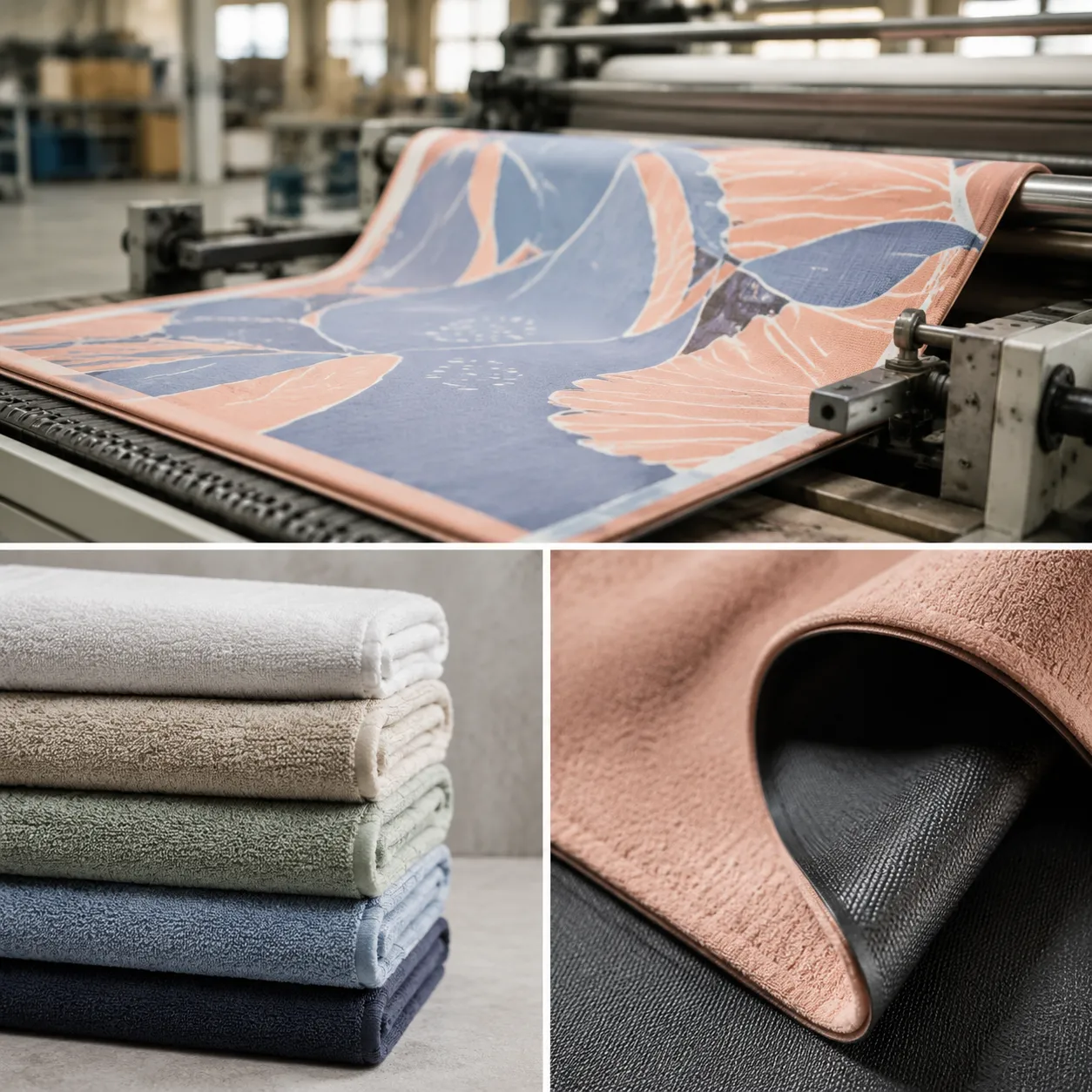
Start with the towel base, not the letter style
For monogram work, the towel body carries more risk than the artwork. A 420-460 GSM towel with loose pile can embroider cleanly on day one, then show draw-in around the initials after the first institutional wash if the ground is too open. For hotel and resort bath use, we usually see the most stable results in ring-spun cotton at 520-650 GSM with a firmer ground construction and a balanced pile height. That range gives enough body to absorb needle penetration without leaving a hard backing feel.
The construction detail buyers often skip is the difference between the decorative border area and the pile field. If the monogram is placed in a dobby border, the stitches sit on a flatter platform and registration stays cleaner. If the initials go directly into full terry, we need to account for pile suppression, underlay coverage, and how much the embroidery will sink after washing. Those are separate engineering decisions, not artwork tweaks.
| End use | Recommended base spec | Why it holds embroidery better |
|---|---|---|
| Upscale hotel room | 100% cotton, 550-620 GSM, ring-spun 16s/1 or 21s/2 pile | Good loft with enough ground stability for border embroidery |
| Luxury retail set | 100% cotton, 600-700 GSM, combed yarn, low-shear finishing | Richer handfeel and better surface uniformity around initials |
| Spa or villa turnover use | 100% cotton, 500-560 GSM, tighter ground, shorter pile | Lower snag risk and faster drying after repeated laundering |
- Ask for the finished towel weight per piece, not only GSM. Piece weight exposes whether the towel is built too light for the claimed construction.
- Confirm whether the monogram sits on border, hem area, or terry field. Each needs a different stitch plan.
- Request the post-wash dimensions after 3 cycles at 60°C if the product is for hotel or spa use.
In a monogram bath towels 2026 buyer guide, decoration method still matters
For most bath towel programs, monogram means embroidery. That is still the right default for initials, crests, and lettermarks under about 65 mm high. But embroidery is not automatically correct on every towel weight or every logo zone. We also quote appliqué embroidery for thicker luxury sets and woven jacquard for large repeat programs where the branding is part of the fabric design rather than a later personalization step.
The practical threshold is stitch density versus ground distortion. A satin-stitch monogram with dense fill on a soft zero-twist style may look refined in a studio photo, but it can create puckering after wash because the base shrinks and the stitched area does not shrink at the same rate. That is one reason we push some buyers away from zero-twist bases for operational hotel programs unless the logo is very small and placed on a stable border.
| Method | Best use case | Watch-out |
|---|---|---|
| Embroidery | Initials, crests, villa names, retail gift sets | Needs backing and pull compensation matched to fabric density |
| Applique plus embroidery edge | Large monograms on thick retail bath towels | Higher labor cost and more visible edge after heavy washing |
| Jacquard weave-in | Large-volume recurring hotel identity programs | Less suitable for one-off initials or many personalized SKUs |
If you are comparing methods side by side, embroidery-vs-sublimation-vs-jacquard.html gives the broader decoration trade-offs. For initials specifically, embroidery wins because it stays legible on absorbent cotton and does not require a print-ready flat face.
What actually fails in laundry
Buyers often ask for wash-life in a single number, but monogram performance fails in several different ways. We separate them because each one traces back to a different spec choice.
- Puckering around the monogram: usually caused by excessive stitch density, over-tight tension, or poor shrinkage balance between towel body and stitched zone.
- Thread abrasion and fuzzing: common when viscose-look shiny thread is chosen for a commercial laundry program instead of more durable polyester embroidery thread.
- Needle-hole grinning in the border: shows up when the dobby border is too loose and the stitch column opens it after wash.
- Hard patch feel on the reverse: comes from oversized backing or double-layer backing where a lighter cutaway would have been enough.
- Letter edge distortion: often linked to inadequate underlay on high pile terry, especially with serif fonts under 8 mm stroke width.
For wash validation, we prefer a small but relevant sequence instead of inflated claims. For hospitality programs, three accelerated wash-and-dry cycles before final approval will catch most embroidery tension problems. If the order is going into an on-premise laundry or an outsourced industrial laundry, we then add a larger benchmark run, usually 15 or 20 cycles, to compare shrinkage, edge clarity, and backing stability. We do not treat a retail home-laundry result as equivalent to that environment.
The test methods we typically reference are dimensional stability after laundering under ISO 5077 and colorfastness to washing under ISO 105-C06. For thread rubbing on the monogram face, we also check colorfastness to rubbing under ISO 105-X12 if the logo uses dark navy, black, or deep emerald thread on a white base.
Font, placement, and stitch count decide whether the towel still looks expensive after 6 months
A monogram that works on paper can fail on terry because the towel surface is not flat. Thin strokes disappear into pile. Fine interior counters close up after washing. Dense script fonts create too much thread build-up in a small area. We usually advise buyers to think about legibility first and style second.
| Design choice | Safer range | Reason |
|---|---|---|
| Monogram height | 35-70 mm | Below this size, pile swallow becomes visible; above this, the stitched area can feel heavy |
| Stroke style | Medium-weight serif or clean block | Better edge definition on terry than very thin script |
| Placement from hem | 55-90 mm above bottom hem | Gives visual balance and reduces fold-line conflict in packing |
| Thread colors per logo | 1-3 colors | More color changes raise cost and increase registration risk on small letters |
- Approve the monogram in vector format with exact size in millimeters.
- Choose whether the logo sits on the border or in the terry field before sampling begins.
- Ask for the sample photo both flat and after one wash cycle; flat-only approvals hide pile interference.
- Freeze thread code, backing type, and placement tolerance on the PO.
For programs where color matching is sensitive, pantone-color-matching-custom-towels.html is useful, especially if your embroidery thread needs to sit against a dyed towel body rather than a white ground.
2026 FOB price bands need the right assumptions
A realistic quote for monogrammed bath towels wholesale in 2026 needs five inputs at minimum: towel size, GSM, yarn grade, decoration location, and order quantity by color. Without those, price comparisons drift because one mill may be quoting a 27x54 inch 520 GSM base while another assumes a 30x58 inch 650 GSM combed towel with denser embroidery.
The price bands below assume FOB China, OEKO-TEX Standard 100 Class I compliant materials, standard export packing, one embroidery position, and quantities large enough to run efficiently. They do not include destination duty, inland delivery at destination, or unusual gift-box packaging.
| Spec scenario | Qty band | Indicative FOB 2026 |
|---|---|---|
| 30x56 in, 540 GSM, ring-spun cotton, 1-color monogram on border | 1,000-2,999 pcs | USD 4.35-5.10/pc |
| 30x56 in, 540 GSM, same spec | 3,000-7,999 pcs | USD 3.98-4.62/pc |
| 30x58 in, 620 GSM, combed cotton, 2-color monogram | 1,000-2,999 pcs | USD 5.28-6.18/pc |
| 30x58 in, 620 GSM, same spec | 3,000-7,999 pcs | USD 4.86-5.72/pc |
| 32x60 in, 680 GSM, combed cotton, satin band plus monogram | 1,000-2,999 pcs | USD 6.45-7.80/pc |
Those ranges reflect actual cost drivers: cotton content, piece weight, embroidery run time, thread trims, rejection risk, and carton efficiency. A crest with 11,500 stitches may add less than USD 0.20 over a simple 3-letter monogram on a large run, but a small order with six thread changes and multiple initials by SKU can push labor overhead much higher. That is why personalized retail sets price differently from a hotel identity program using one repeated lettermark.
If a quote looks unusually low, check whether the supplier has reduced pile density, shifted from combed to carded yarn, or moved the monogram from border to hem area where the result may not look balanced. We covered similar quoting traps in build-towel-tech-pack-that-mills-can-quote.html and negotiate-towel-moq-without-killing-margin.html.
Sampling should prove stability, not just appearance
For this category, a sample approval path that stops at one pre-production piece is too weak. We prefer four control points because each one answers a different risk.
- Base towel approval: confirm size, GSM tolerance, handfeel, and border construction before decoration.
- Embroidery strike-off: confirm thread color, stitch coverage, backing type, and letter edge clarity.
- Washed prototype: run the decorated sample through agreed wash conditions and remeasure shrinkage and distortion.
- Pre-production sample: approve final packing, barcode, care label, and logo placement tolerance before bulk starts.
For initials on terry, we also recommend photographing the reverse side of the sample. That one image reveals whether the backing is oversized, whether thread nests are cleanly trimmed, and whether the reverse feel is acceptable for a face or hand touchpoint. Those details matter for villa, spa, and luxury retail programs in a way they do not for a simple promotional towel.
MOQ, assortment logic, and why personalization changes the factory math
Our standard MOQ is 500 pcs per design per color, but monogram assortments need more discussion because the towel base and the stitched identity are not always the same SKU logic. A hotel ordering one repeated crest across three towel colors is straightforward. A retail brand asking for twelve initials on two towel colors is a very different setup because thread changes, sort control, and final packing checks expand quickly.
- One base towel color with one repeated monogram is the most efficient structure.
- Multiple initials with the same towel body can work if packing is bulk and carton marking is clear.
- Individual retail gift sets with name-level personalization usually need higher quoted labor and longer approval time.
- If you need many initials, ask whether the factory will manage assorted embroidery under one towel base PO or split by SKU.
That is also where buyers confuse MOQ with economic MOQ. Technically, a supplier may accept a small letter assortment, but the rejection handling cost and packout complexity can erase the margin benefit. For buyers under pressure to keep assortment wide, negotiate-towel-moq-without-killing-margin.html is the right companion read.
Lead time is driven by embroidery capacity more than weaving
Bath towel weaving and dyeing are usually not the bottleneck on a modest order. Decoration and sorting are. For a monogram program, the timeline normally breaks down like this:
| Stage | Typical days | What can delay it |
|---|---|---|
| Artwork setup and digitizing | 2-4 days | Font revision, missing vector file, unclear size callout |
| Base towel sample or stock check | 3-7 days | Custom color matching or border revision |
| Decorated prototype | 5-8 days | Thread sourcing, backing adjustment, machine test run |
| Bulk production | 22-35 days | Embroidery queue, color assortment, rework on placement variance |
| Final inspection and export prep | 3-5 days | Barcode mismatch, carton remarking, metal detection if required |
Air freight can shorten transit, but it does not fix a decoration bottleneck. If your launch date is rigid, the better control is to freeze monogram files early and avoid late placement changes after the base towels are already woven. For freight planning, container-vs-air-freight-towel-orders.html covers the cost trade-offs.
The QC sheet should include embroidery-specific checkpoints
A generic towel inspection report is not enough here. The final QC checklist should include embroidery placement tolerance in millimeters, backing consistency, loose-thread count per logo, logo orientation, and wash recheck samples pulled from packed goods. We also like to inspect folded presentation because monograms can disappear into the fold or land too close to the retail belly band, which hurts the first impression even if the stitch quality is fine.
- Placement tolerance: usually keep within plus or minus 5 mm from approved location.
- Stitch appearance: no skipped stitches, birdnesting, thread breaks, or visible tracing misalignment.
- Reverse side finish: trimmed cleanly, no sharp backing corners, no excess adhesive feel.
- Post-wash check: compare at least one pulled sample per lot against approved washed standard.
Certification still matters at the material level. Buyers usually ask us for OEKO-TEX Standard 100 Class I, BSCI, and ISO 9001 records, especially for hospitality and retail export programs. If your team needs help checking what an OEKO-TEX document actually covers, see how-to-read-oeko-tex-certificate.html.
Where buyers usually overpay, and where they should not cut
The waste line in this category is often decorative overbuild. Buyers choose very dense thread fills, metallic-look yarns, oversized crest artwork, or retail gift boxes before the towel base is stable enough to support them. Those features raise quoted cost but do not improve service life. On the other side, the wrong place to economize is the towel ground and embroidery testing. A towel that saves USD 0.34 per piece but loses shape around the initials after hotel laundry is usually the more expensive choice once replacement and guest perception are counted.
Related reads: monogrammed-bath-towels-luxury-brand-guide.html, hotel-towel-sourcing-guide-2026.html, and combed-vs-zero-twist-cotton-explained.html.
Related reads: towel-gsm-decision-framework.html, towel-sizes-dimensions-complete-guide.html, and setting-up-hotel-linen-program-90-day-roadmap.html.
Need a monogram towel quote with workable specs?
Send the towel size, GSM target, logo placement, estimated stitch count, and quantity split. We can quote from OEM-ready specs or help tighten the tech pack first. MOQ is 500 pcs per design per color. Contact us at [email protected] or WhatsApp +86 13205717266.
Request Quote →