Start With the Operating Model, Not the Towel Photo
Beach clubs and hotel pool decks use towels differently from guestrooms. A guestroom bath towel may see one controlled laundry cycle per occupied night. A pool towel may be issued, dropped on a lounger, exposed to SPF oil, collected damp with sand, washed with higher alkali, and redistributed the same afternoon. If procurement only compares size and GSM, the quoted towel may look correct in the sample room and still underperform by week six.
We ask buyers to define three operating facts before yarn, border, or logo placement: expected daily circulation, laundry method, and loss tolerance. A 180-room coastal hotel with one pool and moderate occupancy may need a different towel count than a 70-cabana beach club that runs towel cards and exchanges towels twice per day. The fabric can only support the program if the issue system and par stock are realistic.
| Operating question | Why it changes the spec | Factory-side recommendation |
|---|---|---|
| Is the towel controlled by card, RFID, or open stack? | Open stacks usually lose more units and need lower decoration cost per towel. | Use yarn-dyed stripe or woven border before expensive embroidery. |
| Is laundry in-house or outsourced? | Outsourced laundries often use stronger chemistry and larger tunnel washers. | Specify VAT/reactive dye fastness and test after 20-30 washes. |
| Will towels sit on white loungers? | Dark wet towels can create dye transfer claims. | Require ISO 105-X12 crocking and wet-rub review. |
| Are guests taking towels to beach sand? | Sand abrasion cuts pile and increases linting. | Avoid very long pile; use stable 430-520 GSM terry. |
- Card-control pool deck: higher towel value is acceptable because loss is measured and charged back.
- Open beach basket: keep the towel attractive but avoid costly decoration that walks away.
- Cabana service: appearance matters more; consider jacquard logo or yarn-dyed stripe for visible stacking.
- Hotel pool plus spa crossover: separate the pool towel spec from spa towels to avoid oil and treatment-room stains moving into pool inventory.
Beach Club Towel Hotel Procurement Checklist
This beach club towel hotel procurement checklist is the version we use when a buyer wants a quote that can move into sampling without five rounds of clarification. It is not a design mood board. It is a commercial and operational filter: size, weight, yarn, dye, logo method, test standard, packing, and reorder trigger.
- Confirm towel use: pool deck only, beach access, cabana service, guestroom crossover, or retail sale.
- Set finished size after wash, not greige or pre-wash size. Common finished sizes are 80×160 cm, 86×160 cm, 90×170 cm, and 100×180 cm.
- Choose GSM by laundry life and drying speed. Most hotel beach towels we produce sit between 420 and 580 GSM.
- Define base construction: terry, velour front with terry back, flat-woven hammam, or microfiber suede.
- Specify color method: solid reactive dye, yarn-dyed stripe, jacquard weave, or digital/sublimation print on microfiber.
- Lock decoration size and placement with a millimetre position from border or corner, not "centered somewhere near the end."
- Require testing: dimensional change, colorfastness to washing, rubbing, chlorinated water where relevant, and absorbency after softener removal.
- Confirm packing: piece fold, belly band, barcode, carton count, carton gross weight, and pallet height if using warehouse racking.
- Set reorder rules using seasonal consumption and transit time, not only the last carton count.
The most common mistake is approving a beautiful 650 GSM velour sample for a beach club that launders twice daily and has limited dryer capacity. Heavy towels feel good on day one, but if they retain moisture, they slow laundry turn, smell musty in closed carts, and raise energy cost. For most pool towel procurement, we would rather build a 500 GSM towel with stable loops and good dye performance than a heavier towel that the laundry team quietly dislikes.
Size and GSM: Balance Presence With Laundry Throughput
For beach clubs, the towel must cover a lounger and still fit into commercial washers efficiently. Width matters because many loungers are 65-75 cm wide. A towel narrower than 75 cm looks small, especially after 4-7% shrinkage. A towel above 100 cm wide can feel generous but raises weight, carton volume, and dryer time.
We usually quote pool and resort towels by finished size after washing. Cotton terry towels can shrink 3-6% lengthwise and 2-5% widthwise depending on yarn, terry ratio, and finishing tension. If a buyer asks for 90×170 cm finished, we cut and finish with that target in mind, then verify dimensional change using ISO 6330 domestic washing procedures adapted to the buyer's laundry temperature where needed.
| Finished size | Typical GSM | Approx. towel weight | Best use case | Watch point |
|---|---|---|---|---|
| 75×150 cm | 400-460 GSM | 450-518 g | Budget pool issue, gyms with pool access | May look short on resort loungers |
| 80×160 cm | 430-520 GSM | 550-666 g | Hotel pool towel, controlled beach club stack | Good balance of coverage and drying time |
| 86×160 cm | 450-540 GSM | 619-743 g | Cabana service, club pool deck | Slightly wider cartons; check shelf depth |
| 90×170 cm | 470-560 GSM | 719-857 g | Resort beach towel, lounger cover | Higher laundry energy and freight |
| 100×180 cm | 420-500 GSM | 756-900 g | Oversized retail/resort hybrid | Strong loss control needed due to guest take-home appeal |
A 90×170 cm towel at 520 GSM weighs about 796 g before normal process variation. At 8% moisture regain and carton packaging, a 24-piece carton can approach 21-22 kg gross. That is still workable for export cartons, but some hotel receiving teams prefer cartons under 18 kg for manual handling. This is why we confirm carton weight before final packing instructions, not after production is finished.
Construction Choices That Survive Sunscreen, Sand, and Chlorine
Beach club towels see three specific stressors: sunscreen oil, sand abrasion, and chlorinated water residue. Sunscreen builds on cotton and reduces absorbency when laundry detergent is weak. Sand works like a fine cutting agent in the pile. Chlorine residue can shift certain reactive colors, especially turquoise, coral, and dark navy if the laundry uses inconsistent dosing.
For cotton resort pool towels, our default is ring-spun or combed cotton in the pile with a 16s or 21s yarn depending on GSM and hand feel. Very open, fluffy constructions can look plush but shed more lint under tunnel-wash abrasion. For a beach club that washes at 60°C with alkali booster, we prefer a tighter ground weave and moderate pile height rather than a loose high-pile towel.
| Construction | GSM range we quote | Strengths | Risks to control |
|---|---|---|---|
| Cotton terry, solid dyed | 430-560 GSM | Good absorbency, familiar hotel feel, strong reorder stability | Colorfastness and sunscreen residue |
| Velour front / terry back | 450-580 GSM | Sharper printed or woven appearance on face side | Velour can show abrasion tracks from sand |
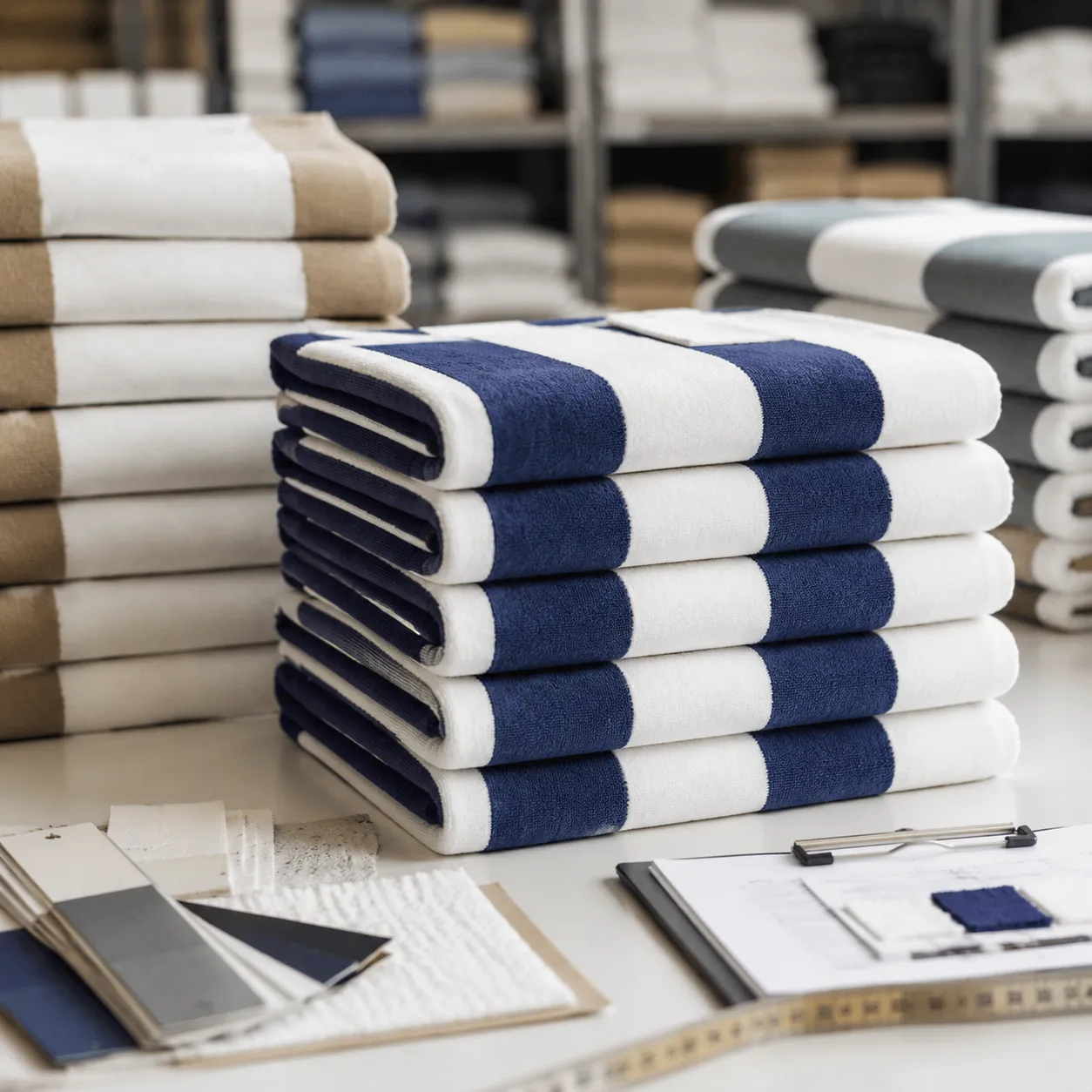
| Yarn-dyed stripe terry | 420-540 GSM | Classic beach club look; stripe stays aligned across production | Longer yarn prep time and higher MOQ per colorway |
| Jacquard logo terry | 480-600 GSM | Logo built into fabric; no embroidery snagging | Artwork must be simplified for loom repeat |
| Microfiber suede print | 250-350 GSM | Fast drying and full-surface artwork | Different hand feel; not accepted by every hotel laundry |
- For high-SPF environments, request absorbency testing after pre-wash and after softener removal, because finishing softener can mask real performance.
- For dark navy or black towels, check wet rubbing before placing towels on pale lounger cushions.
- For striped towels, define whether stripes are yarn-dyed through the fabric or printed on the surface; these are not the same cost or durability.
- For jacquard logos, avoid thin lettering below roughly 6-8 mm stroke width because terry loops blur small details.
Two factory defects are especially relevant here. The first is pile pull lines, where snagged terry loops create visible horizontal streaks after washing. The second is border waving, caused by different shrinkage between the terry body and dobby border. We control this by checking loom tension and measuring border flatness after wash, not only by inspecting the towel dry off the finishing line.
Logo Method: Make Branding Washable, Not Just Visible
Beach clubs often want the towel to act like signage across the pool deck. That is reasonable, but decoration must match the abuse level. A large embroidered crest on every pool towel can look expensive in the sample, then catch on lounger frames or add a hard patch that guests feel when lying down. We usually reserve embroidery for cabana VIP towels, retail towels, or smaller corner marks.
For high-volume hotel beach towels, yarn-dyed stripe, woven dobby text, or jacquard logo gives better cost-per-use. Sublimation is useful when the buyer wants photographic artwork, but it generally means microfiber or polyester-rich fabric, not a classic cotton hotel hand. For a deeper comparison, our decoration team has covered the trade-offs in embroidery vs sublimation vs jacquard and color control in Pantone color matching custom towels.
| Decoration method | Typical added cost at 1,000 pcs | Best placement | Durability note |
|---|---|---|---|
| Small embroidery, up to 8,000 stitches | USD 0.22-0.48 per towel | Corner, 80-120 mm from edge | Good if backing is trimmed cleanly; avoid body contact zone |
| Dobby border text | USD 0.10-0.28 per towel | End border only | Stable, but limited detail and usually one-color effect |
| Jacquard woven logo | USD 0.35-0.75 per towel | Full body repeat or end panel | Strong wash life; requires loom setup and artwork simplification |
| Yarn-dyed stripe layout | USD 0.18-0.55 per towel | Full towel width or length | Classic club look; yarn lead time adds days |
| Reactive print on cotton velour | USD 0.45-0.95 per towel | Velour face | Good color, but MOQ and strike-off approval matter |
If the towel will be guest-facing but not sold, we recommend keeping the logo readable from 2-3 metres rather than filling the full towel. A 140 mm woven crest at the lower third can be more practical than a full-surface pattern that complicates weaving, increases rejection risk, and makes replacement lots harder to match.
Testing Standards to Put in the Purchase Order
A procurement checklist is only useful if it becomes part of the purchase order. We attach test requirements to the approved tech pack and pre-production sample. LUMA & CO. TEXTILE is OEKO-TEX Standard 100 Class I certified, BSCI audited, and ISO 9001 certified, but product-level performance still needs to be specified for the exact towel.
For pool and hotel beach towels, we normally recommend testing colorfastness to washing under ISO 105-C06, rubbing under ISO 105-X12, and chlorinated water exposure under ISO 105-E03 when pools are part of the use case. Dimensional stability can be checked through ISO 6330 washing and drying procedures. Absorbency can be monitored with a sink test or internal drop absorption test, but the buyer should define pass/fail criteria because each brand has a different tolerance for drying speed versus soft hand.
- Dimensional change: target within -5% length and -4% width after 3-5 washes unless a different tolerance is agreed.
- Colorfastness to washing: aim for grade 4 or better for shade change on most resort colors.
- Wet rubbing: require special attention for navy, charcoal, black, emerald, and saturated red.
- Linting: review dryer filter load after repeated washes; visual lint on guest skin is a complaint trigger.
- Seam and hem integrity: inspect skipped stitches, loose border yarns, and frayed corners after wash.
We also recommend a 10-piece pilot wash before bulk shipment on first programs. The buyer, laundry partner, and mill should all review the same washed samples. This catches chemistry issues early. For example, if the laundry uses high residual chlorine on a coral towel, a lab pass on normal washing may not protect the towel from local practice.
MOQ, Pricing Bands, and Where Cost Actually Moves
Our standard MOQ is 500 pcs per design per color. That is enough for solid dyed towels and many embroidery programs. Yarn-dyed stripe and jacquard can still start at 500 pcs, but the price penalty is higher because yarn preparation, loom setup, and shade control are spread over fewer units. If a buyer wants four colorways at 500 pcs each, we price it differently from one colorway at 2,000 pcs.
For a realistic beach club towel hotel procurement checklist, budget should include towel cost, decoration, testing, packing, inland freight, export documentation, ocean or air freight, duties, and local delivery. The towel ex-works price is only one line. A heavier 90×170 cm towel may look only USD 0.55 more at the factory than an 80×160 cm towel, but it also raises carton volume and laundry cost.
| Order volume per design/color | 80×160 cm cotton terry 460-500 GSM | 90×170 cm cotton terry 500-540 GSM | Typical notes |
|---|---|---|---|
| 500 pcs | USD 5.10-6.40 | USD 6.45-7.95 | Sample-matched custom color, higher setup share |
| 1,000 pcs | USD 4.45-5.65 | USD 5.75-7.10 | Better dyeing and packing efficiency |
| 3,000 pcs | USD 3.95-5.10 | USD 5.10-6.35 | More stable yarn purchase and carton planning |
| 8,000 pcs | USD 3.55-4.70 | USD 4.65-5.85 | Best for seasonal chain programs or multi-property rollouts |
A cost-per-use view usually changes the decision. Suppose a 500 GSM towel costs USD 5.35 at 1,500 pcs and lasts 82 commercial washes before visible downgrade. The textile cost is about USD 0.065 per wash. A cheaper 410 GSM towel at USD 4.25 that downgrades after 42 washes costs about USD 0.101 per wash, before counting guest complaints or faster replacement freight. The lower invoice can be the higher operating cost.
Related reads: For broader resort planning, see beach club resort towel program and beach towels in bulk buyers guide. If your team is still deciding weight bands, our towel GSM decision framework gives a practical way to compare hand feel, drying time, and cost.
Packing, Cartons, and Loss-Control Details
Pool towels are bulky. Carton design affects receiving labor, warehouse space, and even towel creasing. For cotton towels above 700 g per piece, we usually recommend 20-24 pcs per export carton depending on size. For lighter 75×150 cm towels, 30 pcs may be acceptable, but the carton must stay below the buyer's handling limit.
Private-label packing should serve operations first. A belly band may look neat for a retail shelf, but for hotel pool issue it adds waste and removal labor. For back-of-house distribution, a simple polybag by 5 pcs or 10 pcs with carton barcode is often more useful. If the beach club sells towels at reception, then hangtag, UPC, care label, and individual fold become more important.
- Mark cartons with item code, size, GSM, color name, PO number, carton quantity, gross weight, and net weight.
- Keep mixed-color cartons separate unless the warehouse has approved mixed replenishment cartons.
- Use washable woven labels for towel identity; printed labels can fade under repeated hot wash.
- Consider discreet color-thread markers by season if the club rotates old and new stock together.
- For RFID programs, define chip location before production so it does not sit under embroidery or a hard folded edge.
Loss control can be built into the towel without making it ugly. A woven club name in the dobby border reduces accidental mixing with nearby properties. A distinctive stripe sequence helps staff identify towels from 10 metres away. For high-loss beach exits, some hotels choose a slightly less retail-like towel for open beach use and reserve the nicer jacquard towel for pool cabanas.
Sampling and Production Calendar for Seasonal Launches
Beach clubs often order too late because the towel seems simple compared with furniture, uniforms, or menus. In reality, custom towel production has yarn purchasing, lab dipping, strike-off, weaving, dyeing, finishing, inspection, packing, and export booking. If the launch date is fixed, the towel calendar should be fixed as well.
| Stage | Typical timing | What buyer must approve |
|---|---|---|
| Tech pack review and quote | 2-4 days | Size, GSM, construction, color, logo method, packing |
| Lab dip or yarn color approval | 5-9 days | Pantone or physical swatch under agreed light source |
| Sample or strike-off | 7-14 days | Hand feel, logo scale, border, washed size |
| Bulk weaving and dyeing | 18-28 days | Production shade and loom quality |
| Finishing, inspection, packing | 5-8 days | AQL report, carton marks, label placement |
| Ocean freight booking and loading | 7-12 days before vessel | Forwarder details, documents, final carton data |
For repeat orders, timing improves because color, construction, and labels are already approved. A straightforward reorder can ship in 25-35 production days after deposit and material confirmation. A new yarn-dyed stripe or jacquard program usually needs 40-55 days before shipment, especially during March-May when hospitality buyers prepare for summer.
- Work backward from the first guest-use date, not from the hotel opening date.
- Approve lab dips under both indoor office light and outdoor daylight if towels are used poolside.
- Wash the sample before final approval; do not approve only the soft, finished sample from the courier bag.
- Reserve 3-5% extra units for opening loss, staff training, photography, and unexpected room or cabana additions.
- Set a reorder trigger when remaining stock reaches 10-12 weeks of forecast consumption, including freight time.
Related reads: If your purchasing team needs a clean specification file, use build towel tech pack that mills can quote. For seasonal replenishment and shipping trade-offs, see container vs air freight towel orders and setting up hotel linen program 90-day roadmap.
What We Need to Quote Accurately
A useful RFQ does not need to be long, but it must be specific. Send the desired finished size, target GSM, towel type, quantity per color, logo file, Pantone references, packing method, destination port or address, and any hotel compliance requirement. If you have an existing towel, send its weight and photos of the border, label, and pile close-up; a physical sample is even better.
We operate a 220-person towel mill in Gaoyang, Zhejiang, producing about 2.4M towels per year for 80+ brand clients across 47 countries. Our MOQ is 500 pcs per design per color. For hospitality towel sourcing, we quote with realistic production timing, carton data, and testing options rather than just a low unit price that ignores laundry life.
The final version of your beach club towel hotel procurement checklist should sit inside the purchase order as measurable requirements. If a supplier cannot confirm washed size tolerance, test method, carton weight, and production calendar, the risk is not only product quality. It is also opening-week shortage, laundry bottleneck, and inconsistent guest presentation.
Build a Pool Towel Spec That Can Be Quoted
Send us your size target, GSM range, logo file, quantity, destination, and laundry notes. We will return a practical OEM quote with MOQ, timing, packing, and test options. WhatsApp: +86 13205717266. Email: [email protected].
Request a towel quote →