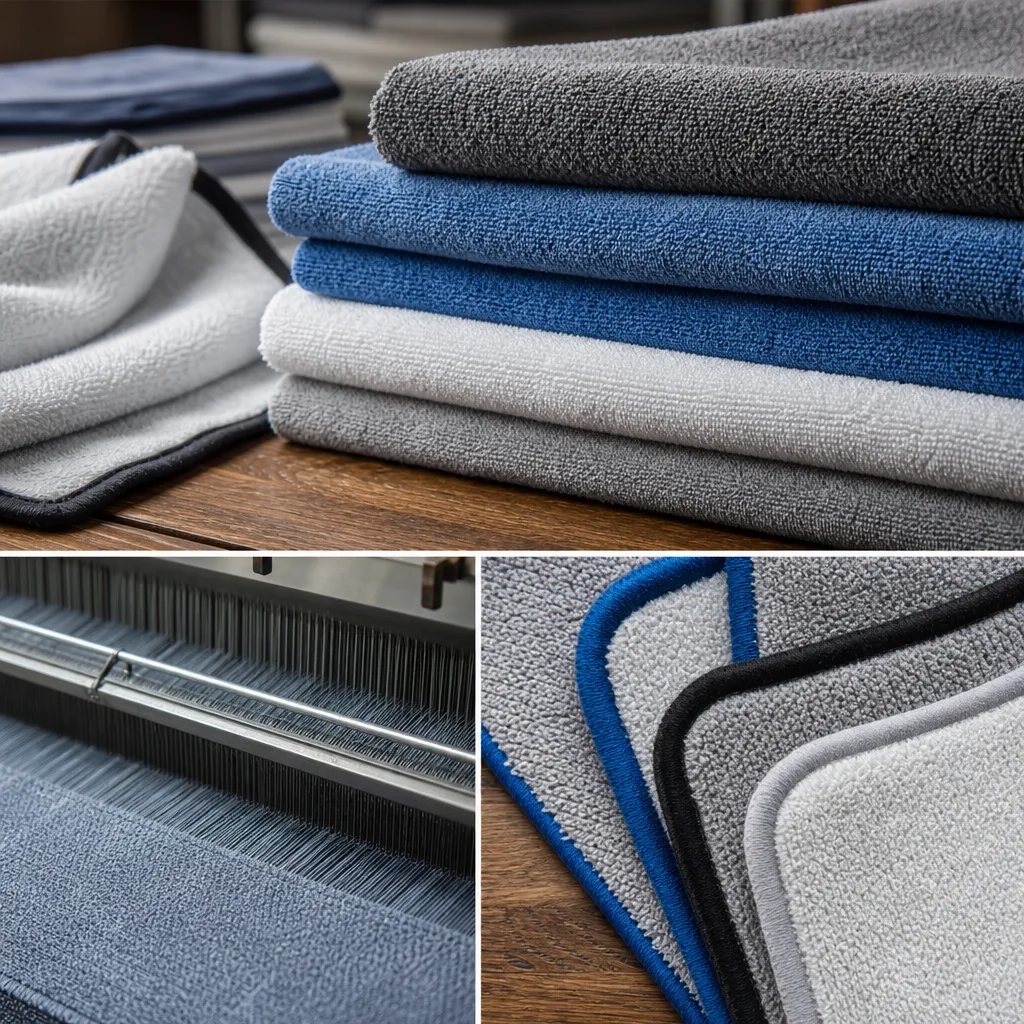
The First Spec Is Pile Geometry, Not Color
For automotive drying, we start with how the yarn sits on the face of the towel. A high-GSM towel with a flat, dense pile can feel impressive in a buyer's hand, but it may push water instead of pulling it into the fabric. For microfiber drying towels, the working face needs open channels so water can move through capillary action instead of staying on the surface.
The most common construction we quote for car wash programs is twisted loop microfiber. Each loop is formed with a slight twist, creating more contact points and a deeper path for water pickup. It is different from a plush detailing towel used for wax removal, where softness and product wipe-off matter more than bulk water absorption.
We also check the split quality of the microfiber. A polyester/polyamide blend is extruded, then split so each filament forms wedge-like segments. Poor splitting leaves rounder filaments that feel smooth but absorb slowly. In production QC, we do not approve a batch only because it reaches the target GSM; we cut a sample, wash it, and check whether the pile opens after finishing.
| Construction | Typical GSM | Best use | Factory caution |
|---|---|---|---|
| Twisted loop microfiber | 450-650 GSM | Final drying after rinse or tunnel wash | Needs good loop recovery after tumble drying |
| Dual-face twist/plush | 500-700 GSM | Retail detailing towel with one drying face and one buffing face | Higher sewing control needed to keep panels flat |
| Waffle microfiber | 320-420 GSM | Glass, mirrors, quick wipe-down | Too thin for full SUV drying unless towel size increases |
| Plush coral fleece microfiber | 380-550 GSM | Interior wipe, wax or spray sealant removal | Can streak water if pile is too dense |
Microfiber Drying Towels: Specs Buyers Should Lock
A clear tech pack prevents the factory from making a towel that matches the photo but misses the performance. For this category, we want buyer approval on blend ratio, GSM tolerance, pile type, size, edge finish, label method, color, and carton packing before sample weaving or knitting starts. The towel may look simple, but small changes shift cost and performance quickly.
- Blend: 80/20 polyester-polyamide is the cost-efficient base; 70/30 improves absorbency and hand feel but normally adds USD 0.18-0.42 per piece depending on size and GSM.
- GSM tolerance: We normally hold +/-5% after washing for stable programs. A 600 GSM target should not arrive as 535 GSM after finishing.
- Size tolerance: +/-2 cm is workable for most OEM programs. Retail boxed towels need tighter folding control than bulk car wash towels.
- Pile height: 4-7 mm is common for twisted loop drying towels. Longer loops absorb well but can snag on badges, license plate frames, and rough trim.
- Edge: Edgeless ultrasonic cut, microfiber suede binding, or low-profile overlock. Thick polyester binding is the usual cause of edge drag on paint.
For a single-pass car drying towel, we usually see buyers choose 60 x 90 cm, 70 x 90 cm, or 80 x 100 cm. A 70 x 90 cm towel at 560 GSM is about 353 g before label and packing. That weight gives enough water capacity for most sedan and crossover drying without making the towel awkward for staff to wring or load into laundry bags.
Absorbency Is Tested After Washing
Microfiber can be made to feel impressive with finishing softeners, but those finishes may reduce first-use absorption. We prefer to judge after a controlled wash cycle, because car wash operators care about the towel on day 30, not only the sample on the desk.
Our internal evaluation combines three checks. First is GSM by ISO 3801 method principles, using conditioned fabric samples. Second is dimensional change after washing, aligned with ISO 6330 wash procedure logic. Third is a water pickup test where a conditioned towel is weighed dry, fully saturated, allowed to drip under a fixed time, then weighed again. It is not a marketing number; it tells us whether a 500 GSM towel is behaving like a real drying towel or just a heavy wipe cloth.
| Test point | Acceptable range for OEM car wash use | Why it matters |
|---|---|---|
| Water pickup after 3 wash cycles | 4.5-6.8 times dry towel weight | Shows real absorption after finishing chemicals are reduced |
| Dimensional change | Within -4% to +2% | Keeps retail packs and folded stacks consistent |
| Lint release after dark panel wipe | No visible fiber shed after 10 wet passes | Prevents complaints on black paint and glass |
| Edge drag check | No hard ridge felt under finger pressure | Reduces risk of clear coat marring from the border |
This is where cheaper towels often fail. We have seen samples that absorbed well before washing, then became flat and slow after six laundry cycles because the loop yarn had weak recovery. For a fleet wash or detailing shop, that changes labor time. If a worker needs two towels instead of one for each vehicle, the landed towel price becomes less important than pieces consumed per day.
Edges, Labels, And The Scratch Problem
A towel used on automotive paint has a different defect profile than a gym towel or hotel hand towel. The fabric body may be soft, while the seam becomes the part that causes a claim. We inspect the edge with finger pressure and a wet black acrylic panel because dry hand feel does not reveal every problem.
Edgeless microfiber towel styles are popular for detailing brands because ultrasonic cutting removes the stitched border. The trade-off is durability at the perimeter. If the cut line is too hot, the edge becomes sharp; if it is too light, the towel frays after repeated tumble drying. For commercial car wash towels, a low-profile overlock or microfiber suede binding can last longer, but the thread and binding must be soft enough for paint contact.
- Use woven care labels only on one corner and keep them small, or choose heat-transfer labels for retail detailing towels.
- Avoid raised rubber patches on towels meant for paint. They look good in packaging and become a risk during fast shop use.
- For private label programs, place hang tags through a corner loop or paper band around the folded towel, not through the towel body.
- Match thread color to towel color when possible. Contrast stitching makes uneven seams easier for customers to notice.
Decoration is limited compared with cotton towels. Embroidery on a drying towel creates a stiff area that can touch paint, so we only suggest it for display packaging, not the wiping surface. For a brand that needs a visible logo, a woven label, belly band, or printed retail sleeve is safer. Our article on embroidery vs sublimation vs jacquard explains why decoration method has to follow the use case, not only the brand guide.
Sizing For Car Wash, Retail, And Detailing Kits
A tunnel wash operator usually wants a towel that dries quickly in laundry and is easy to count. A retail detailing brand may want a heavier hand feel and larger folded presentation. The same fabric cannot serve both perfectly, so we separate the program by channel before quoting.
| Channel | Common size | Recommended GSM | Packing style | Notes |
|---|---|---|---|---|
| Express car wash | 50 x 80 cm or 60 x 90 cm | 420-520 GSM | Bulk 50 or 100 pcs per carton | Fast drying and low loss rate matter more than gift-box feel |
| Detailing shop | 70 x 90 cm | 520-650 GSM | 10 pcs polybag or branded paper band | Good balance for sedans, SUVs, and hand drying |
| Retail auto accessory | 80 x 100 cm | 600-720 GSM | Single OPP bag, printed insert, or kraft sleeve | Shelf feel matters, but carton weight rises quickly |
| Ceramic coating studio | 40 x 60 cm plus 70 x 90 cm kit | 350-600 GSM | Mixed set with color coding | Separate wipe-off towels from final drying towels |
Color also changes sourcing risk. Charcoal, navy, and royal blue hide staining and are common in car wash operations. Bright orange and red can be useful for retail, but we test colorfastness to washing under ISO 105-C06 principles and check crocking on wet white fabric. A towel that bleeds in the first laundry cycle can contaminate lighter towels in the same load.
For buyers comparing microfiber with cotton, the use case should decide. Cotton bath terry is comfortable against skin but not ideal for modern clear coat drying. The comparison in microfiber vs cotton towel comparison is a useful background piece, especially for teams that buy both hospitality and automotive textiles.
Cost-Per-Use Beats A Low Piece Price
We understand why buyers push for the lowest FOB number. In car wash towels, though, a saving of a few cents can disappear in rewash labor, towel replacement, and customer complaints. A thin towel may look cheaper on the purchase order and cost more after 90 days of shop use.
For example, a 60 x 90 cm 430 GSM towel at USD 1.46 may survive about 55 commercial wash cycles before pile collapse if the yarn and edge are basic. A 60 x 90 cm 520 GSM towel with better split microfiber and low-profile binding may quote around USD 2.08 and reach 115 wash cycles under the same laundry routine. The first towel costs about 2.7 cents per use before freight; the second is about 1.8 cents per use. The higher invoice line is not always the higher operating cost.
| Order volume | 60 x 90 cm, 500-540 GSM | 70 x 90 cm, 560-620 GSM | 80 x 100 cm, 650-700 GSM |
|---|---|---|---|
| 500-999 pcs | USD 2.05-2.55 | USD 2.55-3.20 | USD 3.55-4.45 |
| 1,000-2,999 pcs | USD 1.82-2.28 | USD 2.28-2.88 | USD 3.18-3.92 |
| 3,000-9,999 pcs | USD 1.58-2.06 | USD 2.04-2.58 | USD 2.86-3.55 |
| 10,000+ pcs | USD 1.39-1.88 | USD 1.82-2.36 | USD 2.52-3.18 |
These are realistic FOB China bands for OEM microfiber drying towels with standard colors, one label, and bulk or simple retail packing. Final cost changes with 70/30 blend, carton limits, retail inserts, barcode stickers, and whether the buyer needs color-by-color packing. Our MOQ is 500 pcs per design per color, but price stability usually improves above 3,000 pcs because dyeing, cutting, and packing waste spread across more pieces.
Laundry Rules That Protect The Towel
A good drying towel can still fail early if the laundry system is wrong. Microfiber dislikes fabric softener because softener coats the filaments and reduces water pickup. High heat can also damage pile recovery and deform ultrasonic edges.
- Wash new towels once before field use to remove loose finishing residue and transport dust.
- Keep microfiber separate from cotton lint sources, especially cotton bar mops and bath towels.
- Use neutral detergent and avoid silicone softeners, chlorine bleach, and oily residue from shop rags.
- Dry at moderate temperature, ideally below 60 C, and remove towels when dry instead of baking them at the end of the cycle.
- Retire towels from paint-contact work once edges harden, pile mats down, or contamination cannot be washed out.
For automotive teams building a full towel system, we usually color-code by job: one shade for exterior drying, one for glass, one for interior, and one for dirty wheel-area work. That reduces accidental use of contaminated towels on paint. Our auto-detailing microfiber towel program goes deeper into SKU separation, while custom microfiber towels wholesale guide covers broader wholesale planning.
Certification, Compliance, And Factory Controls
Automotive towels do not always require the same skin-contact documentation as baby textiles, but serious buyers still ask for compliance because towels touch workers' hands, enter retail channels, and may ship across multiple markets. We manufacture under ISO 9001 quality management procedures and BSCI social compliance. For chemical safety, we can support OEKO-TEX Standard 100 Class I certified materials when the program requires it.
For microfiber programs, traceability matters at the yarn and dyeing stages. We record yarn lot, dye lot, GSM inspection, cutting lot, sewing line, needle check, and final carton count. This helps when a buyer reports a problem from one warehouse or one delivery window. Without lot control, every claim becomes guesswork.
- Incoming material: yarn count, blend confirmation, shade check, and hand-feel comparison against approved sample.
- In-process QC: GSM check, width control, loop appearance, edge tension, and label placement.
- Finished inspection: random carton pull, size measurement, weight check, lint wipe, and visual defect grading.
- Packing audit: carton quantity, barcode placement, desiccant request if needed, and export mark confirmation.
We are careful with claims such as antibacterial, eco, or recycled. If a buyer wants recycled polyester microfiber, we ask for the certification route before sampling because GRS documentation affects yarn sourcing and lead time. If a buyer wants chemical finishing, we review the claim language and test requirement first. A towel can be functional without adding a claim that creates compliance risk.
Sampling And Production Timeline
A normal OEM timeline for microfiber car wash towels is faster than custom jacquard cotton towels, but it still needs room for color approval and wash testing. If the buyer provides a complete tech pack, we can move quickly. If the project starts with only a photo, we need more rounds to lock the pile, GSM, edge, and packing.
| Stage | Typical timing | Buyer action needed |
|---|---|---|
| Spec review and quote | 1-3 days | Confirm size, GSM, blend, edge, color, packing, and target quantity |
| Lab dip or stock color match | 4-7 days | Approve shade under agreed light source |
| Pre-production sample | 7-12 days | Check hand feel, absorption, edge, label, and folded presentation |
| Bulk production | 18-28 days | Approve sample and deposit, then keep packing details frozen |
| Final inspection and export docs | 2-4 days | Confirm shipping marks, carton list, and freight plan |
Air freight can make sense for launch samples or a small retail top-up, but bulk towels are bulky for their value. Sea freight is usually more rational for 3,000 pcs and above. For logistics planning, container vs air freight towel orders gives the math behind carton volume and landed cost.
Related reads: If your team is still building the specification file, start with build towel tech pack that mills can quote. For MOQ discussions, negotiate towel MOQ without killing margin explains why color count and packing complexity matter as much as total quantity.
Related reads: Buyers comparing car wash towels with other channels may also want microfiber wholesale spec control and the industry overview for auto detailing towels. For product browsing, our microfiber and automotive-relevant towels sit under custom towel products.
What We Need To Quote Accurately
The cleanest quotes come from a short, specific brief. We do not need a long brand deck at the first step; we need the towel details that affect cost and production. If the buyer is unsure, we can quote two or three controlled options instead of guessing one number that later changes.
- Target use: express car wash, detailing studio, retail accessory, dealership, or subscription kit.
- Size and GSM target, or a reference towel weight if size is not fixed yet.
- Blend preference: 80/20 for value, 70/30 for higher absorbency and softer hand feel.
- Edge finish: edgeless, suede binding, or low-profile overlock.
- Color requirements with Pantone reference if the shade is brand-critical.
- Logo method: woven label, heat-transfer label, paper band, insert card, or retail sleeve.
- Order quantity by color and packing method, with destination port or country for freight planning.
We are LUMA & CO. TEXTILE, a 220-employee towel mill operating since 2007 in Gaoyang, Zhejiang, China. We produce about 2.4M towels annually for 80+ brand clients across 47 countries. For microfiber drying towels, our practical MOQ is 500 pcs per design per color, with better cost control at 3,000 pcs and above. For quotes, contact us on WhatsApp at +86 13205717266 or email [email protected].
Build A Drying Towel Spec
Send us size, GSM, blend, edge finish, color, packing, and target quantity. We will return OEM options with realistic pricing, MOQ, and timing.
Request a Quote →