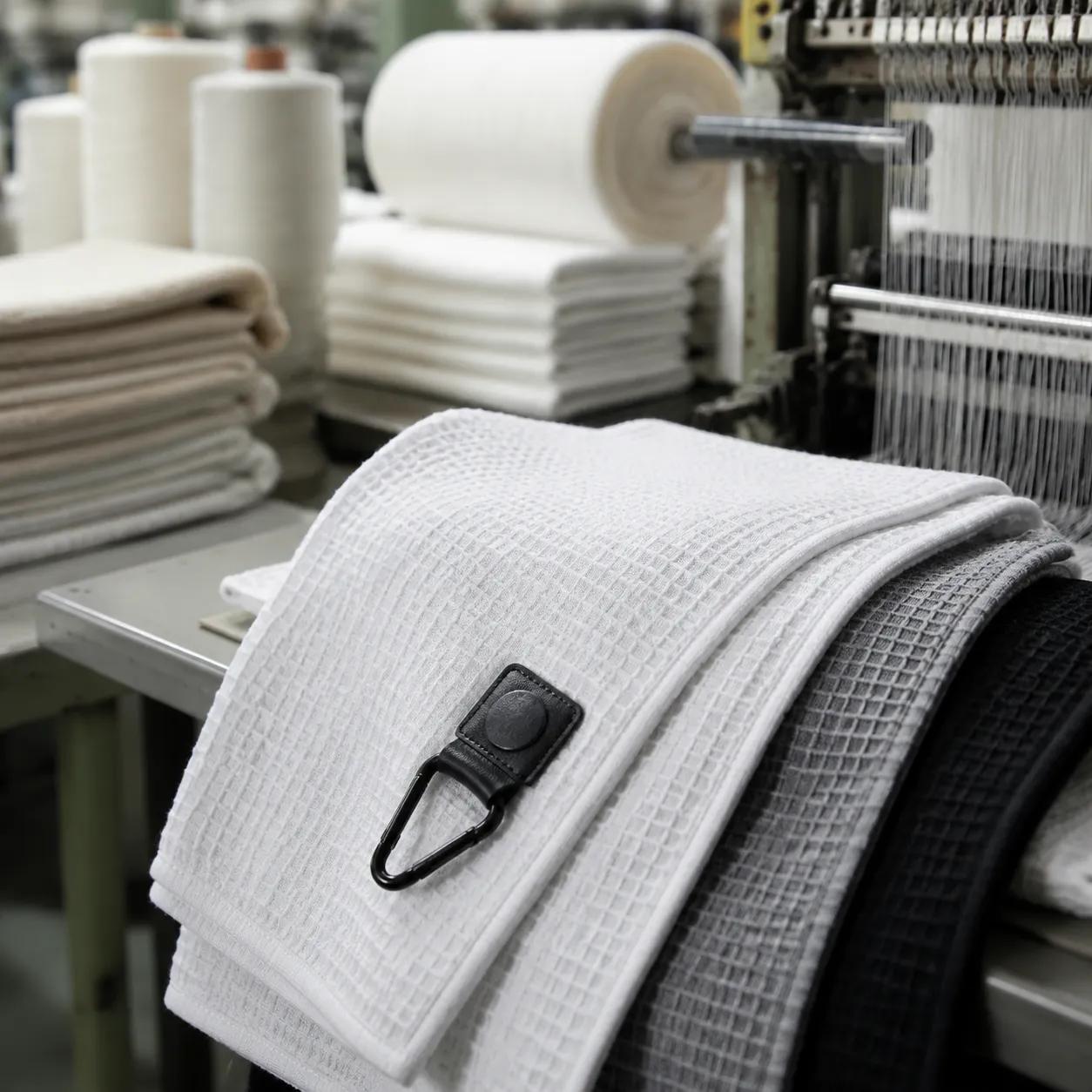
What Makes the Best Magnetic Golf Towel Different
A magnetic golf towel is not just a standard golf towel with a magnet added at the corner. The magnet changes how the towel hangs, how it swings against a club shaft, how the corner reinforcement wears, and how the decoration should be positioned. We make these towels for golf clubs, tournament packs, and private-label golf accessories, so we treat the hardware as a functional component, not an afterthought.
For most OEM programs, the towel body sits in the 280-420 GSM range for microfiber waffle and 430-560 GSM for cotton terry. Sizes usually run from 40 × 40 cm for compact cart towels to 50 × 100 cm for player towels. The magnetic corner normally carries the highest stress because users pull the towel off cart posts, club heads, range cages, and bag frames several times per round.
In our factory QC, we check three points before we approve a production sample: magnet holding force, corner tear resistance, and corrosion risk around the metal parts. A towel can pass appearance inspection and still fail on the course if any one of these is under-specified.
| Component | Factory recommendation | Why it matters on course |
|---|---|---|
| Towel body | Microfiber waffle 300-380 GSM or cotton terry 460-520 GSM | Enough surface area for club grooves without making the towel heavy when wet |
| Magnet | Neodymium N42 or N52, 16-22 mm diameter, plated and covered | Holds to cart frames and irons without dropping during movement |
| Corner reinforcement | Two-layer patch or folded binding with bartack | Prevents tearing when the towel is pulled off metal surfaces |
| Attachment | Grommet plus carabiner, or sewn magnetic tab | Gives the user a backup hanging method on non-metal bags |
| Decoration | Embroidery, woven label, jacquard, or heat transfer depending on fabric | Keeps branding readable after repeated wet-dry cycles |
Start With the Magnet, Not the Logo
The most common sourcing mistake is choosing the towel fabric first, then asking the mill to add a magnet at the end. For a normal bag towel, that can work. For a magnetic towel, we prefer to define the magnet assembly before artwork placement because the reinforced corner affects the usable branding area.
We usually test magnet pull force on a flat low-carbon steel plate before bulk production. For a compact 40 × 60 cm waffle towel, a magnet assembly in the 2.2-3.5 kgf holding range is practical. For a larger 50 × 100 cm cotton towel, we prefer 3.8-5.5 kgf because the wet towel weight increases quickly after rain or club cleaning.
There is a limit. A very strong magnet sounds better in a product description, but it can pull too aggressively against thin cart paint or make the towel awkward for older players to remove with one hand. We have rejected 7 kgf prototypes for this reason. They held well in the lab but felt wrong in use.
- N42 neodymium is normally enough for club shop and tournament towels where cost control matters.
- N52 neodymium gives stronger pull in a smaller size, useful for compact premium accessories.
- Nickel-copper-nickel plating is common, but we still cover the magnet because golf towels sit in wet bags.
- Epoxy coating adds cost but helps when the towel is used near salt air or stored damp after play.
- Hidden magnet pouches look cleaner, but they must be stitched so the magnet cannot rotate inside the corner.
For buyers comparing samples online, the best magnetic golf towel should not be judged only by whether it sticks to a club head in a photo. Ask for the magnet diameter, grade, coating, and pull-force test condition. A 20 mm magnet tested on a thick steel plate will not behave the same on a painted cart frame or a stainless accessory rail.
Fabric Choices That Work With Magnetic Hardware
We make golf towels in both microfiber and cotton, but the magnetic format changes the fabric decision. Microfiber waffle is lighter and dries faster, so it puts less strain on the magnetic corner. Cotton terry feels familiar to country club buyers and works well for embroidery, but the wet weight is higher and the corner needs more reinforcement.
For microfiber waffle, our common construction is 80/20 polyester-polyamide, 300-360 GSM, with a raised waffle pocket that reaches into grooves on irons and wedges. For a more absorbent version, we use 70/30 microfiber at 340-400 GSM, but the price rises because polyamide cost is higher and dyeing control is tighter.
Cotton golf towels usually use 16s/1 or 21s/2 yarns depending on the handfeel target. A 480 GSM cotton towel in 40 × 70 cm absorbs well, but when saturated it can weigh more than double its dry weight. That is why we specify a larger reinforcement patch if the magnet sits inside the towel corner.
| Fabric option | Typical GSM | Best use | Watch point |
|---|---|---|---|
| Microfiber waffle 80/20 | 300-360 GSM | Retail magnetic towels, tournament gifts, DTC golf brands | Heat-transfer labels need wash testing on textured surface |
| Microfiber waffle 70/30 | 340-400 GSM | Higher absorbency programs and player towels | Higher material cost; color matching can need one extra lab dip |
| Cotton terry | 430-520 GSM | Club shops, member gifts, embroidered programs | Wet weight stresses grommet and magnet corner |
| Cotton velour face / terry back | 450-540 GSM | Printed or embroidered premium-looking towels | Velour face can show pressure marks around hardware |
| Ribbed cotton or dobby border | 460-560 GSM | Traditional golf towel appearance | Border must not run under the magnet patch |
A practical note from the sewing line: do not place a thick woven label directly beside the magnetic patch on a 300 GSM waffle towel. The corner becomes stiff on one side and soft on the other, so the towel twists when hanging from a cart. We move labels 35-50 mm away from the hardware zone unless the buyer specifically wants a corner label.
Corner Construction: Where Cheap Samples Fail
The corner is the failure point we see most often in competitor samples. A single brass-tone grommet pressed through one layer of towel may look acceptable in a photo, but it does not distribute pulling force. After 20-30 hard pulls, the hole can oval out. If the towel is cotton, the terry loops around the hole can start to fray.
For a magnetic golf towel with clip, we usually build a reinforced corner using a folded webbing tab, a twill patch, or a double-layer towel fold. On cotton, we prefer a patch area around 45 × 45 mm or larger. On microfiber waffle, a 35 × 40 mm reinforced zone can be enough if the magnet is lighter.
Hardware also needs attention. Zinc alloy carabiners are cheap, but some versions lose spring tension after repeated opening. Stainless or aluminum carabiners cost more, but they reduce complaint risk for resort or coastal golf markets. For grommets, we avoid untreated iron. If a supplier offers a very low price, we ask what the grommet base metal is and whether it passed a salt spray screen.
- Oval grommet hole: caused by thin fabric layers and no backing patch.
- Rust halo: usually from low-grade grommets or split rings stored wet in a golf bag.
- Magnet rotation: happens when a hidden magnet pouch is too loose inside the corner seam.
- Corner curling: caused by too much hardware weight on light 260-280 GSM fabric.
- Needle break risk: appears when the magnet is inserted before sewing instead of after the reinforced pocket is formed.
One process step is easy to miss: we sew the reinforcement first, then insert or attach the magnet assembly depending on design. If the magnet is already in place during stitching, it can pull toward the machine plate, shift seam allowance, and slow production. That raises cost and makes bulk consistency worse.
Logo Placement and Decoration Options
Golf buyers often ask for a large logo centered on the towel. That can work, but magnetic towels hang at an angle more often than standard tri-fold golf towels. We recommend reviewing the towel in its actual hanging position before confirming artwork. A logo that looks centered flat on a table may sit too low when the magnet attaches to a cart post.
Embroidery is still the safest choice for cotton terry and cotton velour. For microfiber waffle, embroidery can flatten the texture and create a stiff zone, so we limit stitch density and use backing that tears cleanly. For more complex sponsor graphics, heat transfer or sublimation-style microfiber printing can work, but the towel must be tested for peel strength and wash durability.
For woven logos, jacquard is possible on cotton, but it is less flexible for small orders because the loom setup and yarn planning take longer. If your program has multiple sponsor logos under one tournament, we usually recommend a neutral towel body plus heat-transfer patches or embroidery panels.
| Decoration method | Recommended fabric | Typical MOQ impact | Factory comment |
|---|---|---|---|
| Embroidery | Cotton terry, cotton velour, heavier microfiber | 500 pcs per design / per color | Good for initials and club crests; avoid very tiny lettering under 4 mm |
| Heat transfer | Microfiber waffle | 500 pcs per design / per color | Works for multi-color logos; test after 10 and 25 wash cycles |
| Woven label | Microfiber or cotton | 500 pcs, but label MOQ may be higher | Clean retail look; keep away from magnet seam |
| Jacquard woven logo | Cotton towel body | 800-1,200 pcs is more efficient | Best for repeated club programs, not one-off sponsor changes |
| Silicone badge | Microfiber or cotton with patch | 500 pcs, higher unit cost | Modern look, but badge thickness affects folding and packing |
If you are still deciding between decoration routes, our comparison of embroidery vs sublimation vs jacquard explains the trade-offs in more detail. For golf-specific program planning, country club golf towel program covers member use, pro-shop replenishment, and tournament needs.
Testing Plan Before Bulk Production
A towel may pass fabric inspection but fail as an accessory. For magnetic golf towels, we add hardware tests to the normal textile QC plan. Our mill is ISO 9001 certified, and we align textile safety requests with OEKO-TEX Standard 100 Class I where applicable. For social compliance audits, we maintain BSCI documentation for buyers that require it.
For fabric, we commonly reference ISO 105-C06 for domestic laundering color fastness and ISO 105-X12 for rubbing color fastness. For dimensional change, we use an internal wash protocol based on ISO 6330 wash conditions, adjusted to buyer laundry requirements. For microfiber towels, we also check lint release because waffle loops can shed if yarn quality is poor or heat setting is rushed.
For hardware, we run pull checks and a wet-storage screen. Where coastal markets are involved, we can arrange a neutral salt spray test similar to ASTM B117 for metal parts. We do not claim every golf towel needs a full laboratory corrosion test, but if the towel is going to Florida resorts, island clubs, or cruise retail, the extra test cost is usually less than replacing rusty goods.
- Approve lab dip or yarn color standard under D65 and TL84 light sources.
- Confirm fabric GSM, size tolerance, and shrinkage target after wash.
- Test magnet pull force on a defined steel surface and record the result in kgf.
- Wash the towel 10 cycles, then inspect grommet, magnet cover, logo, and corner seam.
- Hang the wet towel from a cart-like painted metal tube for a functional check.
- Approve sealed pre-production sample before cutting bulk fabric.
For the best magnetic golf towel programs, we prefer to test a real hanging sample, not only a flat textile swatch. This is especially important when the towel has a heavy embroidered crest plus a magnet on the same side. Weight balance affects how the towel hangs, and golfers notice it quickly.
Pricing Bands and Cost-Per-Round Logic
Magnetic hardware adds real cost. A buyer may see a basic golf towel at a low price and expect the magnetic version to be only a few cents higher. In practice, the magnet, reinforcement, extra sewing time, and hardware inspection usually add USD 0.32-0.85 per piece depending on construction.
Below are realistic FOB China ranges for OEM magnetic golf towel orders from our Gaoyang production line. They assume buyer-supplied artwork, standard packing, and one design / one colorway. Final price depends on exchange rate, yarn cost, decoration area, and hardware grade.
| Order volume | Microfiber waffle 40 × 60 cm | Cotton terry 40 × 70 cm | Larger player towel 50 × 100 cm |
|---|---|---|---|
| 500-999 pcs | USD 2.15-3.05 | USD 2.45-3.45 | USD 4.10-5.60 |
| 1,000-2,999 pcs | USD 1.82-2.62 | USD 2.12-3.05 | USD 3.55-4.85 |
| 3,000-7,999 pcs | USD 1.58-2.28 | USD 1.88-2.72 | USD 3.12-4.35 |
| 8,000+ pcs | USD 1.42-2.05 | USD 1.72-2.48 | USD 2.86-3.98 |
Here is how we explain cost-per-use when a buyer asks for the cheapest magnet. Suppose a resort sells or issues 1,500 towels at USD 2.04 each with a basic magnet that starts dropping after around 18 rounds. The towel cost is about USD 0.113 per round. A stronger reinforced version at USD 2.63 that lasts 42 rounds costs about USD 0.063 per round. The second towel costs more on the purchase order, but fewer members complain and the program spends less per round of actual use.
Our MOQ is 500 pcs per design / per color. We can sample below that quantity for development, but bulk production below MOQ usually creates poor economics because magnet sourcing, dyeing, cutting, sewing setup, and inspection do not scale down neatly.
Production Timeline and Packing Decisions
Magnetic golf towel orders take slightly longer than plain towel orders because the hardware must be sourced, inspected, and matched to the approved sample. If the magnet is custom covered, color-matched, or combined with a special carabiner, we add several days to the schedule.
A normal timeline is 5-7 days for quotation and tech-pack clarification, 7-12 days for sample making after artwork and deposit, 18-28 days for bulk production after sample approval, and 5-9 days for final inspection, packing, and export paperwork. Air freight can move quickly but is expensive because towels have volume. Sea freight is usually better for 2,000 pcs and above unless an event date is fixed.
- Individual polybag: useful for retail or tournament gift kits, but adds packing labor and plastic cost.
- Paper belly band: cleaner for pro-shop presentation; must be sized around the folded towel plus hardware bulge.
- Bulk carton packing: lowest cost for locker-room issue or replenishment stock.
- Hangtag with magnet warning: recommended if the towel includes a strong neodymium magnet.
- Carton drop check: important because magnets can shift toward carton corners if packing is loose.
We also ask whether the towel will ship alone or as part of a kit with balls, tees, gloves, or scorecard holders. A magnet can mark soft packaging if placed directly against coated paper. For retail kits, we normally add a thin separator board or position the magnetic corner away from printed surfaces.
Buyer Spec Sheet We Recommend
A clear spec sheet prevents most delays. If a buyer only sends a product photo and asks for the best magnetic golf towel, we have to make assumptions about magnet strength, fabric, size, and decoration. Those assumptions can be wrong, especially when the target is a known retail benchmark or a club-specific member gift.
- Towel size with tolerance, for example 40 × 60 cm ±2 cm after wash.
- Fabric construction, including GSM and fiber blend such as 80/20 microfiber waffle at 340 GSM.
- Magnet grade, diameter, coating, and target holding force in kgf.
- Hardware type: grommet, carabiner, split ring, sewn tab, or hidden magnet pocket.
- Decoration artwork with Pantone references, stitch count limit, or heat-transfer size.
- Wash test expectation, such as 10-cycle internal check or 25-cycle buyer requirement.
- Packing method, carton quantity, barcode requirement, and destination port.
- Certification needs: OEKO-TEX Standard 100, BSCI, ISO 9001 factory documentation.
Related reads: for spec building, start with build towel tech pack that mills can quote. If your order is still small, negotiate towel MOQ without killing margin explains why the 500 pcs per design / per color threshold exists. For decoration planning, see pantone color matching custom towels.
Related reads: if your brand is comparing microfiber and cotton, microfiber vs cotton towel comparison is useful. For sizing decisions beyond golf, towel sizes dimensions complete guide gives practical dimensions. For shipping math, read container vs air freight towel orders.
How We Would Build a Reliable Program
For a club-shop towel, we would usually start with 340 GSM microfiber waffle in 40 × 60 cm, N42 magnet around 18-20 mm, reinforced corner patch, aluminum carabiner, and embroidery or woven label branding. For a higher-end member gift, we may move to 380 GSM microfiber or 500 GSM cotton terry, use a stronger magnet, add a custom hangtag, and pack each towel in a paper belly band.
For coastal clubs, we would not chase the lowest hardware cost. We would specify covered neodymium magnets, corrosion-resistant grommets, and a wet-storage check before bulk approval. For tournament sponsors, we would protect the event date first: choose a decoration method that can be repeated cleanly and avoid late-stage hardware changes.
LUMA & CO. TEXTILE has produced towels since 2007 with a 220-person team, annual output around 2.4 million towels, and clients in 47 countries. We are OEKO-TEX Standard 100 Class I, BSCI, and ISO 9001 certified. Our role is to help buyers remove weak points before production, because magnetic towel complaints usually come from small details: a loose grommet, an under-sized magnet, a rusty split ring, or a logo placed where the towel folds badly.
A magnetic golf towel should be tested as a piece of course equipment, not only as a decorated textile.
Build a Magnetic Golf Towel Spec
Send us your target size, fabric, logo method, magnet requirement, quantity, and event deadline. MOQ is 500 pcs per design / per color. WhatsApp: +86 13384590853. Email: [email protected].
Request OEM Quote →