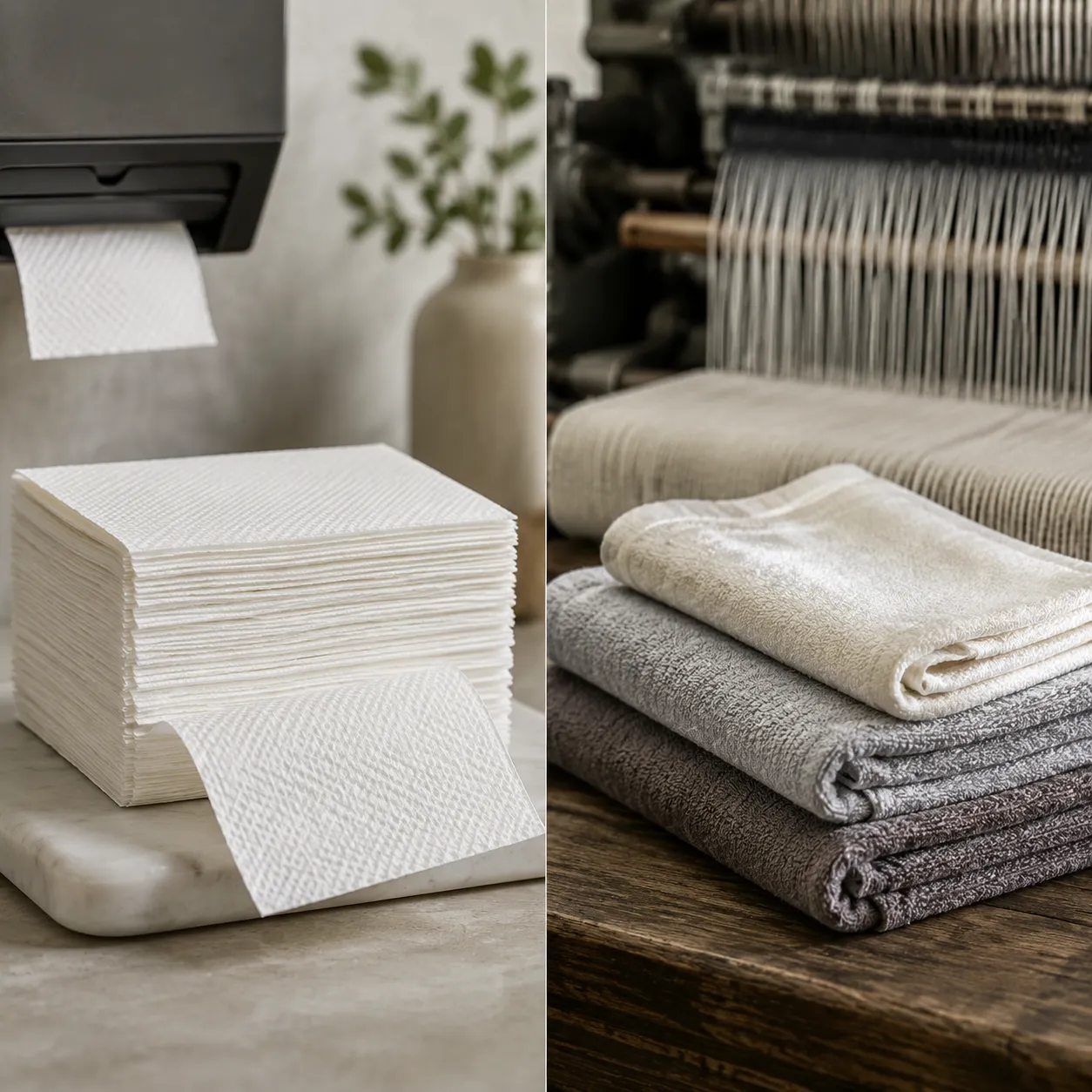
Why Custom Paper Hand Towels Enter the Sourcing Brief
The request usually starts with a hygiene or branding problem. A restaurant group wants a dry folded towel beside the basin. A wedding venue wants a monogram for powder rooms. A hotel operator wants to avoid damp terry hand towels being reused by multiple guests during events. In those cases, custom paper hand towels are not just a cheaper version of cotton; they are a different operating model.
From the textile side, we see buyers get into trouble when they compare one paper piece against one cotton towel. A 3-ply printed paper guest towel may cost only a few cents, but it is consumed once. A 40 × 70 cm cotton custom hand towel may cost more at purchase, but it can pass through 80 to 140 commercial wash cycles if the yarn, hem, dye, and decoration are chosen correctly. The real comparison is carton space, labor, waste removal, guest touchpoint, and cost per use.
For clarity, this guide covers the sourcing decisions we review with brand-side buyers when they are deciding between custom disposable hand towels and reusable textile towels. Where we mention paper pricing, it is based on supplier quotations we have reviewed with clients in Q2 2026 from China and Vietnam packaging vendors; paper products are not produced on our towel looms.
| Use case | Paper towel fit | Cotton towel fit | Factory note |
|---|---|---|---|
| Event powder room, one-night usage | Strong | Possible but requires post-event laundry | Paper reduces reverse logistics when the venue has no laundry partner. |
| Hotel room daily hand towel | Weak for main bath linen | Strong | Reusable cotton is normally lower cost after repeated wash cycles. |
| Restaurant restroom branding | Strong | Moderate | Paper avoids wet towel bins and improves logo visibility per guest. |
| Spa treatment room | Limited | Strong | Cotton or waffle towels handle steam, oils, and skin contact better. |
| Retail gift set | Limited unless positioned as partyware | Strong | A custom bath towel or hand towel has higher perceived shelf value. |
Spec the Substrate Before the Logo
Most rejected disposable guest towel orders are not rejected because of the logo. They fail because the base paper feels too thin, pills when wet, or bleeds print into the white area. For paper, buyers should ask for ply count, sheet weight, emboss pattern, wet-strength resin declaration, folded size, and open size. For cotton, the equivalent decisions are GSM, yarn type, loop height, border width, and hem construction.
A common powder-room paper size is around 12.5 × 20 cm folded and 32 × 40 cm opened, often in 2-ply or 3-ply tissue. The cotton equivalent is usually a 30 × 30 cm fingertip towel at 420–520 GSM or a 35 × 75 cm hand towel at 450–600 GSM. If a buyer asks us to make a reusable version with embroidery, we normally push the base towel toward 480 GSM or above so the logo area does not look sunken after washing.
| Format | Typical dimensions | Material spec | Best decoration |
|---|---|---|---|
| Disposable guest towel | Folded 12.5 × 20 cm; open 32 × 40 cm | 2-ply or 3-ply paper, usually 16–22 gsm per ply | 1-color flexo, foil stamp, or deboss |
| Cotton fingertip towel | 30 × 30 cm or 30 × 50 cm | 420–520 GSM terry, ring-spun or combed cotton | Embroidery, woven label, dobby stripe |
| Cotton hand towel | 35 × 75 cm or 40 × 80 cm | 450–600 GSM terry | Embroidery, jacquard border, reactive dyed body |
| Promo rally-style towel | 30 × 60 cm or 35 × 70 cm | 300–420 GSM terry or velour | Screen print, jacquard, or heat transfer depending on artwork |
- For paper, request a wet rub test on the printed zone after 10 seconds of water contact. The logo should not smear onto fingers.
- For cotton, request absorbency by AATCC TM79 or an internal drop test after pre-washing, because softener residue can make a new towel repel water.
- For both formats, approve a physical folded sample. A flat artwork proof will not show thickness, emboss depth, or stack height.
- If the towel will sit near skincare products, ask whether fragrance, lotion, or oil exposure has been tested. Paper can discolor around oil-based products.
Decoration Choices: Print, Foil, Embroidery, Jacquard
Paper decoration is usually about surface impact. Textile decoration is about surviving laundering. A foil-stamped crest on a napkin can look sharp at a private dinner, but that same metallic effect is not practical on a reusable terry towel unless it becomes a woven label, embroidery thread, or jacquard border. This is where brand teams sometimes need a separate artwork file for each product format.
For paper, 1-color flexographic printing is the safe route when the logo is simple and the order is above 10,000 pieces. Foil stamping can work for boutique events, but the stamping die cost and slower speed add cost. Debossing looks clean on white or ivory stock, but it is easy to under-spec: if the base sheet is too soft, the logo loses edge definition once the towel is stacked.
For cotton, embroidery is the most common choice for customized hand towels used in hotels, clubs, and retail gift programs. We typically keep embroidery under 8,000 stitches on a 35 × 75 cm hand towel to control puckering and production time. For larger repeat logos, jacquard is cleaner because the design is built into the weave, not stitched on top. If you are comparing decoration routes, our article on embroidery vs sublimation vs jacquard gives a useful technical baseline.
| Decoration method | Works on paper | Works on cotton | Main risk to control |
|---|---|---|---|
| Flexo print | Yes | No for terry loops | Ink gain on absorbent paper and small text filling in |
| Foil stamp | Yes | Not for washable terry | Foil flaking if towel is handled with wet hands |
| Deboss | Yes | Rare | Low emboss definition on soft stock |
| Embroidery | No | Yes | Puckering, backing show-through, and slow drying under dense stitches |
| Jacquard weave | No | Yes | Logo distortion if the artwork has fine curves or tiny letters |
MOQ, Price Bands, and What the Numbers Exclude
Our textile MOQ is 500 pcs per design per color. Paper vendors usually quote much higher quantities because printing plates, setup waste, and case packing are not economical at small runs. For buyers comparing custom logo towels across paper and cotton, the minimum order is often the first surprise.
The price bands below are realistic for mid-2026 sourcing discussions, but they are not a universal price list. Paper pricing depends heavily on pulp market, ply count, print coverage, carton quantity, and whether the supplier is a napkin converter or a trading company. Cotton towel pricing depends on yarn count, GSM, dye method, decoration, packaging, and inspection level. Freight, import duty, hotel receiving fees, and local sales tax are excluded.
| Item and volume | Indicative FOB unit price, Q2 2026 | MOQ reality | Comment |
|---|---|---|---|
| 3-ply printed paper guest towel, 10,000–30,000 pcs | USD 0.038–0.072 per pc | Often 10,000 pcs per artwork | One-color print; foil or special stock adds setup cost. |
| 3-ply printed paper guest towel, 50,000–100,000 pcs | USD 0.026–0.049 per pc | Best after carton optimization | Better unit cost, but storage and usage forecast matter. |
| 30 × 50 cm cotton fingertip towel, 500–1,500 pcs | USD 0.88–1.45 per pc | Our MOQ 500 pcs per design/color | 420–500 GSM with small embroidery or woven label. |
| 35 × 75 cm cotton hand towel, 1,000–3,000 pcs | USD 1.65–2.85 per pc | MOQ 500 pcs, better at 1,000+ | 480–600 GSM; embroidery cost varies by stitch count. |
| 40 × 80 cm custom bath towel companion piece, 500–2,000 pcs | USD 2.10–3.75 per pc | MOQ 500 pcs per color | Useful when the same logo program extends beyond powder rooms. |
Here is a current cost-per-use example from a 74-room boutique property we modeled in May 2026. If each public restroom uses 85 disposable pieces per day across 330 operating days, a paper towel at USD 0.041 FOB becomes 28,050 pieces per restroom before freight and waste handling. A reusable 35 × 75 cm cotton towel at USD 2.28 that survives 95 laundry cycles has a product cost of about USD 0.024 per use before laundering. Once commercial laundry is added, cotton may still cost more per use, but it creates a different guest impression and avoids daily carton replenishment. The decision changes if the site lacks laundry access or the towel is for one-day events.
QC Checks Buyers Should Put in the PO
A purchase order that says “white paper towel with gold logo” is too loose. So is “embroidered hand towel, hotel quality.” We prefer POs that define measurable checks because they reduce argument at inspection. For paper, the inspection is closer to packaging QC. For cotton, it is textile QC with wash performance.
- Confirm approved physical sample with folded size, open size, sheet feel, print color, logo position, and carton packing.
- Set a logo placement tolerance. For paper, ±2 mm is normally achievable; for cotton embroidery, ±5 mm is more realistic because towel panels shrink and relax.
- Define shade tolerance. For textile dyeing, use a light box under D65 and TL84 if the towel must match bathroom lighting conditions.
- Require random inspection under ISO 2859-1 sampling. For cotton towels, common AQL settings are 2.5 for major defects and 4.0 for minor defects unless the buyer has stricter rules.
- For OEKO-TEX claims, check the certificate scope. Our textile production supports OEKO-TEX Standard 100 Class I, but a paper napkin converter must provide its own chemical safety documentation.
Two defects are specific enough to call out. On paper, watch for edge dust from dull slitting blades; it leaves fine lint on dark vanity counters. On cotton, watch for embroidery backing that hardens after tumble drying; it can scratch skin and makes the towel feel cheap even if the GSM is correct.
For buyers new to compliance documents, how to read an OEKO-TEX certificate explains how scope, product class, and validity dates should be checked. If you are building the whole towel specification rather than only a logo brief, use our tech pack guide for mills before requesting quotes.
Lead Time and Artwork Approval Sequence
Paper can be fast if the base stock is available and the artwork is one color. Cotton is slower because yarn preparation, weaving, dyeing, decoration, washing, inspection, and packing must be scheduled. The worst delays happen when the buyer approves a digital mockup but waits to approve the physical strike-off. A towel surface is textured; small serif text that looks fine on screen can disappear into terry loops.
| Stage | Paper guest towels | Cotton hand towels | Buyer action |
|---|---|---|---|
| Artwork check | 1–2 days | 1–2 days | Send vector artwork, Pantone target, logo size, and placement. |
| Physical sample or strike-off | 5–9 days | 7–12 days | Approve sheet feel or embroidery density before bulk. |
| Bulk production | 10–18 days | 22–35 days | Avoid changing carton marks or thread color after approval. |
| Inspection and packing | 2–4 days | 3–5 days | Confirm AQL level, barcode labels, polybag rules, and carton drop marks. |
| Sea freight to main EU/US ports | 25–40 days typical | 25–40 days typical | Plan buffer for port congestion and customs exams. |
Our normal textile production window for custom hand towel orders is 30–45 days after sample approval for 500–5,000 pcs, assuming standard yarn and no unusual packaging. Larger programs or jacquard weaving can move to 45–60 days. Paper vendors often quote shorter production time, but the bulkier carton count can make warehousing less convenient. A 50,000-piece paper order may arrive as many large cases that need dry storage away from kitchen steam and cleaning chemicals.
- Send artwork as AI, PDF, or EPS, not only a low-resolution PNG.
- For paper, specify whether the logo is visible on the folded face or only after opening.
- For embroidery, keep small letters above 5 mm height where possible; fine script fills in after washing.
- For jacquard, simplify gradients and thin outlines because the loom reads the design as yarn intersections, not ink.
Packaging, Storage, and Carton Cube
Disposable paper looks small at the washbasin, but it can occupy more warehouse space than buyers expect. Paper is shipped in cases with air volume between folded pieces. Cotton packs denser by weight but must be protected from moisture and odor. If a purchasing team focuses only on FOB unit cost, receiving teams later inherit the storage problem.
For paper guest towels, ask for pieces per inner pack, inner packs per carton, carton dimensions, gross weight, and moisture barrier. For cotton towels, ask whether the product is bulk packed, individual polybagged, belly-banded, or packed for retail. For many hotels, bulk cartons with 50 or 100 pcs inside are enough. For retail or gifting, individual packaging adds USD 0.06–0.22 per pc depending on paper band, printed insert, barcode label, or compostable bag claim.
- Paper storage risk: carton crushing, humidity curling, odor absorption, and print transfer if packed before ink is fully cured.
- Cotton storage risk: mildew if packed above safe moisture level, shade confusion between dye lots, and deformation from over-compression.
- For export cartons, request clear shipping marks with item code, color, quantity, gross weight, net weight, and country of origin.
- If the order is for multiple properties, split carton labels by property name before shipment. Re-sorting at destination is slower and more expensive.
Logistics planning also changes by reorder rhythm. Paper is usually replenished by consumption forecast. Cotton is replenished by loss rate and wash retirement. For freight planning basics, our guide on container vs air freight for towel orders explains why urgent replenishment can erase savings from a low unit price.
When Cotton Is the Better Branded Towel
We do not tell every buyer to switch from paper to cotton. For a two-hour brand launch, paper may be the cleaner operational choice. For a hospitality program that repeats every day, cotton usually deserves a serious calculation. A custom bath towel, a hand towel, and a face towel can share yarn, dye shade, and logo treatment, which gives the property one consistent linen language instead of separate disposable and reusable programs.
Cotton is also better when the towel must absorb more than handwashing water. Spa rooms, gym changing areas, salon basins, and guest bathrooms need fabric that can handle water volume, friction, and laundering. For these uses, 100% combed cotton at 500–650 GSM is a safer hospitality range. For fast-dry programs, 420–500 GSM can work if the yarn and loop height are balanced. If you are comparing GSM choices, our GSM decision framework is more useful than asking suppliers for their default grade.
Decoration durability matters as well. Embroidery thread should be tested for colorfastness to washing, perspiration, and rubbing. Reactive dyed cotton towels should be checked against ISO 105-C06 for domestic and commercial laundering conditions where relevant. We are ISO 9001 certified, BSCI audited, and produce OEKO-TEX Standard 100 Class I towel programs, but the buyer still needs to specify the intended wash process: temperature, detergent chemistry, bleach exposure, dryer heat, and expected cycle count.
Related reads: for hotel linen planning, see the hotel towel sourcing guide and the 90-day hotel linen roadmap. For decoration decisions beyond powder rooms, compare options in embroidery vs sublimation vs jacquard.
Questions to Ask Before Placing the Order
A good sourcing brief does not need to be long, but it must separate disposable presentation from washable performance. Before approving custom paper hand towels or a reusable textile alternative, we ask buyers to answer a few operating questions. The answers change the spec more than the logo does.
- How many towel touches happen per day at each location, and who refills the stock?
- Will the towel be used in a public restroom, guest room, spa room, retail gift box, or event venue?
- Does the brand require paper, cotton, bamboo blend, microfiber, or is the material still open?
- What decoration is mandatory: printed logo, foil crest, embroidery, jacquard, woven label, or name personalization?
- What compliance documents are required by the buyer: OEKO-TEX, BSCI, ISO 9001 process control, FSC for paper, or retailer-specific testing?
- What is the reorder model: monthly disposable replenishment or seasonal reusable towel replacement?
For reusable towel programs, LUMA & CO. TEXTILE can quote from 500 pcs per design per color. Our factory in Gaoyang, Zhejiang has operated since 2007 with 220 employees, supplying more than 80 brand clients across 47 countries and producing around 2.4 million towels annually. Typical custom hand towel and custom bath towels with logo projects move through sampling, bulk weaving or dyeing, decoration, inspection, and export packing rather than a simple print-and-ship process.
Related reads: if your order is mainly a branded giveaway, review hidden costs in cheap promotional towels. If your team is deciding between private label and supplier stock, private label vs white label towel programs will help frame the purchasing route.
Need a paper vs cotton cost check?
Send your towel size, artwork, usage forecast, and target market. We will quote the reusable cotton option and help you compare it against disposable sourcing assumptions. WhatsApp: +86 13384590853. Email: [email protected].
Request a towel quote →