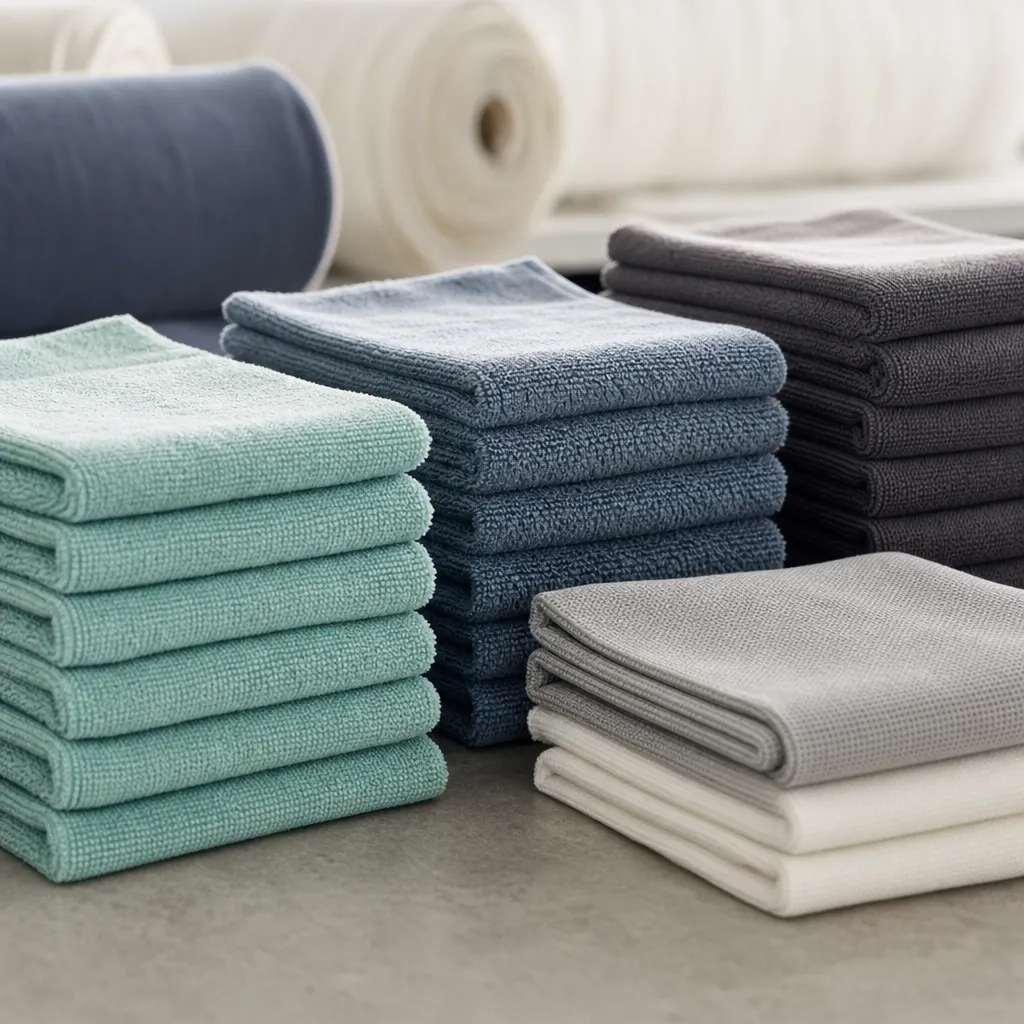
What We Mean By Best Microfiber Cleaning Cloths
In factory terms, the best microfiber cleaning cloths are not the softest sample on the table. They are cloths that keep wiping performance after repeated laundering, do not lint onto glass or stainless steel, and can be produced consistently across bulk lots. For procurement, that means the quote must define yarn blend, denier, split ratio, GSM, size tolerance, edge finish, colorfastness, and packing method.
We produce microfiber programs for retail cleaning kits, janitorial distributors, hotel housekeeping teams, car care brands, and appliance companies. The cloth that works for a hotel mirror trolley is not the same cloth that works for an auto-detailing spray wax kit. A 220 GSM pearl weave may glide well on glass, while a 330 GSM terry microfiber can hold more soil and liquid. If those two cloths are quoted only as "microfiber towel," the buyer will receive random substitutions sooner or later.
| Application | Common size | Recommended GSM | Construction note |
|---|---|---|---|
| Glass, mirrors, appliances | 30 x 30 cm or 40 x 40 cm | 200-260 GSM | Pearl knit or tight flat weave to reduce lint and drag |
| General housekeeping | 30 x 30 cm or 35 x 35 cm | 260-320 GSM | Terry loop microfiber with medium pile |
| Auto interior and dashboard | 40 x 40 cm | 300-360 GSM | Suede or short-pile terry, low silicone residue risk |
| Heavy cleaning and janitorial | 40 x 40 cm or 40 x 60 cm | 350-450 GSM | Higher pile with overlock edge for durability |
| Retail multipack value cloth | 25 x 25 cm or 30 x 30 cm | 180-240 GSM | Cost-controlled knit, usually ultrasonic or overlock edge |
Fiber Split Matters More Than The Hand Feel
Microfiber cleaning performance comes from splitting polyester and polyamide filaments into wedge-shaped segments. A cloth can feel soft and still clean poorly if the splitting is incomplete. In our incoming and in-line checks, we look at fiber opening under magnification and compare absorbency speed after pre-wash. A cloth that beads water for 12 seconds on the surface will frustrate a housekeeping team, even if the sample feels good in a buyer's hand.
Most cleaning cloths use 80/20 polyester-polyamide or 85/15. The 80/20 blend usually has better absorbency and a softer hand because the polyamide content is higher. The 85/15 blend is often chosen for lower-cost retail multipacks where cleaning is light duty. For lint-free microfiber cloths used on glass, the weave structure and finishing are as important as the blend. Loose yarn ends, aggressive brushing, or a dusty cutting room can all create lint complaints.
- 80/20 split microfiber: stronger absorbency, better hand feel, usually USD 0.02-0.06 higher per 30 x 30 cm cloth than 85/15 at the same GSM.
- 85/15 split microfiber: workable for promotional or light household use, but we avoid it for hotel glass carts and premium car care kits.
- 70/30 microfiber: soft and absorbent, but less common for cleaning cloths because cost rises quickly and drying time increases.
- Non-split microfiber: lower cleaning value; we only quote it when the buyer clearly wants a budget dusting cloth, not a performance wipe.
GSM, Size, And Weight: Quote The Cloth, Not Just The Pack
GSM microfiber cloth numbers can look abstract, so we convert them into piece weight before final costing. A 40 x 40 cm cloth at 300 GSM uses about 48 g of fabric before trimming and sewing loss. A 30 x 30 cm cloth at 240 GSM uses about 21.6 g. That difference changes carton weight, air freight cost, shelf pack economics, and the way the cloth feels in use.
For wholesale microfiber cloths, we recommend avoiding very thin cloths below 180 GSM unless the program is disposable-adjacent, such as a short event giveaway. Below that level, the fabric can curl after washing and the edge stitching can feel heavier than the body. On the other side, 500 GSM cloths can be excellent for car drying or polishing, but they are often too bulky for housekeeping and household cleaning sets.
| Spec level | Size and GSM example | Approx. finished piece weight | Use case | Buyer risk |
|---|---|---|---|---|
| Entry retail | 30 x 30 cm, 200 GSM | 18-20 g | Low-price multipack, light dusting | Lower absorbency, more curl after wash |
| Balanced cleaning | 35 x 35 cm, 280 GSM | 34-37 g | Household, hotel room cleaning, janitorial kits | Needs good split fiber to justify the spec |
| Professional terry | 40 x 40 cm, 340 GSM | 54-58 g | Car interior, stainless steel, commercial cleaning | Carton weight and freight must be checked |
| Heavy-duty | 40 x 60 cm, 420 GSM | 101-106 g | Workshop, large surface cleaning, detailing | Can dry slowly if yarn is over-brushed |
Edges, Tags, And The Defects Buyers Actually See
The most common complaint we hear on cleaning cloth programs is not color variation. It is a practical defect: the edge scratches a surface, the tag catches dust, or the cloth leaves a line on glass. For appliance brands and automotive kits, we often recommend ultrasonic cut edges or a soft microfiber binding. Standard polyester overlock is durable and economical, but it can be too raised for delicate finishes.
There is also a production quirk buyers should know: ultrasonic edges work best on stable, lower-pile microfiber. On thick terry microfiber, ultrasonic cutting can seal unevenly or create a stiff ridge. For 320-380 GSM terry cloths, a fine overlock with softened thread is usually safer. If the cloth goes into a glass cleaning kit, we also control loose fiber by adding a pre-shipment air blow and lint inspection step after folding.
- Use ultrasonic edge for glass, screens, and smooth retail cloths when the GSM is usually 180-280.
- Use soft overlock for general cleaning cloths where wash durability matters more than a perfectly flat edge.
- Use microfiber suede binding for premium car care cloths, but allow a higher unit cost and slower sewing output.
- Avoid large woven labels on polishing cloths; heat-transfer care labels or belly bands reduce scratching complaints.
Testing We Trust Before Bulk Shipment
A nice lab dip and a tidy folded sample are not enough. Before bulk approval, we test cleaning cloths for colorfastness, absorbency, dimensional stability, lint, and seam durability. For export buyers, we commonly align documents with OEKO-TEX Standard 100 Class I when skin contact or household use is expected, plus ISO 9001 process records from our quality system. BSCI documentation supports social compliance review for brand clients and retail importers.
For absorbency, we use an internal drop test and compare time-to-absorb before and after one wash. For colorfastness, buyers often request ISO 105-C06 washing and ISO 105-X12 rubbing results. For dimensional change, ISO 6330 washing followed by measurement gives a more reliable picture than a casual sample wash. If a cloth is dark navy, black, or red, we also watch for dye transfer onto white laminate after wet rubbing.
| QC item | Typical method or reference | Our usual acceptance target |
|---|---|---|
| Dimensional change | ISO 6330 wash procedure | Within +/-5% after three home-laundry cycles |
| Colorfastness to washing | ISO 105-C06 | Grade 4 or better for most solid colors |
| Colorfastness to rubbing | ISO 105-X12 wet and dry crocking | Dry grade 4, wet grade 3-4 or better depending on shade |
| Absorbency check | Internal water drop and strip wicking test | Water absorbed in under 5 seconds after pre-wash |
| Lint inspection | Black glass panel wipe and visual check | No visible fiber trail after 10 passes |
Decoration And Branding Without Hurting Performance
Cleaning cloth buyers often want a logo, but the decoration should not ruin the wiping surface. Embroidery creates a raised thread area, so we use it only for gift towels or corner marks. For most microfiber cleaning towels, sublimation, woven label, heat-transfer logo, or printed belly band is cleaner. Sublimation works best on white polyester-rich microfiber, but it changes the hand slightly if the print coverage is heavy.
For private-label multipacks, the most practical branding is often packaging rather than the cloth itself. A four-piece set can use one printed wrap card, a recycled-paper belly band, or a zip pouch with a care icon panel. If the cloth must be color-coded for janitorial use, we recommend yarn-dyed or piece-dyed solids with a small heat-transfer mark. That keeps the wiping face open and avoids a hard logo area.
- Confirm whether the cloth touches glass, paint, screens, stainless steel, or general surfaces.
- Choose decoration away from the main wiping face whenever possible.
- Approve one washed sample, not only the fresh decorated sample.
- Check logo color after ISO 105-C06 washing if the branding is printed onto the cloth.
- Keep care instructions visible: no fabric softener, no bleach, and wash separately from cotton lint sources.
For buyers comparing decoration routes, our article on embroidery vs sublimation vs jacquard gives a useful baseline. For microfiber-specific programs, custom microfiber towels wholesale explains where decoration affects MOQ and sampling time.
Pricing Bands By Volume And Spec
The price difference between a weak cloth and a reliable one can be small on paper and large in use. A 30 x 30 cm, 200 GSM 85/15 cloth may land around USD 0.18-0.26 at 10,000 pieces, while a 35 x 35 cm, 300 GSM 80/20 terry cloth may sit around USD 0.42-0.58 at the same volume. If the lower-cost cloth is replaced after 20 washes and the better cloth lasts 75 washes, the per-use cost changes from roughly USD 0.011 to USD 0.007. That is before counting labor time lost to re-wiping mirrors or customer complaints.
Our MOQ is 500 pcs per design per color, but microfiber cleaning cloth economics improve quickly at carton and dye-lot scale. For custom colors, 2,000-3,000 pcs per shade is usually where dyeing and lab dip cost become easier to absorb. For retail multipacks, buyers should cost the cloth, the insert card, the pouch or wrap, barcode labeling, carton strength, and any retailer carton marks together.
| Order volume | Entry 30 x 30 cm cloth | Professional 35 x 35 cm cloth | Heavy 40 x 40 cm cloth | Notes |
|---|---|---|---|---|
| 500-1,999 pcs | USD 0.28-0.42 | USD 0.55-0.78 | USD 0.88-1.20 | Best for sampling, trial stores, or color testing |
| 2,000-9,999 pcs | USD 0.22-0.34 | USD 0.46-0.64 | USD 0.74-1.02 | Custom color and simple packaging become practical |
| 10,000-49,999 pcs | USD 0.18-0.29 | USD 0.40-0.56 | USD 0.66-0.90 | Most stable range for wholesale microfiber cloths |
| 50,000+ pcs | USD 0.15-0.24 | USD 0.35-0.50 | USD 0.58-0.82 | Best for retail chains and annual replenishment programs |
Timeline From Lab Dip To Carton Close
A realistic timeline prevents rushed finishing, which is where lint, shade, and edge problems often appear. For an existing cloth and existing color, we can usually prepare samples in 5-7 days. A custom color lab dip normally needs 4-6 days, and a decorated pre-production sample takes another 6-10 days depending on logo method and packaging.
Bulk production for microfiber cloths usually runs 18-28 days after sample approval and deposit. Add 3-5 days for final inspection, carton marking, and export documentation. Sea freight depends on destination, but many North America and Europe programs plan 25-38 days on water plus local customs and trucking. Air freight is possible for urgent launches, though dense microfiber cartons can make air cost uncomfortable.
- Day 1-3: confirm size, GSM, blend, edge, color, packaging, and testing requirements.
- Day 4-10: lab dip, available fabric sample, or custom sample preparation.
- Day 11-16: buyer review, wash test, and adjustments to edge or logo placement.
- Day 17-45: bulk knitting, dyeing, finishing, cutting, sewing, inspection, and packing.
- Day 46+: vessel booking, export customs, ocean or air shipment, and destination delivery.
How To Build A Spec We Can Quote Cleanly
A clean RFQ saves several rounds of correction. Instead of asking for the best microfiber cleaning cloths in one line, send the intended surface, cloth size, GSM target, blend, edge type, color count, pack style, test requirements, and annual volume. If you have a current cloth, send the weight per piece and a close photo of the edge. We can reverse-estimate GSM from size and weight, then advise where the construction can be improved.
For retail buyers, we also need the shelf pack dimensions and barcode placement. For janitorial distributors, color coding and carton count matter more. For hotel or serviced-apartment programs, we check whether the laundry uses bleach, high heat, or fabric softener, because microfiber performs badly when washed with softener or mixed with cotton lint. Buyers serving car care should also review our auto-detailing microfiber towel program, because paint-sensitive cloths need tighter edge and lint controls than general cleaning cloths.
- Target surface: glass, screen, paint, stainless steel, tile, laminate, or general dusting.
- Finished size and tolerance: for example, 35 x 35 cm with +/-1 cm tolerance.
- Fabric: 80/20 split microfiber, 280-320 GSM, terry loop or pearl knit.
- Edge: ultrasonic, fine overlock, suede binding, or buyer-approved alternative.
- Compliance: OEKO-TEX Standard 100 Class I, BSCI facility record, ISO 9001 quality system documentation.
- Packing: loose bulk, 2-pack, 4-pack, belly band, pouch, carton quantity, and shipping marks.
Related reads: use microfiber vs cotton towel comparison when deciding whether microfiber is right for the end user, and towel GSM decision framework when your team is stuck between several weights. For quote preparation, build a towel tech pack that mills can quote is the checklist we wish more buyers used before sampling.
Where Cheap Cloths Usually Fail
The failure pattern is predictable. The first sample looks acceptable, the first retail photos look fine, then complaints arrive after the cloth is washed. Edges twist, dark colors bleed slightly, the surface loses absorbency because finishing oil was not removed, or lint appears because the cutting and packing area was not controlled. These are not dramatic defects, but they make a cleaning product feel unreliable.
We push back when the requested price leaves no room for split-fiber quality or finishing control. For example, reducing a 35 x 35 cm cloth from 300 GSM to 220 GSM might save about USD 0.09-0.13 per piece at 20,000 pcs. If the user needs two cloths to clean the same hotel bathroom mirror because the thin cloth saturates quickly, the saving disappears in labor. For a housekeeping team cleaning 90 rooms a day, even 20 seconds of extra wiping per room becomes 30 minutes of paid time daily.
That is why we prefer to define the use case first and the price second. A value cloth has a place, especially in retail promo packs. But for commercial cleaning, hospitality, appliance care, and car kits, the lowest quote often moves cost from the product line into complaints, returns, or labor.
Build A Microfiber Cloth Spec That Holds Up
Send us your target size, GSM, surface use, color count, pack style, and annual volume. We will quote against MOQ 500 pcs per design per color, with practical options for OEKO-TEX, BSCI, ISO 9001 documentation, and bulk production in about 18-28 days after approval. WhatsApp +86 13205717266 or email [email protected].
Request a Quote →