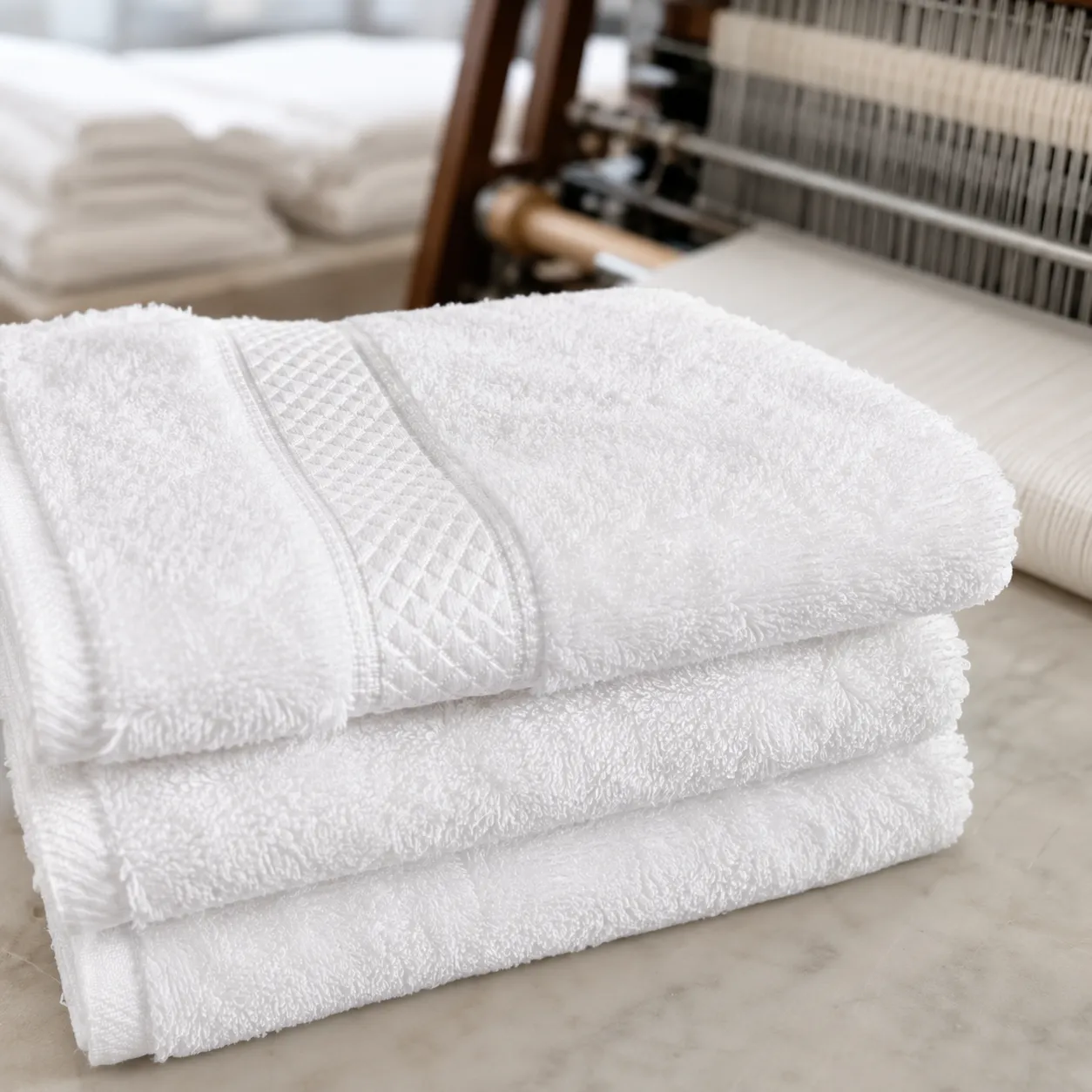
Start With the Failure Modes, Not the Marketing Sheet
For luxury bath towels, inspection should be built around what actually fails in use: loop pull-out, skew after laundering, shade drift between lots, low initial absorbency caused by finishing residue, and border shrinkage that makes the towel rack presentation look cheap even when the cotton price was high. We usually see these issues show up on dense terry constructions from 580-720 GSM, especially when the buyer asks for a plush surface and a decorative border on the same item.
In practical terms, a good incoming and pre-shipment protocol separates appearance defects from performance defects. Appearance can be screened on the table under D65-equivalent lighting. Performance needs named methods: mass per unit area under ISO 3801, dimensional change after laundering under ISO 6330, water absorption by sink-time or drop test as a quick screen, and colorfastness to washing or rubbing under ISO 105 series. If the numbers do not tie back to a method, buyers cannot compare mills on equal ground.
- Reject any QC sheet that says only soft, thick, absorbent without a test method or tolerance
- Ask whether the towel is ring spun, combed ring spun, zero-twist, or low-twist with binder yarn because defect risk changes by construction
- Separate lab test pass from visual acceptability; a towel can pass wash fastness and still look wrong on shelf
What We Inspect First in a Best Luxury Bath Towels QC Inspection Guide
We do not begin with GSM. We begin with construction identity. A buyer approval sample and a bulk lot must match on pile type, ground yarn count, border structure, and finishing route. Two bath towels can both be called 650 GSM Egyptian-style towels in a quote sheet, yet one may be a 16s/1 pile with a 32/2 ground and the other a softer but less stable low-twist face that blooms early and loses body after several hotel washes.
| Inspection point | Why it matters | Typical control |
|---|---|---|
| Pile yarn type | Affects softness, linting and loop security | Match approved construction card and bulk swatch |
| Border width and density | Uneven borders create puckering after wash | Tolerance usually within +/-4 mm by piece |
| Cut edge and hem sewing | Poor stitch balance leads to seam grin or torque | SPI and thread tension checked against golden sample |
| Shade continuity | Luxury programs fail visually before they fail technically | Compare under light box across carton picks |
One specific quirk worth checking on luxury styles is the transition from pile field to dobby border. If the take-up tension is not balanced at the loom, the border area tightens more than the body. The towel may measure correctly before wash but neck inward after laundering. We flag this early by measuring width at three points before and after wash, not only overall finished size.
Set Auditable Benchmarks Before Bulk Starts
For a brand-side team, the cleanest approach is to define pass ranges before yarn booking. For luxury bath towels, we commonly see approved specs around 600-700 GSM, finished size 70 x 140 cm or 76 x 142 cm, and piece weight bands tied to actual area rather than sales copy. A 72 x 142 cm towel at 640 GSM should calculate to about 655 g before commercial tolerance; if the delivered average is 618 g, that is not a rounding issue but a spec miss.
| Test or check | Standard / method context | Working acceptance band |
|---|---|---|
| GSM / mass per unit area | ISO 3801 on conditioned sample | Within +/-5% of approved spec |
| Dimensional change after wash | ISO 6330 domestic laundering | Length and width each within 5% unless agreed tighter |
| Colorfastness to washing | ISO 105-C06 | Minimum grade 4 for shade change, 3-4 staining depending on shade |
| Colorfastness to rubbing | ISO 105-X12 | Dry 4 min, wet 3-4 min |
| pH of aqueous extract | Common OEKO-TEX aligned chemical safety control | Typically 4.0-7.5 |
| Absorbency screen | Internal sink-time method after prewash | Face wet-out within 6-10 seconds by construction |
The benchmark needs context from end use. Hotel and spa programs often wash with alkali, heat, and higher extraction force, so a home-textile test is only the starting line. We normally add three internal laundering cycles before final handfeel review on hospitality styles because silicone-rich finishing can hide a dry or harsh base fabric at first touch.
GSM Alone Does Not Predict a Luxury Result
Buyers still get trapped by the assumption that heavier means better. In inspection, we routinely see a 610 GSM combed ring-spun towel outperform a 690 GSM low-grade dense towel because the lighter piece opens faster, absorbs sooner, and keeps cleaner borders after wash. The heavier one may feel impressive in the carton but lose face after tumble drying due to compact pile and weak loop definition.
For that reason, we record three related observations together: actual GSM, bulk thickness after conditioning, and wet pick-up behavior. If one number rises and the other two do not, the towel may be carrying weight in finishing chemistry or an overbuilt ground rather than useful pile volume. Buyers who need help reading that trade-off usually benefit from our earlier notes on towel GSM decisions and combed vs zero-twist cotton.
- A very dense ground can raise weight while reducing bloom and early absorbency
- Low-twist constructions feel fuller, but they need better loop anchoring and gentler laundering control
- If the towel is for a hotel program, ask for washed sample weight after three cycles, not only ex-factory weight
The Defects That Matter Most on Table Inspection
Luxury bath towels fail visually in consistent ways. The common ones are barre from inconsistent yarn lots, reed marks that interrupt the pile surface, high-low patches where loop height varies, oil soil near the header, and repair knots visible on face. We also watch for side-to-side shade drift after shearing or uneven softener application. On white towels, fluorescent brightener imbalance can make pieces from the same PO look mismatched under cool hotel bathroom lighting.
Another issue specific to plush terry is loop snag sensitivity near fold lines. If compression packing is too hard, the fold memory highlights weak loops at unpacking. We inspect both fresh-opened pieces and pieces that have rested flat for a few hours. That simple step helps distinguish true construction weakness from packing distortion.
| Visual defect | Likely process origin | Buyer impact |
|---|---|---|
| Barre / lane variation | Yarn lot inconsistency or dye variation | Shelf mismatch across retail or hotel room sets |
| Loop missing bands | Loom stop marks or tension fluctuation | Patchy face and lower perceived quality |
| Border puckering | Differential shrinkage between pile body and border | Poor hanger presentation, customer complaints |
| Uneven hemming | Sewing tension or feeding issue | Twist after wash and short usable life |
- Open cartons from top, middle and bottom of the lot, not only front-row cartons
- View pieces under neutral white lighting and again under warmer indoor light
- Check the towel folded, fully opened, and hung from the short side
- Rub the border seam lightly to see whether loose thread ends start emerging
Wash Testing: Where Luxury Claims Usually Break
A towel that passes table inspection can still fail the customer after the first laundering. We recommend a wash panel using ISO 6330 as the baseline method, then adapting detergent dose and drying route to the buyer's real program. For hotel projects, we often simulate a hotter wash and stronger tumble cycle than typical household use. The goal is not to be harsh for the sake of it; the goal is to expose border torque, seam grin, lint release, and handfeel collapse before the PO is fully consumed.
In one recent 650 GSM bath sheet program, the issue was not shrinkage but lint release concentrated at the cut hem after cycle two. The root cause was a trimming setting that left unstable pile ends near the seam turn-under. That type of defect will not be visible in a one-piece showroom sample. It appears only when bulk finishing and sewing are running at production speed.
- Record before and after size at three body positions, not a single center measurement
- Weigh lint captured from the dryer screen during trial cycles if the buyer is comparing two constructions
- Rate handfeel after wash only after the towel has fully conditioned; warm towels feel softer than they are
- Review shade after wash against retained approval sample under the same light source
Related reads: For teams building a broader hotel program, see hotel towel sourcing guide, hotel towel suppliers, and setting up a linen rollout.
Sampling Size, AQL, and the Reality of Bulk Decisions
The phrase best luxury bath towels QC inspection guide should not lead buyers to overcomplicate the sampling plan. For visual and workmanship issues, we usually work off ANSI/ASQ Z1.4 style thinking for lot sampling, then tighten internal rules for critical appearance points on luxury goods. AQL is useful, but only if you define which defects are critical, major, and minor before the inspector opens cartons.
We normally class fiber contamination, broken seam, severe oil staining, or shipment shade mismatch as major failures for this category. A single tiny repair knot hidden in the pile might be minor. A repeated bowing problem across multiple cartons is major because it affects the whole lot. This is where experienced inspection teams add value: the count alone does not tell the commercial story.
| Lot size | Typical sample pull | What to prioritize |
|---|---|---|
| 500-1,200 pcs | 50-80 pcs | Construction match, size, shade, sewing |
| 1,201-5,000 pcs | 80-125 pcs | Add wash panel and carton distribution checks |
| 5,001-12,000 pcs | 125-200 pcs | Increase cross-carton shade review and packing accuracy |
If the order includes multiple white levels, retail banding, or embroidered identifiers, sampling should split by SKU rather than pooling everything together. Decoration and packout errors tend to hide inside otherwise acceptable terry lots. For branded projects, our decoration team often aligns this with the approval discipline used in monogrammed bath towel programs and tech pack setup.
Price Bands and What QC Level They Usually Support
Inspection intensity has a cost, but weak control costs more. On current 2026 FOB China pricing for plain dyed luxury bath towels, a 70 x 140 cm combed cotton style at 620-660 GSM usually lands around USD 4.10-5.35 per piece at 500-1,000 pcs, depending on yarn market, color depth, and border complexity. At 3,000-5,000 pcs, the same family often sits around USD 3.55-4.72. A heavier 100 x 150 cm bath sheet at 650-720 GSM can reach USD 7.20-9.60 at modest volume.
What buyers should notice is how little the inspection cost changes relative to product risk. Adding lot-based wash checks, light-box shade review, and retained sample control may add only a few cents per piece spread across the order, but it protects against room-level mismatch claims or retail returns. We push back when someone wants a luxury handfeel target with a stripped-down QC scope; those two decisions conflict.
| Order profile | Indicative FOB USD/pc | QC scope that makes sense |
|---|---|---|
| 500 pcs, 620 GSM, 70 x 140 cm | 4.10-5.35 | Inline sewing checks, final visual inspection, one wash panel |
| 2,000 pcs, 650 GSM, 76 x 142 cm | 3.78-4.98 | Add shade continuity review across cartons and absorbency screen |
| 5,000 pcs, 680 GSM, bath sheet | 6.65-8.40 | Full bulk wash benchmark, retained standard, stronger AQL discipline |
Lead Times: When the Risk Enters the Calendar
The calendar affects quality more than buyers expect. For a new luxury bath towel program, lab dips usually need 3-5 days, yarn prep and loom scheduling another 6-9 days, weaving 12-18 days depending on volume, dyeing and finishing 6-8 days, sewing and packing 4-6 days, then inspection and rework buffer 3-5 days. In total, a realistic first bulk run is often 30-43 days after sample signoff. Repeat orders can compress if the yarn and dye recipe are stable.
The mistake is collapsing the back end. If you leave no time for wash retest or carton rework, the factory is forced to ship with unresolved border or shade issues. For freight planning, container vs air freight matters less than giving QC enough room to act on findings before booking cutoff.
- Reserve 3-5 days after final inspection for corrective action on sewing or repacking
- Do not schedule shade approval from phone photos; use retained swatch control
- If yarn is newly sourced, add time for test confirmation before mass dyeing
The Short Buyer Checklist We Actually Use
If your team needs a working version of a best luxury bath towels QC inspection guide, keep it short enough that it gets followed. One page is better than a 20-line document nobody uses on the floor. We suggest fixing the construction card first, then agreeing the wash method, then setting visual defect severity with photos from the approval sample.
- Lock construction details: size, GSM, yarn type, border structure, hem spec, approved shade
- Name the test methods in the PO or tech pack: ISO 3801, ISO 6330, ISO 105-C06, ISO 105-X12
- Retain two sealed approval samples: one at buyer side, one at mill side
- Inspect bulk across carton positions and across production dates if the lot is split
- Release shipment only after wash panel and visual grading both pass
Related reads: Buyers comparing raw material and performance trade-offs can also review microfiber vs cotton towel comparison, how to read an OEKO-TEX certificate, and products for hotel programs.
Need a QC-ready luxury bath towel quote
Send the target size, GSM, yarn preference, wash standard, and packout plan. We can quote against an inspection-ready spec, not a vague softness brief. MOQ is 500 pcs per design per color. Contact us at [email protected] or WhatsApp +86 13205717266.
Request Quote →