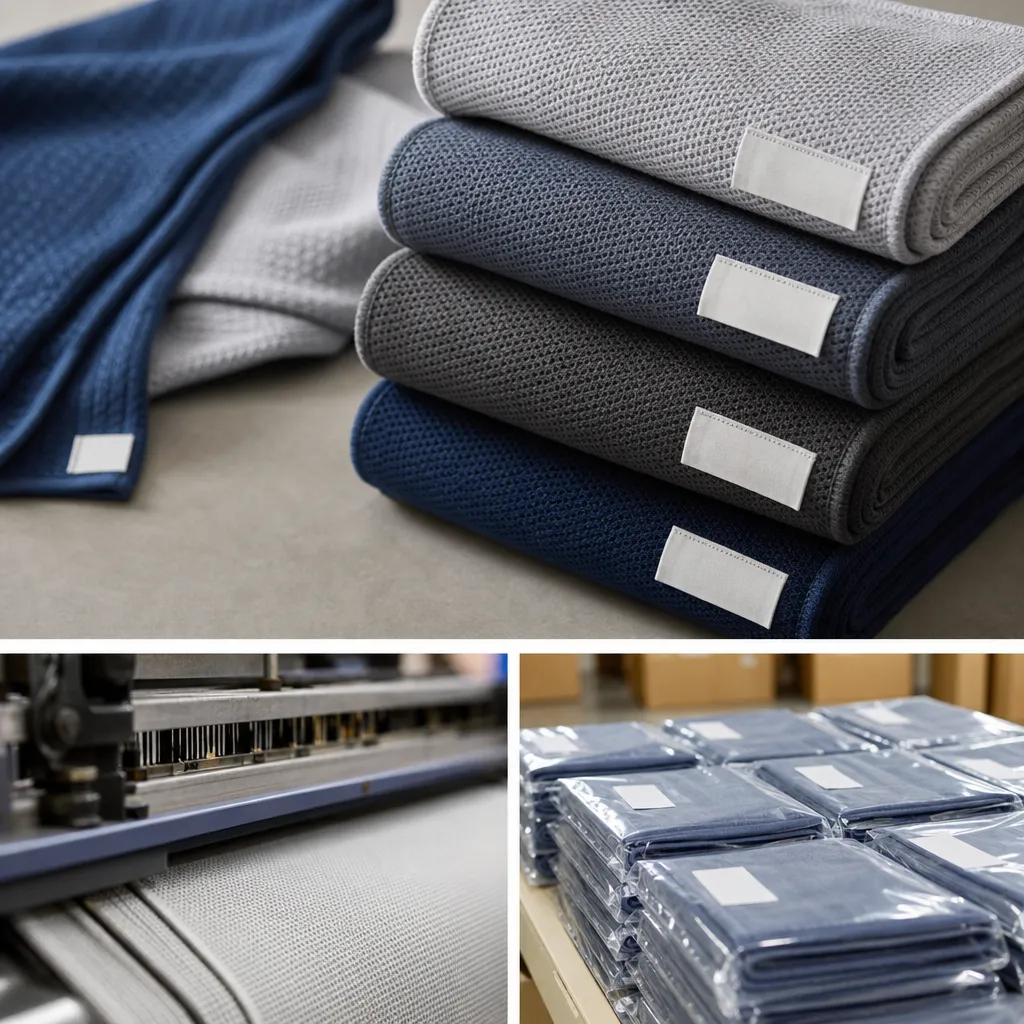
Map the inspection to the actual construction first
Before anyone counts defects, we pin down what kind of item is being inspected. Most microfiber beach towels in this category are either printed suede microfiber with a terry back, usually 250-320 GSM overall, or full microfiber terry around 280-360 GSM. Those two builds fail differently. Suede-face printed towels are more likely to show ghosting, panel shade variation, and heat-press skew. Full terry microfiber is more likely to show loop crush, streaky shearing, or inconsistent handfeel across lots.
That distinction matters because some checkpoints are our internal factory controls, while others are buyer-facing acceptance points. For example, we usually hold print panel alignment tighter than the final shipment tolerance during inline control, because once hemming starts there is less room to recover. By contrast, carton count accuracy and barcode placement are buyer standards tied to your warehouse system, not textile-industry norms.
- Our common internal inline control for cut-panel squareness is within 1.2 cm before hemming on 160×80 cm blanks.
- A typical buyer acceptance tolerance for finished size is ±3 percent unless the tech pack states a fixed centimeter tolerance.
- For printed placement on borderless artwork, buyers usually care more about visible image drift at the edge than about center-point math.
What should be checked before bulk sewing starts
The highest-value inspection point is not final random inspection. It is pre-production approval on the first heat-transfer or first print strike. On beach towels, a surprising number of shipment disputes come from approving a digital mockup and skipping a physical strike-off on the real base fabric. Microfiber reflects color differently from cotton, especially on saturated turquoise, coral, and deep black grounds.
For sublimated or transfer-printed programs, we check three things on the strike-off: whether dark fills are fully penetrated without chalky haze, whether fine lines stay closed after brushing, and whether the face remains smooth after the press cycle. The second point is specific to this product: a 0.6 mm white line in artwork can visually disappear if the nap direction is disturbed during finishing.
| Pre-bulk checkpoint | Why it matters on microfiber beach towels | Common sign-off basis |
|---|---|---|
| Print strike-off on actual base cloth | Confirms color on synthetic face, not just on paper proof | Buyer approved physical swatch |
| Hem construction sample | Shows corner bulk and edge waving risk after wash | Sealed sample or counter sample |
| Absorbency trial after printing | Printed face can feel dry but still fail pickup expectations | Internal comparison against approved sample |
| Pack-out mock carton | Checks fold marks, insert fit, barcode position | Buyer carton layout or warehouse SOP |
Inline inspection catches the defects final QC cannot fix
A good microfiber beach towel QC inspection guide puts most attention on the line, not only at the end. Once the towel is printed, cut, hemmed, brushed, folded, and packed, many issues become expensive to rework. We split inline inspection into four stations: greige or incoming fabric check, print check, sewing check, and finishing check.
At print check, we compare repeat panels under D65 light where possible and also under warm indoor light because beach graphics with large sky or sand areas can shift more visibly in hotel or retail environments than in the lab booth. For sewing, the recurring failure is edge tunneling: the hem looks straight on the table, but after the towel relaxes, one long side ripples because feed ratio and panel tension were not balanced.
- Check roll or panel shade continuity before loading the print batch, especially for reorder lots mixed from different knitting dates.
- Approve the first 20-30 printed pieces against the strike-off for edge clarity, face smoothness, and transfer paper offset marks.
- Measure hem width and corner buildup during the first sewing hour; thick corners on microfiber can create skew after folding.
- Review brushed or finished handfeel at mid-run, because over-brushing can mute print sharpness on the face.
The defect list that matters most on printed beach towels
Not every defect deserves the same weight. On this category, buyers usually notice visual defects before they notice absorbency numbers. We therefore rank defects by customer visibility first, then by functional risk. That is different from institutional bath towel inspection, where seam security and size consistency often lead.
| Defect mode | Where it appears | How we classify it in practice |
|---|---|---|
| Ghosting or double image | Printed face, especially around logos and lettering | Major if visible at arm's length |
| Heat press crease mark | Large solid background fields | Major on retail or branded resort orders |
| Edge waving after hemming | Long sides after folding open | Major when persistent on flat table |
| Uneven pile or slick patches | Back side or full-terry surface | Minor to major depending on area |
| Loose trimming threads at corner | Hem finish | Minor unless snagging opens seam |
| Panel skew | Artwork sits twisted to towel shape | Major if beyond spec tolerance |
Two product-specific faults deserve extra attention. First is transfer shadow at the fold line, which happens when stacked printed panels retain a faint pressure mark before final setting. Second is reverse-side grin-through on certain suede-plus-terry constructions, where a dark face print visually contaminates a white terry back at stitch lines. Neither issue shows up in a generic cotton towel checklist.
How we test absorbency without pretending it is a lab-only decision
Absorbency on microfiber beach towels is tricky because buyers often want two things at once: a vivid printed face and real drying performance. Those goals can conflict. A heavily compacted suede face feels smooth and photographs well, but pickup often relies more on the back side or on the overall construction than on the printed face itself.
If the program requires formal testing, we can reference buyer-requested methods or third-party lab protocols. For internal release, we usually combine a simple water pickup comparison with wash recovery checks after one laundering cycle. That is our own production control, not an industry regulation. If a buyer wants a named benchmark, we normally align the wash procedure with ISO 6330 for domestic laundering conditions and use colorfastness methods such as ISO 105-C06 where print durability is in scope.
- Ask whether the towel is expected to dry skin, lounge chairs, or both; the use case changes the acceptable handfeel.
- Do not sign off absorbency from an unwashed sample only, because finishing chemicals can temporarily affect pickup.
- On 300-gram class beach towels, a small gain in print sharpness can mean a noticeable drop in first-touch absorbency.
AQL, measurements, and what those numbers mean
Buyers regularly ask for 'standard inspection,' but that phrase is vague. We recommend stating the sampling level and AQL in the PO or tech pack. For many branded towel orders, a common framework is ANSI/ASQ Z1.4 single sampling, General Inspection Level II, with AQL 2.5 for major defects and 4.0 for minor defects. That is a buyer acceptance convention, not a microfiber-specific law.
Measurements should be linked to product use. A 90×170 cm promotional beach towel at 260-280 GSM can tolerate a bit more visual movement than a tightly framed art towel with full-bleed borders. For bulk production, we usually see realistic finished size tolerances in the range of ±2.5 cm to ±4.0 cm depending on the base fabric elasticity and the print/heat process.
| Spec point | Typical buyer range | Notes |
|---|---|---|
| Finished size | 75×150 cm to 100×180 cm | Larger formats need stricter panel control during heat process |
| Overall GSM | 250-360 GSM | Suede-face printed styles often sit at the lower end |
| Major defect AQL | 2.5 | Common buyer standard for final random inspection |
| Minor defect AQL | 4.0 | Often used with General Level II |
| MOQ | 500 pcs per design per color | Our standard MOQ for custom production |
Related reads: if your team is still locking the base construction, see microfiber vs cotton towel comparison, towel GSM decision framework, and build towel tech pack that mills can quote.
Packaging mistakes still cause avoidable claims
After textile inspection passes, packing can still create claims that look like fabric faults. Beach towels with large printed faces are sensitive to fold pressure. If the fold stack is too tight, you can open cartons weeks later and see pressure lines across dark color blocks. That is not a print failure in the strict sense, but the customer experiences it as one.
We usually review fold direction, polybag thickness if used, carton humidity exposure, and barcode placement against the buyer's intake process. For club, resort, and retail programs, outer carton markings also need to match the shipping label logic used by the receiving warehouse. Again, that is not an industry textile standard; it is a logistics control point.
- Avoid over-compressing towels with heavy dark-face prints in export cartons above roughly 14-16 kg net weight.
- If inserts are required, confirm they do not emboss the face during long transit.
- State whether assortment is solid-color carton pack, ratio pack, or one-design-per-carton before production starts.
| Pack-out item | Common buyer requirement | Inspection focus |
|---|---|---|
| Individual fold | Logo facing out or artwork centered | Consistency and crease risk |
| Barcode label | Specific side placement | Scan visibility after palletizing |
| Inner bag | Optional or mandatory | Seal quality and suffocation warning text if required |
| Outer carton marks | PO, style, color, quantity | Warehouse receiving accuracy |
Price bands and timing for inspection-heavy orders
Inspection requirements change cost, though not as much as buyers often assume. The larger cost driver is usually the towel construction and print method, then whether rework risk has been reduced early enough. For a custom microfiber beach towel program around 80×160 cm, printed, hemmed, and export packed, workable FOB China pricing often falls in these ranges: about USD 2.05-2.45 at 1,000 pieces, USD 1.72-2.08 at 3,000 pieces, and USD 1.48-1.88 at 10,000 pieces, depending on GSM, print coverage, back construction, and packaging.
Third-party final inspection, if requested by the buyer, is normally a separate service cost. The practical point is that better inline control is cheaper than late sorting. A rework on 3,000 pieces because of panel skew can add several days and eat more margin than the inspection program ever cost.
- Artwork and spec review: 1-3 days
- Lab dip or print strike-off approval: 4-7 days
- Pre-production sample if needed: 5-8 days
- Bulk production for 3,000-8,000 pcs: 18-28 days
- Final inspection and booking handoff: 2-4 days
What we ask buyers to put in the PO
The cleanest inspections happen when the PO tells us what standard we are inspecting against. Without that, teams improvise. For this category, the useful fields are not complicated, but they need to be explicit.
- Base construction: suede microfiber face with terry back, or full microfiber terry
- Finished size and tolerance in cm, not only in inches
- Target GSM tolerance and whether it applies before or after washing
- Artwork approval basis: digital proof only, strike-off, or sealed sample
- Inspection method: internal standard, third-party AQL, or buyer's own protocol
- Packing details down to fold method, barcode side, and carton assortment
Related reads: for packaging and shipment planning, see container vs air freight towel orders and beach club resort towel program. If the artwork itself is the risk, pantone color matching custom towels helps prevent avoidable approval loops.
A workable buyer checklist for final release
If we reduce the whole microfiber beach towel QC inspection guide to one release routine, it is this: confirm the approved reference, inspect against the right defect priorities, test the visible print issues early, and keep packaging from creating new defects after sewing is done. The strongest program is the one where the buyer, the mill, and the inspector are all reading the same tolerances and the same sample standard.
- Match bulk pieces to the sealed sample or approved strike-off before counting defects.
- Measure size, weight, and print placement on a meaningful sample set, not only one piece per carton.
- Open folded goods fully to check edge waving, ghosting, and pressure marks on dark panels.
- Verify carton assortment, barcode logic, and shipping marks against the PO.
- Release only after any rework lot is reinspected as a separate batch.
Need a microfiber beach towel spec reviewed
Send us your artwork, size, GSM target, and packing plan. We can mark the inspection points that should be controlled at strike-off, inline, and final random inspection. MOQ is 500 pcs per design per color. Contact us on WhatsApp at +86 13205717266 or email [email protected].
Request a quote →