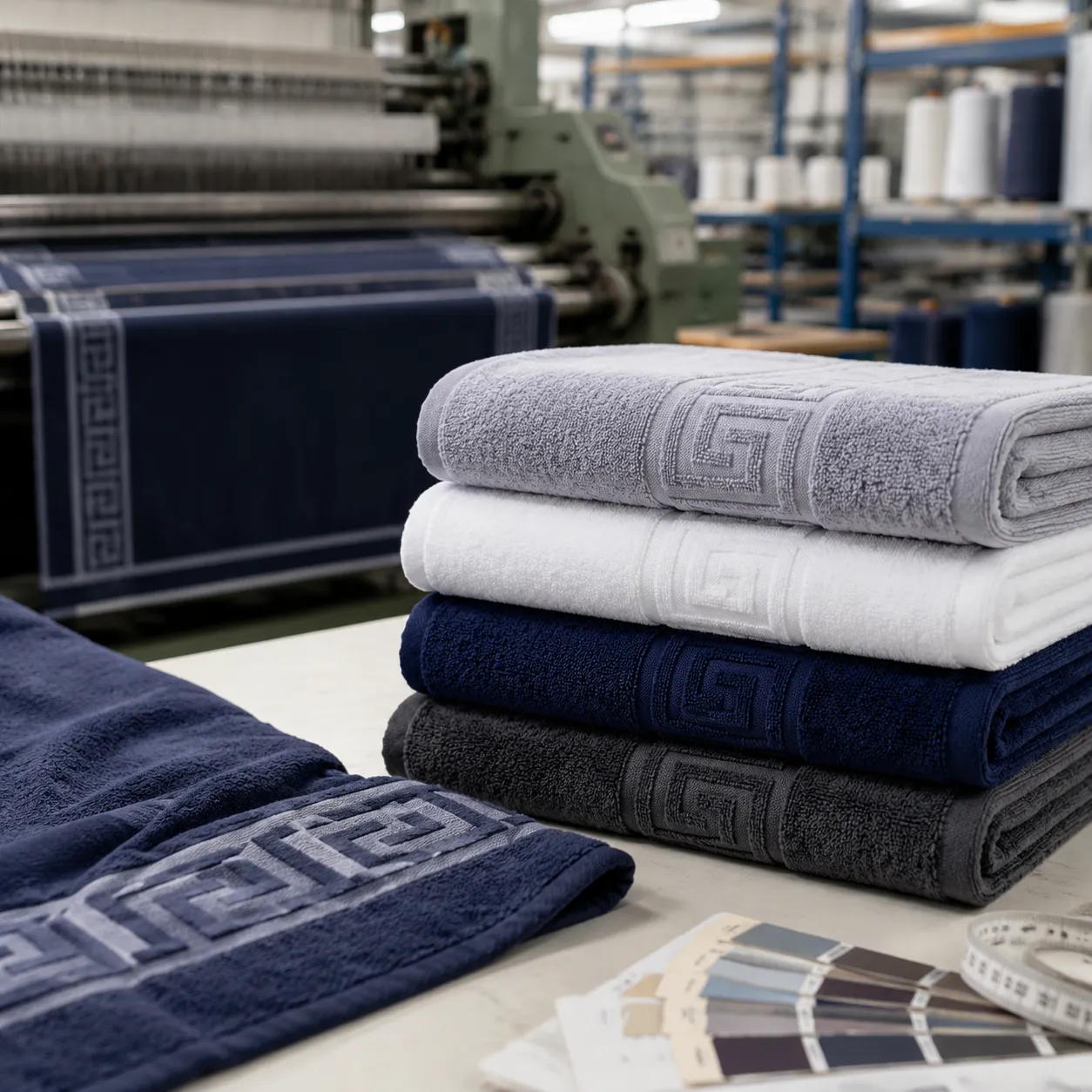
What we verify before we trust a jacquard mill
A jacquard factory audit is different from a standard towel audit because the decoration is built into the structure, not added later. We want to see how the mill controls warp selection, loom setup, and pattern repeat before we discuss color or packing. If a supplier cannot explain how they maintain edge definition on a 2-color woven logo, we stop there.
For this product class, the first questions are practical: how many jacquard looms are actually available, what repeat width they can run, and how much downtime they see on pattern changeovers. A mill that makes plain terry well may still struggle with a woven logo field if its draw-in loss is high or its pattern card process is weak.
- Ask for live loom counts, not just total machine photos.
- Confirm whether the mill can run jacquard on terry, velour, or flat weave constructions.
- Check if sample approval is done on the same loom type used in bulk.
- Ask how the factory controls logo distortion at the towel border and hem.
| Audit item | What we expect to see | Red flag |
|---|---|---|
| Jacquard loom capacity | Clear count of looms assigned to logo towels | Only general factory photos, no machine allocation |
| Pattern control | Stored repeat cards and version control | Changes made by hand without record |
| Tension setup | Documented warp tension and take-up settings | Operator 'memory' as the main process control |
| Pre-production sample | Bulk-matched sample from production loom | Handmade sample from a different machine |
Jacquard logo towel factory audit checklist: the core room checks
When we walk the production floor, we start where the woven structure is formed. That means yarn prep, loom setup, pattern definition, and in-line inspection. The logo may be small, but the process behind it is not.
This is where we look for specific failure modes that do not show up in a standard bath towel audit. The most common are broken pattern edges, float inconsistency, pile height mismatch between logo and field, and a towel that bows after finishing because the warp tension was off. A buyer can miss all of that if the factory only shows one perfect showroom sample.
| Checkpoint | What to inspect | Why it matters |
|---|---|---|
| Yarn lot segregation | Separate lot cards for face, ground, and border yarns | Mixed lots can shift shade and handfeel |
| Warp and weft setup | Pattern card, draft sheet, and beam record | Controls logo repeat accuracy |
| Loom trial run | Start-up waste, first 20 pieces, and operator notes | Shows whether the mill stabilizes quickly |
| Finishing line | Compaction, shearing, and washing sequence | Affects logo crispness and towel dimension |
| In-line QC | AQL or internal point check at fixed intervals | Catches drift before a full batch is lost |
- Measure logo edge clarity on at least three towels from the same run.
- Check whether terry loops stay even at the boundary of the woven logo.
- Inspect hem stitching and side borders after a wash simulation.
- Verify that the factory tracks first-off, middle-run, and end-run output separately.
If the supplier cannot show you the same jacquard repeat on the floor that they showed in the sample room, you are not auditing a factory; you are auditing a prototype.
How the weaving structure changes the audit
A jacquard logo towel is not just a towel with a pattern. The fabric structure itself changes the inspection logic. We separate the audit into three possibilities: terry jacquard, velour jacquard, and flat-weave logo towels. Each one fails differently.
On terry jacquard, loop formation is the first risk because the pattern can pull loops too tight and leave thin areas. On velour, the cut surface can blur the logo if the shearing knife or brushing stage is inconsistent. On flat weave, the risk is less about pile and more about registration, skew, and border stability.
| Construction | Main defect mode | What to ask the mill |
|---|---|---|
| Terry jacquard | Loop height breaks at logo edges | How do you balance pile tension across the repeat? |
| Velour jacquard | Blurred or fuzzy logo after shearing | How many passes do you use before final shearing? |
| Flat-weave logo towel | Skewed repeat or border curl | How do you control take-up and edge tension? |
| Woven stripe/logo hybrid | Pattern misalignment between zones | Is one operator or one loom group assigned to the full run? |
The details here are why we do not group this product with generic promo towels. The audit needs to confirm the machine path, not just the final appearance. If the mill is used to woven golf towels or decorative hospitality pieces, that experience helps, but we still verify repeat stability with the exact construction being ordered.
Jacquard logo towel factory audit checklist for QC and lab control
A proper audit includes both floor control and lab control. For logo towels, the lab is not only about colorfastness. It is also where we confirm shrinkage, dimensional stability, and whether the woven pattern distorts after washing. We ask for the test method, the sample condition, and the pass/fail criteria in writing.
We prefer mills that can show a documented wash cycle such as ISO 6330 or an agreed internal laundry simulation, plus dimensional checks before and after drying. For woven logo products, that is often more useful than a generic visual approval. We also check whether the mill runs shade control under a standard light source, ideally with a light box and a traceable batch sheet.
| Test or control | Target / method | Audit note |
|---|---|---|
| Wash durability | ISO 6330-style cycle or defined internal equivalent | Ask for before/after photos and measurement sheet |
| Dimensional stability | Shrinkage recorded in warp and weft directions | Logo can skew if shrinkage is uneven |
| Color control | Light box comparison against approved master | Useful on border and logo yarns |
| Fiber compliance | OEKO-TEX Standard 100 Class I certificate | Verify certificate number and scope |
- Ask for lab records on the same yarn lots used for the bulk order.
- Confirm the mill can trace complaints back to beam, loom, and finishing date.
- Inspect whether inspection AQL differs for decorative and plain zones.
- Check if the factory has an internal hold area for suspect lots.
For compliance, we still want the basics in place: OEKO-TEX Standard 100 Class I for skin contact, BSCI for social compliance, and ISO 9001 for process discipline. Those certificates do not prove weave quality on their own, but they tell us whether the factory has a system worth auditing. If you want a broader certificate reading method, see how to read oeko tex certificate.
Capacity, MOQ, and cost signals that tell you if the mill is real
A mill can pass the visual audit and still be a bad sourcing fit if its economics are wrong for your lane. We ask for minimum order quantity, sample lead time, bulk lead time, and the price break at two or three volume bands. The numbers should be specific, not vague.
For jacquard logo towels, a realistic MOQ is often 500 pcs per design or per color if the mill already has the right loom setup. If the pattern is more complex or the towel size is large, the factory may prefer 800 to 1,200 pcs to avoid waste on beam changeovers. That is not a negotiation failure; it is a production reality.
| Volume band | Typical FOB China range | What drives the price |
|---|---|---|
| 500-999 pcs | USD 3.10-4.40 per piece | Pattern complexity, yarn count, finishing loss |
| 1,000-2,999 pcs | USD 2.65-3.85 per piece | Better loom efficiency and lower setup cost per piece |
| 3,000+ pcs | USD 2.30-3.40 per piece | Stable repeat production and lower waste ratio |
Those figures move with towel size, loop density, border style, and whether embroidery is added after weaving. If a buyer asks for a very low landed price, we usually push back with a cost-per-use view. A towel that saves twenty cents at purchase but loses shape after a short run through laundry is not a saving. It is a replacement cycle.
- Ask whether setup waste is included in the quote or added later.
- Check whether the MOQ is tied to one design, one color, or one loom run.
- Request the bulk lead time in days, not weeks.
- Verify whether packing is individual polybag, band wrap, or export carton only.
Sample approval points that prevent bulk surprises
Jacquard samples need more scrutiny than a simple cut-and-sew towel sample. We usually want three checkpoints: lab dip or yarn shade approval, woven handloom or machine sample approval, and pre-production confirmation from the actual loom used for bulk. If the supplier skips one, the risk moves downstream.
The sample should answer three questions: does the logo read clearly at arm’s length, does the towel shrink into the correct dimensions after wash, and does the finish still feel acceptable once the shearing or softening stage is complete. If the answer is only visual, the approval is incomplete.
- Approve the yarn shade and construction spec first.
- Check the woven logo against the tech pack under standard light.
- Wash the sample with the agreed protocol and re-measure dimensions.
- Compare edge straightness, hem quality, and logo crispness after drying.
- Issue bulk approval only after the factory-matched pre-production sample passes.
If you are building the spec from scratch, our build towel tech pack that mills can quote guide is the fastest way to remove ambiguity. For logo execution choices, embroidery vs sublimation vs jacquard helps buyers decide whether woven branding is actually the right method for the use case.
Defects we see most often in jacquard logo towel audits
The best audits focus on known failure patterns. We see the same defects again and again, and most of them are preventable if the factory has disciplined loom control. Buyers should know exactly what they are looking for before they sign off on the first lot.
- Logo ghosting caused by uneven finishing pressure.
- Pattern drift when beam tension changes during long runs.
- Border curling after washing because the edge is too tight.
- Shade banding when the mill mixes yarn lots inside one production window.
- Pile flattening in the logo field due to over-shearing or excessive compaction.
| Defect | Likely cause | Audit action |
|---|---|---|
| Pattern drift | Weak repeat control or operator changeover | Check version logs and first-off photos |
| Border curl | Tension imbalance or poor finishing | Inspect after wash and after drying |
| Shade banding | Mixed yarn lots | Request lot traceability by beam |
| Logo blur | Over-shearing or pile damage | Review finishing settings and knife maintenance |
One extra point we check is packaging pressure. A tightly compressed export carton can make a jacquard towel look flatter than it really is, especially if the logo relies on pile height contrast. If you want the next layer of control, our towel sizes dimensions complete guide and towel gsm decision framework articles help tie size and weight to the right use case.
A practical audit scorecard you can use on site
We prefer a simple scorecard so the buying team can make a fast go or no-go decision while still leaving room for technical notes. You do not need fifty line items if five of them are the ones that usually break the order.
| Score area | Pass criteria | Weight |
|---|---|---|
| Loom control | Machine type, repeat card, and operator process are documented | 30% |
| QC discipline | In-line checks, holds, and traceability are visible | 25% |
| Lab proof | Wash, shrinkage, and color records are available | 20% |
| Sample match | Pre-production sample matches bulk-ready output | 15% |
| Commercial fit | MOQ, price, and lead time align with your program | 10% |
- Use a hard stop if the mill cannot show bulk-matched samples.
- Require named contacts for weaving, QC, and shipping.
- Record the certificate numbers and expiry dates on the audit form.
- Add photo evidence for loom setup, finishing, and carton packout.
A good supplier will not object to this level of scrutiny. In fact, the better mills usually like it because it separates serious buyers from quote collectors. If you also need a sourcing path for other woven logo programs, our jacquard logo towel MOQ negotiation playbook and woven logo jacquard towel pricing framework are useful follow-ups, but this audit comes first.
Related reads
For adjacent sourcing work, these articles are the closest matches to this checklist: designing for jacquard pattern brief, towel gsm decision framework, and build towel tech pack that mills can quote.
If your program is still comparing decoration methods or planning a broader private-label rollout, also look at embroidery vs sublimation vs jacquard, custom logo towels oem decoration guide, and private label vs white label towel programs.
Request a jacquard logo towel factory review
Send us your spec, target qty, and target price. We will check loom fit, audit risks, MOQ, and production timing before you place the order. WhatsApp +86 13205717266 or email [email protected].
Get a Quote →