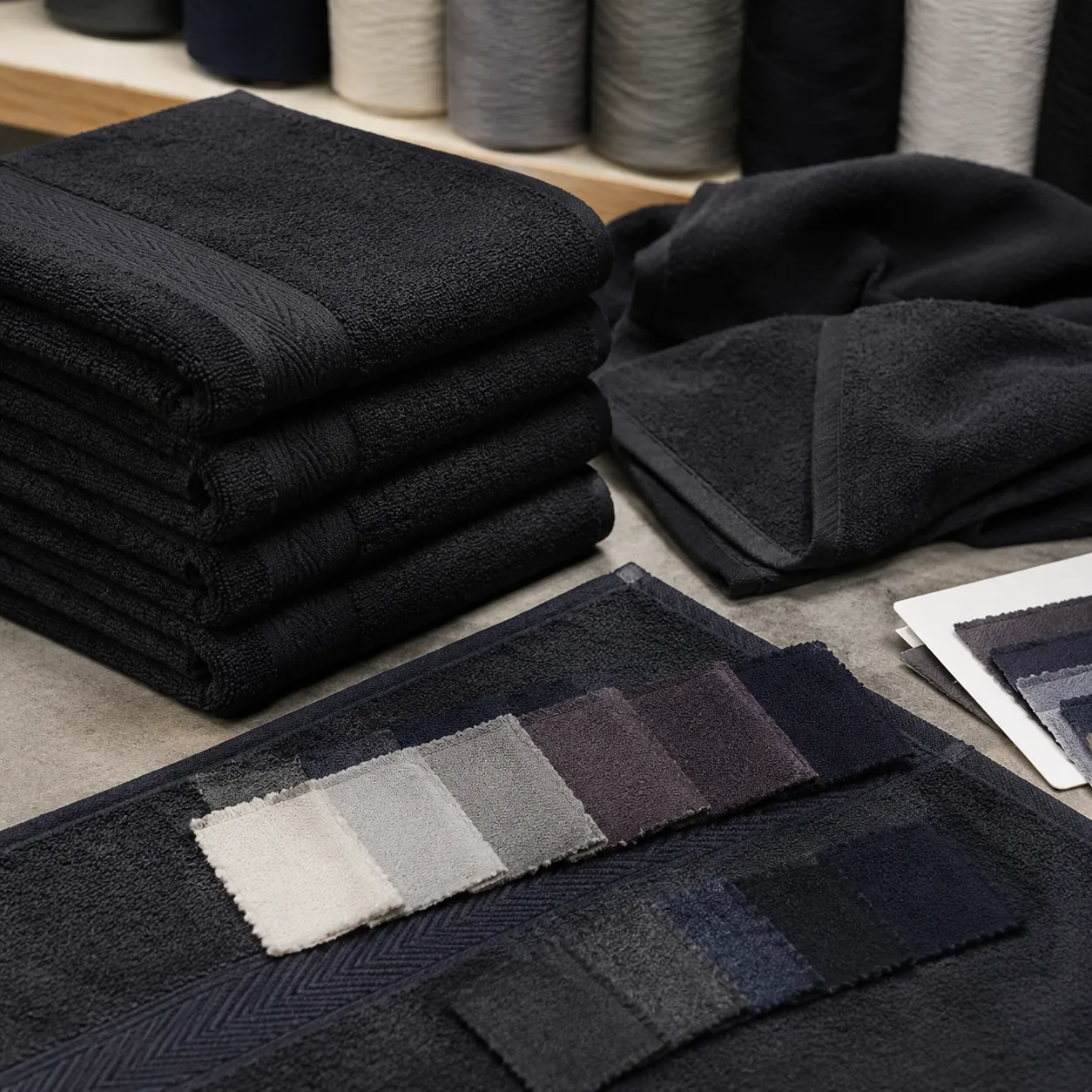
Start with the blank towel, not the monogram
If you are costing embroidered hand towels, the decoration is usually not the biggest line. The towel body often represents 58-76% of FOB value depending on size, GSM, yarn and border construction. Buyers who start from logo size first usually compare quotes that are not built on the same base, so the numbers look arbitrary even when they are not.
For a hand towel program, we normally quote from four base constructions: 30x30 cm guest towel, 35x75 cm standard hand towel, 40x80 cm fuller hand towel, and 50x100 cm salon or spa hand towel. A dobby border gives the cleanest embroidery zone. A cam border can work, but if the monogram sits too close to pile transition, the stitches bridge unevenly and letter edges look jagged after washing.
| Base towel spec | Typical weight per pc | Common yarn route | FOB China at 3,000 pcs |
|---|---|---|---|
| 30x30 cm, 450-500 GSM, 16s single terry | 41-45 g | Carded cotton | USD 0.23-0.29 |
| 35x75 cm, 500-550 GSM, 16s/21s terry | 131-146 g | Carded or combed cotton | USD 0.74-0.98 |
| 40x80 cm, 520-580 GSM, ring-spun terry | 166-186 g | Combed cotton | USD 1.02-1.31 |
| 50x100 cm, 550-650 GSM, denser pile | 275-325 g | Combed cotton | USD 1.66-2.22 |
Those ranges assume OEKO-TEX 100 Class I compliant materials, BSCI-audited production, and ISO 9001 process controls. They also assume standard export packing, not retail gift boxes. If a quote is much lower, check whether the supplier is swapping combed yarn for carded, reducing actual cut size, or quoting on a lower finished GSM after wash relaxation.
What actually moves the monogram hand towels cost breakdown
Embroidery cost on hand towels is driven by five variables that are easy to miss on an RFQ: stitch count, thread color count, placement on border versus pile, hooping efficiency, and whether names are fixed or variable. A single-script letter and a three-letter crest do not run the same way on the machine even if both fit inside a 70 mm area.
- Stitch count: a 1-letter serif monogram may run 4,800-6,200 stitches; a dense crest with outline can reach 11,000-14,500.
- Thread colors: 1 color runs faster; each thread change adds stoppage and setup loss, especially on smaller lots.
- Embroidery field: flat dobby border is stable; high-pile field embroidery often needs topping film and slower speed.
- Name personalization: fixed logo across all pieces is efficient; variable initials or names increase programming and sorting labor.
- Backing and trimming: water-soluble topping, tear-away backing, and hand-trimming standards vary by supplier.
For sourcing proof, we build embroidery time from machine speed and stoppage rates rather than guessing a flat decoration adder. On 450-550 GSM cotton terry, we usually cap real production speed around 650-750 stitches per minute for border embroidery and lower if the border is soft or narrow. The same digitized file may run 10-18% slower on dark reactive-dyed towels because operators spend more time checking thread show-through and trimming flyaway fibers.
| Embroidery variable | Low-impact case | Higher-cost case | Typical FOB adder |
|---|---|---|---|
| Logo complexity | Single initial, 1 color, 5k stitches | 3-letter monogram with outline, 10k stitches | USD 0.08-0.19 vs USD 0.18-0.34 |
| Placement | Centered on 5 cm dobby border | Placed on pile with topping film | Add USD 0.02-0.05 |
| Personalization | One artwork all units | Variable initials in mixed cartons | Add USD 0.05-0.16 |
| Thread route | Standard rayon embroidery thread | Higher fastness polyester thread | Add USD 0.01-0.03 |
The split between setup cost and run cost
This is where small hotel groups and boutique brands usually misread quotes. Embroidery has a front-loaded portion: digitizing, sample sew-out, thread matching, frame setup, operator balancing, and first-piece approval. Then it has a run portion based on time and handling. If you divide the same setup over 600 towels or 12,000 towels, unit economics change fast.
| Cost line | How mills usually charge it | Realistic range |
|---|---|---|
| Digitizing monogram file | One-time charge or waived above volume | USD 25-60 per design |
| Physical sample with embroidery | Charged then credited on bulk | USD 35-85 per sample |
| Thread shade matching | Included if stock shades work; charged if custom | USD 0-20 per color decision |
| Bulk run embroidery labor | Per piece based on stitches and handling | USD 0.08-0.34 per pc |
If a buyer asks for six towel colors, four monogram thread colors, and low MOQ by color, the setup burden can exceed the thread-and-stitch burden. That is why two programs with the same total quantity can have different economics. We see this often in hospitality renovation projects where each property wants its own initial set but purchasing wants one combined PO.
A buyer scenario: boutique hotel vanity towel set
Let us use one realistic scenario rather than generic averages. A 48-room boutique hotel wants hand towels for guest bathrooms and spa reception. The spec is 35x75 cm, 530 GSM, combed cotton, reactive navy body, white monogram, 6 cm dobby border, embroidery centered 55 mm above hem. Order quantity is 4,800 pcs split across two logo versions: room use and spa use.
- We calculate the blank towel from finished weight, yarn route, dye class, and hemming standard.
- We test the border width against the embroidery field so the needle does not strike the pile ridge.
- We estimate stitch count from the digitized file, then apply real machine efficiency rather than nominal speed.
- We add inspection, thread trimming, metal detection if requested by retailer, and export packout.
| Scenario cost line | Basis | FOB range per pc |
|---|---|---|
| Blank towel | 35x75 cm, 530 GSM, combed cotton, reactive dyed | USD 0.84-0.96 |
| Embroidery run | Approx. 6,800-7,600 stitches, 1 color on dobby border | USD 0.10-0.15 |
| QC, trimming, ironing/appearance control | Hospitality presentation standard | USD 0.02-0.04 |
| Packing | 12 pcs/poly, 120 pcs/export carton | USD 0.03-0.05 |
| Allocated setup over 4,800 pcs | Digitizing + sample + balancing | USD 0.01-0.03 |
| Total FOB China | Excluding duties and destination freight | USD 1.00-1.23 |
That price band is supportable because each line corresponds to a production action. If the same project drops to 1,200 pcs total, the blank towel cost barely moves, but setup allocation and handling loss rise materially. The likely FOB result becomes around USD 1.13-1.39 per pc, depending on color split and approval revisions.
Where quotes go wrong: three recurring cost traps
- Embroidery on pile instead of border: buyers approve artwork without confirming the sew area. On terry loops, satin stitches can sink and edges fuzz after laundry. Mills then add topping film, lower speed, and rework more pieces.
- Too many initials for the MOQ: 500 pcs per design per color is workable for one logo, but 500 pcs spread across 18 initials is not a true production lot. Someone still has to sort, relabel, and check every bundle.
- Retail-style fold and insert on hotel budgets: belly bands, tissue, barcode stickers, and unit polybags can add more than the embroidery on simple hand towels.
We also push back when clients request zero-twist hand towels with embroidery on a narrow border. Zero-twist can feel softer, but the border can distort more during sewing and laundering unless the ground is stabilized well. For embroidered hospitality hand towels, ring-spun or combed conventional yarn often gives cleaner letter shape over repeated washes.
Technical checkpoints that deserve to be on the PO
A usable quote needs more than size and GSM. For custom hand towel pricing, we need the spec lines that affect machine behavior and wash result. These are not cosmetic details. They determine whether the embroidery stays flat, whether the border waves, and whether thread color bleeds onto the cotton after commercial laundering.
- Finished size tolerance: for example ±3% after wash, not loom-state size only.
- Finished GSM tolerance: for example ±5%, measured after conditioning, because pre-wash greige weight can mislead buying teams.
- Border width: minimum usable embroidery field, such as 50 mm clear of pile transition.
- Embroidery thread spec: rayon or polyester, ticket size, and required wash fastness.
- Colorfastness standard: ISO 105-C06 for domestic laundering or a project-specific commercial wash benchmark.
- Needle and backing method: especially important for soft terry and dark shades.
Two process details matter here. First, we normally check towel dimensional stability and skew after the pre-production wash because border alignment can shift once the loops relax. Second, for dark navy, black, or red hand towels with light embroidery, we prefer a thread fastness review under ISO 105-X12 rubbing and a laundering check to ISO 105-C06 so buyers do not discover white thread staining after rollout.
Lead time is usually decided by approvals, not sewing
A straightforward run of monogrammed hand towels does not take long once everything is frozen. The long part is often artwork correction, Pantone discussion, sample courier time, and waiting for one stakeholder to approve the border placement. Buyers who ask for rush production should shorten the approval chain first.
| Stage | Typical days | What slows it down |
|---|---|---|
| Quote and spec review | 1-3 days | Missing size, border width, stitch reference |
| Digitizing and sample sew-out | 3-5 days | Artwork revisions, unclear serif detail |
| Lab dip or thread color approval | 2-4 days | Non-stock thread shade matching |
| Bulk towel weaving/dyeing | 18-28 days | Custom color, yarn booking, high-season queue |
| Embroidery and finishing | 5-9 days | High stitch density, many color splits |
| Final QC and packing | 2-4 days | Retail inserts, barcode application |
For most programs, total lead time is around 30-45 days after sample approval and deposit. If cotton shade is stock, artwork is simple, and color splits are limited, we can sometimes ship faster. If each property in a hotel group wants a different monogram, expect the schedule to widen because internal sorting and approval multiply.
Related reads: If you are still locking the towel spec, start with towel GSM selection logic and how to build a towel tech pack. If your team is deciding between embroidery and woven branding, compare methods in embroidery vs sublimation vs jacquard.
How to reduce cost without making the towel look cheaper
The best savings usually come from simplification, not downgrading. Reducing from combed cotton to carded can save money, but on hand towels used close to the face and sink, buyers notice lint and handfeel quickly. We usually find better value in the decoration architecture and order planning.
- Keep the monogram inside a stable dobby border instead of the pile field.
- Use one towel body color across properties and vary only embroidery thread where branding allows.
- Choose one- or two-color monograms before adding outline stitches that increase density.
- Consolidate initials into fewer production lots rather than splitting small cartons by room or outlet.
- Skip individual polybags unless retail compliance or hygiene protocol requires them.
On one recent spa program, moving from a pile-field crest to a border monogram reduced embroidery time by roughly 22% and cut trimming defects enough to pay for the slightly wider border. The towel did not look cheaper. It looked cleaner, because the embroidery sat where the fabric was stable.
What a solid RFQ should contain
If you want comparable quotes for monogram hand towels cost breakdown work, send the same technical packet to every mill. Otherwise one supplier prices a combed towel with polyester thread and another prices a lighter carded towel with rayon thread, and purchasing ends up comparing two different products.
- Finished towel size and target GSM
- Cotton route: carded, combed, ring-spun, zero-twist if applicable
- Ground color and dye method
- Border width and exact embroidery placement from hem
- Artwork file plus target stitch size
- Expected order quantity by color and by monogram version
- Packing method: bulk export or retail-ready
- Required compliance: OEKO-TEX 100 Class I, BSCI, ISO 9001, any retailer testing add-ons
Related reads: For buyers balancing lower MOQs against unit cost, see how to negotiate towel MOQ without killing margin. If this hand towel order is part of a larger property setup, setting up a hotel linen program in 90 days helps align ordering windows and approvals.
Our practical baseline for buyers
For most hospitality and brand programs, the commercially stable zone is a 35x75 cm or 40x80 cm hand towel in 500-560 GSM cotton with a usable dobby border and a one-color monogram under about 8,000 stitches. At that point, decoration is visible, wash risk is manageable, and unit price stays rational at bulk volume.
Our standard MOQ is 500 pcs per design per color. We produce around 2.4 million towels annually in our 220-employee mill, and we quote against actual production conditions rather than generic trading-house averages. For projects needing OEKO-TEX 100 Class I materials, BSCI and ISO 9001 documentation, we can include those records in the quote package so your sourcing team sees what supports the numbers.
Need a usable price build for your program?
Send size, GSM, artwork, border width, quantity split, and packout requirement. We will return a line-by-line quote with realistic FOB bands, MOQ notes, and lead time. Email [email protected] or WhatsApp +86 13205717266.
Request a Quote →