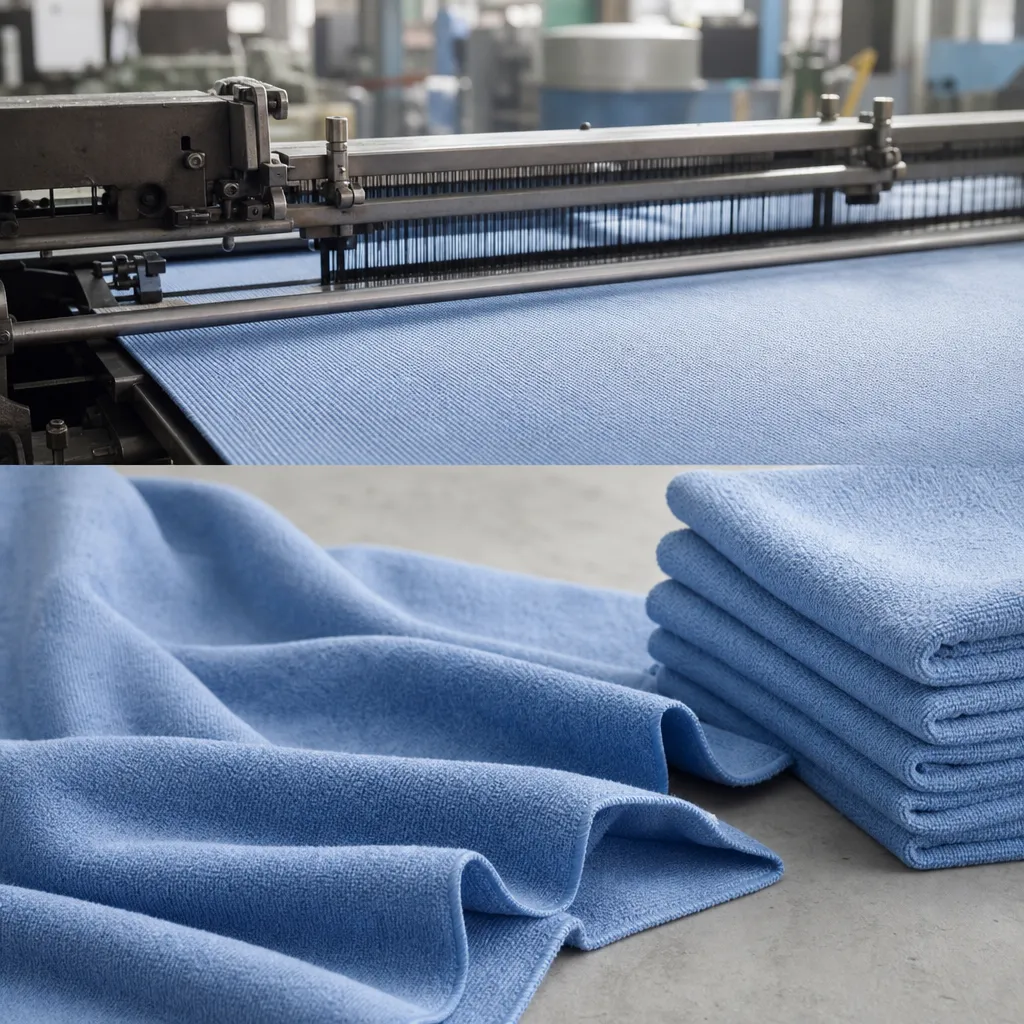
Why glass towels fail even when the spec sheet looks acceptable
Glass is less forgiving than paint, chrome, or sealed stone. A towel that performs well on dashboards can still drag on tempered side windows or leave residue on interior windshields. We usually trace failures to four construction choices: yarn fineness, knit geometry, edge handling, and finishing chemistry. GSM alone does not predict any of those very well.
The most common complaint from brand clients is not visible lint. It is a light film that appears only under raking light or after the panel dries fully. In production terms, that usually comes from one of three causes: residual spin finish not fully removed during scouring, pile tips that are too long and redistribute cleaner instead of lifting it, or a dense border that behaves differently from the body fabric. Those are product problems, not user error.
- A high-pile 330-380 GSM coral fleece can feel softer in hand but often smears cleaner on glass because the loops hold too much liquid at the wipe edge.
- An overheated ultrasonic cut edge can become slightly stiff; on dark tinted glass it may leave a directional swipe line.
- Low split quality in the yarn reduces capillary pickup, so the cloth moves moisture around rather than trapping it.
- Silicone-heavy softener can improve handfeel in approval samples and still ruin first-use clarity on mirrors and windows.
The two constructions that actually work
For this category, we narrow most OEM programs to either waffle weave or short-suede knit. Both can work, but they solve different wipe behaviors. Waffle weave creates small channels that break surface tension and pull moisture into the recesses. Suede knit gives a flatter contact plane with lower lint risk, which many automotive brands prefer for final buffing on interior glass.
| Construction | Typical GSM | Best use | Watch-out |
|---|---|---|---|
| Waffle weave | 280-340 | First-pass cleaning, exterior glass, mirrors, humid environments | If knit is too open, it can snag on damaged window film edges |
| Short suede / tricot-style | 220-300 | Final buff, interior windshield, display glass | If yarn split is weak, absorbency drops fast after a few washes |
| Low-pile terry | 240-300 | General utility, bundled kits | More likely to leave micro lint on glass than the two options above |
If a client wants one towel for a glass cleaner SKU, we usually steer them toward a waffle weave around 300 GSM rather than a generic terry. If the brand already sells a two-step system, a damp waffle towel paired with a dry suede finishing cloth is more reliable. That recommendation comes from claim reduction, not from trying to increase SKU count.
Waffle weave works because the knit controls liquid, not because it is trendy
A useful glass cloth should release enough friction to break cleaner residue, but not so much fabric contact that it floods the panel again. Waffle cells help by creating alternating contact and void areas. In practice, that means the towel can pick up a narrow film of cleaner without loading the whole face at once.
We watch two manufacturing details closely on this structure. First is cell depth consistency across the width of the roll. If take-down tension drifts during knitting, the cells flatten near one selvage and drying behavior becomes uneven. Second is post-dye heat setting. If the set is too aggressive, the waffle collapses slightly and the towel loses some grab. Those are not issues you see on a basic color card; they show up later in performance complaints.
On glass, the buyer is paying for controlled pickup and clean release. If the cloth stores liquid but does not let go of residue, the user sees haze.
Blend ratio matters, but split quality matters more
Most workable programs in this segment sit at 80/20 or 75/25 polyester/polyamide. The extra polyamide helps absorbency and wipe smoothness, but the headline ratio is only part of the story. We have tested 80/20 towels that outperformed nominally better 75/25 towels because the filament splitting was cleaner and more uniform.
If you are building a private-label line, ask how the mill checks splitting and absorbency after dyeing, not only before. Dye-house heat history can change final hand and pickup. We typically verify with a simple vertical wicking comparison and a controlled panel wipe test using diluted glass cleaner on black acrylic and mirror plate. Acrylic is useful because it exposes drag marks early, while mirror plate shows haze faster than many factory windows.
- For value-tier retail, 80/20 is usually the best balance of cost and wipe performance.
- For detailer-oriented kits, 75/25 often gives a smoother final pass, especially in suede construction.
- Below 20% polyamide equivalent performance, brands should ask harder questions about split quality and finish, because nominal blend claims alone do not guarantee results.
Edges cause more complaints than the body fabric
A good body fabric can still lose the account if the edge is wrong. On glass, borders are the first place we look when a customer reports lines at the end of the stroke. Overlock seams are durable and economical, but they create a raised contact point. Satin binding looks neat in retail packs, yet on glass it tends to hold cleaner and can skip. For this use case, we see the lowest complaint rate with either edgeless laser or ultrasonic cut, provided the cut is stable and not overfused.
| Edge type | OEM suitability for glass | Cost effect | Failure mode to monitor |
|---|---|---|---|
| Ultrasonic cut | Strong if process is controlled | +USD 0.03 to 0.06/pc vs overlock | Hard edge if horn pressure or dwell is too high |
| Laser cut | Very clean appearance | +USD 0.05 to 0.08/pc | Heat tint or local stiffness on dark colors if calibration drifts |
| Micro overlock | Budget programs only | Baseline | Seam track can leave a line at the towel edge |
| Folded binding | Usually avoid for glass-specific SKU | +USD 0.07 to 0.11/pc | Border retains moisture and causes end-pass smear |
When we approve edgeless production, we also check curl after three laundering cycles. A cut edge that curls inward slightly may still pass visual inspection at packing but becomes awkward in use because the operator loses flat contact on the panel.
What we test before approving a production lot
A sourcing team does not need a lab full of instruments to filter weak options, but it does need repeatable checks. For microfiber towel for glass programs, our release process combines physical tests with use simulation. We keep it simple enough that buyers can mirror parts of it in their own office or warehouse.
- Run AATCC 135 wash dimensional stability after three home-laundry cycles to see if the towel distorts enough to affect flat wiping.
- Check colorfastness to rubbing with ISO 105-X12 on dark shades; loose dye on a black towel can transfer to a white detailing towel packed beside it.
- Perform a controlled haze check on mirror plate under angled LED light after one damp pass and one dry pass.
- Measure absorbency response time on a fixed cleaner volume, not plain water only, because surfactants change wipe behavior.
- Inspect edge hardness by hand and by glide test across clean tempered glass. This catches overfused ultrasonic edges quickly.
Certifications also matter, but only in the right way. OEKO-TEX Standard 100 Class I is useful when the towel may contact skin and when brands need restricted-substance assurance for retail compliance. BSCI relates to social compliance of the supply chain, not wipe clarity. ISO 9001 helps because it indicates a managed quality system, but it does not replace product testing. Buyers sometimes mix those roles together.
Where the real price breaks sit
This category is sensitive to small cost moves because many programs are packed in multi-packs or bundled with chemicals. Still, chasing the very lowest FOB often creates claim costs that wipe out the savings. A towel that leaves haze drives returns, bad reviews, and customer support labor much faster than a general-purpose cloth would.
| Spec scenario | MOQ | FOB China unit price | Notes |
|---|---|---|---|
| 30x30 cm suede, 240 GSM, edgeless, 80/20 | 5,000 pcs | USD 0.34-0.43 | Entry glass cloth for retail multipacks |
| 40x40 cm waffle, 300 GSM, ultrasonic edge, 80/20 | 3,000 pcs | USD 0.62-0.79 | Most balanced option for private label |
| 40x60 cm waffle, 320 GSM, laser edge, 75/25 | 2,000 pcs | USD 1.02-1.29 | Automotive enthusiast or pro-detail channel |
| 50x80 cm suede, 260 GSM, custom hangtag and polybag | 2,000 pcs | USD 1.18-1.46 | Display glass or oversized household format |
Here is a realistic cost-per-use example from a recent internal comparison. A 40x40 cm budget terry cloth quoted at USD 0.48 looked attractive against a waffle version at USD 0.71. But the terry sample fell out of spec on user panel feedback after about 22 wash-and-use cycles because lint and drag complaints climbed. The waffle sample stayed acceptable through 61 cycles. That puts the budget option around USD 0.0218 per acceptable use versus about USD 0.0116 for the better towel, before counting customer complaints or replacement freight.
The brief details buyers forget to send
We can quote faster and more accurately when the intended cleaning chemistry is clear. Alcohol-heavy glass sprays, ammonia-free household formulas, and waterless detailing products all interact a bit differently with microfiber. Interior automotive glass also behaves differently from bathroom mirrors because of off-gassing film and cabin residues.
- Tell the factory where the towel will be used: car interior glass, household window, mirror, display, or stainless-and-glass combo cleaning.
- State whether the towel is for single-cloth use or part of a two-towel system.
- Specify edge preference and whether border contact on glass is acceptable.
- Confirm pack format: loose bulk, belly band, hook card, resealable pouch, or kit insert.
- Include any claim language planned on the packaging such as lint free, streak free, washable, or safe for tinted windows so testing can match the promise.
If you need help shaping the spec before sampling, our article on build-towel-tech-pack-that-mills-can-quote is a practical place to start. Buyers working across multiple wipe categories often also compare microfiber-vs-cotton-towel-comparison and towel-gsm-decision-framework before locking the line architecture.
Sampling, production, and what slows the schedule
For a straightforward OEM run, our normal MOQ is 500 pieces per design per color, but glass-specific microfiber is usually more efficient from 2,000 pieces upward because of knitting and finishing setup. Lab dips or color confirmation take 2-4 days. Proto samples normally take 7-10 days if greige fabric is available. Bulk production runs 18-30 days after sample approval and deposit, depending on edge process, packaging complexity, and whether the fabric needs a custom knit instead of stock base cloth.
What delays this category most often is not fabric weaving. It is packaging revisions after performance claims are rewritten, or a late switch from overlock to edgeless once the first user test reveals border marks. That is why we would rather settle the use-case early than quote a broad "microfiber cloth" and fix problems after the first sample.
| Stage | Typical days | Main risk |
|---|---|---|
| Spec review and quote | 1-3 | Missing end-use details |
| Sample making | 7-10 | Edge revision after first wipe test |
| Bulk fabric + cutting + finishing | 18-30 | Custom color or laser queue |
| Packing and export prep | 4-7 | Barcode or insert changes |
A microfiber towel for glass should earn its place in the line
If the brand is selling this as a specialist item, the product needs to behave differently from a general all-purpose cloth in a way the end user can feel immediately. That usually means one-pass pickup, low drag on dry glass, and no visible lint under angled light. If a sample only feels soft and looks tidy in the pack, it is not enough.
For adjacent reading, buyers developing automotive or household wipe ranges often review auto-detailing-microfiber-towel-program, custom-microfiber-towels-wholesale-guide, and container-vs-air-freight-towel-orders. If your end market sits closer to car care than general home textiles, our industry page for auto detailing towels gives a broader range view.
Need a glass towel spec reviewed
Send your target size, construction idea, edge preference, and pack format. We can suggest a workable OEM spec, quote bands by volume, and sampling timing. WhatsApp +86 13384590853 or email [email protected].
Request a quote →