Start With the Use Case, Not the Logo
Golf towels look simple on a PO, but the wrong first decision usually shows up after the first rain day or the third laundry cycle. A towel clipped to a bag needs a different corner reinforcement than a folded retail towel on a pro shop shelf. A tournament giveaway needs faster decoration and a lower unit cost than a member welcome towel. We start every RFQ by separating these three channels because they drive fabric, GSM, logo method, and packaging.
For LUMA & CO. TEXTILE orders, the practical MOQ is 500 pcs per design / per color. Below that quantity, the fixed work is still the same: lab dip, strike-off, cutting setup, decoration trial, metal detector pass, carton marking, and export paperwork. We can quote 500 pcs, but most golf programs become cleaner at 1,000 to 3,000 pcs because the clip, label, and embroidery setup costs spread more sensibly.
| Use case | Common size | Fabric direction | Logo direction | Buyer risk if underspecified |
|---|---|---|---|---|
| Pro shop retail | 40 x 60 cm or 16 x 24 in | 450-550 GSM cotton velour or waffle | Embroidery, woven label, or jacquard | Shelf fold hides logo or hang card does not fit fixture |
| Member gift | 40 x 70 cm or tri-fold 16 x 25 in | 500-620 GSM terry/velour combo | Embroidery or jacquard | Logo feels good but clip corner tears under bag use |
| Tournament giveaway | 30 x 50 cm or 12 x 20 in | 350-450 GSM terry, microfiber, or waffle | Print, low-stitch embroidery, woven patch | Unit price works but colorfastness fails in rain |
| Resort rental set | 45 x 75 cm | 520-650 GSM cotton terry | Jacquard border or small embroidery | Laundry shrinkage changes fold and stack height |
Custom Golf Towels 2026 Buyer Guide: Spec Choices
The main spec choice is not cotton versus microfiber in isolation. It is how the towel will be handled: clipped outside a golf bag, sold folded, washed by a club laundry, or handed out once at registration. Custom logo golf towels for bag use need abrasion resistance at the grommet zone and a stable fabric edge. Retail towels need a better handfeel and a cleaner presentation fold. Tournament towels need predictable lead time and a decoration method that will not bottleneck during peak season.
- Bag towel: specify reinforced corner patch, rust-resistant grommet, clip pull test, and washing after hardware attachment.
- Tri-fold golf towel: approve fold line, center logo position, and hook orientation while the towel is folded, not only while flat.
- Retail towel: control barcode sticker position, hang card hole, folded dimensions, and polybag warning text if selling in North America.
- Club laundry towel: require shrinkage and lint checks after 5 wash cycles before bulk approval.
- Event towel: prioritize colorfastness to rubbing and perspiration, because towels are handled wet during hot tournament days.
For cotton programs, we normally use 21s/2 or 32s/2 cotton yarn depending on target GSM and surface. For microfiber waffle golf towel programs, common constructions are 80/20 polyester-polyamide at 280-360 GSM, but we do not recommend microfiber if the buyer wants a heavy country-club handfeel. It dries quickly, yet it does not carry embroidery the same way a cotton terry or velour face does.
Fabric Face Decides Feel and Decoration
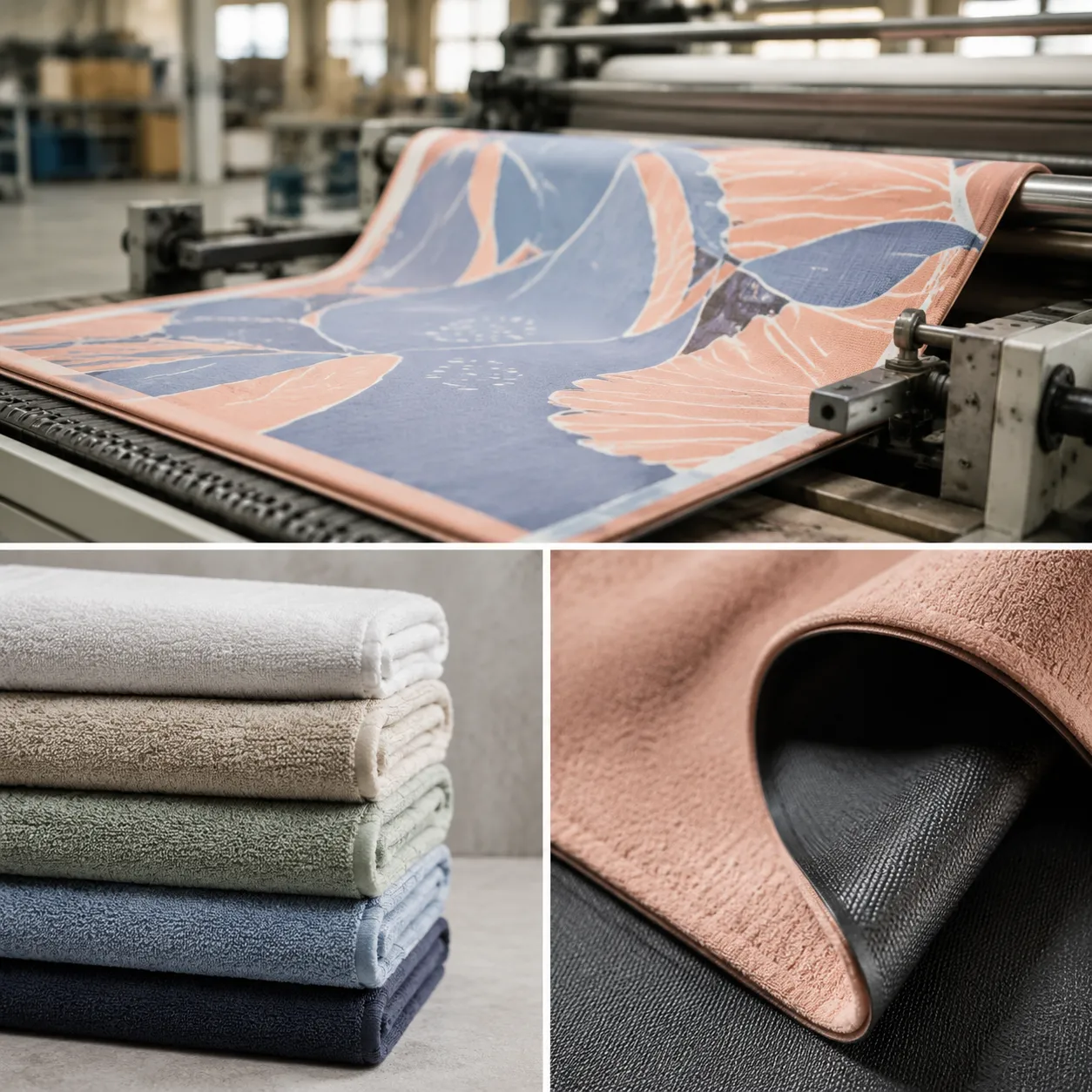
A golf towel usually has two working surfaces. The front face may be velour for a clean embroidery or print zone; the back may remain terry loop for grip and cleaning. Waffle golf towel constructions use raised cells to lift moisture and sand, but the cell height can distort small logos. Jacquard towels weave the design into the towel itself, which is strong for resort or club identity, but requires more planning than an embroidered crest.
For buyers comparing custom golf towels with broader decoration choices, the useful rule is simple: embroidery suits small crests and names, jacquard suits repeat identity or border designs, and sublimation suits full-color artwork on polyester microfiber. We keep embroidery away from dense terry loops unless the design has enough underlay and a backing that can survive washing without curling.
| Construction | Typical GSM | Best for | Decoration fit | Factory note |
|---|---|---|---|---|
| Cotton terry both sides | 430-580 GSM | Member gifts, course use | Embroidery, woven patch | Good absorbency, but loops can snag if clip hardware is rough |
| Cotton velour front / terry back | 450-620 GSM | Retail and club logo towels | Embroidery, screen print, debossed border | Cleaner logo face; velour shearing must be even to avoid shade streaks |
| Microfiber waffle | 280-360 GSM | Travel, tournament, quick dry | Sublimation, heat transfer, woven label | Fast dry, lower freight weight, less luxury handfeel |
| Jacquard cotton | 480-650 GSM | Resort, private club, gift set | Woven-in logo or pattern | Longer yarn planning and higher MOQ discipline needed |
| Tri-fold cotton towel | 460-600 GSM | Bag clip towel | Embroidery or woven label | Logo must be approved in folded and hanging position |
Two topic-specific checks matter here. First, velour shearing height must be checked after dyeing, not only on greige fabric, because uneven shearing creates a cloudy logo field. Second, the grommet area must be tested after washing; a corner that holds before laundering can loosen when the fabric shrinks around the metal eyelet.
Logo Method and Hardware Need One Approval Sample
We prefer to approve logo and hardware together. If embroidery is approved on a flat towel and the carabiner is added later, the finished towel may hang with the logo rotated 90 degrees or partly hidden by the tri-fold. For a 16 x 24 in tri-fold golf towel, the logo center often sits 95-115 mm below the top fold, but that depends on clip position, fold width, and whether the towel is displayed hanging or stacked.
For embroidery, buyers should provide DST or AI artwork plus Pantone references. We test thread shade against the approved towel color under D65 light. Dense club crests often run 8,000-18,000 stitches. Once a logo passes 22,000 stitches on a small towel, the cost and stiffness both rise; in those cases we often suggest a woven patch or jacquard border instead. For more detail on method selection, see embroidery vs sublimation vs jacquard and custom logo towels OEM decoration guide.
- Request a hanging photo, folded photo, and flat photo of the same approval sample.
- Specify clip type: black plastic hook, zinc alloy carabiner, brass-tone clip, or no clip.
- Ask for grommet inner diameter, outer diameter, and corrosion resistance statement.
- Confirm whether the embroidery backing is tear-away, wash-away, or cut-away.
- Set an allowable logo placement tolerance, usually +/-5 mm for embroidery on golf towels.
For hardware, we use a simple pull check before bulk packing: 20 N for lightweight microfiber towels and 30 N for heavier cotton bag towels. This is not a substitute for a third-party lab standard, but it catches weak corner reinforcement, poor grommet setting, and edge stitching that is too close to the hole.
Price Bands by Volume and Spec
Golf towel pricing is sensitive to weight, decoration time, and hardware. A towel that looks only USD 0.38 cheaper on FOB China may fail economically if the club replaces it after one season. For example, a 42 x 65 cm cotton velour towel at 520 GSM weighs about 142 g before embroidery and hardware. If it lands at USD 2.95 FOB and survives 70 club laundry cycles, the towel cost is about USD 0.042 per use. A lighter 360 GSM towel at USD 2.18 FOB that starts edge curling after 32 cycles costs about USD 0.068 per use, before reordering and staff handling.
| Order volume | Basic terry, 380-450 GSM | Velour/terry, 480-580 GSM | Microfiber waffle, 280-360 GSM | Jacquard cotton, 500-650 GSM |
|---|---|---|---|---|
| 500 pcs | USD 2.25-3.10 | USD 3.05-4.35 | USD 1.85-2.65 | USD 4.20-5.90 |
| 1,000 pcs | USD 1.85-2.65 | USD 2.55-3.75 | USD 1.55-2.25 | USD 3.55-5.10 |
| 3,000 pcs | USD 1.45-2.20 | USD 2.10-3.20 | USD 1.25-1.95 | USD 2.95-4.45 |
| 10,000 pcs | USD 1.18-1.85 | USD 1.78-2.75 | USD 1.05-1.62 | USD 2.55-3.90 |
These are 2026 planning bands for OEM golf towel wholesale programs from our China mill, excluding unusually high stitch counts, gift boxes, RFID labels, and air freight. OEKO-TEX Standard 100 Class I materials, BSCI social compliance, and ISO 9001 production controls are available across the constructions, but buyers still need to define which certification documents must be attached to shipment files.
QC Checks That Catch Golf-Specific Failures
Standard towel inspection is not enough for golf towels because the failure points are local: the hook corner, the logo face, and the edge seam. We use AQL sampling based on ISO 2859-1 for visual inspection, usually General Inspection Level II with AQL 2.5 for major defects and 4.0 for minor defects unless the buyer has stricter retail requirements. For club programs, we also add wash and hardware checks before final carton sealing.
- Check GSM by cutting a measured specimen and weighing against the approved tolerance, normally +/-5%.
- Measure size before and after washing; cotton golf towels should usually stay within 3-5% shrinkage depending on construction.
- Run colorfastness to washing using ISO 105-C06 for dyed cotton programs and review staining on adjacent fabric.
- Test rubbing fastness using ISO 105-X12, with special attention to dark navy, bottle green, and black club colors.
- Inspect the grommet zone after washing and pull testing, not only at sewing inline inspection.
- Review lint release after tumble drying if the towel will enter hotel or club laundry systems.
Common reject modes include embroidery puckering on velour, cracked heat transfer on waffle microfiber, rusty low-grade grommets, skipped stitches around the hem, and shade mismatch between towel body and woven label. We also watch for clipped pile lines on velour caused by dull shearing blades. That defect is easy to miss in a flat warehouse photo but obvious under pro shop lighting.
Timeline From RFQ to Carton Close
A normal golf towel order is not slow, but it does punish late artwork changes. Lab dips can move quickly if Pantone references and towel fiber are clear. Jacquard takes longer because yarn planning and loom setup are fixed earlier than embroidery. If a buyer wants tournament delivery, we ask for the event date, required in-hand date, port, and delivery ZIP code at RFQ stage, not after sample approval.
| Stage | Cotton embroidered towel | Microfiber printed towel | Jacquard towel | Buyer action needed |
|---|---|---|---|---|
| RFQ and tech pack review | 1-2 days | 1-2 days | 2-3 days | Confirm size, GSM, artwork, packaging, target ship mode |
| Lab dip or strike-off | 5-8 days | 4-6 days | 7-10 days | Approve color under agreed light source |
| Pre-production sample | 7-10 days | 6-9 days | 10-14 days | Approve logo, fold, clip, label, carton mark |
| Bulk production | 18-28 days | 15-24 days | 25-35 days | Freeze PO quantity and decoration files |
| Final QC and packing | 2-4 days | 2-4 days | 3-5 days | Review inspection photos or book third-party inspection |
| Export booking | 5-12 days | 5-12 days | 5-12 days | Choose sea, rail-sea, or air based on event date |
For sea freight, buyers should allow 28-42 days on water and inland delivery depending on destination. Air freight can rescue an event, but towels are weight-sensitive. A 3,000 pc cotton towel order can move from a sensible FOB program into an expensive landed cost if air freight is added late. For a deeper freight comparison, read container vs air freight towel orders.
Packaging and Cartons Affect Retail Margin
Packaging is often treated as an afterthought, but it changes labor at the course and freight cube. A tri-fold towel in an individual polybag is faster for tournament distribution. A belly band or hang card looks cleaner in a pro shop but needs a stable fold and a carton that prevents crushing. Gift boxes look good for member welcome kits, yet they increase carton volume and can push a shipment into a higher freight bracket.
- For pro shop retail, approve folded size, barcode location, hang hole diameter, and carton facing direction.
- For event handout, use carton marks by course, date, or sponsor group so volunteers do not open every carton.
- For resort replenishment, pack by color and SKU; mixed cartons save space but slow receiving.
- For online retail, add drop-test review and barcode scan check before bulk carton close.
Our usual export carton for mid-size golf towels is 5-ply corrugated with 10-18 kg gross weight, depending on towel size and packaging. We avoid overpacked cartons because compressed velour can hold crease marks after long ocean transit. For microfiber, compression is less risky, but printed faces still need protection against abrasion inside the carton.
Documents, Compliance, and Mill Proof
For brand and hospitality buyers, supplier proof should be checked before deposit. LUMA & CO. TEXTILE operates with OEKO-TEX Standard 100 Class I certification, BSCI audit documentation, and ISO 9001 quality management. Those certificates do not replace product testing, but they reduce the risk that the order is being routed through an unknown subcontractor. Buyers can also request current certificate numbers and scope pages during vendor setup.
If your internal compliance team is new to textile certificates, how to read an OEKO-TEX certificate is a useful primer. For building a cleaner RFQ package, we also recommend build a towel tech pack that mills can quote, especially if your project includes multiple colorways or sponsor logos.
- Ask whether the certificate scope covers towel fabric, thread, label, or only the dyeing mill.
- Put MOQ clearly on the PO: 500 pcs per design / per color for our standard OEM golf towel setup.
- Request the final approved sample number on the bulk inspection report.
- List acceptable replacements for clip hardware before bulk production starts.
- Confirm whether care labels need US, EU, UK, or bilingual content.
RFQ Checklist Before You Ask for a Quote
The fastest quote is not the shortest email. A useful RFQ gives us enough information to cost yarn, dyeing, decoration, hardware, packaging, and carton space in one pass. Missing artwork or unclear GSM usually means the first quote is only a placeholder, which wastes time for both sides.
- Send towel size in cm or inches, target GSM, and fabric face preference.
- State whether the towel is for retail, member gift, tournament, resort use, or club laundry.
- Provide logo file in AI, PDF, DST, or high-resolution PNG, plus Pantone colors.
- Choose decoration method or ask us to compare embroidery, jacquard, sublimation, and woven patch.
- Specify clip, grommet, label, barcode, polybag, hang card, or gift box requirements.
- Give order quantity by color and design, with forecast reorder quantity if available.
- Tell us required delivery date, destination country, and preferred freight mode.
Related reads: country club golf towel program, custom golf towel with logo sourcing guide, and golf towels wholesale buyer specs cover adjacent buying decisions. For fabric comparisons, towel GSM decision framework and towel sizes dimensions complete guide help teams align internal specs before RFQ.
A good custom golf towels 2026 buyer guide should leave you with fewer open variables, not more slogans. For most buyers, the clean starting point is 1,000 pcs, 40 x 60 cm, 480-550 GSM cotton velour/terry, embroidered crest under 15,000 stitches, reinforced grommet corner, and carton markings by SKU. From there, we adjust up for retail feel, down for tournament budget, or sideways into microfiber when quick-dry weight matters more than cotton handfeel.
Quote a Golf Towel Program
Send size, GSM, logo file, quantity, clip choice, and delivery window. We will return a factory quote with MOQ, sample timing, FOB China pricing, and QC notes. WhatsApp +86 13205717266 or email [email protected].
Request a Quote →