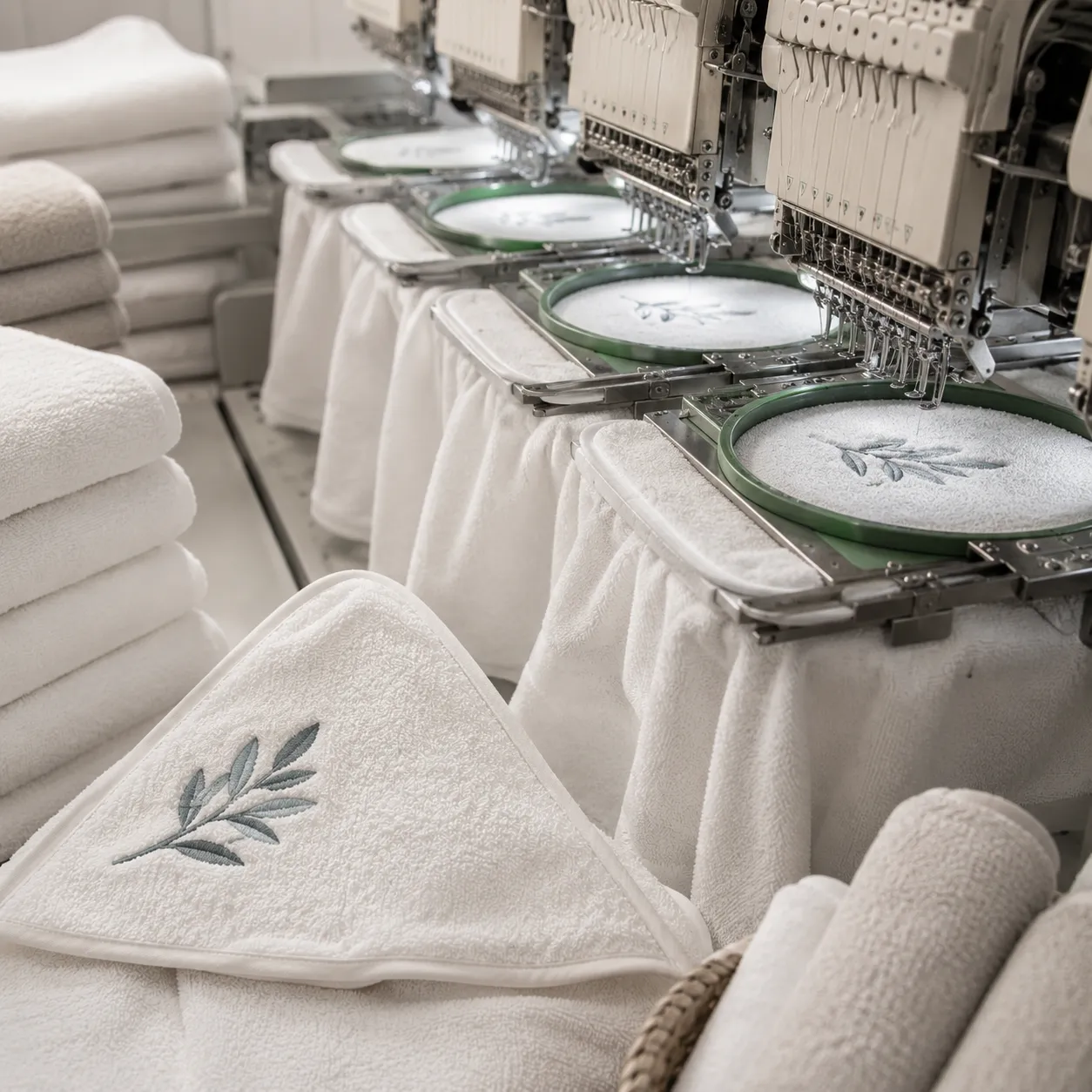
Why Hooded Towels Fail Differently
A hooded towel is not just a bath towel with a triangle sewn on top. The hood adds a second fabric layer, extra seam bulk, and a curved wearing position that changes how embroidery behaves. On a flat bath towel, we can usually hoop the decoration zone with steady tension. On a hood, the frame must hold terry, seam allowance, and sometimes binding tape without distorting the pile.
The most common failure we see in buyer samples is not thread breakage. It is puckering around the logo after wash testing. This happens when the embroidery stitch count is too high for a soft 360-420 GSM hood fabric, or when the backing is too light for a dense satin border. Another hood-specific defect is seam shadowing: the embroidery sits too close to the center hood seam, so the presser foot rides unevenly and the logo edge becomes wavy.
For brand-side buyers, the useful spec is a combined spec: towel GSM, hood panel size, embroidery placement, stitch count, thread type, backing, and wash target. If those decisions are separated across design, procurement, and a local decorator, the final product often costs more and performs worse.
| Buyer program | Common use | Factory risk we check first |
|---|---|---|
| Baby gift set | 0-24 month bath use | Loose satin stitches, rough backing edge, OEKO-TEX Class I requirement |
| Kids swim towel | Pool, beach, swim class | Hood seam bulk, chlorine wash fade, oversized embroidery stiffness |
| Resort hooded towel | Cabana or rental program | High laundering frequency, hood shrinkage, barcode or care label durability |
| Retail hooded beach towel | DTC or boutique retail | Color matching, folded presentation, carton compression marks |
Building an Embroidered Hooded Towel Spec
For an embroidered hooded towel, we start with the wearer and laundry environment before we discuss thread colors. A baby towel used at home can be softer and lighter. A kids hooded bath towel for swim schools needs more absorbency and stronger seam reinforcement. A hooded beach towel for resort retail needs a larger body panel but should still dry fast enough to avoid mildew complaints in humid storage.
Our usual cotton terry range for hooded towels is 380-520 GSM. Below 360 GSM, the body can feel thin after the hood is attached, especially on sizes above 70 x 140 cm. Above 550 GSM, the hood becomes heavy on smaller children and shipping volume increases quickly. For microfiber hooded ponchos, the usable range is usually 240-320 GSM, but embroidery needs extra stabilizing because microfiber has less pile grip than cotton terry.
| End use | Body size | Hood size | Recommended GSM | Decoration note |
|---|---|---|---|---|
| Baby bath gift | 75 x 75 cm square | 28 x 28 cm hood panel | 380-430 GSM cotton terry | Keep logo under 55 x 55 mm; soft cutaway backing |
| Toddler bath towel | 80 x 120 cm | 31 x 34 cm hood panel | 420-470 GSM cotton terry | Name embroidery works well at 18-26 mm letter height |
| Kids swim towel | 70 x 140 cm | 33 x 36 cm hood panel | 430-500 GSM cotton terry | Avoid dense fill blocks on the hood crown |
| Youth beach poncho | 60 x 85 cm poncho body | 34 x 38 cm hood panel | 300-360 GSM velour-terry or microfiber | Chest embroidery is often cleaner than hood embroidery |
| Resort retail hooded towel | 75 x 150 cm | 36 x 40 cm hood panel | 460-520 GSM cotton terry | Jacquard border plus small hood embroidery can reduce stitch cost |
- For babies: use OEKO-TEX Standard 100 Class I materials, soft backing, and no hard woven badge on the hood interior.
- For swim schools: specify 450-500 GSM cotton, double-needle hood seam, and reactive dye tested for chlorine exposure.
- For beach clubs: use a larger body panel and avoid oversized hood embroidery that holds water after washing.
- For DTC retail: confirm folded dimensions early, because a thick hood changes mailer and shelf packaging costs.
Embroidery Placement: Hood, Chest, Or Corner
The hood is the obvious place for branding, but it is not always the best place. If the logo is simple, small, and meant to show when the towel is folded, hood placement works well. If the logo has tiny text or a mascot with detailed fill stitches, the chest or lower corner usually gives a cleaner result because the fabric sits flatter in the hoop.
On hood embroidery, we normally keep the design at least 22 mm away from the hood center seam and 18 mm away from binding tape. For baby hooded towel embroidery, we also check the reverse side by hand after trimming. A backing corner that feels acceptable on an adult bath towel can irritate a child’s neck when the hood is worn wet.
We digitize differently for terry than for fleece or jersey. On looped cotton terry, small letters need an underlay that presses the pile down before the top stitch forms. Without that, loops push between thread columns and the lettering looks broken after the first tumble dry. For dense logos, we may add a low-density knockdown stitch field, but it must be used carefully because it changes the handfeel of the hood.
| Placement | Best for | Size range | Risk if overdesigned |
|---|---|---|---|
| Hood front | Monogram, animal face, resort crest | 40 x 40 mm to 90 x 75 mm | Puckering near seam, stiff hood front |
| Left chest on poncho | Brand logo, swim team mark | 55 x 45 mm to 110 x 80 mm | Less visible when folded |
| Lower towel corner | Retail logo, name personalization | 60 x 30 mm to 140 x 55 mm | Can drag in laundry if threads are too long |
| Hem border | Hotel or club identification | 80 x 25 mm to 180 x 35 mm | Limited detail because border zone is narrow |
- Send the logo at final embroidery size, not only as a large vector file.
- Mark the hood seam line, binding line, and folded presentation line on the tech pack.
- Limit small text to 5 mm minimum letter height on terry; 6 mm is safer for names.
- Approve a washed embroidery sample, not only a fresh machine sample.
- Confirm whether the reverse side must be skin-soft for baby or toddler programs.
Thread, Backing, And Stitch Count Limits
For cotton hooded towel OEM production, we use 120D/2 polyester embroidery thread for most programs because it holds color better than rayon under repeated laundering. Rayon has a softer sheen, but it is less forgiving in high-alkaline hotel laundry. For baby gift sets, thread and backing must be checked against OEKO-TEX Standard 100 Class I, not only the towel fabric.
Stitch count is one of the clearest cost and quality controls. A 48 x 48 mm two-letter monogram may run 1,800-2,600 stitches. A filled cartoon animal at 85 x 70 mm can run 9,000-13,500 stitches. On a hood panel, we try to keep most designs under 10,000 stitches unless the fabric is at least 460 GSM and the logo is positioned away from the seam.
Backing choice changes comfort. Tearaway backing is fast, but it can leave scratchy fragments if used on high-pile terry. Cutaway backing stabilizes better, especially for curved hood panels. For infant programs, we often use a soft polymesh cutaway and trim with rounded corners. If the buyer wants a completely covered reverse side, we can add a soft cover patch, but it adds roughly USD 0.09-0.18 per piece depending on size and order volume.
- Safe stitch range: 1,500-6,500 stitches for most baby and toddler hood marks.
- Upper practical range: 8,000-11,000 stitches for kids swim towels with 450 GSM or heavier terry.
- Thread colors: 1-4 colors are efficient; 6 or more colors slow the embroidery line and raise thread-change defects.
- Small lettering: avoid script fonts below 7 mm height because terry loops close the counters after washing.
- Backing trim: rounded cutaway edges reduce rubbing when the hood sits against the neck.
Construction Details Buyers Should Specify
The hood itself needs a construction spec. We cut the hood panel with pile direction aligned to the body towel when possible. If pile direction is reversed, shade can look different even when the yarn and dye lot are identical. On solid reactive-dyed cotton, this shade illusion becomes visible under retail lighting, especially on navy, sage, and sand colors.
For hood seams, we usually recommend overlock plus topstitch or a double-needle lockstitch depending on fabric weight. A simple overlock-only seam is cheaper, but it can twist after 30-40 industrial washes. Binding tape should be pre-shrunk or matched to the towel shrinkage; polyester binding on cotton terry can ripple if the towel body shrinks more than the tape.
One construction quirk matters for decoration: if the embroidery is done after hood assembly, seam bulk limits hooping. If it is done before hood assembly, placement must account for seam allowance with tighter cutting control. For larger programs, we usually embroider the flat hood panel first, then assemble, because the logo position is cleaner and the machine speed is more stable.
| Construction item | Factory recommendation | Why it matters |
|---|---|---|
| Hood seam allowance | 8-10 mm with reinforced topstitch | Controls twisting and keeps embroidery centered after sewing |
| Binding tape | Cotton or cotton-poly tape tested for compatible shrinkage | Prevents rippling around the hood opening |
| Pile direction | Match hood and towel body when possible | Reduces shade difference between panels |
| Hanger loop | Bar-tacked cotton tape at neck seam | Useful for swim schools and resort changing rooms |
| Label position | Side seam or lower corner, not hood interior for babies | Avoids neck irritation and improves compliance labeling |
Testing: Wash, Shrinkage, And Safety
We test hooded towels more strictly than flat towels because the hood seam and embroidery backing can fail even when the body fabric passes. For shrinkage, we use ISO 6330 domestic washing or an agreed industrial wash simulation depending on the market. A realistic target for cotton hooded towels is within 5% lengthwise and 6% widthwise after five wash cycles, though thick terry and binding combinations may need pre-production tuning.
Color fastness should match the expected use. For retail baby towels, ISO 105-C06 washing and ISO 105-X12 rubbing are standard checks. For pool or swim programs, we add chlorine exposure review, because a pastel hood and a saturated embroidered logo can age differently. If the towel is for hotels, clubs, or rental use, we discuss higher wash temperatures and detergent alkalinity before confirming the shade.
Safety is not only certification paperwork. On baby and toddler towels, we check loose threads, needle fragments, backing edges, and label placement during final QC. Our facility operates under ISO 9001 process control, BSCI social compliance, and OEKO-TEX Standard 100 Class I capability for baby-safe textile components when specified in the purchase order.
- Incoming fabric check: GSM, width, pile condition, shade lot, and absorbency spot test.
- Embroidery line check: first-piece stitch registration, thread tension, backing trim, and needle condition.
- Sewing QC: hood seam alignment, binding tension, hanger loop strength, and label position.
- Wash review: shrinkage, puckering, thread color change, and handfeel after drying.
- Final AQL: common inspection level II with defect categories agreed before production.
If a buyer asks us to add a 120 mm filled logo on a 390 GSM baby hood, we will push back. The sample may photograph well, but the hood will feel board-like after backing and thread are added.
MOQ, Pricing, And Cost-Per-Use
Our standard MOQ is 500 pcs per design / per color. For personalized hooded towel programs with individual names, the towel body can still run at 500 pcs per color, but name embroidery requires a separate data file, sequencing plan, and higher QC time. We do not recommend name-by-name personalization for orders below 800 pcs unless the selling price supports the handling cost.
Pricing depends on towel size, GSM, cotton quality, hood construction, stitch count, and packaging. As a working range, a 75 x 75 cm baby hooded towel at 400 GSM with a 2,500-stitch monogram is very different from a 75 x 150 cm resort hooded beach towel at 500 GSM with an 8,500-stitch crest. Buyers sometimes compare only FOB unit price, but laundry life changes the real cost.
For example, one swim school specification we reviewed could be made at about USD 4.35 per piece using 390 GSM terry and a light hood seam. We quoted a stronger 470 GSM version with reinforced hood construction at USD 5.72 per piece at 1,200 pcs. In their laundry trial, the cheaper spec was projected at around 45 usable washes, while the reinforced version was set for about 95 washes. That puts the cheaper towel near USD 0.097 per use and the stronger towel near USD 0.060 per use, before considering replacement labor.
| Order volume | Baby hooded towel 380-430 GSM | Kids hooded towel 430-500 GSM | Resort hooded towel 460-520 GSM |
|---|---|---|---|
| 500-799 pcs | USD 3.10-4.45 | USD 4.80-6.70 | USD 6.40-8.90 |
| 800-1,499 pcs | USD 2.82-4.05 | USD 4.35-6.15 | USD 5.95-8.25 |
| 1,500-3,999 pcs | USD 2.54-3.72 | USD 3.98-5.62 | USD 5.48-7.55 |
| 4,000+ pcs | USD 2.31-3.38 | USD 3.66-5.18 | USD 5.05-6.95 |
These FOB China ranges assume standard cotton terry, 1-4 embroidery colors, normal polybag or belly band packing, and stitch counts under about 8,000. Retail gift boxes, individual barcode labels, organic cotton claims, or dense multi-color embroidery change the range.
Production Timeline And Approval Flow
A custom hooded towel program has more approval points than a flat towel because we need to lock both sewing fit and decoration. If the buyer approves artwork without a hood placement sample, we still cannot safely release bulk cutting. A 5 mm placement drift on a bath towel corner may pass; on a hood, it can make the logo look off-center when worn.
- Tech pack review and cost estimate: 1-2 working days after receiving size, GSM, artwork, packaging, and target market.
- Lab dip or yarn shade confirmation: 5-8 days for reactive-dyed cotton colors.
- Embroidery digitizing and strike-off: 3-5 days for standard logos; longer for character art.
- Proto sample with hood construction: 7-10 days after fabric and artwork are approved.
- Bulk production: 25-38 days for most 500-4,000 pc programs after deposit and sample approval.
- Final inspection, packing, and export documents: 3-5 days before vessel or air handover.
Peak-season timing can stretch if the program uses custom dyed yarn, special carton packing, or multiple name embroidery files. For sea freight, buyers should add routing time separately. If the delivery window is tight, we can sometimes overlap fabric dyeing with embroidery digitizing, but we will not start bulk embroidery until the stitch sample is approved.
What To Put In The Tech Pack
A good tech pack saves time because it removes guessing from sampling. We need the body size, hood panel size, GSM, fiber content, color standard, embroidery artwork, placement drawing, care label text, packaging, and target certification. If your team is still building the file, our guide on building a towel tech pack mills can quote is a practical starting point.
For decoration comparison, see embroidery vs sublimation vs jacquard. If the program includes printed microfiber ponchos or beach items, microfiber vs cotton towel comparison and beach towels in bulk buyer guide will help your team decide whether embroidery is the right branding method.
- Artwork: vector file plus final embroidery size in millimeters.
- Placement: distance from hood seam, hood opening, and finished folded edge.
- Fabric: GSM, yarn preference, pile style, color standard, and absorbency target.
- Use case: baby bath, swim school, resort retail, beach club, or gift set.
- Compliance: OEKO-TEX Class I if used for infants, plus any retailer labeling requirements.
- Packing: folded size, hangtag, barcode, gift box, carton quantity, and carton drop-test needs.
Related reads: For cotton handfeel decisions, read combed vs zero twist cotton explained and towel GSM decision framework. For certification review, use how to read an OEKO-TEX certificate before approving baby or toddler textile claims.
Related reads: If your hooded towel will ship with beach or resort inventory, compare specs against beach club resort towel program and container vs air freight towel orders. For size planning, towel sizes dimensions complete guide is useful before pattern cutting starts.
How We Quote Hooded Towel Programs
At LUMA & CO. TEXTILE, we manufacture custom towel programs in Gaoyang, Zhejiang, China with 220 employees and annual output around 2.4 million towels. We have supplied 80+ brand clients across 47 countries. For hooded towels, our decoration team and sewing line review the artwork together before quoting because the lowest stitch cost is not useful if the hood cannot be sewn cleanly.
We normally ask for the target wearer age, body size, GSM, color, artwork, stitch size, order quantity, packing method, and required certification. If you only have a reference sample, send photos of the front, hood interior, seam, label, and folded pack. We can reverse-engineer the likely GSM and construction, then recommend where the embroidered hooded towel should be strengthened or simplified.
For quotes or sample discussion, contact us by WhatsApp at +86 13384590853 or email [email protected]. The more complete the tech pack, the faster we can return a factory-level price with realistic production days and MOQ.
Quote A Hooded Towel Program
Send size, GSM, artwork, placement, quantity, and target market. We will check embroidery feasibility, hood construction, MOQ, and FOB pricing.
Request a hooded towel quote →