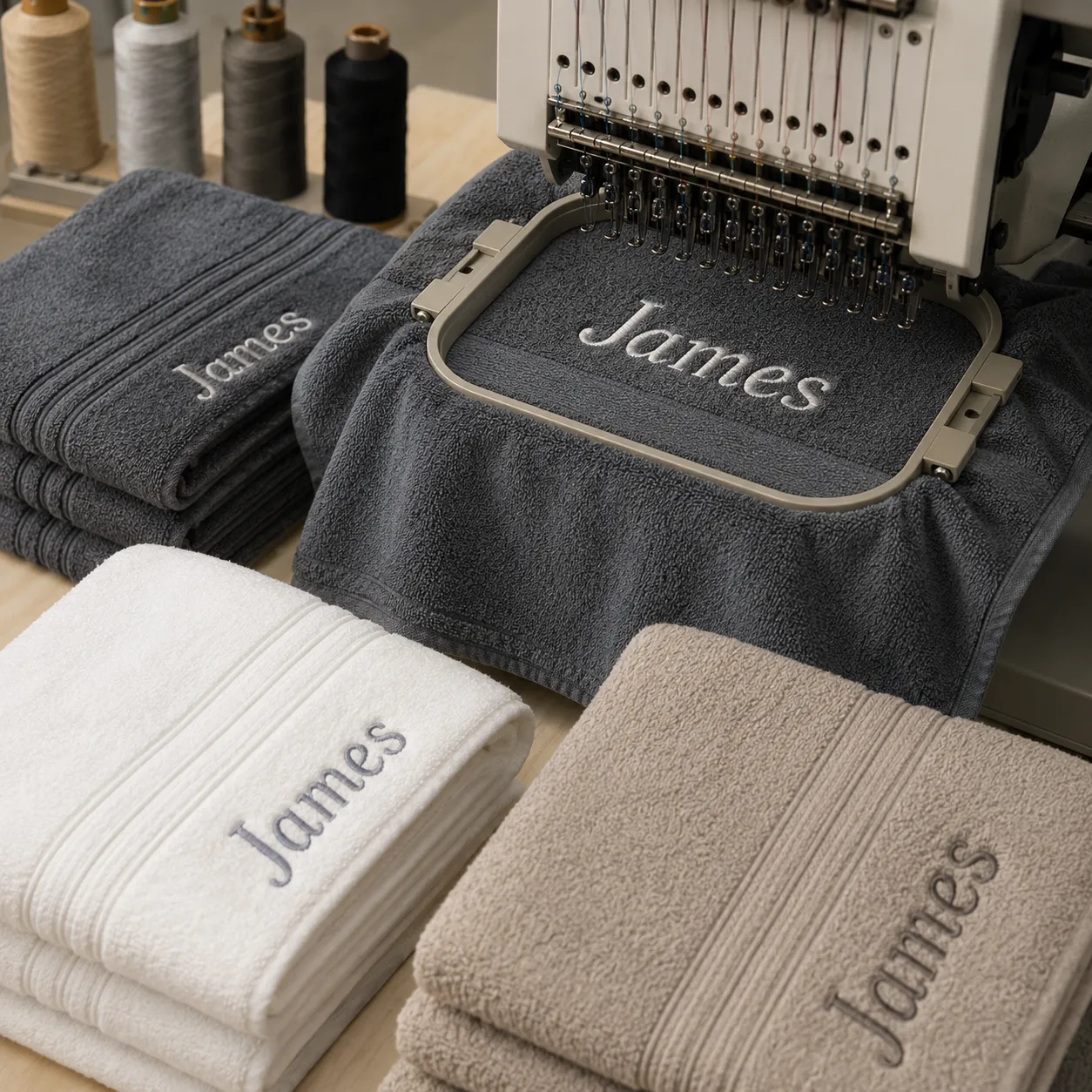
Where custom towels with name fit in production
Custom towels with name sit between standard private-label towels and fully bespoke artwork. The towel body is usually made as one bulk program: same yarn, same GSM, same dye lot, same size. The names are then applied as variable decoration by embroidery, woven jacquard, reactive print, sublimation on microfiber, or heat-transfer label depending on the fabric and use case.
Our MOQ remains 500 pcs per design and per color because yarn preparation, dyeing, loom setup, cutting, and sewing cannot be priced one towel at a time. Inside that 500 pcs, the name field can vary piece by piece if the buyer supplies a clean name list and accepts the decoration handling charge. For example, 500 navy gym towels with 500 different member names is workable; 80 navy, 120 white, 95 sage, and 205 black towels is four color programs and must be quoted differently.
| Program type | Usual towel base | Name method | Practical note |
|---|---|---|---|
| Hotel VIP amenity | 500-650 GSM cotton face towel or bath towel | Embroidery or small woven label | Best packed by room, suite, or guest-list batch |
| Beach club membership | 360-480 GSM velour cotton or 220-300 GSM microfiber | Embroidery, reactive print, or sublimation | Names should stay away from hem fold and corner grommet zones |
| Sports team towel | 320-420 GSM terry or 250-320 GSM microfiber | Embroidery or sublimation | Roster changes need a name-free overage plan |
| Retail gift towel | 450-600 GSM cotton hand or bath towel | Embroidery or monogram | Carton labeling must match SKU and name sequence |
Choose the name method before choosing the towel
A name can be decoration, identity control, or a gift cue. Those are not the same factory problem. Embroidered name towels feel durable and are readable on terry, but stitch count affects cost and hand feel. Sublimation is faster for full-color variable names on polyester microfiber, but it does not work on cotton. Jacquard can weave a name into the towel, yet it is only sensible when the same name repeats across a large quantity, such as a resort, brand, club, or event.
For cotton towels, we normally test embroidery on a real production swatch after dyeing because pile height changes how letters sit. A 6 mm terry loop can swallow thin script strokes, while a sheared velour beach towel gives cleaner edges. On microfiber, the decision is more about print migration, edge sharpness, and whether the towel will be washed with solvents, sunscreen residue, or disinfectant.
| Method | Best use | Typical size range | Factory risk to control |
|---|---|---|---|
| Embroidery | Names, initials, room labels, team names | 55-180 mm wide name field | Loop snagging, puckering, thread shade drift |
| Sublimation | Full-color personalized towels bulk orders on microfiber | Any print field within heat-press bed | Name-list mismatch, ghosting, heat marks |
| Reactive print on cotton | Repeated names or artwork with soft hand feel | Usually panel or full face | Color bleeding if wash-off is rushed |
| Jacquard weave | Brand name or club name repeated across all towels | Pattern repeat set by loom design | Longer setup and less flexibility for variable names |
| Woven or heat-transfer name label | Operational ID, laundry tracking, staff issue | 25-70 mm label | Edge lift, label abrasion, skin feel complaints |
- Use embroidery for cotton terry when the name is small, high-value, and expected to survive hotel or club laundry.
- Use sublimation for microfiber beach, gym, or promotional towels when every name is different and full-color artwork is involved.
- Avoid jacquard for one-name-per-piece personalization unless the same name repeats at least several hundred times.
- Keep heat-transfer labels away from face-use zones; they work better on hems, hanging loops, or staff-issue towels.
Lettering that survives pile, laundering, and folding
The artwork file for a name program is usually simple, but the stitch result is not. We digitize the font into thread paths, then run it on our Tajima multi-head embroidery machines using the actual towel fabric. Satin stitch that looks clean on a polo shirt can sink into a 580 GSM bath towel. For terry, we often add a knockdown stitch under the name so the pile stays flat and the letters remain readable after washing.
We ask buyers to approve names at production scale, not only on a PDF. A 9-letter name and a 17-letter name behave differently in the same frame. If the longest name is forced into the same width as the shortest one, the long name becomes thin and weak. For embroidered name towels, we usually set a maximum character count per line and confirm whether long names may shift to two lines.
| Name field | Recommended spec | Why it matters |
|---|---|---|
| Minimum letter height | 7 mm on low pile, 9-11 mm on terry | Smaller letters fill in after repeated wash and tumble dry |
| Embroidery backing | Water-soluble film on top, tear-away or soft cut-away below | Controls pile push-through and reduces puckering |
| Thread | 120D/2 polyester for commercial wash; rayon only for low-heat retail use | Polyester holds color better under bleach-free industrial laundry |
| Stitch density | 0.38-0.45 mm spacing for most satin fields | Too dense makes the towel stiff and can distort hems |
| Safe placement | 35-60 mm above hem depending on towel size | Avoids seam bulk, fold crease, and border shrinkage |
- Receive the name list in XLSX or CSV with one name per row, no merged cells, and one column for carton or guest-room code if needed.
- Run spelling normalization exactly as approved by the buyer; we do not translate, shorten, or correct names without written confirmation.
- Digitize the longest and shortest names first, then check both on the actual towel quality.
- Make a pre-production sample set of 3-6 names before opening the full embroidery run.
- Scan finished pieces against the approved list during packing so the carton mark and towel name match.
GSM, size, and pile choices that affect personalization
Name decoration behaves differently by towel construction. A dense 620 GSM bath towel gives a soft hand, but it is harder to embroider cleanly than a 430 GSM hand towel with lower pile. A velour beach towel accepts embroidery neatly on the sheared side, while loop terry gives better absorbency on the reverse. For gym programs, 340-420 GSM cotton is often enough because the towel is washed frequently and needs fast drying more than deep pile.
We do not treat GSM as a prestige number. For a 50 x 100 cm club towel, 450 GSM gives a finished towel around 225 g before decoration and label packaging. At 600 GSM, the same size moves toward 300 g, which raises freight and laundry drying time. A 75 g difference across 1,200 towels adds about 90 kg to shipment weight before cartons.
- Face towels for VIP amenity sets: 32 x 32 cm or 35 x 35 cm, 480-600 GSM cotton, embroidery field under 90 mm wide.
- Gym towels: 40 x 80 cm or 45 x 90 cm, 320-420 GSM cotton terry, short names or initials near the hem.
- Beach club towels: 80 x 160 cm or 90 x 170 cm, 360-480 GSM velour cotton, optional corner grommet outside the name zone.
- Microfiber travel towels: 70 x 140 cm, 220-300 GSM polyester/polyamide, sublimated names with pouch labeling.
- Hotel bath towels: 70 x 140 cm or 76 x 152 cm, 550-700 GSM cotton, embroidery kept below the main body contact area.
Costing a name program without hiding the handling work
The base towel price is only one part of a name order. Variable decoration adds list processing, digitizing, machine setup, operator checks, slower packing, and sometimes individual polybag labels. This is why a single-name logo towel and a towel order with 700 different names cannot share the same unit price even if the fabric is identical.
For our mill pricing, volume matters but complexity also matters. The bands below are realistic FOB China ranges for standard specifications in 2026, using OEKO-TEX Standard 100 Class I compliant dyes and trims. Final pricing depends on yarn market, exchange rate, packing, artwork, and whether the order uses cotton, microfiber, or blended yarn.
| Quantity | Cotton towel with embroidered name | Microfiber towel with sublimated name | Typical added services |
|---|---|---|---|
| 500-999 pcs | USD 3.85-7.40 per pc | USD 2.60-5.10 per pc | Name list check, 1 embroidery tape or print template, standard export carton |
| 1,000-2,999 pcs | USD 3.25-6.65 per pc | USD 2.25-4.55 per pc | Barcode or room-code sticker, 3-6 name PP samples, carton sequence report |
| 3,000-7,999 pcs | USD 2.90-5.95 per pc | USD 1.95-4.10 per pc | Inline AQL checks, split shipping marks, spare-name overage plan |
| 8,000+ pcs | USD 2.55-5.40 per pc | USD 1.72-3.70 per pc | Dedicated production window, packing by destination, pre-shipment inspection file |
A practical example: a 1,400-piece resort member program using 80 x 160 cm velour beach towels at 430 GSM, one embroidered name per towel, and individual kraft belly bands would usually land around USD 6.10-6.85 FOB per piece. Removing the name saves perhaps USD 0.42-0.58 per piece, but it also removes the member identification function the buyer wanted. Switching to a thinner 320 GSM towel may save about USD 0.70-0.95 per piece, yet the towel may curl at the border and look tired after one season of pool laundry. That is where cost-per-use should be calculated, not just unit price.
Testing standards we actually apply
Certification and testing should be attached to the materials and risks in the order. Our factory holds OEKO-TEX Standard 100 Class I for relevant towel articles, BSCI social compliance, and ISO 9001 quality management. Those do not replace order-specific testing. For named towels, the risk points are decoration durability, shade consistency, dimensional change, and whether the name remains readable after laundering.
For cotton embroidery, we use ISO 105-C06 washing color fastness as a reference for dye and thread performance, ISO 105-X12 for rubbing fastness, and ISO 6330 domestic washing procedures when the buyer wants a repeatable laundering simulation. For commercial hotel or spa use, we may add higher-temperature wash trials agreed in the tech pack, because a 40 C home wash does not represent an 80 C laundry tunnel.
- Shade band: lab dip approval under D65 light, then bulk shade checked against the approved swatch before cutting.
- Dimensional change: pre-wash and post-wash measurement with tolerance usually within plus or minus 5 percent unless the buyer specifies tighter limits.
- Embroidery durability: no loose top thread longer than 3 mm after wash test; backing must not scratch or form hard edges.
- Name accuracy: finished towel name must match approved list exactly, including accents and spacing where supplied in the data file.
- Needle damage: no visible hole tearing around dense letters after tension check and wash cycle.
For variable-name orders, the inspection file must prove two things: the towel meets the physical spec, and the correct name is on the correct piece. One without the other is still a failed shipment.
Timeline from name list to packed cartons
Personalization adds calendar time even when the towel fabric is straightforward. A standard dyed cotton towel program takes about 25-38 days after deposit and sample approval. Adding hundreds of unique names normally adds 3-8 working days, depending on stitch count, machine availability, and packing sequence. Sublimation microfiber can be faster on printing but still needs name-list control and heat-press scheduling.
| Stage | Typical time | What we check |
|---|---|---|
| Tech pack and quotation | 2-4 days | Size, GSM, towel construction, decoration method, name field rules |
| Lab dip or print strike-off | 4-7 days | Color under D65, thread shade, print sharpness, artwork scale |
| Pre-production samples | 7-12 days | Longest names, shortest names, wash result, packing label logic |
| Bulk towel production | 18-28 days | Yarn lot, dye lot, weaving, cutting, hemming, inspection |
| Name decoration and packing | 4-10 days | List matching, stitch quality, sequence packing, carton marks |
| Final QC and export booking | 2-5 days | AQL inspection, weight check, document set, shipment plan |
Rush programs are possible only when the buyer freezes the name list early. A late roster update after embroidery starts may require extra blank towels, a second machine setup, and a revised packing report. For event towels, we normally recommend 2-3 percent blank overage so new attendees can be handled locally with a neutral towel instead of delaying the full export shipment.
Packing, cartons, and name privacy
The packing method should match how the towels will be distributed. A hotel opening may need cartons by floor. A tournament may need towels by team or tee-time group. A DTC gift program may need individual barcode labels and no visible name on the outer carton. We can print carton sequence reports, but the buyer must define the distribution logic before final packing begins.
For privacy, we prefer order IDs on carton marks and keep full names inside the packing list or buyer-approved label file. If the towels are going to a third-party warehouse, we can use SKU plus short code instead of a visible personal name. This reduces returns caused by warehouse staff reading a label differently from the buyer's system.
- Lock the final name list before bulk decoration starts and mark any VIP or sample names separately.
- Use one spelling source only; do not send email corrections, chat screenshots, and spreadsheet edits in parallel.
- Confirm whether names with accents, hyphens, apostrophes, or non-Latin characters must be preserved exactly.
- Approve a carton coding format such as destination, room, team, SKU, or order number.
- Keep at least 1 percent undecorated stock when the delivery site expects last-minute additions.
Common defects and the controls that prevent them
The defects on custom printed towels and embroidered pieces are usually small at the machine but expensive at destination. A shifted name can look acceptable on an inspection table and still be rejected by a club member. A thread color can pass in daylight and fail under warm hotel bathroom lighting. That is why our decoration QC checks position, spelling, thread tension, and shade before the towel reaches final packing.
Our normal finished-goods inspection uses AQL 2.5 for major defects and AQL 4.0 for minor defects unless the buyer sets another standard. For name accuracy, we treat spelling mismatch as a major defect because the towel cannot be reworked without visible needle marks in most terry constructions. On sublimation microfiber, ghosting or double-image names are also major defects if visible from normal viewing distance.
- Puckering around embroidery: reduce stitch density, add better backing, or move the name away from a thick border.
- Unreadable script font: increase letter height, change to block lettering, or limit the maximum name width.
- Thread color mismatch: approve thread cards against dyed bulk fabric, not only against a digital mockup.
- Print ghosting on microfiber: control transfer paper movement, pressure, dwell time, and cooling before stacking.
- Packing mismatch: scan or manually tick each finished name against the approved sequence list before carton sealing.
Related reads: for buyers still building the base specification, our towel GSM decision framework and complete towel size guide help narrow the body towel before names are added. Decoration teams can also compare embroidery, sublimation, and jacquard in this method guide.
For adjacent sourcing decisions, see pantone color matching for custom towels, how to build a towel tech pack mills can quote, and our notes on negotiating towel MOQ without killing margin. Beach operators planning bulk personalized beach towels can also review the beach club resort towel program.
What to send for a clean quotation
A complete quotation package saves several days because we can price the towel and the personalization path together. If only a mockup is available, we can still estimate, but final pricing may change after the name list, stitch count, and packing logic are confirmed. The more variable the names are, the more the spreadsheet matters.
| Buyer file | Minimum detail needed | Why we need it |
|---|---|---|
| Towel spec | Size, GSM, yarn, color, hem style, quantity per color | Sets weaving, dyeing, cutting, and base towel cost |
| Decoration brief | Method, placement, maximum name width, thread or print colors | Controls machine setup and reject risk |
| Name list | CSV or XLSX, one name per row, distribution code if required | Prevents spelling errors and packing mismatch |
| Artwork file | AI, PDF, EPS, or high-resolution PNG for logo or layout | Allows digitizing or print separation |
| Compliance requirement | OEKO-TEX, BSCI, ISO 9001 file request, test standard if buyer-specific | Aligns document set before shipment |
| Packing plan | Bulk carton, individual bag, belly band, barcode, room or order sequence | Changes labor time, carton count, and export weight |
For LUMA & CO. TEXTILE orders, the working MOQ is 500 pcs per design and per color. We operate as a vertically integrated mill in Gaoyang with weaving, dyeing coordination, cutting, sewing, decoration, and final QC tied into one order file. For custom towels with name, that single file matters because a towel may pass fabric inspection and still fail the order if the name data is wrong.
Quote a Named Towel Program
Send towel size, GSM target, quantity, decoration method, and a sample name list. We will return a factory quotation with MOQ, timing, and testing notes. WhatsApp: +86 13384590853. Email: [email protected].
Request OEM Quote →