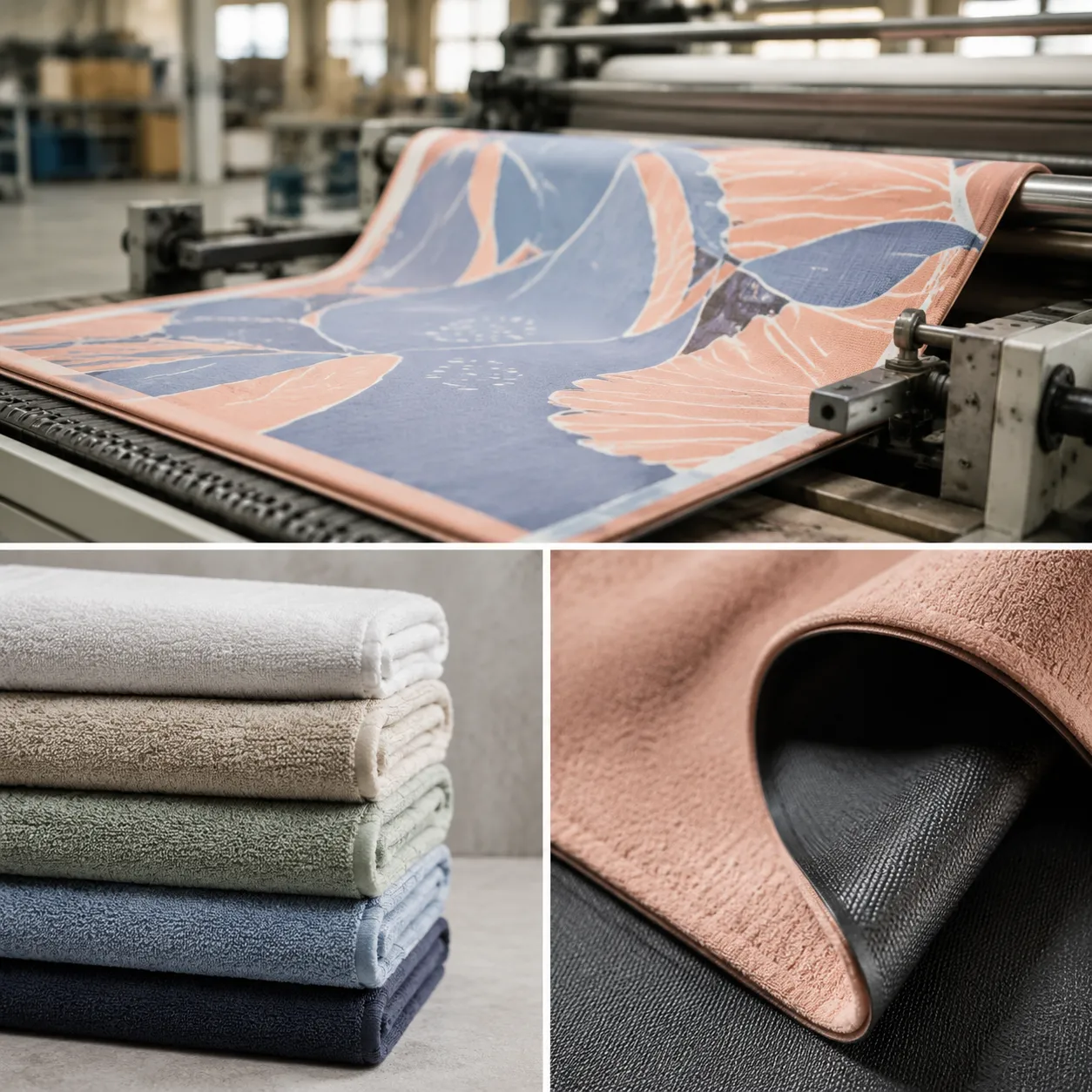
Start With the Use Case, Not the Artwork
We produce towels every day, so we look at yoga mats through a textile lens first: what surface touches skin, how sweat moves, how the printed layer behaves under compression, and whether the backing keeps shape after rolling. A mat for a slow-flow retail kit is not built the same way as a studio mat used under 38°C heat and disinfected after every class.
For most custom printed yoga mats, buyers are really choosing between three structures: a microfiber towel laminated to natural rubber, a printed PVC or TPE mat, or a separate printed yoga towel packed with a plain mat. Because LUMA & CO. TEXTILE is a towel mill, we usually recommend the first or third route for brand programs that need color artwork and sweat performance. PVC mats can be cheap, but the print layer often sits on the surface and abrades at heel and palm zones.
- Retail DTC launch: artwork matters, but carton cube and odor on unboxing also affect returns.
- Hot-yoga studio program: wet grip, wash life, and edge delamination risk are more important than a glossy print.
- Corporate wellness gift: lower GSM and lighter rubber can control freight, but the surface still needs enough pile density for sublimation.
- Resort or retreat kit: sand, sunscreen, and outdoor UV exposure should be considered before approving pale colors.
Our MOQ is 500 pcs per design and per color. That MOQ is not a sales trick; below that level, digital transfer setup, lamination trials, rubber cutting, color proofing, and packing line changeover make the unit cost unstable. If you need to test a concept, it is usually better to run 500 pcs in one versatile design than 200 pcs each across three designs.
Custom Printed Yoga Mats: Construction Options
The most common construction we quote for custom printed yoga mats is a 200-260 GSM polyester microfiber face laminated to a 1.5-3.0 mm natural rubber base. The microfiber surface takes sublimation print cleanly. The rubber base gives floor grip and cushioning. Total finished weight normally sits between 1.1 kg and 2.4 kg depending on size and thickness.
| Construction | Typical spec | Best use | Main risk |
|---|---|---|---|
| Microfiber top + natural rubber | 200-260 GSM face, 1.5-3.0 mm rubber | Private label yoga mats with full artwork | Edge lift if lamination temperature or adhesive coat is wrong |
| Printed yoga towel only | 260-360 GSM microfiber, silicone dots optional | Studios that already provide mats | Towel shift if dot pattern is too sparse |
| TPE mat with surface print | 4-6 mm foam mat | Low-sweat beginner programs | Print scuffing at hand and foot pressure zones |
| Cotton yoga rug style | 420-650 GSM woven cotton | Natural-fiber retail story | Lower print precision and more shrinkage |
A construction detail buyers often miss is the face-fabric stretch direction. Microfiber warp and weft stretch are not identical. If the artwork has a center mandala, a 3-5 mm distortion after heat pressing is visible. We stabilize the printed fabric before lamination and mark cutting direction on the production sheet, especially for symmetrical artwork.
For rubber, we check thickness tolerance, density, odor, and surface powder. Natural rubber has better floor grip than many foamed synthetics, but it must be aired and packed correctly. If mats are sealed too soon after lamination, cartons can arrive with a heavy rubber smell even when the material itself passed incoming inspection.
Print Method: Why Sublimation Is Usually Safer
For a microfiber yoga towel surface, sublimation is usually the cleanest yoga mat printing method. The dye bonds inside the polyester fiber under heat rather than sitting as a thick ink film. That matters because palms, elbows, and knees rub the same zones repeatedly. A surface ink can crack or polish smooth; sublimation keeps the fabric hand feel closer to the original.
We normally print at 190-205°C with controlled dwell time, then allow the printed roll to relax before lamination. If the fabric goes straight from heat press to adhesive bonding while still under tension, the finished mat can curl at the short ends. Curl is not only cosmetic. On a studio floor, a lifted corner becomes a trip point.
- Fine line minimum: keep lines at 1.2 mm or wider for reliable visibility after pile movement.
- Safe border: leave 8-12 mm from the cut edge for critical logos or text.
- Dark solid areas: expect more visible lint and hand marks than mid-tone artwork.
- Pantone matching: provide coated Pantone references, but approve against fabric strike-off, not a screen image.
- Repeat alignment: large geometric patterns need a printed cutting marker, not only a PDF file.
For color work, we follow the same discipline we use on towels: lab dip or print strike-off first, then bulk approval. Buyers who are building a full yoga range should also read our notes on Pantone color matching for custom towels, because the same brand-color problem appears when artwork moves from digital file to textile substrate.
Grip Is a System: Wet Face, Rubber Back, Edge
A non-slip yoga mat does not come from one material choice. Grip depends on the wet behavior of the printed face, the friction of the backing against the floor, the flatness of the mat, and how the edge is finished. We test grip informally during sampling with wet palms because standard dry friction checks do not represent a hot-yoga class.
For the face, brushed microfiber feels soft in retail handling, but if the pile is too high it can feel slippery before sweat activates it. A lower-pile 220-240 GSM face is often more stable than a fluffy 320 GSM face laminated to rubber. For a separate yoga towel, higher GSM can make sense because the towel must absorb more moisture without a rubber backing.
| Spec item | Recommended range | Factory comment |
|---|---|---|
| Microfiber face GSM | 200-260 GSM for laminated mats | Good print clarity without excessive pile shift |
| Yoga towel GSM | 260-360 GSM | Better sweat capacity when used over studio mats |
| Rubber thickness | 1.5-3.0 mm | 2.0 mm balances weight and cushioning for most DTC programs |
| Finished size | 61 x 173 cm, 61 x 183 cm, or 66 x 183 cm | Wider mats improve comfort but raise freight cost quickly |
| Edge tolerance | +/- 5 mm | Tighter tolerance requires slower cutting and more waste |
Edge finishing deserves more attention than it gets. Some factories simply cut the laminated sheet and pack it. We prefer a clean die-cut or CNC cut with adhesive coverage checked to the border. A common defect mode is 'smiling edge' delamination, where the microfiber lifts in a curved line near the corner after rolling and unrolling. It usually comes from uneven adhesive coat weight or cutting before the laminate has fully cured.
Artwork Rules We Enforce Before Sampling
Good artwork files reduce sampling rounds. We need vector files for logos and editable high-resolution files for full-surface art. A 150 dpi file may look acceptable on a phone, but on a 183 cm mat it can print soft. For full-bleed artwork, we ask for final-size art at 200-300 dpi, plus 15 mm bleed on each side.
- Confirm finished size and orientation before artwork layout. A 61 x 183 cm mat is not the same visual field as a square towel.
- Place logos outside high-abrasion zones if possible. The center line and top-hand area see the most rubbing.
- Avoid white micro-text on dark photographic artwork. Pile direction can break small letter shapes.
- Send Pantone references for brand colors and accept that fluorescent shades cannot be matched exactly by sublimation.
- Approve one physical strike-off under daylight and indoor studio lighting before bulk production.
If your range includes both mats and towels, build one technical pack for the whole kit. Our article on how to build a towel tech pack that mills can quote is written for towels, but the same logic applies: dimensions, GSM, color standard, artwork placement, packing, barcode, testing, and target landed cost should be visible before quotation.
Testing: What We Check Before Bulk Release
We do not treat a printed mat as approved just because the color looks right. Before bulk release, we check print fastness, lamination strength, dimensional change, rubber odor, and rolling recovery. For textile colorfastness, we reference ISO 105-C06 for washing and ISO 105-X12 for rubbing where applicable. For restricted substances, we can supply OEKO-TEX Standard 100 Class I documentation on qualified textile components.
Laminated mats need a peel check. In production, we cut narrow strips from the trial laminate and pull the face fabric from the rubber backing after curing. The goal is not only high force. We want consistent failure behavior. If the adhesive releases cleanly from rubber, the bond is weak. If fibers tear from the face fabric, the lamination is stronger than the textile surface, which is usually acceptable.
| Check | Method or reference | Practical pass target |
|---|---|---|
| Colorfastness to washing | ISO 105-C06 adapted for microfiber face | Grade 4 or better for staining on approved colors |
| Dry and wet rubbing | ISO 105-X12 | Grade 4 dry, grade 3-4 wet depending on shade |
| Dimensional change | Internal wash and dry cycle | Within +/- 3% for separate yoga towels |
| Lamination peel | Internal strip pull after curing | No clean adhesive separation along the edge |
| Needle/metal control for packed textile goods | Factory metal detection procedure | 100% packed-goods pass before carton sealing |
Our mill operates under ISO 9001 quality procedures and BSCI social compliance. We have supplied 80+ brand clients across 47 countries since 2007, with annual towel output around 2.4 million pieces. For buyers selling into baby, wellness, or skin-contact channels, certification scope matters. Use our guide on how to read an OEKO-TEX certificate before assuming a supplier certificate covers every component in a yoga kit.
Pricing Bands and Cost Per Use
Pricing depends heavily on rubber thickness, size, print coverage, packing, and whether you are buying a laminated mat or a separate microfiber yoga towel. The bands below are realistic FOB China ranges for OEM orders from our type of factory. They are not valid for unusually heavy retail boxes, licensed artwork inspections, or urgent air shipment.
| Order volume | Printed microfiber yoga towel | Printed microfiber + rubber mat | Typical lead time |
|---|---|---|---|
| 500-999 pcs | USD 4.10-6.30/pc | USD 10.80-15.40/pc | 28-38 days after approval |
| 1,000-2,999 pcs | USD 3.55-5.20/pc | USD 9.20-13.60/pc | 30-42 days after approval |
| 3,000-5,999 pcs | USD 3.10-4.65/pc | USD 8.35-12.10/pc | 34-46 days after approval |
| 6,000+ pcs | USD 2.75-4.20/pc | USD 7.70-11.30/pc | 40-55 days after approval |
Here is how we push back on the cheapest option. A retreat operator once compared a USD 6.90 printed foam mat against a USD 11.85 microfiber-rubber mat. The cheaper mat looked attractive for a 900-piece order, saving USD 4,455 upfront. But after three months of weekly use, the surface print at the palm zone had visible scuffing, and 18% of mats were removed from guest use. If the higher-spec mat lasts 85 sessions and the cheaper one lasts 28 sessions, the cost per session is about USD 0.14 versus USD 0.25 before handling and replacement labor. For studio and hospitality programs, that difference matters more than the first invoice.
For very low-budget promotions, we may recommend a printed towel without a rubber base. It is lighter, ships more efficiently, and still gives the brand a large artwork surface. For buyers comparing cotton and microfiber performance, our microfiber vs cotton towel comparison explains why microfiber is usually chosen for printed yoga surfaces.
Production Timeline and Approval Gates
A stable production calendar prevents rushed approvals. For a new OEM yoga mat program, sampling usually takes 7-12 days after artwork and material confirmation. If a custom rubber color, special carton, or retail sleeve is needed, add 4-7 days. Bulk production starts only after signed sample approval, deposit, final packing details, and shipping marks.
- Day 1-2: confirm size, GSM, rubber thickness, artwork files, packing, and compliance needs.
- Day 3-6: print strike-off and color adjustment on microfiber face fabric.
- Day 7-12: lamination sample, cutting, edge check, rolling test, and sample dispatch.
- Day 13-18: buyer review, revised sample if needed, and pre-production sheet lock.
- Day 19-50: bulk printing, lamination, curing, cutting, inspection, packing, and carton sealing depending on quantity.
Ocean freight is usually more sensible than air for rubber-backed mats because weight builds fast. A 2.0 mm natural rubber mat packed in a retail sleeve may reach 1.5-1.8 kg per piece after packaging. Air freight can erase the savings of a careful FOB negotiation. For shipment planning, see our guide to container vs air freight towel orders; the carton math is similar, but mats are denser.
Common Defects We Try to Prevent
The failures we see are usually process failures, not mysterious material problems. A mat can pass visual inspection flat on a table and still fail after being rolled tightly for two weeks in a carton. That is why we include rolling recovery in sampling and avoid packing immediately after lamination.
- End curl: often caused by heat tension, uneven laminate cooling, or packing before cure time is complete.
- Ghosting in print: caused by fabric movement during transfer, especially on long gradient artwork.
- Corner delamination: linked to low adhesive coverage near the edge or dull cutting blades pulling the face fabric.
- Rubber odor complaint: worsened by sealing mats too soon or using low-grade rubber filler.
- Barcode sleeve mismatch: happens when multiple designs share similar cartons and no line-side scan check is used.
For club and studio buyers adding towels to a mat program, we also recommend checking laundry behavior. The article why gym towels fail after 50 washes covers linting, edge failure, and chemical damage that can also affect yoga towels used in rental programs.
What to Send Us for a Reliable Quote
A clear quote request saves three or four email rounds. Tell us whether you need a laminated mat, a separate printed towel, or a kit with both. Include target retail price if you have one, because packaging and thickness choices can be adjusted before sampling rather than after the cost comes back too high.
- Finished size, thickness, and preferred weight range.
- Face fabric GSM and whether the surface should feel smooth, suede-like, or towel-like.
- Artwork file with Pantone references and intended logo placement.
- Packing method: belly band, polybag, kraft tube, retail box, or set packaging.
- Destination country, expected order quantity, and delivery deadline.
- Compliance needs such as OEKO-TEX Standard 100 Class I, BSCI, ISO 9001 documentation, or buyer-specific testing.
Related reads: for yoga towel sizing and fit, see our best yoga mat towel fit guide and private label yoga towel OEM specs. If you are pairing mats with studio accessories, the logo yoga mat towel kit specification is also useful.
Related reads: for broader decoration choices, compare embroidery vs sublimation vs jacquard. For MOQ planning, read negotiate towel MOQ without killing margin. For product families beyond yoga, our gym towel range is listed at /products.html#gym and yoga-sector use cases are close to ../industries/yoga-pilates-towels.html.
Build a Yoga Mat or Towel Spec
Send artwork, size, target quantity, and destination. We will check construction, print method, MOQ, price band, and production timing. WhatsApp: +86 13384590853. Email: [email protected].
Request a factory quote →