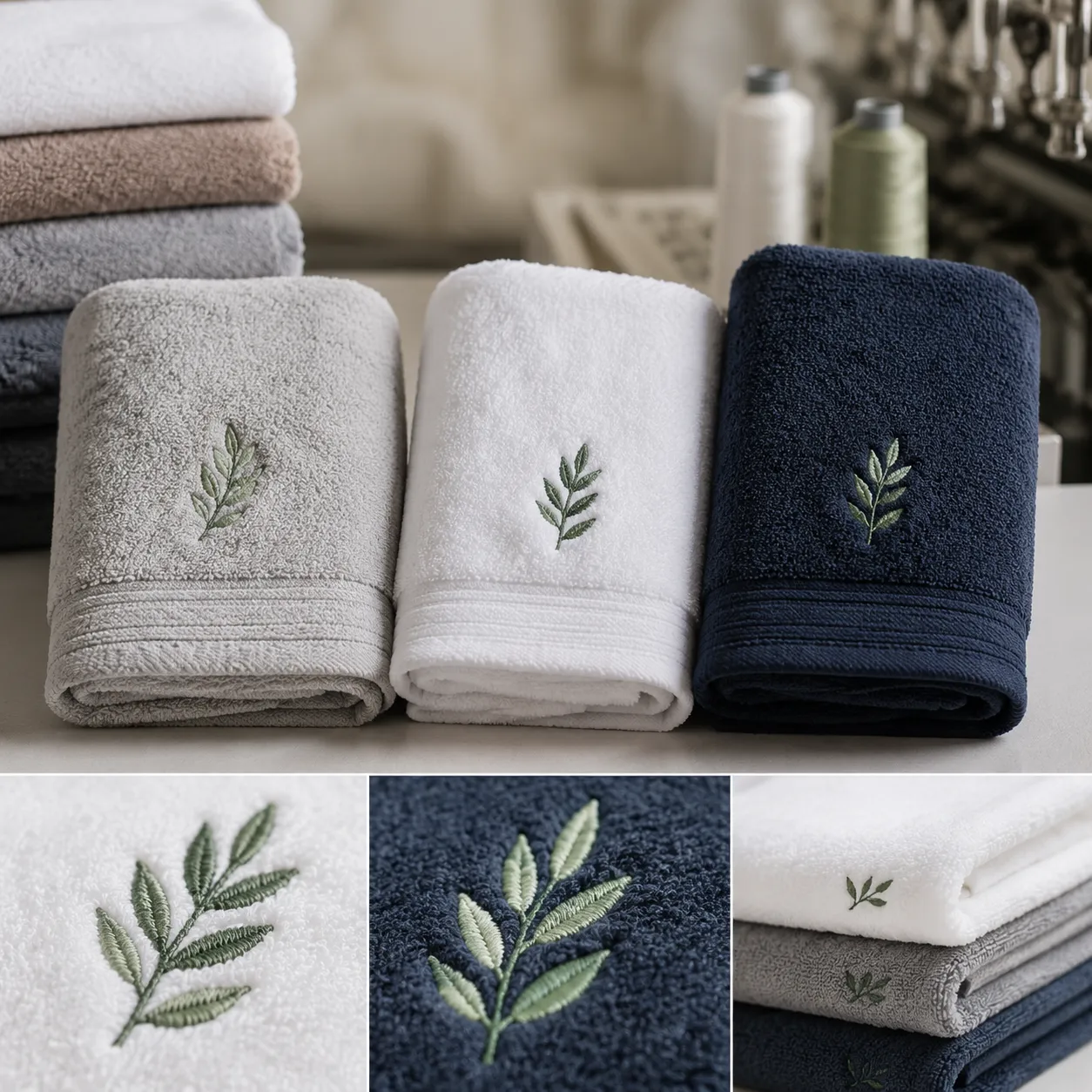
Start with the logo, not the machine
Embroidery on hand towels fails most often before the needle touches fabric. The problem is usually artwork that was drawn for paper, signage, or a website and then copied directly onto terry loops. A 1 mm serif, a thin script tail, or a shaded gradient may look clean in a PDF, but on a 450–600 GSM cotton towel it becomes thread bulk, loose loop interference, or unreadable detail.
In our decoration room, we first reduce the artwork into three questions: what must remain readable at arm's length, what can be simplified, and what should be moved to a woven label or hangtag instead. For custom embroidered hand towels, this step saves more money than arguing over thread cost. A design reduced from 13,800 stitches to 7,600 stitches may run cleaner, feel softer, and reduce decoration cost by USD 0.18–0.32 per piece depending on quantity.
- Crests and hotel emblems: usually need satin borders, limited fill, and a minimum height of 35–45 mm.
- Wordmarks: work best when letter height is above 6 mm for block fonts and above 8 mm for script fonts.
- Initials or monograms: can sit smaller, but thread contrast must be controlled against the towel color.
- Fine-line icons: often need to be thickened during digitizing rather than stitched exactly as supplied.
- Multi-color marks: should stay within 2–4 thread colors unless the order size justifies longer machine changeover.
Embroidered Hand Towel Logo Decoration Comparison
For an embroidered hand towel logo decoration comparison, we do not rank methods as good or bad. We match each method to towel GSM, logo size, laundry conditions, and the buyer's tolerance for hand-feel. A spa hand towel used beside a treatment bowl needs a softer logo than a retail gift towel hanging on a display rack. A hotel towel washed at 60°C with alkaline detergent needs a more conservative stitch plan than a corporate giveaway used at home.
| Decoration choice | Best use | Watch point on terry |
|---|---|---|
| Satin stitch outline | Borders, initials, simple icons, small monograms | Too much width causes raised edges that catch in laundry |
| Fill stitch | Solid crests, badges, block symbols | High density can flatten pile and create a stiff patch |
| Applique plus embroidery | Large logos above 80 mm, resort emblems, retail gift sets | Fabric edge must be locked cleanly or it frays after wash |
| Embroidery on dobby border | Hotel marks and club names placed below the terry field | Border shrinkage can pucker if backing tension is wrong |
| Woven label instead of embroidery | Very small text, QR codes, care branding | Looks less integrated but avoids heavy stitch density |
Satin stitch vs fill stitch is not just a visual choice. Satin stitches run across a narrow shape, so they lift nicely on initials and outlines. Fill stitches cover an area in rows, so they are needed for solid logos, but they also add a panel of thread that resists the towel's natural movement. On a 40×70 cm hand towel, we try to keep the embroidered zone below about 75×55 mm unless the towel is meant mainly for presentation.
The hand towel construction changes the answer
A logo that runs well on a 650 GSM bath towel may distort on a lighter hand towel. Hand towels have less fabric mass to absorb needle tension, and the embroidery area is closer to hems, dobby borders, and folded edges. We usually build hotel and spa hand towels between 430 and 560 GSM. Retail gift towels sometimes go to 600 GSM for a fuller shelf feel, while gym or salon hand towels may sit at 380–450 GSM for faster drying.
| Hand towel base | Typical spec | Embroidery guidance |
|---|---|---|
| Hotel terry hand towel | 40×70 cm, 500–560 GSM, 16/1 or 21/2 cotton yarn | Use medium-density logo, preferably 45–70 mm wide |
| Spa treatment hand towel | 35×75 cm or 40×70 cm, 450–520 GSM, softer pile | Avoid dense fill near the area touched by guest skin |
| Retail monogram towel | 40×70 cm, 520–600 GSM, combed cotton | Satin monogram works well; test thread sheen under store lighting |
| Gym or locker hand towel | 30×50 cm or 35×70 cm, 380–460 GSM | Small logo only; heavy embroidery makes the towel dry unevenly |
| Promotional hand towel | 30×50 cm, 330–420 GSM | Use simplified embroidery or switch to label if budget is tight |
Loop height matters. On high-loop terry towel embroidery, loose pile can push through the thread and make a logo look fuzzy after washing. We use a water-soluble topping for many designs, especially white thread on navy or charcoal towels. The topping holds loops down during stitching and dissolves during finishing. Skipping it saves only a small handling cost, but the defect is visible: cotton loops appear as small dots through the fill area.
Placement is a durability decision
Logo embroidery placement affects laundering, folding, and guest perception. The common request is lower center, 60–90 mm above the bottom hem. That works for many hotel programs, but it is not always the safest position. If the towel has a dobby border, the border may shrink differently from the terry field. Dense embroidery placed half on the dobby and half on the pile can pull the two zones against each other.
One sample case from our line: a boutique hotel approved a 40×70 cm, 540 GSM hand towel in deep green with a 64 mm gold crest positioned 25 mm above a 35 mm dobby border. The first embroidery trial looked sharp. After five industrial wash cycles, the crest cupped upward at the bottom edge. The cause was not thread quality. The logo sat too close to the woven border, and the fill density locked the fabric while the border shrank slightly. We moved the crest 18 mm higher, reduced fill density by 9%, and changed the underlay direction. The revised sample passed 25 wash cycles without cupping.
- Mark the towel's final folded position before approving artwork placement.
- Keep dense logos at least 40 mm away from heavy borders when possible.
- Avoid embroidery across seam transitions or thick hem corners.
- Check left-right centering after washing, not only on the fresh sample.
- Confirm whether the logo should face outward on a tri-fold, roll, or hanger display.
For a broader sizing discussion, our towel sizes and dimensions guide is useful before finalizing placement. If the towel is part of a hotel program, compare the logo location with the fold standard in the hotel towel sourcing guide.
Digitizing rules we use before sampling
Good digitizing is not automatic file conversion. The stitch file must compensate for terry movement, pile height, shrinkage, and thread pull. We request AI, EPS, PDF, or high-resolution PNG artwork, but we do not send those files straight to the embroidery machine. Our decoration team builds a DST file, runs a first strike-off, then adjusts underlay and density.
- Minimum letter height: 6 mm for clean block letters; 8–10 mm for script or serif letters.
- Recommended thread: 120D/2 polyester for hotel laundry because it resists chlorine-free oxidizing detergents better than rayon.
- Needle range: usually 75/11 or 80/12 sharp embroidery needles, adjusted for towel thickness.
- Backing: tear-away backing for many hand towels; cut-away backing only when the logo is large or unstable.
- Topping: water-soluble film for high pile, dark colors, and fine lettering.
A defect we reject early is thread tunneling, where the fabric puckers into small channels beside satin stitches. It can happen when the satin column is too wide or when backing tension is excessive. Another common issue is bird nesting on the reverse side, especially when operators try to run a dense crest too fast. On hand towels, the back side still matters because guests see it when the towel is folded or hung.
Cost drivers: stitch count, handling, and rejects
Embroidery cost is not calculated only by thread consumption. The machine time, hooping labor, color changes, trimming, inspection, and reject allowance all move the price. A small 3,200-stitch monogram may run quickly on multi-head machines. A 14,500-stitch crest with five colors can slow output and increase handling marks if operators must re-hoop carefully near a border.
| Order volume per design/color | Simple logo, 3,000–5,500 stitches | Medium logo, 6,000–10,000 stitches | Dense logo, 10,500–16,000 stitches |
|---|---|---|---|
| 500–799 pcs | USD 2.35–3.10 FOB/pc | USD 2.75–3.65 FOB/pc | USD 3.35–4.45 FOB/pc |
| 800–1,499 pcs | USD 2.05–2.78 FOB/pc | USD 2.42–3.28 FOB/pc | USD 2.98–3.95 FOB/pc |
| 1,500–2,999 pcs | USD 1.86–2.48 FOB/pc | USD 2.18–2.90 FOB/pc | USD 2.68–3.52 FOB/pc |
| 3,000+ pcs | USD 1.68–2.22 FOB/pc | USD 1.96–2.62 FOB/pc | USD 2.38–3.15 FOB/pc |
The ranges above assume a cotton hand towel around 40×70 cm and 450–560 GSM, with normal export packing. Yarn choice, towel color, embroidery position, private-label packaging, and certification documents can shift the final quote. Our MOQ is 500 pcs per design per color. Below that level, machine setup, sample matching, and packing labor take too much share of the unit cost.
A cheaper embroidery file is rarely cheaper after bulk inspection. If the logo needs 8,000 stable stitches, forcing it down to 5,000 can create gaps, fuzzy edges, and more second-quality towels.
Consider a 1,200-piece hotel reorder using a 40×70 cm, 520 GSM towel. A simplified 58 mm crest at 7,400 stitches may land around USD 2.70 FOB per piece. Keeping the original artwork with a shaded shield and tiny motto could raise the file to 13,200 stitches and push the towel near USD 3.38 FOB per piece. If the heavier logo also increases laundry reject risk by even 3%, the apparent branding upgrade becomes expensive over a two-year linen cycle.
Sampling path for logo approval
We separate artwork approval from towel approval. First we confirm the logo interpretation on a fabric swatch or pilot towel. Then we wash the embroidered sample and inspect the face, reverse, edge stability, and color. For hotel and spa customers, we recommend approving the sample after at least three wash-and-dry cycles, not straight from the machine.
| Stage | Factory action | Typical timing |
|---|---|---|
| Artwork review | Check logo size, colors, minimum line width, placement | 1–2 days |
| Digitizing and thread match | Build DST file, select polyester thread, prepare sample card | 2–4 days |
| Strike-off embroidery | Run logo on actual towel fabric or closest available base | 3–5 days |
| Wash check | Test shrinkage, puckering, loop show-through, thread security | 3–6 days |
| Bulk production | Weaving, dyeing, embroidery, finishing, inspection, packing | 25–38 days after sample and deposit approval |
| Export dispatch | Carton marking, booking, customs documents | 4–9 days depending on sailing or air schedule |
For test references, we commonly align towel performance checks with ISO 6330 domestic washing procedures for sample comparison, ISO 105-C06 for color fastness to washing where relevant, and ISO 105-X12 for rubbing fastness on dyed grounds. Our factory systems are ISO 9001 certified, our social compliance audit is BSCI, and we can produce OEKO-TEX Standard 100 Class I certified towels when the yarn, dye, thread, and accessory package are all controlled under the approved route.
Where embroidery should lose to another method
Embroidery is strong for initials, crests, club marks, and luxury hotel identity. It is not the right answer for every hand towel. If the artwork contains a photographic gradient, very small sponsor names, or a full-edge pattern, another decoration route may protect both budget and appearance. We say this early because switching methods after sampling wastes 10–14 days.
- Choose jacquard when the logo or pattern should be woven across the towel body and the order volume can support yarn-dyed or dobby planning.
- Choose sublimation for full-color artwork on microfiber, not for cotton terry hand towels.
- Choose a woven label for tiny text, compliance marks, QR codes, or retail storytelling.
- Choose embroidery for durable, raised branding where the logo can be simplified and kept within a controlled size.
Our embroidery vs sublimation vs jacquard article gives a wider method comparison. For buyers still building the base towel spec, read combed vs zero-twist cotton explained and towel GSM decision framework before locking the decoration file.
Bulk QC points our inspectors do not skip
During bulk production, embroidered towels need inspection beyond normal textile checks. We inspect towel size, GSM, shade, absorbency, seam condition, and packing, but the logo adds its own risks. A stable first sample does not guarantee stable bulk if thread lots change, machines run too fast, or operators hoop too close to the border.
- Measure logo position from the same reference edge on every inspection lot.
- Check thread color under D65 light and compare against the approved sample.
- Rub the logo face by hand to find loose loops trapped in the stitch field.
- Inspect the reverse side for knots, long jump threads, and backing residue.
- Wash random bulk pieces before final release if the logo has dense fill or high contrast.
For one retail client, the logo looked correct on the face side but failed our reverse-side check. A trimmed jump thread between two letters was left at 11–13 mm on part of the lot. It did not show in flat product photography, but it caught on a packing insert during folding. We stopped the line, retrimmed the affected cartons, and added a reverse-side trim check at the packing table. That kind of defect is small until 2,400 gift towels reach a distribution center.
If your team is writing an RFQ, the build a towel tech pack that mills can quote checklist will help you specify logo size, stitch expectations, packing, and test requirements. For certification paperwork, use how to read an OEKO-TEX certificate so the towel body and embroidery materials are covered correctly.
What to send us for a clean quote
A good RFQ for monogrammed hand towels or logo hand towels should include more than a logo file. We need the towel base, GSM target, color, size, expected laundry method, logo dimensions, placement, packing, and shipment terms. If you are unsure about the decoration method, send the artwork in its original form and tell us where the towel will be used. We can return two practical options instead of one fragile design.
- Artwork: AI, EPS, PDF, or high-resolution PNG, plus Pantone or thread color target.
- Towel spec: size, GSM, yarn preference, color, border style, and whether OEKO-TEX Standard 100 Class I is required.
- Logo instruction: width or height in millimeters, preferred position, and fold/display method.
- Order plan: quantity per design per color; our MOQ is 500 pcs per design per color.
- Commercial details: destination port, Incoterm preference, packing requirement, and target delivery window.
For most approved programs, sampling takes 9–17 days depending on artwork complexity and towel base availability. Bulk production normally needs 25–38 days after sample approval and deposit. Add freight time based on route: air shipment is faster but costly for cotton towels, while sea shipment is more stable for replenishment planning. Our team in Gaoyang, Zhejiang manages weaving, dyeing, embroidery, finishing, inspection, and export packing under one production schedule.
LUMA & CO. TEXTILE has 220 employees and has produced OEM towel programs since 2007. We supply more than 80 brand clients across 47 countries, with annual output around 2.4 million towels. For a quote on an embroidered hand towel logo decoration comparison using your actual artwork, contact us by WhatsApp at +86 13205717266 or email [email protected].
Send the logo before you lock the towel
Share your artwork, hand towel size, GSM target, quantity, and delivery market. We will review stitch feasibility, placement risk, MOQ, pricing band, and sample timing.
Request a decoration review →