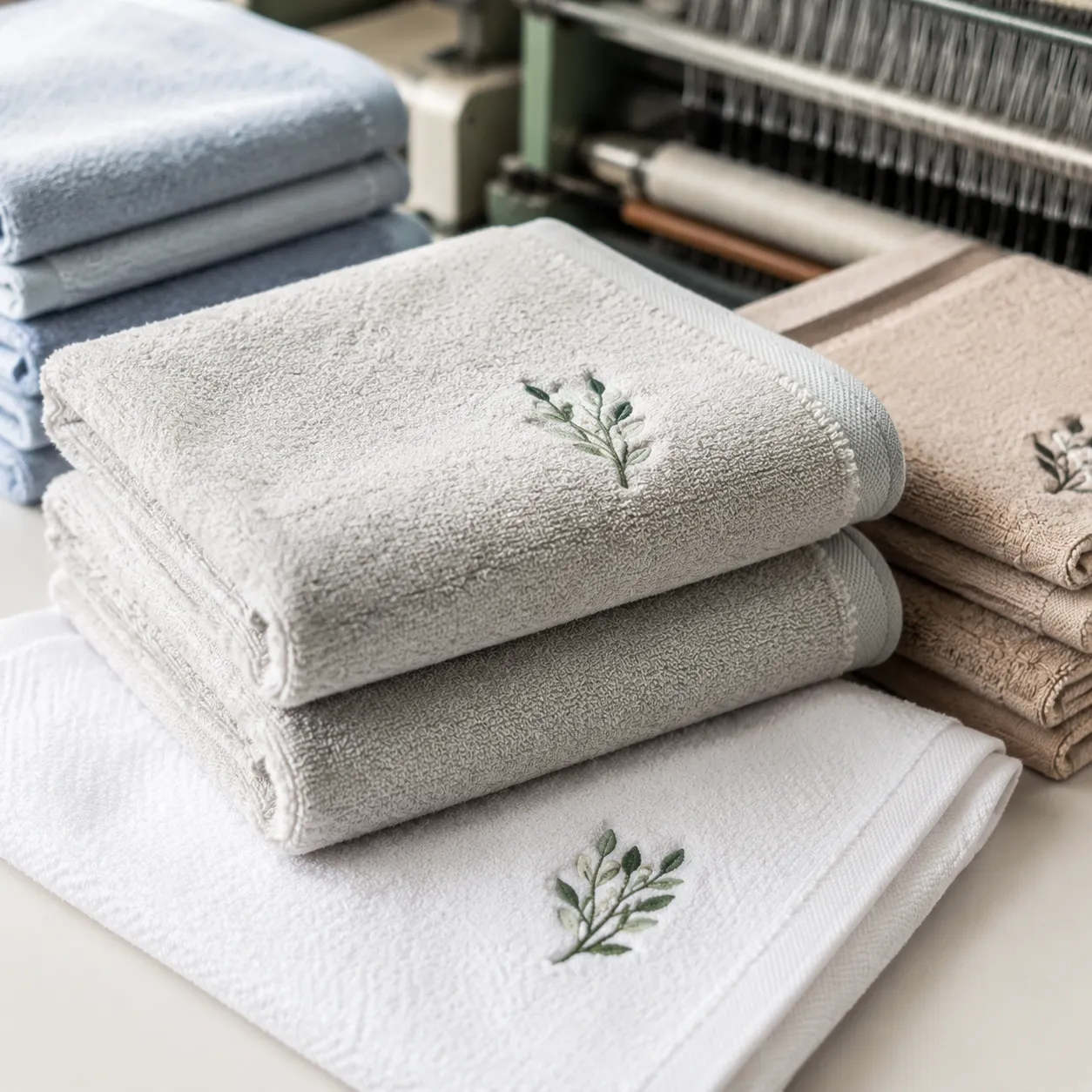
Why personalized face towels fail at small scale
Face towels look low-risk because the unit is small. In the mill, the opposite is often true. A 30×30 cm or 33×33 cm towel gives very little open area for decoration, and every mistake is visible because the user holds it close to the face. If the embroidery is stiff, if the thread bleeds, or if the backing scratches the skin after laundering, the buyer hears about it quickly.
The most common sourcing mistake is treating personalized face towels like miniature bath towels. A bath towel can carry a 90 mm monogram on a dobby band without affecting comfort. A face towel usually needs a softer loop, a smaller stitch count, tighter pH control, and more careful name sorting in packing. For hotel turndown, spa retail, wedding gifting, and private-label skincare kits, those details matter more than adding another 50 GSM.
- Pile interference: terry loops hide thin lettering, especially script fonts below 11 mm cap height.
- Backing feel: heavy tear-away backing can remain at the reverse side and feel rough when damp.
- Name sorting errors: personalized SKUs need barcode or line-list control, not bulk carton packing.
- Border distortion: small towels twist more visibly when embroidery tension is too high near the hem.
- Skin contact risk: residual dyestuff, pH drift, and rough labels are less acceptable on face products.
Base towel spec before any name is added
We normally start with the base towel, not the logo file. Decoration can only sit well on a stable fabric. For cotton face towels, our workable OEM range is usually 420–620 GSM. Below 400 GSM, embroidery can pucker the cloth unless the design is very small. Above 650 GSM, the towel feels dense but dries slowly in hotel or spa laundry.
For most branded sets, we recommend combed cotton ring-spun yarn in 16s/1 or 21s/2, depending on the handle required. Zero-twist can feel softer at first touch, but for embroidered face towels it is easier to snag around the stitched area. If the buyer wants a spa or skincare presentation towel, a low-twist cotton with controlled loop height often balances softness and stability better.
| Use case | Common size | GSM range | Construction note | Best decoration position |
|---|---|---|---|---|
| Hotel guest face towel | 30×30 cm or 32×32 cm | 450–520 GSM | Combed cotton terry, 16s/1 pile, tighter ground weave | Dobby band or lower corner |
| Spa treatment towel | 33×33 cm or 35×35 cm | 500–600 GSM | Softer pile, lower lint spec, reactive dyed pastel colors | One corner, 35–45 mm from edges |
| Retail monogram towel | 30×30 cm | 480–580 GSM | Higher loop uniformity for folded shelf presentation | Centered above border or corner mark |
| Gift set washcloth | 28×28 cm or 30×30 cm | 400–500 GSM | Lightweight to reduce gift box weight | Small initial or woven label |
| Skincare kit towel | 25×25 cm or 30×30 cm | 360–460 GSM | Quick dry, low lint, white or undyed cotton | Minimal logo, no large fill stitch |
A 30×30 cm towel at 520 GSM weighs about 47 g before decoration and packing. That seems light, but 3,000 pieces already represent about 141 kg of finished terry before cartons. Small towels are not free to ship; we still calculate carton compression, moisture control, and name-level sorting labor.
Embroidery rules for names, initials, and spa logos
Embroidery is the usual choice for personalization because it survives laundry better than heat transfer and looks appropriate for hospitality or gifting. But on face towels, the embroidery file must be engineered for terry pile. We use water-soluble topping on the face side so loops do not poke through the stitches, and a soft cut-away or light tear-away backing depending on stitch density.
For one-line names, we try to keep the finished embroidery within 55–80 mm wide. Initials can be 18–32 mm high. A small skincare logo can work at 35–50 mm wide if the artwork is simplified. We avoid satin strokes under 1.2 mm because they disappear into the pile after washing. For script lettering, 75/11 ballpoint needles and 40 wt rayon or polyester thread are common, but thread choice depends on laundry chemistry.
| Decoration item | Recommended limit | Factory reason |
|---|---|---|
| Single initial | 18–32 mm height | Readable without creating a hard patch on the towel corner |
| First name | 55–80 mm width | Keeps stitch count controlled and reduces towel skew |
| Two-line name and date | Not preferred below 30×30 cm | Small text fills with lint and becomes hard to inspect |
| Logo with fine outline | Minimum 1.2 mm stroke | Thinner satin stitches sink into terry pile |
| Dense filled icon | Under 2,800 stitches | Higher stitch count makes the face towel stiff and slower to dry |
For monogram face towels, a 900–1,600 stitch design is normally safe. A detailed crest can reach 3,500 stitches, but we would push back unless the towel has a flat woven panel. One recent spa buyer wanted a 48 mm botanical mark with 14 leaves. We reduced it to 7 leaves and removed the inner vein lines; the sample dropped from 3,240 stitches to 1,870 stitches and the reverse side became noticeably softer.
- Keep embroidery at least 28 mm from the sewn edge on 30×30 cm towels to avoid hoop tension at the hem.
- Use water-soluble topping on terry; skipping it saves little and causes broken-looking letters.
- Avoid metallic thread for face contact unless the towel is decorative only.
- Specify whether the reverse side must be skin-soft; this changes backing selection and trimming labor.
- For assorted names, send the final name list as a locked spreadsheet, not pasted into email messages.
Dobby band, corner mark, or woven label?
The placement decision affects both cost and comfort. A dobby band gives a flatter surface, so fine embroidery reads better. The trade-off is that a band on a small towel reduces absorbent area and can feel less soft if it is too wide. For 30×30 cm face towels, we usually keep the dobby band between 20 and 28 mm.
Corner embroidery is softer in the hand because most of the towel remains full terry. It works well for initials, guest names, or a spa logo. The risk is distortion if the hoop catches the hem. Woven labels are cheaper for repeated branding, but they are not true personalization unless the names are printed or woven separately, which becomes inefficient below several thousand pieces per name.
| Branding method | MOQ reality | Typical add-on cost | Best fit | Main caution |
|---|---|---|---|---|
| Corner embroidery | 500 pcs per design/color | USD 0.18–0.46 per towel | Names, initials, small spa marks | Name list control and backing softness |
| Dobby band embroidery | 500 pcs per design/color | USD 0.22–0.58 per towel | Hotel sets, retail monograms | Band width must not dominate the towel |
| Woven label | 1,000–2,000 pcs per label | USD 0.05–0.14 per towel | Private label collections | Label edge can irritate face if placed poorly |
| Jacquard initial repeat | 800–1,200 pcs per design/color | USD 0.20–0.50 per towel | Repeated brand pattern, not individual names | Yarn-dyed lead time is longer |
| Sublimated microfiber face cloth | 500 pcs per artwork | USD 0.12–0.32 per towel | Full-color gift or event artwork | Different hand feel from cotton terry |
If a buyer needs 500 pieces with 500 different names, embroidery is possible, but it is an operations project. The decoration line runs slower because each piece must be matched to the name sheet, stitched, checked, folded, and packed in sequence. If the buyer needs 500 pieces with one repeated hotel logo, the same machine time is much easier to control.
Skin-safe testing and certification are not optional
A towel used on the face should not be specified only by softness. We test and document the chemistry side because the product touches wet skin, eye areas, and sometimes freshly treated spa skin. Our mill holds OEKO-TEX Standard 100 Class I, which is the stricter class often used for baby and direct-skin textile products. We also operate under BSCI social compliance and ISO 9001 quality management.
For dyed cotton face towels, we normally review color fastness to washing under ISO 105-C06 and rubbing under ISO 105-X12. Dimensional change can be checked after washing using ISO 6330 procedures. For face-contact programs, pH value is also important; ISO 3071 is a common method for textile pH extract testing. A towel that feels soft but sits at a high alkaline pH after finishing is not acceptable for spa or skincare buyers.
- Ask for a valid OEKO-TEX Standard 100 Class I certificate when towels are used on the face or for children.
- For dark embroidery thread on white towels, confirm washing and rubbing fastness, not only thread shade.
- If towels are packed with skincare products, check fragrance transfer from cartons, polybags, or printed inserts.
- For salon or spa laundry using peroxide or chlorine, tell the mill before lab dips are approved.
- Require needle detection if the goods will enter baby, beauty, or department-store channels.
Related reads: buyers comparing skin-contact requirements can review how to read an OEKO-TEX certificate and our notes on monogrammed bath towels for luxury brands. For base cotton choices, combed vs zero-twist cotton explains why first-touch softness is only one part of the decision.
Pricing bands for custom face towels
Prices depend on cotton yarn, towel weight, dyeing, embroidery stitch count, packing, and whether each towel has a different name. The ranges below are realistic FOB China indications for OEM cotton personalized face towels in 2026. They are not quotes; artwork, yarn price, carton method, and compliance documents can move the final number.
| Order volume | Base cotton face towel | With simple repeated embroidery | With individual names | Typical carton packing |
|---|---|---|---|---|
| 500–999 pcs | USD 0.62–0.92 | USD 0.86–1.38 | USD 1.05–1.72 | 100–160 pcs per export carton |
| 1,000–2,999 pcs | USD 0.54–0.80 | USD 0.74–1.12 | USD 0.92–1.46 | 120–180 pcs per export carton |
| 3,000–7,999 pcs | USD 0.48–0.71 | USD 0.65–0.98 | USD 0.82–1.26 | 150–220 pcs per export carton |
| 8,000+ pcs | USD 0.43–0.65 | USD 0.58–0.88 | USD 0.73–1.10 | Carton plan optimized by towel weight |
Our MOQ is 500 pcs per design per color. For name personalization, the practical minimum can still be 500 total pieces, but setup labor is higher if every unit is unique. A buyer sometimes asks for 120 pieces for a wedding or VIP event. We can explain the construction, but a factory line is not efficient at that quantity because thread setup, digitizing, cutting, inspection, and export packing are nearly the same as a 500-piece run.
Cost-per-use is the better way to compare options. Suppose a 30×30 cm 470 GSM towel with low-grade open-end yarn costs USD 0.49 and survives 22 spa laundry cycles before the edges curl and the embroidery looks fuzzy. That is 2.23 cents per use. A 540 GSM combed cotton version with controlled stitching may cost USD 0.91 and run 78 cycles in the same laundry, or 1.17 cents per use. The cheaper towel wins the first invoice and loses the operating budget.
Sampling workflow and production timing
Personalization adds approval steps. We do not advise approving only a digital embroidery mockup. Terry pile changes how the letterform reads, and the reverse side must be touched after washing. A good sample review includes an unwashed sample, one wash sample, and a check of the folded presentation.
- Confirm towel size, GSM, yarn type, color, edge style, and whether there is a dobby band.
- Send vector artwork or a font file, plus a locked name list if names are individualized.
- We digitize the embroidery and issue stitch count, thread colors, and placement measurements.
- Sample towels are made and washed once for shrinkage, pile coverage, and reverse-side feel.
- Buyer approves physical sample, then bulk yarn, dyeing, weaving, sewing, embroidery, inspection, and packing begin.
| Stage | Normal timing | Notes |
|---|---|---|
| Tech pack review | 1–2 days | Faster if size, GSM, Pantone, and artwork are complete |
| Lab dip or white towel confirmation | 3–6 days | Dark shades need extra fastness review |
| Embroidery strike-off | 3–5 days | Includes digitizing and first stitch-out |
| Physical sample towel | 7–12 days | Longer if custom yarn-dyed band is needed |
| Bulk production | 22–35 days | Depends on volume, dyeing, and name complexity |
| Final inspection and packing | 2–4 days | Individual name sorting can add time |
| Sea freight booking | 7–14 days before ETD | Air shipment can move faster but costs more per kg |
For a 2,000-piece spa order with two towel colors and 160 different staff or guest names, we would normally plan 35–45 days after sample approval before shipment. For 10,000 pieces with one repeated logo and standard white cotton, 28–34 days is more realistic if yarn is available. Air freight can help an event deadline, but small towels are dense; freight cost may add USD 0.18–0.40 per unit depending on destination.
QC points we inspect before packing
Face towel inspection is not only counting pieces. We check towel square, edge sewing, loop defects, stains, shade bands, embroidery registration, loose threads, needle marks, backing trim, and name accuracy. For AQL inspection, many buyers use ANSI/ASQ Z1.4 or ISO 2859-1 sampling plans. Critical defects include metal contamination, wrong name, wrong color, oily stain, and broken needle evidence.
One defect specific to small personalized towels is what our embroidery team calls the halo line. It appears when the hoop pressure crushes pile around the name, leaving a rectangular mark after steaming. It may disappear after washing, but if the towel is sold folded in a gift box, the mark is visible at retail. We reduce this by adjusting hoop pressure, using a smaller frame, and allowing relaxation time before final folding.
- Measure finished size after conditioning; a 30×30 cm towel usually needs a tolerance such as ±1.0 cm.
- Check skew by folding corner to corner; small towels show diamond distortion quickly.
- Rub the embroidery reverse side on the cheek or inner wrist after washing to evaluate backing feel.
- Audit name spelling against the approved spreadsheet, not against carton labels only.
- Confirm polybag warning text, suffocation marks, and country-of-origin labeling for the destination market.
Related reads: if the towel will be part of a hotel set, start with hotel towel sourcing and setting up a hotel linen program. If you are still deciding between stitch, print, or weave, our comparison of embroidery, sublimation, and jacquard will help avoid the wrong decoration method.
Packing personalized orders without mix-ups
The last 5% of the order can create most of the complaints. Personalized face towels often ship as gift sets, room drops, member kits, or retail bundles. If the packing instruction is vague, the factory may pack by production sequence while the buyer expects alphabetical order, store allocation, or mixed assortments by carton.
For individual names, we prefer a packing matrix with four fields: name, towel color, thread color, and unit packing type. If the towel is paired with a skincare product, ribbon, hangtag, or box, each component needs its own SKU code. We can print carton marks by hotel property, spa branch, event table number, or e-commerce SKU, but that must be locked before bulk packing begins.
- Use one approved spelling file with line numbers; do not send revised names in chat messages.
- Add 1–2% extra blank towels when late name changes are likely.
- Separate replacement pieces in a clearly marked inner carton.
- For retail, decide whether the embroidery faces out in the fold; this affects folding labor.
- For Amazon or DTC cartons, confirm barcode placement and polybag thickness before production.
Our factory base is 220 employees, operating since 2007, with annual output around 2.4 million towels for 80+ brand clients across 47 countries. That scale helps with cotton purchasing and QC systems, but personalization still depends on clean buyer data. A perfect towel with the wrong name is a reject.
What to send us for an accurate quote
A clear brief lets us quote within a narrow band instead of padding for unknowns. For custom face towels, the most important details are finished size, GSM, cotton type, towel color, decoration method, stitch size, number of unique names, packing, and target delivery date. If you already have a reference towel, send its weight in grams and a close photo of the pile and edge.
- Finished towel size, such as 30×30 cm, 32×32 cm, or 35×35 cm.
- Target GSM and hand feel: quick-dry, soft spa, hotel laundry, or gift presentation.
- Cotton requirement: combed cotton, low-twist cotton, organic cotton, or blended option.
- Decoration file in AI, PDF, SVG, or high-resolution PNG, plus font file for names.
- Quantity by towel color and thread color, with MOQ planned at 500 pcs per design/color.
- Compliance needs: OEKO-TEX Standard 100 Class I, BSCI, ISO 9001, pH, color fastness, or retailer test protocol.
- Packing method: bulk, individual polybag, paper belly band, gift box, or set packing with other products.
- Delivery terms and destination port or address for freight estimate.
If the first quote target is unrealistically low, we will say so. Reducing GSM from 520 to 380, removing topping, and using a cheaper thread may cut USD 0.20–0.30 from the unit price, but it can also create fuzzy lettering and a harsher reverse side. For a towel used on the face, that saving is rarely worth the complaints.
For product category context, see our hand towel and face towel range, or compare sizing decisions in the complete towel dimensions guide. For MOQ planning, negotiating towel MOQ without killing margin explains where factories can be flexible and where the math does not work.
Build a face towel spec we can produce
Send size, GSM, artwork, name count, packing method, and delivery market. We will review construction, decoration risk, MOQ, price band, and timing. WhatsApp: +86 13384590853. Email: [email protected].
Request a quote →