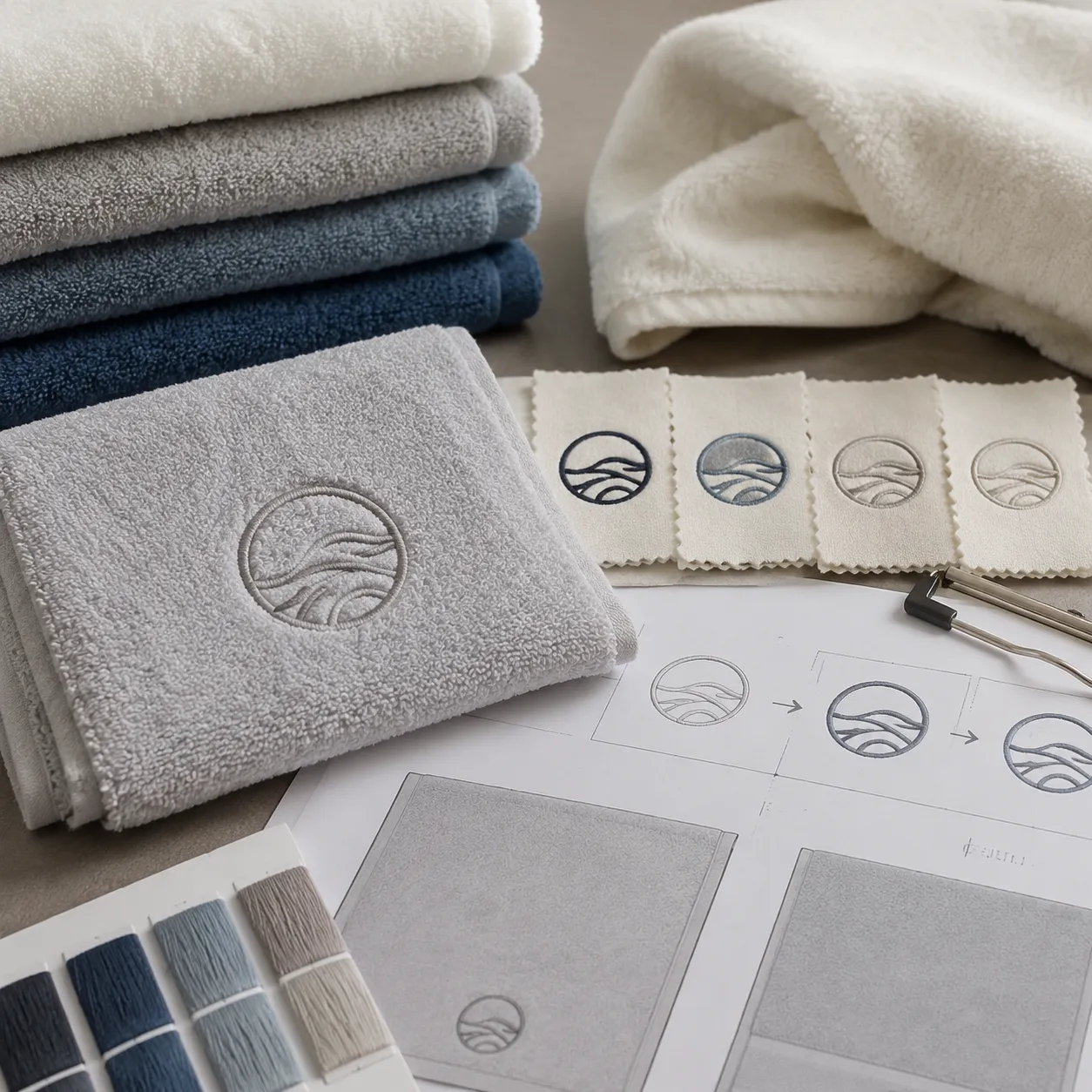
Why hand towel embroidery fails at sample stage
Hand towels look simple on a PO: usually 30×30 cm, 35×35 cm, 30×50 cm, or 40×70 cm, with a logo in one corner or above the dobby border. The problem is that embroidery is not printed ink. It is thread pulled through a moving terry surface, and terry loops do not behave like flat shirting fabric.
In our decoration room, most sample disputes come from four causes: the logo file is too detailed for the towel size, the buyer approves a dry sample without a wash test, the placement is measured from the wrong reference point, or the stitch density is set as if the fabric were woven poplin. A clean embroidered mark needs enough structure under the stitches, but too many stitches make the towel boardy and slow to dry.
For a 40×70 cm hand towel in 500-580 GSM cotton terry, a 60×35 mm logo is normally safe if the smallest letters are at least 5 mm high. On a 30×50 cm guest towel at 420-500 GSM, we prefer logos under 48 mm wide unless the design is a simple monogram. If a buyer asks us to place a dense crest across the hem, we usually recommend either a woven label or jacquard instead. The cheapest approval is the one that stops a bad decoration method before bulk thread is ordered.
| Risk in sample approval | What we check | Typical factory tolerance |
|---|---|---|
| Logo sinks into terry loops | Top stitching, underlay, water-soluble film use | No broken outline at 50 cm viewing distance |
| Placement shifts after wash | Measure before and after 3 wash cycles | ±4 mm from approved reference point |
| Towel feels stiff under logo | Stitch count versus logo area | Avoid heavy blocks above 9,000 stitches on small hand towels |
| Thread shade looks different under hotel light | D65 light box and warm LED visual check | Closest approved thread card or Pantone reference |
The embroidered hand towel sample approval workflow
Our embroidered hand towel sample approval workflow runs in gates, not casual photo messages. Each gate removes one source of later argument. For repeat programs, the workflow can be completed in 10-14 days after artwork confirmation. For first-time hotel, spa, or retail buyers, 16-22 days is more realistic because thread color, towel base, and packaging may all need approval.
- Confirm towel base: size, GSM, yarn, border style, color, and shrinkage target.
- Convert artwork into embroidery format and send a digitized layout proof with stitch count.
- Run a strike-off on matching terry, not on plain cotton cloth.
- Wash the strike-off if the towel is for hospitality, gym, salon, or spa use.
- Make a full pre-production sample using the approved towel body and packing method.
- Record sign-off values: logo size, position, thread code, backing type, carton pack, and wash result.
The digitized proof is not only a picture. It should show logo width and height, stitch direction, estimated stitch count, thread colors, and whether we use tear-away or cut-away backing. For terry, we often add water-soluble topping so the stitches sit above the pile instead of disappearing between loops. This small process step adds handling time, but it prevents the fuzzy edge that buyers sometimes mistake for poor thread quality.
For small logos, we do not recommend approving only by phone photo. Camera angle can hide puckering around the edge. We send close-up photos, ruler photos, and a flat-lay measurement sheet. For buyers with strict brand standards, we courier physical samples because hand feel cannot be judged from a screen.
What the sample request must include
A mill can only sample accurately when the request separates towel specification from decoration specification. If the RFQ says only "white hand towel with embroidered logo," we have to make assumptions on GSM, pile height, hem width, thread shine, and placement. Those assumptions may be wrong even if the sample looks acceptable at first.
- Towel size and weight: common hand towel ranges are 30×50 cm at 400-520 GSM, 35×75 cm at 450-560 GSM, and 40×70 cm at 480-620 GSM.
- Base construction: ring-spun cotton, combed cotton, zero-twist blend, waffle, or velour face. Embroidery behaves differently on each surface.
- Artwork file: AI, EPS, PDF, or high-resolution PNG, plus the final logo size in millimeters.
- Placement rule: measure from lower hem, side edge, dobby border, or towel center. Do not mix reference points.
- Thread reference: Pantone target plus accepted embroidery thread brand if your brand manual requires it.
- Use case: hotel laundry, retail gift, salon, gym, golf club, spa treatment room, or event giveaway.
We also ask whether the towel will be washed with bleach, peroxide, optical brighteners, or high-temperature drying. Polyester embroidery thread is usually stronger in industrial laundry than rayon thread, but rayon gives a softer sheen for retail monograms. On white hotel hand towels, polyester thread is our default unless the buyer has a specific brand standard.
Related reads: buyers building the base towel before adding decoration can use our hand towel design OEM spec playbook and the towel sizes dimensions complete guide. For artwork preparation across decoration methods, see custom logo towels OEM decoration guide.
Logo digitizing: the approval most buyers skip
Digitizing is where an embroidery design becomes machine instructions. A flat logo file does not tell the Tajima or Barudan head how to stitch corners, where to add underlay, or how much pull compensation is needed. On terry, pull compensation is important because loops move under needle tension. A 50 mm logo can narrow by 1-2 mm if the digitizing is too tight.
For small hand towels, we usually keep stitch density around 0.35-0.45 mm spacing for satin areas, then adjust after the first strike-off. Dense fill stitches can look clean on a cap but feel hard on a towel corner. If a hotel guest uses that corner to wipe hands or face, the embroidery should not scratch.
| Logo element | Safer embroidery rule | Factory comment |
|---|---|---|
| Small letters | Minimum 5 mm height | Below this, loops and thread blur the counter spaces |
| Fine line icon | Minimum 0.8 mm finished line | Single-run lines disappear after repeated washing |
| Solid filled block | Keep under 45×25 mm on guest towels | Large fill areas create stiffness and edge puckering |
| Metallic thread | Use only after physical approval | Higher breakage rate and rougher hand feel |
| Tone-on-tone mark | Approve under two lighting conditions | Low contrast changes sharply between warm and cool light |
We normally send a stitch simulation before the physical strike-off, but simulation is not final approval. It cannot show pile interference, backing shadow, or needle marks. If the logo has a circle, we pay special attention to roundness after wash. Circles and thin rectangular borders reveal pull distortion faster than script text.
Sample tests before we ask for sign-off
For hospitality and wellness programs, a dry sample is not enough. The towel will enter laundry tunnels, extractors, tumble dryers, towel warmers, or spa oil environments. We run practical tests before recommending sign-off, and for larger programs we can align the test plan with ISO and AATCC methods used by third-party labs.
| Test point | Method or reference | Approval target |
|---|---|---|
| Dimensional change | ISO 6330 domestic washing reference or buyer laundry simulation | Hand towel shrinkage usually within 3-6% depending on construction |
| Colorfastness to washing | ISO 105-C06 or equivalent internal wash check | Thread and towel body no visible staining on adjacent fabric |
| Rubbing fastness | ISO 105-X12 dry and wet crocking | No obvious thread color transfer during normal handling |
| Puckering after wash | Visual inspection plus flat measurement | No severe rippling around embroidery edge |
| Needle damage | Back-side inspection under light | No runs, holes, or weakened border yarns |
We are OEKO-TEX Standard 100 Class I certified, and we can source compliant towel yarns, sewing thread, and labels for baby, hotel, and skin-contact programs. Our facility also operates under BSCI social audit controls and ISO 9001 quality management. Those certificates do not replace sample approval, but they reduce material and process risk when the buyer needs consistent repeat orders.
A specific defect we watch for is backing shadow on white or pastel towels. If the backing is too heavy, the logo area looks slightly gray from the front after pressing. If the backing is too light, the stitches may sink or pucker. We usually test 1-2 backing weights during strike-off when the logo is dense or placed near a dobby border.
Placement proof: measure from the right edge
A placement proof must define the reference edge. On hand towels, the lower hem can move after sewing and washing, while a dobby border may be more visually important to the guest. If a logo is described as "bottom right," that is not enough for production. We need exact distances, such as 55 mm above bottom hem and 45 mm from right side edge, measured to the logo bounding box.
For towels with a decorative border, we prefer measuring from the border top or bottom line because it is the visual anchor. On a 30×50 cm towel with a 35 mm dobby border, placing a logo 18 mm above the border may look balanced. On a plain hem towel, the same logo may appear too low after the hem rolls during laundering.
- Corner logo: lowest cost, fastest hooping, best for guest towels and powder-room hand towels.
- Centered above border: cleaner for hotel suites, but requires tighter folding alignment in packing.
- Monogram on lower center: good for retail gift sets, slower to hoop because each towel must be centered.
- Full name embroidery: workable for private-label personalization, but MOQ and lead time depend on name variation count.
Our usual placement tolerance is ±4 mm for standard corner embroidery and ±3 mm for high-visibility centered monograms, assuming the towel body is within approved size tolerance. If the buyer requires tighter control, we need slower hooping and more in-line checks, which adds labor cost. We prefer to state that clearly before bulk rather than argue during final inspection.
Pricing, MOQ, and lead time for sample approval
Our standard MOQ is 500 pcs per design per color. For embroidered hand towels, the total price depends on towel GSM, towel color, logo stitch count, number of thread colors, and whether each piece has individual packaging. A 4,200-stitch corner logo behaves very differently from a 13,500-stitch crest, even if both are called "one logo" on the buyer's spreadsheet.
| Order volume | Typical FOB China price range | Sampling and bulk timing |
|---|---|---|
| 500-999 pcs | USD 1.95-3.10 per 30×50 cm towel with simple embroidery | Sample 14-22 days; bulk 28-38 days after approval |
| 1,000-2,999 pcs | USD 1.62-2.65 per 30×50 cm or 35×50 cm towel | Sample 12-20 days; bulk 25-35 days after deposit |
| 3,000-7,999 pcs | USD 1.38-2.28 per standard hand towel | Sample 10-18 days; bulk 24-32 days depending on dyeing |
| 8,000+ pcs | USD 1.18-1.96 per standard program item | Sample 10-16 days; bulk 22-30 days if yarn and thread are available |
Sample charges usually include blank towel development, embroidery digitizing, thread setup, and courier cost. For repeat buyers, we often waive part of the sampling cost once the bulk PO reaches the agreed MOQ. Air courier for samples normally takes 3-6 days to North America or Europe after dispatch; remote destinations can take longer.
Cost-per-use is where we push back on overly light towels. A 30×50 cm hand towel at 330 GSM may save about USD 0.22 per piece against a 470 GSM version, but if it loses shape after 35 commercial washes instead of 80, the laundry cost per service day rises. For a 2,400-piece boutique hotel order, that saving can disappear in one replacement cycle. If the towel carries embroidery, replacing early also wastes the decoration cost.
What sign-off should record before bulk
A signed sample without written values is weak protection for both sides. We keep a sample approval record that production, QC, packing, and merchandising can all use. The buyer should keep the same record internally so that procurement, marketing, and operations do not approve different versions of the same towel.
- Approved towel size, GSM, yarn type, border construction, and color reference.
- Logo file name, final logo size, stitch count, thread color codes, and backing type.
- Placement measured from named edges, with a photo showing ruler position.
- Wash result, including shrinkage percentage and any visible puckering comments.
- Packing method: bulk pack, polybag, belly band, carton quantity, and carton marks.
- Tolerance agreement for size, weight, placement, shade, and embroidery appearance.
For inspection, we normally use AQL sampling logic based on ISO 2859-1. Embroidery defects are grouped by severity. A missing logo, wrong thread color, or mirrored placement is major. A loose thread tail that can be trimmed may be minor if it does not affect use. Needle cuts, oil marks, or backing showing from the front are treated more seriously because they affect durability or appearance.
Related reads: if you are comparing decoration choices before sampling, see embroidery vs sublimation vs jacquard. For brand teams preparing full specifications, use build towel tech pack that mills can quote and pantone color matching custom towels.
Common buyer decisions during approval
The sample stage is not only a pass-or-fail checkpoint. It is where buyers make practical decisions that affect bulk efficiency. We prefer to discuss these decisions early because changing them after embroidery thread is purchased or towels are dyed can add 7-15 days.
- Approve one master color or every colorway: if towel colors are dark and light, test both because thread contrast and backing shadow change.
- Use one logo size across towel sizes: this saves digitizing cost, but a logo that fits a bath towel may overpower a hand towel.
- Choose retail fold or laundry fold: centered embroidery must align with the visible fold face if the towel is packed for shelf display.
- Run a pilot order: useful for hotel openings or spa rollouts when housekeeping wants a laundry trial before full replenishment.
For a new program, we often suggest 2-3 sample variants instead of one. For example, the same 35×75 cm towel at 480 GSM and 540 GSM, with the same 52 mm logo stitched at two densities. That small sample matrix costs more than one photo sample, but it lets the buyer feel the difference and choose based on use, not guesswork.
LUMA & CO. TEXTILE has produced OEM towels since 2007, with a 220-person team and about 2.4 million towels per year across hotel, spa, gym, beach, golf, and retail programs. We supply 80+ brand clients in 47 countries. For embroidered hand towel programs, the best results come when merchandising, decoration, and laundry requirements are approved together instead of one department at a time.
Need a sample approval sheet?
Send the towel size, GSM target, logo file, placement sketch, and expected order volume. We will return a sampling plan with timing, MOQ, and decoration risks. WhatsApp: +86 13205717266 or email [email protected].
Request a sample plan →