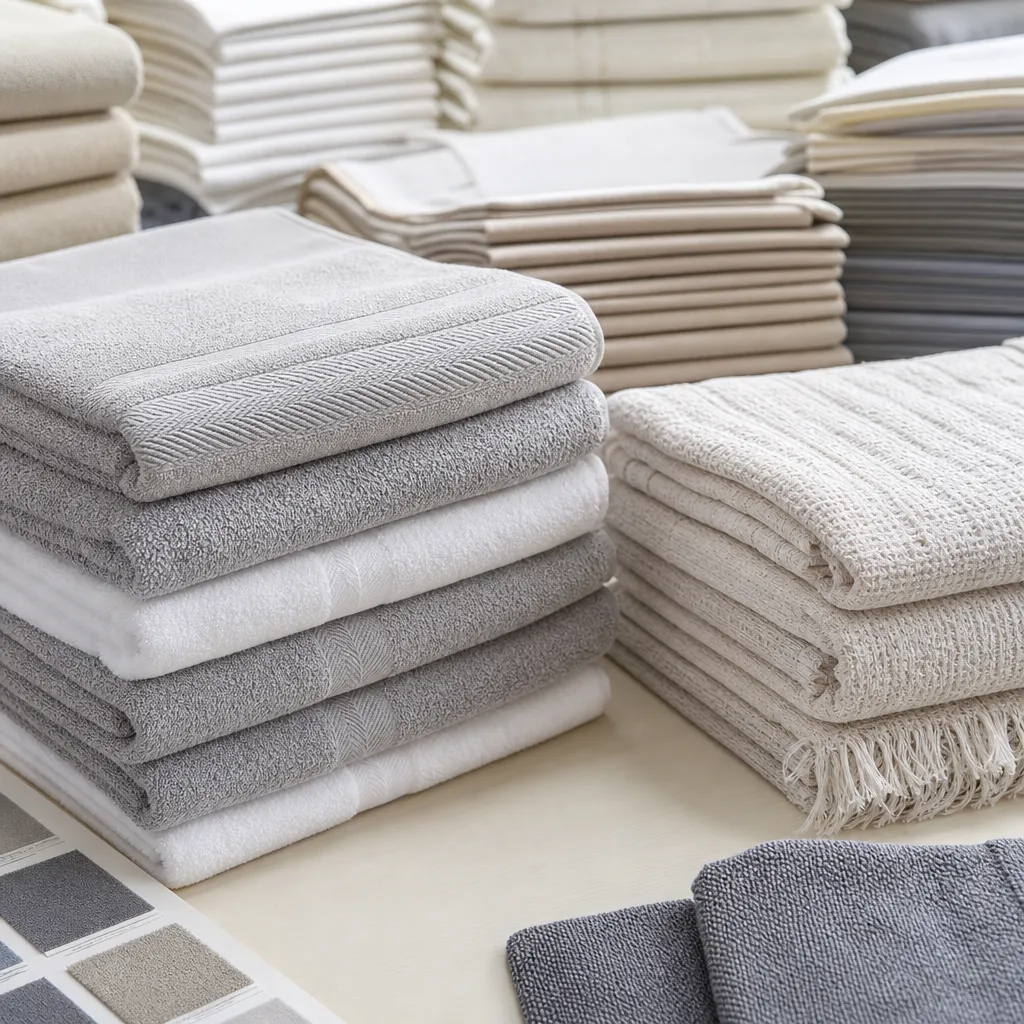
Why Hand Towels in Bulk Fail Differently Than Bath Towels
Hand towels sit in a hard-working category. They are smaller than bath towels, but they often see more daily touches: guest bathrooms, spa treatment rooms, gym sink areas, salon stations, yacht cabins, and retail gift sets. In our mill, we treat them as a separate specification rather than just a scaled-down bath towel.
The main failure points are not always obvious during sample approval. A hand towel can pass a showroom check and still fail in use because the border tension is wrong, the pile is too loose near the hem, or the label edge becomes abrasive after repeated alkaline washing. For hospitality hand towels, we usually test shrinkage after three industrial wash cycles before confirming bulk production. For retail packs, we also check folding recovery and barcode label placement because shelf presentation matters.
- Border curling: often caused by high tension difference between the terry body and dobby border, especially on 28–34 cm widths.
- Uneven pile height: more visible on small towels because the inspection surface is compact and guests notice streaks quickly.
- Hard hand feel after washing: usually linked to low-grade cotton, too much softener in finishing, or poor rinsing after dyeing.
- Logo distortion: common when embroidery is placed too close to the hem or when jacquard artwork ignores loop density.
- Excess lint: a bigger complaint for dark bulk cotton hand towels used in spas, salons, and gyms.
For buyers building a full towel range, we recommend comparing the hand towel with the bath towel after washing, not only in the new state. The relationship between size, GSM, and drying time is explained in our towel GSM decision framework, and size pairing can be checked against the complete towel dimensions guide.
Choose the Construction Before You Choose the GSM
For Turkish-style hand towels, construction comes before weight. A 420 GSM flat-weave peshtemal-style towel behaves very differently from a 420 GSM terry hand towel. Both may be sold under Turkish hand towels wholesale programs, but they serve different users and price points.
We normally separate hand towels into four production families: terry cotton, flat-woven hammam style, terry with dobby border, and jacquard pattern. The yarn count, loop formation, and border structure decide whether the towel is better for hotel turnover, spa display, retail gifting, or beach club washrooms.
| Construction | Typical GSM | Best use | Factory note |
|---|---|---|---|
| Terry cotton hand towel | 420–580 GSM | Hotels, gyms, serviced apartments | Good absorption; needs controlled pile shearing for smooth surface |
| Turkish flat-weave hand towel | 260–390 GSM | Retail gift sets, spa display, beach club washrooms | Fast drying; lower plushness but better packing efficiency |
| Dobby border terry towel | 450–620 GSM | Hospitality and private-label bathroom sets | Border must be balanced to avoid curling after tumble drying |
| Jacquard hand towel | 480–650 GSM | Logo programs, clubs, branded retail | Artwork should avoid fine strokes below 2.5 mm in woven areas |
One construction quirk we watch closely is the transition zone between the dobby border and pile field. If the loom setting leaves too many ground yarn floats in that zone, the towel can develop a horizontal weak line after repeated washing. On small towels this defect appears faster because users often grip the towel exactly at the border.
Sizing: Small Changes Affect Carton Count and Wash Behavior
The most common export sizes we make are 30×30 cm, 30×50 cm, 33×33 cm, 34×76 cm, 40×60 cm, and 40×70 cm. The right size depends on the environment. A gym sink towel can be compact. A hotel hand towel needs enough surface area for guest use. A Turkish-style retail towel may use a longer rectangular format to show fringe, stripe, or woven branding.
For hand towels in bulk, size is also a freight decision. A shift from 30×50 cm to 40×70 cm can nearly double packed towel volume even if the GSM increase looks modest. That affects carton count, warehouse handling, and replenishment cost.
| Size | Common use | Recommended GSM | Approx. finished weight |
|---|---|---|---|
| 30×30 cm | Gym counter, amenity kit, face/hand dual use | 360–480 GSM | 32–43 g |
| 30×50 cm | Hotel bathroom, spa station, salon basin | 430–560 GSM | 65–84 g |
| 34×76 cm | US-style hand towel, golf locker room | 450–600 GSM | 116–155 g |
| 40×60 cm | European hospitality, retail sets | 420–570 GSM | 101–137 g |
| 40×70 cm | Spa, boutique hotel, decorative hand towel | 380–540 GSM | 106–151 g |
We allow normal towel dimensional tolerance of about ±3% after finishing, then check wash shrinkage separately. For cotton terry hand towels, our target after three ISO 6330 wash procedures is usually within 5% lengthwise and 4% widthwise. Flat-weave hammam constructions can shrink differently because the ground weave and fringe tension react more strongly to washing and tumble drying.
- For hotels, avoid undersized 28×45 cm towels unless you are controlling laundry cost very tightly.
- For spa retail sets, choose longer formats if the towel will be folded with visible stripe or fringe.
- For gyms, prioritize fast drying and low lint over heavy GSM.
- For boutique bathrooms, match hand towel proportions to the bath towel border width so the set looks planned.
- For e-commerce, confirm folded size before approving packaging artwork.
Cotton, Yarn, and the Turkish-Style Feel
The term Turkish towel is used loosely in the market. Some buyers mean towels woven in Turkey. Others mean flat-woven hammam styling, long-staple cotton feel, fringe ends, and lighter drying behavior. As a China-based OEM mill, we do not pretend origin we cannot provide; instead we quote the construction honestly as Turkish-style, hammam-style, or flat-weave cotton.
For bulk cotton hand towels, yarn choice has a direct effect on hand feel and lint. Carded cotton can work for budget promotional programs, but it tends to lint more and feels rougher after 20–30 washes. Combed cotton removes shorter fibers and gives a cleaner surface. Ring-spun yarn improves strength and loop definition. Zero-twist can feel soft in the showroom but is not always our first choice for heavy commercial washing because it can shed more if the pile is not stabilized correctly.
| Yarn option | Typical use | Strengths | Buyer caution |
|---|---|---|---|
| Carded cotton 21s/2 | Economy hand towel, short-cycle promo | Lower cost, acceptable for low wash frequency | More lint and less smooth surface |
| Combed cotton 21s/2 or 32s/2 | Hotel, spa, retail bathroom sets | Cleaner hand feel, better durability | Costs more but usually lowers replacement rate |
| Ring-spun cotton | Hospitality and gym programs | Good loop strength and absorption | Must control dyeing for dark shades |
| Cotton-bamboo blend | Spa and boutique retail | Soft touch, smooth drape | Longer drying time at higher GSM |
| Flat-weave cotton | Hammam-style sets | Compact packing, quick drying | Less plush; buyer must align user expectation |
If you are comparing combed cotton and zero-twist options, the deeper material explanation is in combed vs zero-twist cotton. For Turkish-style bath and hand towel families, our article on Turkish hammam beach towels also helps clarify flat-weave behavior.
Decoration Choices for Small Towels
Decoration on hand towels requires restraint. A logo that looks clean on a bath towel can feel crowded on a 30×50 cm piece. Embroidery, jacquard, woven labels, heat transfer patches, and yarn-dyed stripes are all possible, but each has a different minimum line thickness and cost impact.
For embroidery, we usually keep the design within 70×35 mm on a 30×50 cm towel unless the customer wants a very visible retail logo. Stitch density should be controlled around 0.38–0.45 mm spacing for standard cotton terry. Dense satin stitches can make the towel stiff in the corner, and guests may feel the backing when drying hands.
For jacquard hand towels, we ask for vector artwork early because woven logos cannot reproduce the same fine detail as embroidery or printing. If a letter stroke is below 2.5 mm, we may thicken the artwork or recommend embroidery. On flat-weave hammam styles, yarn-dyed stripes and woven end borders often look cleaner than placing a large stitched logo onto a thin towel.
- Embroidery: best for initials, club crests, boutique hotel marks, and retail monograms.
- Jacquard: best for repeated patterns, border logos, and high-wash brand programs.
- Woven label: cost-efficient for private-label retail packs but must use soft edges.
- Yarn-dyed stripe: useful for Turkish-style hand towels where decoration is part of the weave.
- Sublimation: suitable mainly for polyester microfiber, not cotton terry programs.
For a broader comparison, see our guide to embroidery vs sublimation vs jacquard. Buyers preparing artwork should also review Pantone color matching for custom towels, because cotton dyeing and thread color matching follow different tolerances.
MOQ, Pricing, and What Drives the Quote
Our standard MOQ is 500 pcs per design per color. That applies to hand towels in bulk, including Turkish-style flat-weave towels, terry towels, and decorated programs. Below that quantity, machine setup, dye lab dips, label sourcing, packing setup, and inspection time become too large a share of the cost.
Pricing depends on finished size, GSM, cotton grade, dye shade, decoration, packing method, and order volume. Dark reactive dye shades usually cost more than white or light pastel shades because dye consumption, rinsing time, and wastewater treatment load are higher. Fringe tying on hammam-style towels also adds labor cost if the buyer wants hand-twisted fringe rather than machine-finished ends.
| Order volume | 30×50 cm terry, 450–520 GSM | 40×60 cm terry, 480–580 GSM | Turkish-style flat-weave, 300–380 GSM |
|---|---|---|---|
| 500–999 pcs | USD 0.92–1.38 / pc | USD 1.34–1.95 / pc | USD 1.05–1.62 / pc |
| 1,000–2,999 pcs | USD 0.78–1.16 / pc | USD 1.15–1.68 / pc | USD 0.91–1.41 / pc |
| 3,000–7,999 pcs | USD 0.66–1.02 / pc | USD 0.98–1.48 / pc | USD 0.79–1.24 / pc |
| 8,000+ pcs | USD 0.58–0.91 / pc | USD 0.86–1.31 / pc | USD 0.70–1.12 / pc |
A cheaper towel is not always cheaper in use. For example, a 30×50 cm carded cotton hand towel at USD 0.69 may survive about 38 commercial wash cycles in a gym washroom before edge fraying and grey cast become unacceptable. A combed cotton version at USD 0.97 may hold for around 74 cycles under the same laundry process. That puts the first towel near USD 0.018 per use cycle and the second near USD 0.013, before counting labor and freight for replacements.
If a buyer is under pressure to reduce unit price, we usually adjust size, border complexity, or packing first. Cutting yarn quality too far is the last step because it damages the user experience and increases claims. Our MOQ article, negotiate towel MOQ without killing margin, explains where there is flexibility and where there is not.
Testing and Certifications We Expect Buyers to Ask For
For brand-side buyers, certification should be checked at two levels: the factory system and the product material. LUMA & CO. TEXTILE is OEKO-TEX Standard 100 Class I, BSCI, and ISO 9001 certified. OEKO-TEX Class I is the strictest product class because it covers baby and toddler contact requirements, which is useful when hand towels may be sold for family bathrooms or hospitality use.
For quality testing, we commonly use ISO 6330 for domestic washing and drying procedures, ISO 105-C06 for color fastness to washing, ISO 105-X12 for rubbing fastness, and internal absorbency drop tests for terry performance. For export cartons, we also run random carton drop checks based on the buyer’s packing requirement, especially for retail sets with belly bands or printed boxes.
- Confirm the certificate holder name and scope, not only the logo on a PDF.
- Check whether the towel material, dyeing process, and accessories fall under the certified scope.
- Request wash test results for the actual color, because navy, black, and dark green behave differently from white.
- Review shrinkage after finishing and after washing; both numbers matter.
- Keep one sealed pre-production sample for claim comparison after delivery.
If your compliance team is new to textile documents, our guide on how to read an OEKO-TEX certificate gives a practical checklist. We can provide current certification copies during the quotation and sampling stage.
Production Timeline From Lab Dip to Shipment
Hand towels are fast compared with bathrobes or highly engineered jacquard blankets, but they still need a realistic calendar. The biggest delays usually come from late artwork approval, repeated Pantone revisions, or packaging changes after the pre-production sample is approved.
| Stage | Typical timing | Factory action |
|---|---|---|
| Tech pack review | 1–2 days | Check size, GSM, yarn, decoration, packing, and target price |
| Lab dip or strike-off | 4–7 days | Dye shade or woven/embroidered logo sample prepared |
| Sample production | 6–10 days | Make hand towel sample in closest production construction |
| Bulk yarn and dyeing | 7–12 days | Prepare yarn, dye lots, and shade continuity records |
| Weaving and sewing | 8–16 days | Weave towel body, hem, trim threads, add label or decoration |
| Inspection and packing | 3–5 days | AQL inspection, weight checks, carton packing, shipping marks |
| Total normal lead time | 28–45 days | Excludes sea freight and customs clearance |
For repeat orders with approved yarn, color, label, and carton artwork, we can often shorten the production window to 21–32 days depending on loom capacity. For first-time custom woven hand towels, especially jacquard or yarn-dyed stripe programs, we prefer not to rush the sampling phase because a corrected sample saves more time than fixing bulk defects later.
Freight planning should start before the goods finish packing. A 10,000 pc order of 30×50 cm terry hand towels may fit comfortably as LCL shipment, while larger 40×70 cm programs with retail packaging can move into container planning sooner. Our logistics comparison in container vs air freight towel orders helps buyers decide when air shipment is justified.
Tech Pack Details That Prevent Rework
A clear tech pack reduces quotation time and prevents sample loops. We do not need a complicated document, but we do need the details that affect yarn ordering, loom setup, dyeing, decoration, labeling, and carton packing. Photos alone are not enough because two towels can look similar and cost differently by 20–35%.
- Finished size with tolerance, such as 30×50 cm ±3%.
- Target GSM after finishing, not only estimated fabric weight.
- Construction type: terry, flat-weave hammam, dobby border, jacquard, or yarn-dyed stripe.
- Cotton grade or blend, including combed cotton if required.
- Pantone TCX or physical color reference for dyed towels.
- Decoration file in AI, PDF, or high-resolution vector format.
- Label position, label material, and care label language.
- Packing method: bulk polybag, 6-pack bundle, belly band, kraft box, or retail carton.
- Compliance requirement: OEKO-TEX, BSCI, ISO 9001 factory documents, or buyer-specific testing.
- Target delivery date and destination port or warehouse.
We also ask buyers to tell us the laundry environment. A towel for a hotel outsourced laundry should not be built the same way as a DTC bathroom set washed at home. If the buyer can provide detergent type, wash temperature, tumble drying temperature, and expected replacement cycle, we can tune the GSM and yarn more accurately.
Related reads: for quoting documents, use build a towel tech pack that mills can quote. For hotel sets that include bath, hand, and wash towels, start with the hotel towel sourcing guide 2026 or the 90-day hotel linen roadmap.
How We Inspect Bulk Hand Towel Orders
Because hand towels are small, defects can hide in a carton if inspection only checks the top layers. Our QC team pulls samples across cartons and production lots, then checks size, weight, color, stitching, pile defects, label placement, and carton marks. For larger programs, we use AQL sampling aligned with ISO 2859-1 principles, with buyer-specific acceptance levels when required.
Two defect modes are especially common in small towels. The first is skewed hem alignment, where the towel folds unevenly and retail packs look crooked. The second is pile barré, a faint horizontal shade or height band caused by yarn tension or dye uptake variation. Barré may be acceptable in low-cost industrial towels, but we reject it for hotel, spa, and retail programs where towels are stacked visibly.
- Measure finished size from relaxed towels, not stretched edges.
- Weigh random pieces to confirm GSM consistency across lots.
- Check border flatness after steam and after wash testing.
- Rub dark towels on white cotton cloth to screen for crocking risk.
- Open retail packs from different cartons to confirm label and folding consistency.
- Compare bulk goods with the sealed pre-production sample before final packing.
Our factory has operated since 2007 with about 220 employees and annual towel output near 2.4 million pieces. We supply more than 80 brand clients across 47 countries, but the practical rule remains simple: the approved sample must match the bulk shipment. If we cannot reproduce a requested spec consistently at the target price, we will say so before production.
Final Buying Advice for Bulk Programs
For most buyers, the safest starting point is a 30×50 cm or 40×60 cm combed cotton terry hand towel at 460–540 GSM, with a balanced dobby border and OEKO-TEX compliant dyeing. For Turkish-style retail or spa programs, a 300–370 GSM flat-weave towel can work well if the customer understands it is lighter, faster drying, and less plush than terry.
Do not approve hand towels only by softness in the sample room. Wash them, tumble dry them, fold them, and compare the border after use. If the towel will carry a logo, test the decorated area with wet hands because backing stiffness and label edges are easier to feel on a small towel.
Related reads: buyers comparing small towel programs for active environments can review sweat towels for gym spec guide. For spa and treatment-room use, see spa towels wholesale bleach-proof and salon guidance and our product range at /products.html#hand.
Need a Hand Towel Bulk Quote?
Send size, GSM, construction, color, decoration file, packing method, and target quantity. Our MOQ is 500 pcs per design per color. WhatsApp: +86 13205717266. Email: [email protected].
Request a factory quote →