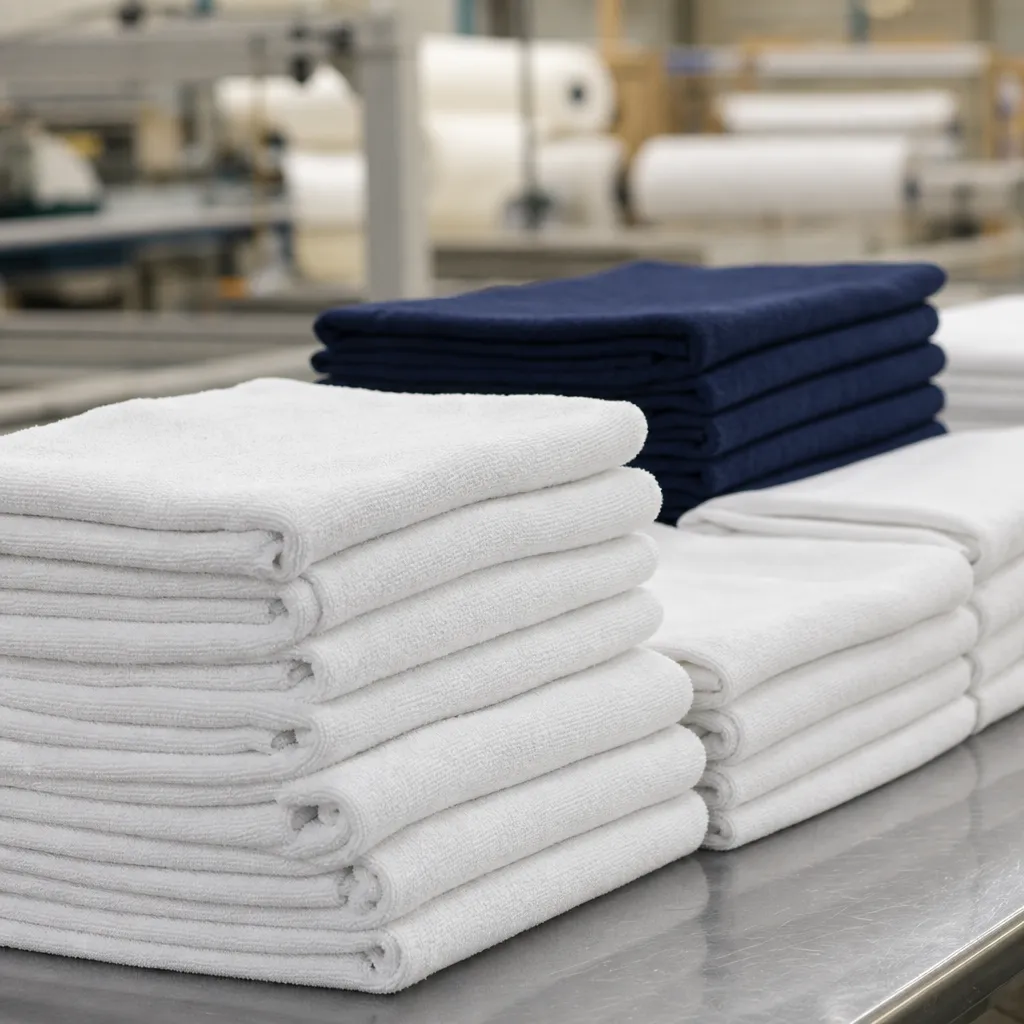
Start with where the towel will actually work
A bar mop is not one product in hotel use. We see three real use cases: back-bar spill control, kitchen line wiping, and general service wiping in banquet or breakfast areas. If a buyer tries to cover all three with one low-cost towel, the complaints arrive from different departments for different reasons. Back-bar teams want quick pickup and a soft hand. Kitchen teams want heat tolerance, low lint, and stable size after frequent chlorine or alkali wash. Housekeeping usually wants bright whiteness and simple replenishment by carton count.
- For back-bar and restaurant service, we usually quote 250-320 GSM in 100% cotton with a dobby or plain border kept narrow.
- For kitchen line use, 300-380 GSM works better because the cloth keeps body after repeated wash and wringing.
- For mixed-use hotel programs, a middle spec around 285-335 GSM is the safest compromise if departments must share inventory.
The first checklist question is simple: who owns the towel budget, and which department has veto power after trial laundering. If procurement skips that, the factory can make the right towel and the hotel can still reject it because the wrong internal user approved the first sample.
The bar mop towel hotel procurement checklist we ask buyers to complete
This is the minimum RFQ information that lets us quote accurately instead of padding the FOB to cover risk. Hotels that give us all of this usually move from quote to bulk approval one sample round faster.
- Finished size in cm, not just "standard". Common requests are 30×30 cm, 33×33 cm, 38×64 cm, and 40×70 cm.
- Target finished GSM after washing, or at least a pre-wash reference with allowed shrinkage.
- Fiber content: 100% cotton, cotton-rich blend, or ring spun vs open-end preference.
- Ground construction: 16s, 20s, or 21s yarn systems are typical depending on handle and price target.
- Edge construction: lock stitch hem, overlock plus hem turn, or tucked selvedge where applicable.
- Color and whiteness requirement, including whether optical brightener is acceptable.
- Laundry conditions: wash temperature, chlorine use, oxygen bleach use, and tumble dry range.
- Packout per inner and per export carton, plus whether barcode labels are required.
- AQL level for final inspection; many hospitality buyers stay at AQL 2.5 major / 4.0 minor.
| Spec point | What we need | Why it changes the quote |
|---|---|---|
| Size | Finished cm with tolerance | Larger cut size affects yarn use, loom efficiency, and carton count |
| Weight | GSM or grams per piece after wash | A 25 g piece and a 42 g piece are not comparable on price |
| Yarn | Open-end or ring spun cotton | Ring spun costs more but sheds less and feels cleaner in service |
| Hem | 2-side or 4-side hem detail | More sewing time and stronger corners reduce fray claims |
| Laundry method | Normal wash or heavy institutional wash | This changes shrinkage target and finishing settings |
Do not buy on whiteness alone
The most common sourcing mistake on hotel bar towels is approving the brightest sample instead of the most stable sample. A very bright white can come from stronger optical brightener use, but that does not tell you anything about absorbency, wash-down stability, or edge durability. For this product, we pay more attention to water pickup in the first 10 seconds and to how the hems look after accelerated laundering.
On our side, we usually run a simple sink test before lab work: lay the towel flat, place a measured droplet field across three zones, and compare spread and pickup speed against the control lot. Then we confirm with internal absorbency timing and laundering. For formal reporting, buyers often ask us to align with ISO 6330 for domestic washing procedure references and ISO 5077 for dimensional change checks. Even when the hotel's own laundry is harsher than domestic ISO conditions, these standards still help everyone discuss shrinkage with the same baseline.
- If a sample feels waxy or "finished", ask whether a softener-heavy finish was used; that can delay first-use absorbency.
- If whiteness is critical, ask for a retained control after wash cycle 1 and wash cycle 15, not only an ex-factory panel.
- If the towel will contact glassware, low lint matters more than extra loft.
Construction details that separate a usable towel from a complaint file
Bar mop towels look simple, but the defect pattern is specific. Two points matter more than buyers expect: loop anchoring and hem balance. A loose terry loop can snag on speed racks and undercounter hardware. A hem sewn too tight on a light-body towel creates edge tunneling after hot wash, so the cloth twists and never folds flat again.
For hotel programs, we prefer a compact terry face with moderate loop height instead of an airy bath-towel style pile. The reason is practical: a shorter, denser loop resists hook pulls better in foodservice environments. We also watch skew after finishing. If the body grain is off, the towel shrinks diagonally and looks misshapen after only a few turns.
| Construction item | Safer spec | Failure mode if underspecified |
|---|---|---|
| Loop profile | Low to medium loop, tighter beat-up | Snagging and fuzzy surface after line use |
| Hem width | 0.8-1.2 cm balanced fold | Roping edges or corner curl after laundry |
| Thread for sewing | Poly core spun sewing thread | Broken hems before fabric body is worn out |
| Shrinkage target | Within 6% length and width after agreed wash method | Mismatched stacking and poor fit in dispensers or bins |
| Fabric basis | Cotton terry, not flat mock-terry | Weak absorbency despite acceptable appearance |
Price bands that match real specs
Broad price claims are not useful on this item because a small square service towel and a longer kitchen wipe are different products. Below are realistic FOB China ranges we are seeing for 2026 on white cotton bar mop programs, based on our MOQ of 500 pieces per design per color, though hotels usually order far above that for carton efficiency.
| Common size / spec | Order volume | FOB China USD/pc |
|---|---|---|
| 30×30 cm, 260-290 GSM, open-end cotton | 5,000-9,999 pcs | 0.19-0.25 |
| 33×33 cm, 285-320 GSM, ring spun cotton | 5,000-9,999 pcs | 0.24-0.31 |
| 38×64 cm, 300-340 GSM, open-end cotton | 10,000-29,999 pcs | 0.41-0.53 |
| 40×70 cm, 320-360 GSM, ring spun cotton | 10,000-29,999 pcs | 0.52-0.66 |
| White program with barcode sticker and custom carton mark | 30,000+ pcs | Add 0.01-0.03 |
If a buyer asks for 100% ring spun cotton, tight shrinkage tolerance, carton-level barcode control, and heavy-duty hems, but wants the price of a light open-end towel, we push back. A difference of USD 0.07 per piece can be the difference between a towel that survives 70-90 commercial washes and one that starts fraying before 35. On a 12,000-piece annual consumption program, that cheaper option can force a mid-cycle top-up that costs more in freight and administration than the initial savings.
Laundry trial should happen before artwork, carton marks, or label approval
Hotels often spend too much time discussing outer carton print while the critical risk is still unresolved: whether the towel survives the property's wash reality. For this product, we recommend a short wear-and-wash trial before signoff on final packaging. We send enough pieces from the same pilot lot so the kitchen or stewarding team can run repeated turns in their own process.
- Approve lab dips or whiteness target first.
- Make a pilot sample lot from the intended bulk yarn and sewing setup.
- Run 10, 20, and 30-wash checks in the hotel's actual laundry or contractor laundry.
- Record shrinkage, edge fray, linting on dark surfaces, and absorbency after repeated use.
- Lock the sample as sealed standard before carton print approval.
A technical detail buyers miss: if the laundry uses chlorine aggressively, the sewing thread often fails before the terry body does. That is why we specify the thread system separately on commercial-use bar mops. Another one is pH carryover after rinse. If finishing residues and laundry chemistry combine badly, the towel can feel harsh even though the cotton itself is fine.
Certifications and compliance still matter on a utility towel
Because this is a back-of-house article, some buyers relax compliance requirements. We do not recommend that. Our standard documentation for towel programs includes OEKO-TEX STANDARD 100 Class I, BSCI, and ISO 9001 process control. Even when the towel is not a guest-facing item, hotels still need traceable chemical management and stable production controls.
- Ask the supplier for the current OEKO-TEX STANDARD 100 Class I certificate number, not only a logo on the quotation.
- Confirm whether the mill or only the trading company holds BSCI audit coverage.
- Check if the quality system is built around ISO 9001 with lot traceability tied to shipment records.
If your team needs help reading a chemical safety certificate, our article on how to read OEKO-TEX paperwork is a better starting point than a generic compliance checklist.
Lead times and MOQ: what is normal
For stock white programs with a stable construction, sampling is usually 5-7 days. A new custom build with size confirmation, hem trials, and wash validation is more often 9-14 days. Bulk production is commonly 18-28 days after sample approval and deposit, depending on loom loading and sewing capacity. During peak summer export periods, add about 5-8 days if the order includes custom carton marks or mixed pack ratios.
| Stage | Typical timing | What delays it |
|---|---|---|
| Quote after full RFQ | 1-3 days | Missing finished size, missing wash conditions |
| Proto or counter sample | 5-10 days | Changing yarn system or hem style mid-round |
| Laundry trial lot | 7-12 days | Waiting for hotel test feedback |
| Bulk production | 18-28 days | Custom packout, high-season capacity, approval drift |
| Export readiness | 2-4 days | Carton barcode mismatch or final inspection hold |
Our MOQ is 500 pieces per design per color, but for a hotel utility-towel program that is rarely the economic order point. Once you factor in freight and replenishment friction, many buyers are better served at 5,000 pieces and above. If your order is split across properties, read negotiate towel MOQ without killing margin together with build towel tech pack that mills can quote.
Packout mistakes that create counting disputes
This item is low value per piece, which means receiving errors are expensive relative to the line value. We see more disputes from counting and packout confusion than from color variation. Hotels should decide early whether goods are counted by dozen, by fixed inner bundle, or by exact carton piece count.
- A common export setup is 12 pcs per poly bundle and 20-25 bundles per carton, but this should match receiving workflow at the property or central warehouse.
- If the towel goes straight into service inventory, avoid oversized cartons above about 16 kg gross weight; they slow counting and increase handling damage.
- If you need property-level allocation, print carton marks by destination code instead of relying on hand-applied stickers.
For buyers comparing freight options, container vs air freight for towel orders covers the trade-off more clearly than a general logistics article. If the same hotel program also includes guest bath items, hotel towel sourcing guide 2026 and setting up hotel linen program 90 day roadmap are the two internal reads we usually share first.
A short rejection checklist before you release the PO
If any one of these points is still open, we would not advise releasing bulk production for a bar mop towel hotel procurement checklist program.
- No sealed sample retained by both buyer and mill.
- No agreed wash method tied to shrinkage tolerance.
- No written hem construction or sewing thread spec.
- No carton count method defined for receiving.
- No agreement on whether optical brightener is allowed.
- No final inspection standard stated in the PO.
- No confirmation of compliance documents for OEKO-TEX, BSCI, and ISO 9001.
That looks strict for a simple towel, but utility articles create repeat friction when they are bought loosely. The cleaner the checklist, the less time your team spends arguing over replacements for goods that were never fully specified.
Need a bar mop towel RFQ reviewed?
Send us your target size, wash conditions, annual volume, and packout plan. We will mark up the spec gaps before you place the order. MOQ 500 pcs per design per color. WhatsApp +86 13205717266 or email [email protected].
Request Quote Review →