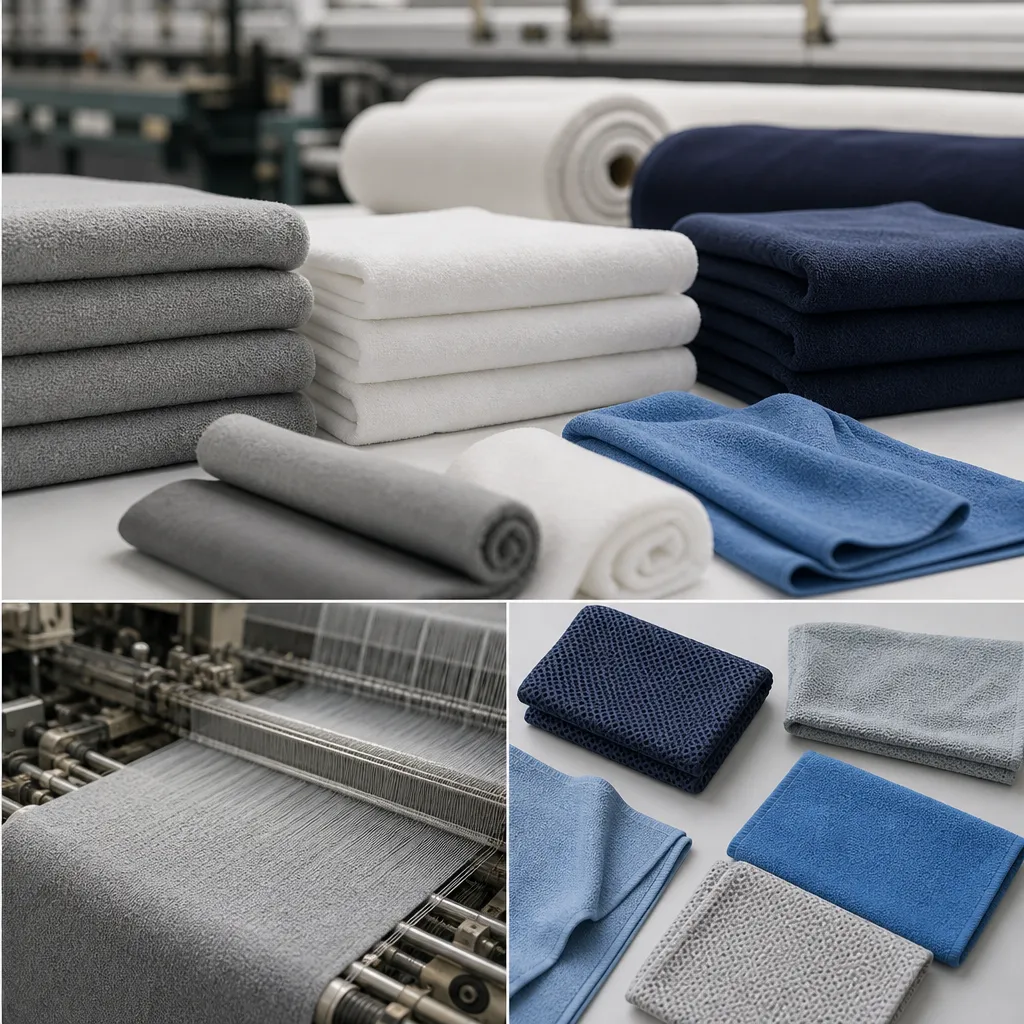
What Bulk Cooling Towels Really Need to Do
Cooling towels are not small bath towels. The cooling effect comes from evaporation: the user wets the towel, wrings it, snaps or shakes it, then wears it around the neck or over the head. If the fabric holds too much water, it feels heavy and drips. If it holds too little, it dries in 10 minutes and the customer thinks the towel failed.
In our factory, we separate these orders into three buyer use cases before quoting: sports retail, promotional event distribution, and occupational heat-control programs. Each one needs a different balance of GSM, edge finish, decoration method, and pouch packing. A 38 x 100 cm towel for a marathon sponsor is not the same product as a reusable towel for landscaping crews working outside for 8-hour shifts.
- Event giveaway: low unit cost, fast drying, logo visibility, individual pouch or polybag.
- Sports brand retail: softer hand feel, higher color consistency, hangtag or zipper pouch, better edge stitching.
- Workwear or outdoor staff: stronger seam, darker colors, wash durability, clear care instructions.
- Hotel pool or beach club: larger size, softer microfiber face, no rough plastic tube packaging.
For bulk cooling towels, we normally start sampling at 140-180 GSM for microfiber mesh, 180-220 GSM for smooth microfiber, and 240-320 GSM for PVA sponge cloth. Above those ranges, buyers often pay for weight without getting proportional cooling performance.
Choose the Fabric Before You Choose the Logo
The fabric decision controls almost every later decision. Microfiber accepts more print methods and feels closer to apparel. PVA absorbs more water and can feel colder on first use, but it dries stiff unless packed moist or carefully explained to the user. A blended cool-yarn fabric sits between the two, but it needs more careful dye control because shade variation shows clearly on light colors.
| Fabric type | Typical GSM | Cooling behavior | Best use case | Factory caution |
|---|---|---|---|---|
| Microfiber mesh, 80/20 polyester-polyamide | 140-170 GSM | Fast evaporation, light on neck | Marathons, gyms, promo kits | Thin fabric can curl after heat transfer if temperature is too high |
| Smooth microfiber, 85/15 or 80/20 | 180-220 GSM | Softer touch, slightly longer wet time | Retail sports towels, yoga, travel | Dense print can reduce wicking if ink coverage is heavy |
| PVA sponge cooling towel | 240-320 GSM equivalent | High water pick-up, strong initial cold feel | Work crews, golf carts, outdoor staff | Dries hard; packaging and care copy must be correct |
| Polyester cooling knit with cool-yarn finish | 150-200 GSM | Lightweight, apparel-like drape | Running brands, tennis clubs | Cooling claim should be tested, not only stated by yarn supplier |
For custom cooling towels with full-surface artwork, we usually avoid PVA. PVA printing is possible, but the color is flatter and registration is less sharp than on polyester microfiber. If a buyer wants a sponsor wall, a map print, or a retail pattern, sublimated microfiber is the safer route.
Two construction details matter more than most first-time buyers expect. First, the selvedge or overlock edge must not scratch the neck when wet. Second, the towel must pass a simple twist recovery check: after wetting, wringing, and stretching by hand, it should return flat without rope-like distortion. We reject rolls that show diagonal skew over 3 percent after wet relaxation.
Size, GSM, and Water Pick-Up Targets
A cooling towel is worn differently from a gym sweat towel. The common neck towel size is 30 x 90 cm or 30 x 100 cm. Wider sizes like 40 x 100 cm feel more substantial, but they also increase fabric consumption and pouch size. For children, airline amenity kits, or small promo packs, 25 x 75 cm can work if the buyer accepts shorter wet duration.
| Size | Recommended GSM | Approx. dry unit weight | Water pick-up target | Typical application |
|---|---|---|---|---|
| 25 x 75 cm | 140-160 GSM | 26-30 g | 2.2-2.8x dry weight | Amenity kits, low-cost event packs |
| 30 x 90 cm | 150-180 GSM | 41-49 g | 2.5-3.2x dry weight | Running events, gym welcome kits |
| 30 x 100 cm | 160-200 GSM | 48-60 g | 2.6-3.4x dry weight | Retail sports cooling towels |
| 40 x 100 cm | 180-220 GSM | 72-88 g | 2.8-3.6x dry weight | Golf, tennis, outdoor staff |
| PVA 33 x 90 cm | 260-300 GSM equivalent | 77-89 g | 5.0-7.0x dry weight | Industrial heat-control programs |
We measure water pick-up by weighing a dry towel, immersing it in water for 60 seconds, letting it drip vertically for 30 seconds, then weighing again. For more formal projects, we can run AATCC 79 for absorbency and AATCC 197 for vertical wicking on microfiber. For colorfastness, ISO 105-C06 washing and ISO 105-X12 rubbing are more useful than a vague “washable” claim.
A common mistake is asking for very high GSM because it sounds more durable. For evaporative cooling towels, more mass can slow drying and make the product unpleasant during exercise. A 30 x 100 cm microfiber towel at 190 GSM weighs about 57 g before trim and packing. Moving to 250 GSM raises the fabric weight to 75 g, but it also makes the towel warmer when the user stops moving.
Decoration: Sublimation, Screen Print, or Woven Label
Decoration is where many low-price quotations become unrealistic. A one-color logo near the corner is simple. Full-bleed sponsor graphics on a stretch microfiber towel require artwork control, shrinkage allowance, and shade approval. Polyester microfiber can shrink 2-5 percent during heat setting, so we print with compensation based on the confirmed fabric roll, not only the PDF file.
- Confirm fabric first. Do not approve artwork on one microfiber quality and bulk-produce on another.
- Lock print area. A logo placed 15 mm from the edge may disappear into the overlock seam if tolerance is ignored.
- Test ink hand feel. Heavy screen print can block moisture movement and feel rubbery when wet.
- Approve wet appearance. Some pale colors darken strongly after soaking, especially light grey and mint.
For promotional cooling towels, sublimation is the cleanest method for full-color artwork because the dye enters the polyester fiber and keeps the surface breathable. Screen print is cheaper for simple logos at volume, but it adds a film layer. Embroidery is rarely our first recommendation for this product because the stitches add weight and can rub the neck.
If the buyer wants brand identification without affecting cooling performance, we often use a small woven label or heat-transfer label at one short end. This keeps the main towel surface open for evaporation. For a broader decoration comparison, see embroidery vs sublimation vs jacquard and our notes on Pantone color matching for custom towels.
Packaging Changes the Quote More Than Buyers Expect
The towel itself may be light, but the packaging can add 15-45 percent to the final landed cost. A plain polybag is inexpensive and efficient for carton loading. A carabiner bottle, EVA pouch, or printed zip pouch improves retail presentation but increases mold, printing, assembly, and freight volume.
| Packing option | Added cost at 3,000 pcs | Carton impact | Best for | Comment |
|---|---|---|---|---|
| Individual OPP bag with care sticker | USD 0.035-0.060 | Lowest volume | Race events, staff issue | Fastest option and easy barcode sticker application |
| Frosted zip pouch | USD 0.120-0.210 | Medium volume | Retail gym or club shop | Can include printed insert card |
| PET bottle with clip | USD 0.260-0.420 | High volume | Outdoor promotions | Looks useful but freight cube increases quickly |
| Mesh drawstring pouch | USD 0.180-0.310 | Medium-high volume | Sports brand kits | Better drying after use than sealed plastic |
| Printed paper sleeve | USD 0.070-0.140 | Low-medium volume | Sustainability-focused events | Works only if towel is packed dry |
PVA cooling towels need extra discussion. If packed completely dry, the towel becomes rigid and may alarm users who expect a soft textile. If packed damp, the preservative system and shelf-life control must be checked against destination regulations. For EU and children’s products, we avoid casual antimicrobial claims unless the chemistry and documentation are in place.
- Use dry packing for microfiber unless the buyer has a special activation concept.
- Avoid airtight wet packing for long ocean freight unless preservative and carton testing are confirmed.
- Print care instructions clearly: wet, wring, snap, reuse, wash separately before first use.
- For retail, reserve enough pouch space so the user can repack the towel without folding it into an impossible shape.
Testing and Certifications We Can Actually Support
LUMA & CO. TEXTILE operates under ISO 9001 procedures, BSCI social compliance, and OEKO-TEX Standard 100 Class I material control where applicable. For cooling towels that touch the neck and face, we recommend using OEKO-TEX-compliant yarn, dye, print ink, and labels rather than only testing the greige fabric.
Buyers sometimes ask us to “certify cooling.” There is no single universal towel cooling certificate that all markets recognize. We can, however, define measurable tests: surface temperature drop after wetting and snapping, evaporation rate under controlled airflow, absorbency time, wicking height, colorfastness, dimensional change after washing, and seam strength.
- AATCC 197: vertical wicking behavior for microfiber and cooling knit fabrics.
- AATCC 79: absorbency time, useful for comparing finish recipes.
- ISO 105-C06: colorfastness to domestic and commercial laundering.
- ISO 105-X12: dry and wet rubbing fastness, important for dark neck towels.
- ISO 6330: domestic washing and drying procedure before measuring shrinkage.
One defect mode we watch closely is hydrophilic finish loss. Some low-cost microfiber feels excellent in the first water test, then loses wicking after five detergent washes because the finish was not durable. For repeat programs, we test before wash and after 5 wash cycles. If a buyer is building a gym or outdoor staff replenishment program, that extra test is cheaper than replacing complaints later.
MOQ, Pricing, and the Real Cost Per Use
Our standard MOQ is 500 pcs per design per color. For bulk cooling towels, that MOQ works for solid-color microfiber with a corner logo. Full-sublimation artwork is also possible at 500 pcs, but the unit price is higher because printing setup, paper waste, and cutting alignment are spread across fewer pieces.
| Order quantity | Microfiber solid + one logo | Microfiber full sublimation | PVA with pouch | Typical lead time after approval |
|---|---|---|---|---|
| 500 pcs | USD 0.86-1.18 | USD 1.24-1.70 | USD 1.42-1.95 | 18-24 days |
| 1,500 pcs | USD 0.64-0.92 | USD 0.98-1.36 | USD 1.18-1.62 | 20-27 days |
| 5,000 pcs | USD 0.48-0.74 | USD 0.76-1.08 | USD 0.96-1.38 | 24-32 days |
| 12,000 pcs | USD 0.39-0.62 | USD 0.65-0.94 | USD 0.84-1.20 | 28-38 days |
These bands assume common sizes between 30 x 90 cm and 30 x 100 cm, standard export cartons, and normal label requirements. Heavy retail pouches, individual barcodes, hangtags, or special compliance testing change the number. Air freight also changes the landed cost sharply because many packs are bulky even when the towel is light.
Cheap is not always cheaper in use. For example, a 30 x 90 cm towel at 145 GSM with a low-durability finish might quote at USD 0.46 on a 10,000 pc event order. A 170 GSM microfiber with better hydrophilic treatment and stronger overlock may quote at USD 0.58. If the cheaper towel is used twice before the sponsor logo cracks or the edge frays, the cost is USD 0.23 per use. If the better towel survives eight event and gym uses, the cost is about USD 0.073 per use. That difference matters when the towel carries a brand name.
Production Timeline and Approval Points
Cooling towel orders look simple, but missed approval points create delay. The two most common causes are late pouch artwork and late confirmation of towel color under wet conditions. A dry navy towel and a wet navy towel can look like different products under store lighting.
- Day 1-2: confirm tech pack, size, GSM, fabric type, logo method, packing, target price.
- Day 3-7: lab dip or print strike-off, fabric hand-feel sample, pouch mock-up if needed.
- Day 8-10: buyer approval of dry and wet towel appearance, logo placement, care label.
- Day 11-20: yarn or fabric preparation, dyeing or printing, heat setting, cutting.
- Day 21-27: sewing, trimming, inspection, individual packing, carton marking.
- Day 28-35: final QC, booking, export documentation, loading for sea or air shipment.
For urgent race events, we can sometimes compress a microfiber order to 14-18 production days after artwork approval if fabric is in stock and packing is simple. PVA, custom-dyed microfiber, and retail pouch programs need more time. If the delivery date is fixed, tell the mill the event date first, not after the sample is approved.
Related reads: if the towel will sit inside a wider fitness merchandise program, compare the construction notes in our sweat towels for gym spec guide and the durability problems explained in why gym towels fail after 50 washes. For microfiber decisions, our microfiber vs cotton towel comparison is a useful starting point.
Buyer Checklist Before You Ask for a Quote
The fastest quotations come from clear use-case information. We do not need a perfect technical file on day one, but we do need enough detail to avoid quoting the wrong product. A low-cost event towel, a retail fitness accessory, and an outdoor worker cooling towel should not share the same bill of materials.
- Target size, such as 30 x 90 cm, 30 x 100 cm, or 40 x 100 cm.
- Fabric preference: microfiber mesh, smooth microfiber, PVA, or open to factory recommendation.
- GSM target or hand-feel reference sample if available.
- Decoration method: corner logo, full sublimation, label, sleeve, or pouch print.
- Packing requirement: bulk pack, OPP bag, zip pouch, bottle, paper sleeve, or retail carton.
- Compliance needs: OEKO-TEX Standard 100, BSCI factory, ISO 9001 documentation, destination market rules.
- Expected order quantity per design and per color, with our MOQ at 500 pcs.
- Delivery deadline and shipping mode: sea, rail, courier, or air freight.
If you are still building the specification, use our towel GSM decision framework, towel sizes and dimensions guide, and build a towel tech pack that mills can quote. For shipping math, especially with bottle packaging, the guide to container vs air freight towel orders will help avoid surprise freight costs.
LUMA & CO. TEXTILE has manufactured custom towel programs since 2007 with 220 employees, annual output around 2.4 million towels, and export shipments to 47 countries. For sports teams, gyms, events, outdoor work crews, and promotional distributors, we prefer to quote from a real spec instead of selling the lightest towel that can pass a photo check.
Build a Cooling Towel Spec That Survives Use
Send size, quantity, logo artwork, packing idea, and delivery date. We will recommend fabric, GSM, decoration, MOQ, test points, and realistic pricing. WhatsApp: +86 13205717266. Email: [email protected].
Request a cooling towel quote →