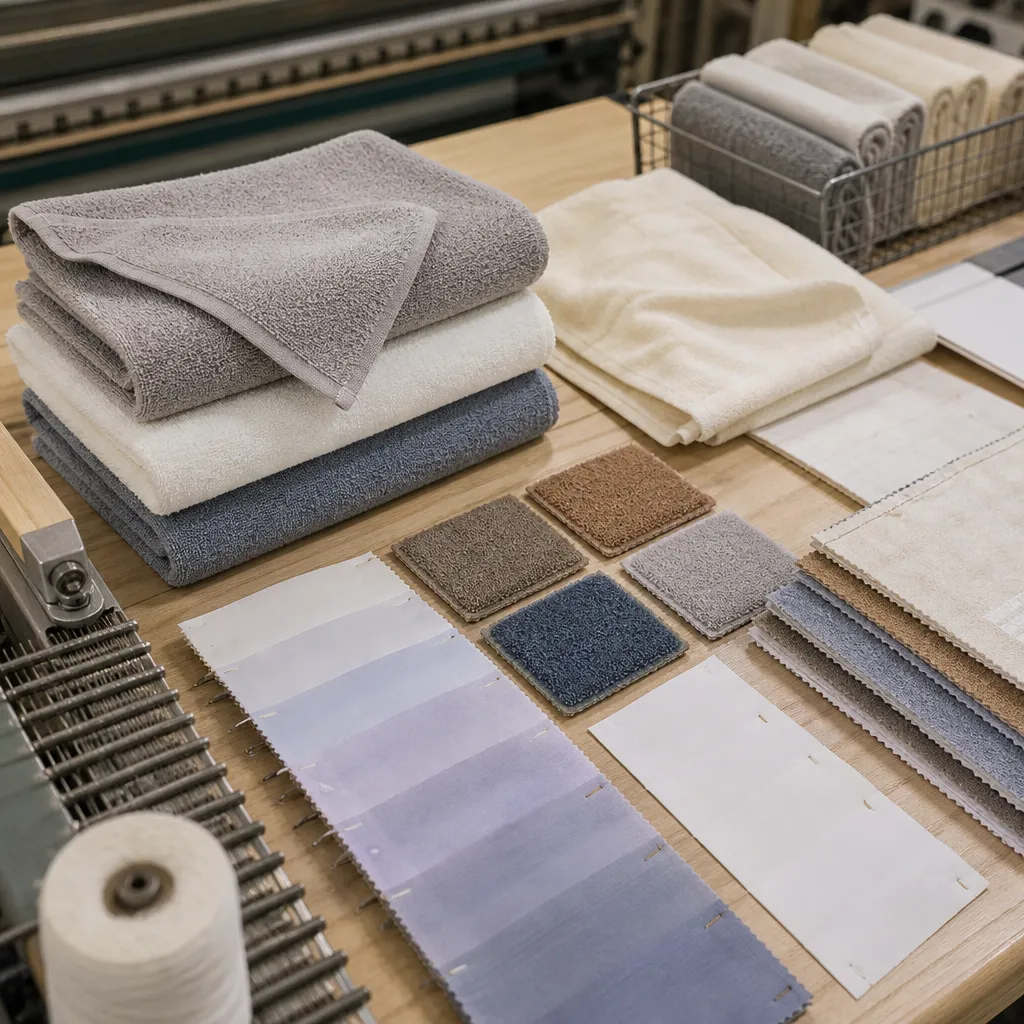
Start with the failure mode, not the color card
Buyers often begin with black, charcoal, or white because that is what the front-of-house team wants to see. For best salon towels, we start one step earlier: what is ruining the current stock? In salons, the repeat failures are usually bleach spotting from lightener, peroxide fade around folded edges, silicone buildup from conditioners, and roughness after high-alkaline wash. If you do not identify the main failure, you can easily buy a towel that looks right on day one and fails by week eight.
- For color bars, the main risk is chemical discoloration, especially on dark shades.
- For wash stations, the main risk is water absorption drop from product residue and fabric softener misuse.
- For facial and treatment use, the main risk is skin feel and edge distortion after hot washing.
- For high-turn salons, the main risk is cost per usable wash, not the FOB piece price alone.
We normally ask for three operating numbers before quoting: washes per week, whether chlorine bleach is used, and whether towels are segregated by service. Those three inputs change the recommended yarn, color depth, and hem construction more than the logo or packaging does.
What the best salon towels usually look like in bulk programs
For wholesale salon programs, the most stable construction is not the softest towel on the showroom shelf. It is usually a ring spun or combed cotton terry in the 380-520 GSM range, with a compact pile, 16s or 20s ground yarn, and lock-stitched hems that hold shape in repeated commercial washing. Below that range, the towel often feels thin and loses body quickly. Above it, drying time rises and chemical carryover becomes harder to rinse out.
| Use case | Recommended size | GSM range | Typical construction | Why it works |
|---|---|---|---|---|
| Color service / shoulder protection | 40x70 cm | 380-430 GSM | Cotton terry, low-to-mid pile | Dries faster, less bulky, lower replacement cost |
| Shampoo station / general use | 35x75 cm | 420-470 GSM | Combed cotton terry | Balanced absorption and wash durability |
| Spa-style premium salon service | 40x80 cm | 480-520 GSM | Combed cotton with denser loops | Better handfeel and heat retention for treatments |
| Backbar utility / heavy chemical exposure | 30x30 cm or 30x50 cm | 360-420 GSM | Dark utility towel, compact pile | Lower cost and easier sorting by task |
We generally do not push zero-twist for salon work unless the brand is positioned at the luxury end and has disciplined laundry controls. Zero-twist feels fuller but is more vulnerable to loop bloom and handfeel drop under rough chemical washing. If you want more context on yarn trade-offs, see combed-vs-zero-twist-cotton-explained.html.
Dark shades hide stains, but they do not stop bleach damage
A common sourcing mistake in salon towels wholesale is assuming black solves everything. Black towels hide tint stains, makeup, and some oxidation marks, but they do not resist chlorine or peroxide by themselves. Once lightener lands on reactive-dyed cotton, you can get a copper-orange halo or a pinkish cast depending on the dyestuff system. We see this most often along the folded ridge where product sits longer before rinsing.
- Black and charcoal are best for visual stain control.
- Chocolate and deep plum often mask oxidative spotting better than pure jet black in real use.
- White works when the operator uses controlled bleaching and wants maximum sanitation visibility.
- Mixed-color programs reduce visible wear by assigning dark towels to chemical work and lighter towels to face or hand service.
For dyed salon towels, we typically test to ISO 105-C06 for domestic and commercial laundering color change, and ISO 105-X12 for crocking if the towel will contact robes or client garments. For brands making bleach-resistant claims, we also run an internal spot application test using the buyer's actual lightener or peroxide system, because standardized wash tests alone do not fully predict localized chemical burns.
Why hem construction matters more than most buyers expect
On salon towels, hems fail before the body does surprisingly often. The towel body may still absorb well, but corners curl, side seams torque, or the end hem tunnels after repeated hot cycles. That happens when the shrinkage of the terry field and the shrinkage of the hem tape are not balanced. We usually spec a wider end hem and tighter stitch density for salon programs than for giveaway or low-use retail towels.
| Construction point | Low-risk spec | Common failure if underspecified |
|---|---|---|
| End hem width | 1.5-2.5 cm | Roping, waviness, edge rollover |
| Side finish | Double-fold or reinforced selvage | Fraying and width loss |
| Stitch density | 8-10 stitches per inch equivalent | Open seams after wash |
| Shrinkage target | Within 5% after test wash | Twist, size drift, poor stack presentation |
One salon-specific quirk: towels used under neck rests and on shampoo bowls get repeated compression while still wet. That creates seam stress at the same fold line every day. If we know the towel will be folded the same way at every station, we can recommend a spec that reduces cracking at that line.
Cotton, blends, and what we actually recommend
Most buyers asking for the best salon towels still land on 100% cotton because absorption and heat comfort matter. That said, not every cotton towel is right for salon use. Short-staple, loosely built terry can lint heavily in the first laundry cycles, especially on dark garments. For steady commercial performance, we prefer combed cotton or stable ring spun cotton with a tighter pile geometry.
- 100% cotton terry: best for absorption, client comfort, and hot towel services.
- Cotton-poly blend: useful when budget matters more than plush feel; usually lower absorbency but better dimensional stability.
- Dobby border-free terry: better for chemical salons because decorative borders often distort first.
- Low-pile utility terry: good for bleach-heavy tasks where replacement frequency is expected.
For salons that also retail towels, we often separate the backbar program from the retail shelf program. Using one construction for both sounds efficient, but the service towel and the retail towel almost never need the same pile height, shade tolerance, or packaging.
Price bands by volume: where the money actually goes
A realistic FOB China budget for salon hand towels depends on GSM, yarn grade, dye depth, and whether you need private label trim. For MOQ, our baseline is 500 pcs per design per color. Most salon groups buy in 2,000-12,000 piece runs split across two to five shades.
| Volume | Spec example | FOB USD/pc | Notes |
|---|---|---|---|
| 500-1,000 pcs | 35x75 cm, 400 GSM, dark dyed cotton | 0.86-1.14 | Higher dye-lot and setup cost per piece |
| 2,000-4,000 pcs | 35x75 cm, 430 GSM, combed cotton | 0.71-0.96 | Most common salon wholesale tier |
| 5,000-9,000 pcs | 40x70 cm, 450 GSM, branded wash label | 0.66-0.89 | Better carton efficiency and yarn purchasing |
| 10,000+ pcs | Multi-color program, 420-480 GSM | 0.61-0.84 | Best for chain salon replenishment plans |
Cheap quotes below these levels usually come from one of four cuts: lighter actual GSM than declared, smaller actual cut size before hemming, lower shade consistency, or weaker hemming thread. We would rather show buyers where the cost moves than approve a spec that creates a replacement problem. For example, a 430 GSM dark cotton towel at USD 0.82 lasting around 95 commercial wash cycles costs less per service than a USD 0.68 towel that loses appearance at 42 cycles. The piece price looks lower, but the usable-life cost is worse.
The wash tests we want to see before bulk approval
Salons operate closer to a chemical environment than many buyers admit, so lab dips and shade approvals are only part of the signoff. Before bulk, we prefer a simple but strict wash benchmark using buyer-relevant products and cycle conditions.
- Approve the towel construction and target weight first, not only the color swatch.
- Run a 5-wash quick screen for handfeel, linting, and seam integrity.
- Run a 20-wash benchmark with the salon's detergent and, if used, peroxide or bleach spot exposure.
- Score color change, absorbency time, shrinkage, and edge condition against an agreed standard.
- Lock the approved sample with date, lot note, and tolerance before bulk weaving.
For absorbency, we often use a simple drop test plus retained-water comparison after standardized saturation. For dimensions and mass variance, our QC team checks against agreed tolerance after conditioning. If a buyer claims bleach resistance, we ask for the exact oxidizer concentration. A towel that survives oxygen-based stain remover may still fail under direct contact with salon lightener.
Lead time for salon towel programs
The timeline is usually shorter than hotel bath towel programs, but shade approval can still slow things down. For dyed salon towels with standard woven labels, our normal planning looks like this.
| Stage | Typical days | What can delay it |
|---|---|---|
| RFQ review and spec alignment | 2-4 days | Missing size tolerance or unclear shade target |
| Lab dip and towel sample | 7-12 days | Dark shades needing second dip approval |
| Bulk yarn booking and weaving | 12-18 days | Peak season loom loading |
| Dyeing, finishing, cutting, sewing | 8-14 days | Re-dye for shade correction |
| Final QC and packing | 3-5 days | Extra wash test request |
| Sea freight planning after ex-factory | Varies | Port schedule and destination routing |
A practical total is 32-53 days from approved sample to ex-factory for most orders. If you need embroidery, barcode stickers per bundle, or custom retail belly bands, add a few more days. If freight choice becomes the bottleneck, see container-vs-air-freight-towel-orders.html.
A buying matrix for different salon models
Not every salon should buy the same towel. A single-location premium color studio has different priorities from a 40-branch chain or a barber-heavy operation.
- Chain salons: choose 400-450 GSM, dark program colors, stable hems, and easy reorder continuity by lot.
- Premium color studios: choose 430-500 GSM combed cotton with softer handfeel, but separate utility towels for bleach work.
- Barber and mixed-service shops: use denser dark towels for chemical tasks and lighter hot-service towels separately.
- Retail-focused salons: split B2B operational towels from shelf product; do not force one spec to do both jobs.
For bleach-heavy operators, it can be smarter to run a two-tier program: one lower-cost dark utility towel for technical services, and one softer customer-contact towel for finishing and presentation. That usually lowers total replacement cost because you stop over-engineering every piece.
Common RFQ gaps that make salon towel quotes unreliable
We see the same missing fields in salon towel inquiries. Buyers ask for a quote on "black salon towel" and receive numbers that are not actually comparable. If you want clean pricing and fewer sample rounds, the RFQ needs a technical base.
- Finished size in cm, not only category name
- Target GSM with tolerance
- Fiber content and whether combed cotton is required
- Color reference, ideally Pantone-adjacent visual direction for packaging and shade intent
- Expected wash environment, including bleach or peroxide exposure
- Hem requirement, label type, and pack quantity per carton
- Certification requirement such as OEKO-TEX STANDARD 100 Class I, BSCI, or ISO 9001 documentation
We hold OEKO-TEX STANDARD 100 Class I, BSCI, and ISO 9001 certification because many salon groups sell near skin-sensitive service environments or through retail channels that require formal compliance records. If certification review is part of your sourcing workflow, how-to-read-oeko-tex-certificate.html gives a useful checklist.
Related reads: If you are building a full spec packet, start with build-towel-tech-pack-that-mills-can-quote.html and towel-gsm-decision-framework.html. For operations teams comparing service categories, salon-towels-wholesale-bleach-proof.html and spa-towels-need-different-cotton-than-hotel.html are also relevant.
Our practical recommendation
If a buyer asks us for the best salon towels without overcomplicating the project, our default recommendation is a 35x75 cm or 40x70 cm combed cotton terry at 420-460 GSM, in dark program shades, with reinforced hems, tested for wash shrinkage and spot chemical exposure before bulk. That is the safest middle ground for most salon chains and independent studios. It absorbs well, survives repeated laundering, and does not carry the drying-time penalty of heavier bath-style constructions.
If your salon uses strong oxidizers daily, separate technical-use towels from client-contact towels. If your team wants a softer presentation towel, do that with a second SKU rather than compromising the whole program. And if your current supplier only quotes by color and size without discussing wash chemistry, they are probably quoting too early.
Related reads: For sizing and assortment planning, see towel-sizes-dimensions-complete-guide.html and negotiate-towel-moq-without-killing-margin.html. If your salon also sells branded accessories, private-label-vs-white-label-towel-programs.html helps frame that decision.
Need a salon towel quote with wash-life assumptions?
Send your target size, GSM, color plan, and wash conditions. We can quote from our 500 pcs per design per color MOQ and flag the likely risk points before sampling. WhatsApp: +86 13205717266 | Email: [email protected]
Request a quote →