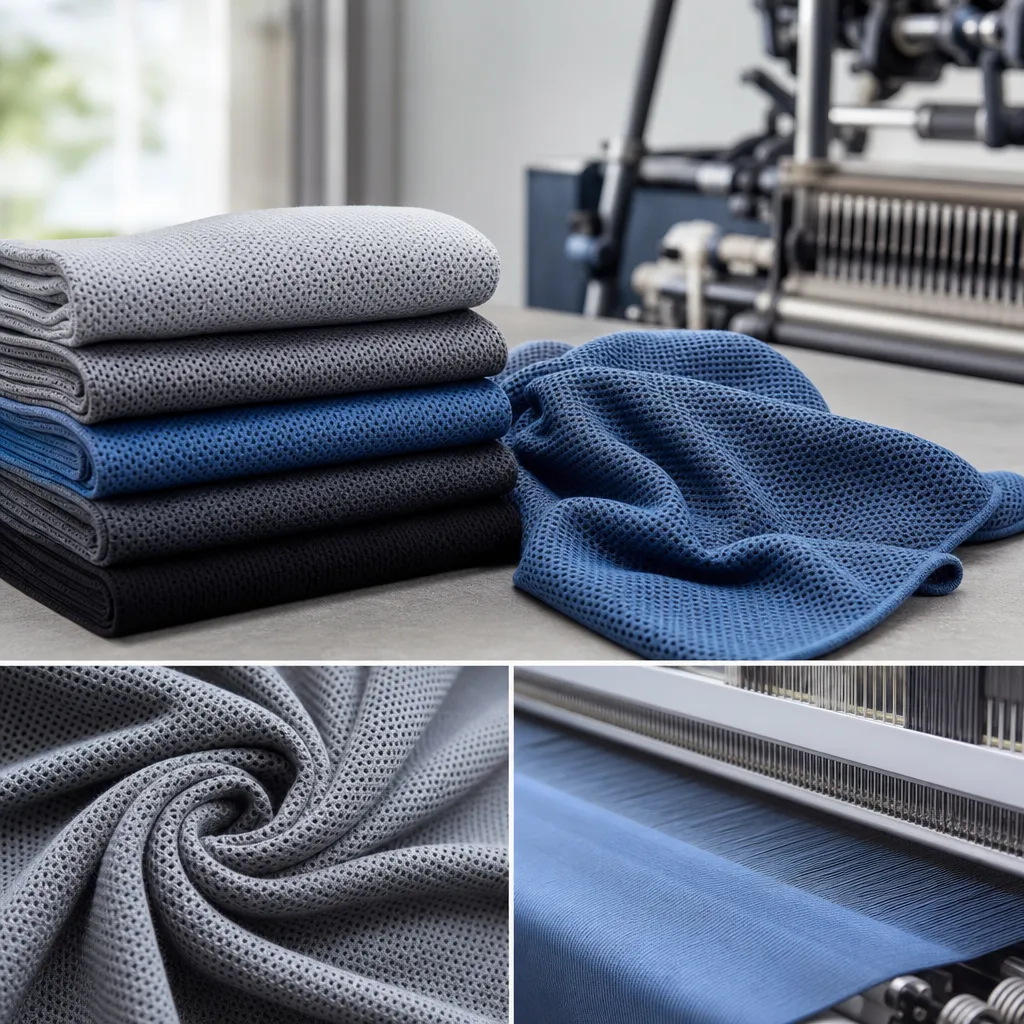
A testable definition of best cooling towels
At the mill, we treat cooling performance as a controlled moisture-and-airflow result, not a slogan printed on a hangtag. The towel must absorb water quickly, release it through evaporation at a predictable rate, keep its hand-feel after washing, and carry a logo without blocking too much surface area. For most sports, golf, marathon, and outdoor staff programs, that points to a lightweight microfiber mesh or knit in the 150-240 GSM range.
The best cooling towels for a retail brand are often different from the best towels for a stadium giveaway. Retail buyers can accept a higher unit cost for softer yarn, better edge binding, and printed pouch packaging. Event buyers usually need a lighter construction that survives one season, passes restricted substance checks, and arrives on a fixed date. We quote both, but we do not hide the trade-offs.
| Use case | Common size | GSM range | Main risk if underspecified |
|---|---|---|---|
| Marathon or outdoor race | 30 x 100 cm or 30 x 110 cm | 150-190 GSM | Edges curl after wet twisting and the print bleeds into the border |
| Gym retail accessory | 33 x 100 cm or 40 x 100 cm | 180-230 GSM | Too much logo coverage reduces evaporation area |
| Golf or tennis cooling towel | 30 x 90 cm or 35 x 95 cm | 170-220 GSM | Metal clip or pouch hardware stains during humid storage |
| Construction or field staff kit | 30 x 120 cm | 190-240 GSM | Dark shades heat faster in direct sun and show salt marks |
| Promo giveaway | 25 x 80 cm or 30 x 80 cm | 140-170 GSM | Low stitch density causes border separation after a few wet pulls |
Cooling duration: our bench setup, not a guess
Cooling-duration claims are easy to inflate because the test room changes the result. A towel that stays cool for 25 minutes at 24 °C and 55% relative humidity will not behave the same at 33 °C and 75% humidity. For a verifiable OEM benchmark, we document the equipment and setup before we compare samples.
- Condition samples for 24 hours under ISO 139 textile atmosphere: 20 ±2 °C and 65 ±4% relative humidity.
- Cut or fold each towel to a test area of 30 x 30 cm, keeping the same fabric layers for all samples.
- Immerse in water at 20 ±1 °C for 60 seconds, then spin in a laboratory hydro-extractor at 700 rpm for 30 seconds or wring with a roller set to 2.5 kg/cm line pressure.
- Place the wet towel on a perforated acrylic stand inside a climate chamber set to 30 °C and 60% RH, with horizontal airflow of 0.8 m/s measured by an anemometer 10 cm above the fabric.
- Record surface temperature every 60 seconds with a calibrated infrared sensor and confirm three points using a contact thermocouple taped below a 0.05 mm polyethylene film.
- Define cooling duration as the time until the towel surface rises to within 2.0 °C of the dry control fabric under the same airflow.
This setup gives buyers a number they can compare from one development round to the next. In our recent trials, a 180 GSM polyester-nylon bird-eye mesh in 30 x 100 cm format held a 2 °C differential for 18-26 minutes under the chamber method above. A denser 235 GSM version absorbed more water but felt heavier on the neck and dried more slowly inside a pouch. A PVA sheet sample stayed cold longer at first contact but became stiff when dry, which some retail customers dislike.
If a cooling towel supplier gives only a duration claim and no room temperature, humidity, airflow, water temperature, and wring method, the number is not useful for sourcing.
Fabric choices we actually put on the cutting table
Most custom cooling towels we produce are polyester or polyester-nylon blends because the filament structure can be engineered for capillary movement and fast evaporation. Cotton is comfortable, but for this product category it usually holds too much water and becomes heavy. For buyers comparing microfiber versus cotton, cooling towels sit on the microfiber side for a practical reason: controlled drying speed matters more than plushness.
| Construction | Typical blend | Weight | Factory note |
|---|---|---|---|
| Bird-eye mesh knit | 80/20 polyester-nylon or 85/15 | 160-220 GSM | Good balance of drape, evaporation, and sublimation clarity |
| Fine waffle microfiber | 100% polyester or 88/12 polyester-polyamide | 180-240 GSM | More texture against skin; can trap lint if packed with cotton goods |
| PVA sponge sheet | PVA with reinforcing scrim | Measured by thickness, often 1.2-1.8 mm | Strong cold touch but dries stiff; needs sealed tube or wet-use instructions |
| Warp-knit cooling fabric | Polyester with cooling mineral yarn optional | 150-200 GSM | Stable width, lower curl, better for long scarf-style products |
| Brushed microfiber | Polyester-polyamide | 200-260 GSM | Softer hand but slower evaporation and less crisp logo edge |
For brand programs, we usually start with bird-eye mesh because it gives the safest ratio of cooling effect, wash stability, and decoration tolerance. The small open cells increase exposed wet surface area. During cutting, however, the fabric can skew if the roll tension is uneven. We relax rolls for at least 12 hours before cutting long formats such as 30 x 120 cm; otherwise, the towel may twist after sewing.
A second construction quirk is edge memory. Lightweight knits below 160 GSM can curl at the long sides, especially after heat transfer printing. We control that with a 7-9 mm coverstitch or folded binding. Ultrasonic cut edges look clean on day one, but we avoid them for wet-pull sports products unless the buyer accepts a shorter use cycle.
Logo coverage can damage the cooling effect
Decoration is where many cooling towel projects lose performance. A large rubberized heat transfer can seal the fabric surface and reduce evaporation exactly where the user touches the towel. Sublimation is usually the cleanest option for white or light polyester fabric because the dye becomes part of the fiber surface without adding a thick film.
- Sublimation print: best for all-over artwork, gradients, race maps, sponsor walls, and retail graphics on white microfiber cooling towel fabric.
- Screen print: workable for small logos, but ink hand-feel must be tested; heavy plastisol-style deposits are not suitable.
- Heat transfer label: acceptable for compact logos below about 45 x 80 mm; avoid covering the center cooling zone.
- Woven label: useful for brand identity at the hem, especially when the towel body must stay uncoated.
- Embroidery: rarely recommended on thin cooling fabric because stitches add weight, pucker the knit, and feel abrasive when wet.
For more complex branding comparisons, our decoration team uses the same artwork discipline covered in embroidery vs sublimation vs jacquard. On cooling towels, we usually ask buyers to separate the performance area from the logo area. A 30 x 100 cm towel can carry a 20 x 70 cm sublimated graphic safely, but a dense transfer across that same zone will change the user experience.
QC checks before we approve bulk cutting
A cooling towel may pass a first-hand sample review and still fail in bulk if the fabric roll width drifts, the GSM runs low, or the dye lot shifts under sublimation heat. Our incoming inspection uses roll-by-roll weight checks, width measurement after relaxation, and shade banding under D65 light. For printed goods, we compare sublimation paper output and finished fabric using a spectrophotometer, normally targeting Delta E below 1.5 for brand-critical colors and below 2.5 for general event graphics.
- GSM tolerance: usually ±5% for microfiber knit; tighter tolerance increases fabric sorting cost.
- Size tolerance: ±1.0 cm for towels up to 100 cm length, ±1.5 cm for longer scarf formats.
- Colorfastness to washing: tested by ISO 105-C06 or an equivalent buyer-required method.
- Colorfastness to perspiration: tested by ISO 105-E04 because neck use exposes the towel to sweat and sunscreen.
- Dimensional change: checked after ISO 6330 domestic wash cycles; we normally want shrinkage below 3% for microfiber cooling towels.
Two defect modes are specific to this category. The first is printed ghosting caused by fabric stretch while the sublimation paper is moving through the calendar press. We reduce it by controlling fabric tension and using edge pins or a tacky paper system for long repeat artwork. The second is mildew odor from packing towels with residual moisture after wet testing. All wet-tested samples must be dried to a stable weight before sealed pouch packing.
Compliance for skin-contact sports goods
Cooling towels are usually worn on the neck, face, and arms, so chemical compliance matters even when the item is sold as a sports accessory. LUMA & CO. TEXTILE operates with OEKO-TEX Standard 100 Class I capability, BSCI social compliance, and ISO 9001 quality management. For children’s camps, school athletics, or family retail programs, we recommend OEKO-TEX Class I or Class II alignment rather than treating the towel like a low-risk giveaway.
Buyers should also define packaging claims carefully. If the hangtag says “instant cooling,” the fabric should produce a measurable surface temperature drop under the agreed chamber setup. If it says “UPF” or “antibacterial,” additional tests and chemistry documents are needed. We can source treated yarns or finishes, but each finish must be checked for wash durability and restricted substances.
| Requirement | Relevant standard or document | Why it matters |
|---|---|---|
| Restricted substances | OEKO-TEX Standard 100 Class I or Class II | Controls skin-contact chemical risk for dyes, auxiliaries, and prints |
| Factory quality system | ISO 9001 | Ensures documented incoming inspection, process control, and corrective action |
| Social compliance | BSCI audit framework | Common requirement for retail, sports, and hospitality buyers |
| Wash testing | ISO 6330 | Creates a repeatable domestic laundering condition before measuring shrinkage |
| Colorfastness to perspiration | ISO 105-E04 | Important for neck towels used with sweat and sunscreen |
MOQ, sampling, and bulk lead time
Our standard MOQ is 500 pcs per design per color. For a simple solid-color cooling towel with a small label, we can sometimes combine fabric dye lots across related SKUs, but printed artwork still requires separate setup. For full sublimation, each design needs its own paper, color approval, and press record. That is why a 6-design order at 500 pcs each is more efficient than 20 designs at 150 pcs each.
- Tech pack review and fabric proposal: 1-2 working days after we receive size, GSM target, artwork, packaging, and compliance needs.
- Lab dip or print strike-off: 4-7 days for standard polyester shades, 7-10 days if the artwork needs Pantone correction.
- Pre-production sample: 5-8 days after artwork and trim approval.
- Bulk fabric knitting or greige allocation: 5-12 days depending on GSM and yarn blend.
- Printing, cutting, sewing, inspection, and packing: 10-18 days for most 500-10,000 pc orders.
- Final inspection and export preparation: 2-4 days before vessel or air handover.
For timing discipline, we use the same logic explained in build a towel tech pack that mills can quote. A clear pack prevents sampling loops. For custom cooling towels, the most common missing items are the wet size target, the dry hand-feel preference, logo placement measured from the hem, pouch artwork dieline, and whether the cooling-duration test must be run before shipment.
Price bands we see in current OEM programs
Pricing depends on fabric weight, size, print coverage, trim, packaging, and compliance documentation. A buyer asking for the best cooling towels at a giveaway budget should expect a simpler construction. A buyer building a retail accessory line can justify better fabric and pouch work because returns and bad reviews cost more than the extra cents in material.
| Specification | 500 pcs | 3,000 pcs | 10,000 pcs | Notes |
|---|---|---|---|---|
| 30 x 80 cm, 155 GSM mesh, woven label, opp bag | USD 1.28-1.65 | USD 0.82-1.08 | USD 0.66-0.88 | Entry event item; limited decoration area |
| 30 x 100 cm, 185 GSM microfiber mesh, full sublimation, opp bag | USD 1.74-2.25 | USD 1.18-1.52 | USD 0.96-1.24 | Most common sports and gym program |
| 33 x 110 cm, 210 GSM mesh, sublimation plus printed pouch | USD 2.36-3.05 | USD 1.68-2.14 | USD 1.38-1.76 | Better retail shelf presentation |
| 30 x 120 cm, 220 GSM warp-knit, hem label, reusable tube | USD 2.88-3.70 | USD 2.08-2.62 | USD 1.72-2.18 | Field staff, tennis, and golf kit use |
| PVA cooling towel in tube, 1.5 mm sheet | USD 2.20-2.95 | USD 1.54-2.06 | USD 1.28-1.66 | Strong cold touch; packaging must prevent drying cracks |
As a cost-per-use example, a 30 x 100 cm microfiber mesh towel at USD 1.42 on a 3,000 pc order may survive 35-45 normal wash-and-use cycles if the edge stitching and sublimation are controlled. A cheaper 145 GSM towel at USD 0.74 may be suitable for a one-day race pack, but if a gym sells it as a reusable accessory and users discard it after 8-12 uses, the apparent saving becomes a brand complaint. We prefer to match the construction to the use cycle rather than remove grams until the towel no longer performs.
Packing decisions that affect moisture, odor, and freight
Cooling towels are frequently packed in pouches, tubes, or zipper bags. Packaging changes the logistics profile and sometimes the product condition. A towel sealed too tightly after steam pressing can trap humidity, especially in summer shipments. We use moisture checks before carton sealing and add desiccant when the destination route is humid or the buyer chooses reusable plastic tubes.
- Flat opp bag: lowest cost and smallest carton volume; good for race kits and online bundles.
- Carabiner pouch: useful for gyms and outdoor retail, but metal colorfastness and salt-spray resistance should be checked.
- Reusable plastic tube: strong shelf impact, higher freight volume, and higher mold risk if moisture control is poor.
- Mesh drawstring bag: breathable and practical for wet return use, but print area is smaller.
- Paper belly band: lower plastic use, suitable only if the towel does not need dustproof retail protection.
A 30 x 100 cm 185 GSM towel in a flat opp bag typically packs about 120-150 pcs per export carton depending on fold. The same towel in a rigid tube may drop to 40-60 pcs per carton, raising sea and air freight cost per piece. For buyers shipping urgent event goods, the freight discussion should happen before packaging approval. Our logistics notes in container vs air freight towel orders apply strongly to bulky tube programs.
Briefing our mill without slowing development
A practical cooling towel brief does not need to be long, but it must answer the questions that affect knitting, printing, and testing. If you already have a reference sample, send the dry weight, wet weight after soaking and wringing, size, packaging photos, and intended retail or event use. If you are starting from a target price, tell us the required use cycle so we do not quote a fabric that looks acceptable only before washing.
- Target user: race participant, gym member, golfer, outdoor crew, school athlete, or retail customer.
- Finished size and acceptable tolerance after washing.
- Preferred GSM range or reference sample weight.
- Decoration method, artwork file, Pantone colors, and maximum logo coverage.
- Packaging format, barcode needs, carton marks, and destination country.
- Required standards: OEKO-TEX, BSCI, ISO 9001 documents, or buyer-specific chemical list.
- Cooling-duration test condition, if you want a claim printed on the product page or hangtag.
Related reads: for adjacent athletic programs, compare sweat towels for gym specs, why gym towels fail after 50 washes, and our custom microfiber towels wholesale guide. For artwork and color control, review Pantone color matching custom towels before approving sublimation strike-offs.
LUMA & CO. TEXTILE has produced towel programs since 2007 with 220 employees, annual output around 2.4 million towels, and shipments to 80+ brand clients across 47 countries. For cooling towel OEM work, we normally quote within 1-2 working days once the specification is complete. Contact us by WhatsApp at +86 13205717266 or email [email protected] with your target size, GSM, artwork, volume, packaging, and required test setup.
Build a cooling towel spec that can be tested
Send your size, GSM target, artwork, packaging idea, order volume, and cooling-duration requirement. We will reply with fabric options, realistic pricing, MOQ, sampling time, and QC checkpoints.
Request OEM cooling towel quote →