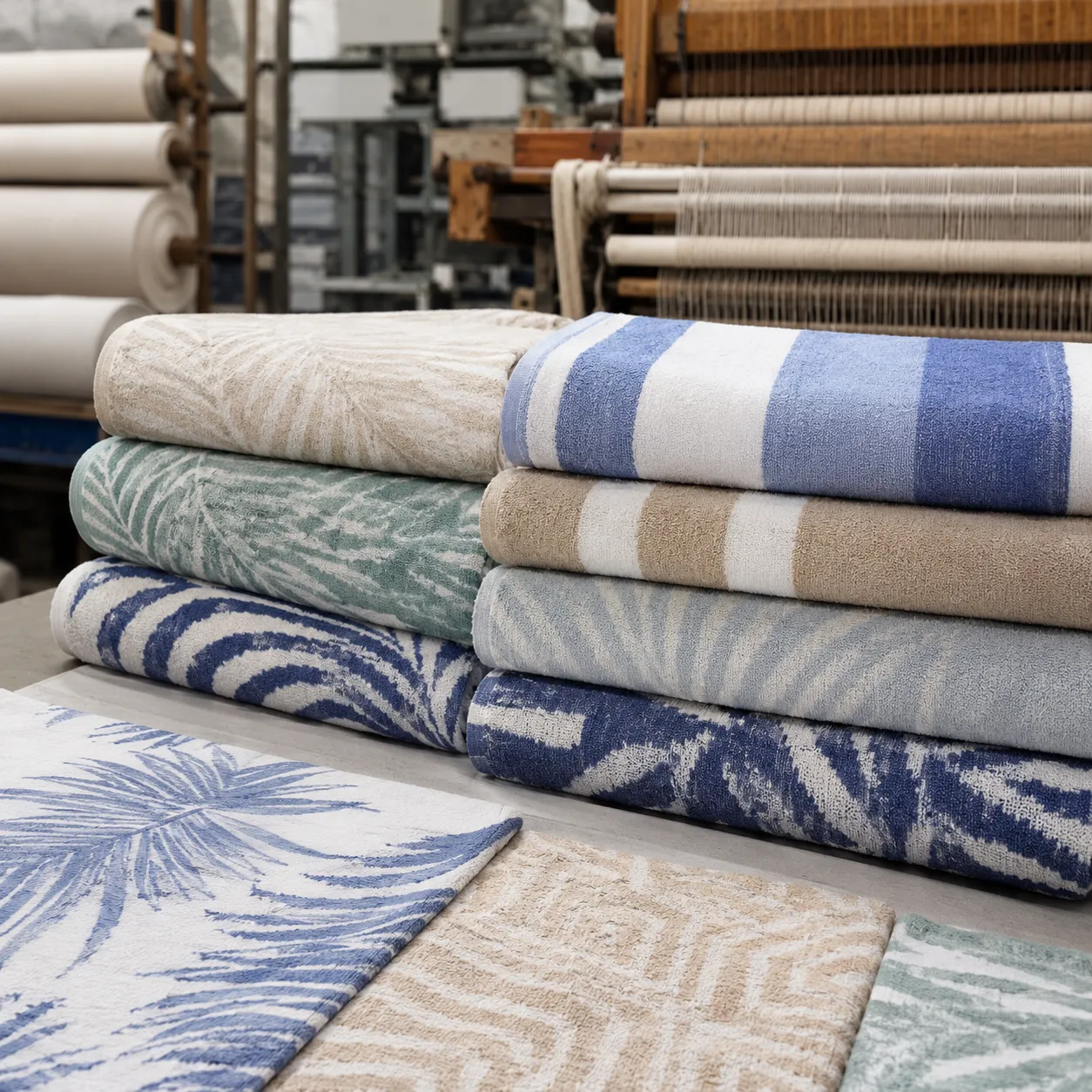
Start With the Use Case, Not the Artwork
Beach towels carry more visual branding than hotel bath towels, but they also take rougher handling. A guest drags the towel across a lounger, shakes sand out of it, leaves it in sun for four hours, then drops it into a mixed laundry cart with sunscreen and pool water still in the pile. If the base construction is wrong, the best logo file will not save the program.
At our mill in Gaoyang, Zhejiang, we usually separate beach programs into three working lanes: resort and beach club use, retail or DTC resale, and promotional event use. Each lane can be custom woven, printed, embroidered, or packed under private label, but the towel weight and yarn structure should be chosen before decoration.
| Buyer use case | Recommended construction | Typical GSM | Main risk if underspecified |
|---|---|---|---|
| Beach club or resort pool deck | Cotton terry or velour-terry with reinforced dobby border | 430-560 GSM | Border wave, linting, and short laundry life |
| Retail lifestyle towel | Cotton velour face with terry back or yarn-dyed jacquard | 380-520 GSM | Color variation between bulk lots |
| Surf, gym, or travel bundle | Microfiber suede or waffle microfiber | 240-330 GSM | Poor handfeel if fabric is too thin |
| Festival or drinks brand giveaway | Reactive printed cotton or poly-cotton terry | 300-420 GSM | Low perceived value and edge curling |
For a resort beach towel program, we do not recommend copying a bath towel spec. Bath towels are judged by plushness in a bathroom. Beach towels need surface area, fast enough drying, color visibility, and stable edges after repeated high-temperature drying. A 500 GSM beach towel often performs better than a 650 GSM bath towel outdoors because the pile is lower, the towel dries faster, and packing volume is lower.
High-Quality Custom Beach Towels: Mill Specs That Matter
For high-quality custom beach towels, we check six specifications before quoting: size, GSM, yarn type, decoration method, edge construction, and testing requirement. If any one is missing, the quotation may look attractive but the final towel can land far from the buyer's expectation.
- Size tolerance: we hold plus or minus 2.0 cm after wash for standard cotton beach towels when the tech pack gives finished size, not greige size.
- GSM tolerance: normal bulk tolerance is plus or minus 5 percent because terry loop height and finishing moisture affect final weight.
- Yarn choice: 16s or 21s cotton is common for beach terry; finer yarn gives cleaner artwork but costs more and dries slightly slower.
- Border width: 4-7 cm dobby borders resist distortion better than narrow decorative borders on oversized towels.
- Label position: woven labels should sit away from the corner seam stress point, usually 7-10 cm from the edge.
One construction quirk buyers often miss is the shearing step on cotton velour beach towels. Velour is made by cutting the loop tops on the face side, then brushing and leveling the surface. If the shearing blade is set too deep, the print surface looks smooth at first but the towel loses pile density and can show pale streaks after wash. If it is too shallow, the logo edges look fuzzy. We normally run a small shearing trial before bulk for detailed printed artwork.
Another beach-specific issue is border bowing. Large towels, especially 90 x 170 cm and above, can bow across the width if the border tension is not balanced against the terry body. On jacquard beach towels we adjust warp tension and inspect the first 30 meters of loom output before releasing the full beam.
GSM and Size: Where Buyers Overspend
A heavier towel is not automatically a better beach towel. Above roughly 600 GSM, drying time increases, carton volume increases, and laundry cost rises. For beach clubs that wash daily, the cost of water extraction and tumble drying can matter more than the purchase price difference.
| Finished size | Best GSM range | Approx. unit weight | Best fit |
|---|---|---|---|
| 75 x 150 cm | 360-450 GSM | 405-506 g | Retail sets, travel, event programs |
| 80 x 160 cm | 420-520 GSM | 538-666 g | Beach club deck towel, mid-range resort |
| 90 x 170 cm | 430-560 GSM | 658-857 g | Oversized beach towels for resorts or retail |
| 100 x 180 cm | 450-580 GSM | 810-1044 g | Luxury lounger towel or cabana program |
For example, a 90 x 170 cm towel at 520 GSM weighs about 796 g before label and packing. If the same towel is pushed to 650 GSM, the fabric weight rises to about 995 g. On a 6,000-piece order, that adds around 1.19 metric tons of textile weight before cartons. The towel may feel heavier, but the buyer also pays more yarn cost, more freight, and longer drying time.
For custom logo beach towels used on loungers, we often prefer 80 x 160 cm or 90 x 170 cm. The first size is easier to launder and control in cartons. The second gives a stronger guest experience and better artwork field. We only recommend 100 x 180 cm when the buyer has premium cabana positioning or wants a retail hero product.
Logo Method Changes the Base Towel
Decoration is not an afterthought. A towel designed for embroidery is not the same as a towel designed for reactive printing or jacquard weaving. We ask buyers to decide the branding method early because the yarn, pile height, and border layout need to support it.
| Logo method | Best fabric base | Minimum practical detail | Factory note |
|---|---|---|---|
| Reactive print on velour face | Cotton velour-terry, 380-500 GSM | Fine gradients and multi-color art | Requires controlled steaming and washing-off to prevent back staining |
| Yarn-dyed jacquard | Terry or velour jacquard, 430-600 GSM | Bold logos, stripes, repeat patterns | Artwork must be converted to weave structure; too many colors slow the loom |
| Embroidery | Terry or velour with stable pile, 420-560 GSM | Text above 7 mm height | Backing and stitch density must avoid hard patches on the towel |
| Sublimation | Polyester microfiber, 240-320 GSM | Photo artwork and full bleed | Not cotton; handfeel and absorbency are different |
For reactive printed cotton, we test crocking and wash-off carefully. We commonly reference ISO 105-C06 for washing colorfastness and ISO 105-X12 for rubbing colorfastness. Beach programs with navy, black, red, or deep green artwork need extra attention because loose dye can mark pale borders or transfer in wet bags.
For jacquard, the design must respect the towel grid. Curves and small serif letters become stair-stepped when translated into loops. If the logo has fine lettering, embroidery or print may be cleaner. Our decoration team often compares three strike-off options for brand clients: a two-color jacquard, a velour print, and a small woven label with a plain towel body. That comparison usually prevents expensive bulk corrections.
Related reads: for a deeper decoration comparison, see embroidery vs sublimation vs jacquard. For color approval workflow, our Pantone color matching guide explains lab dips, tolerance, and why screen color is not enough.
Cotton, Microfiber, and Blended Options
Cotton is still the safest choice for resort, hotel, and beach club buyers because it feels familiar and absorbs well. For beach towels, we usually use carded cotton for promotional and mid-range programs, combed cotton for cleaner pile and lower lint, and long-staple cotton blends when the buyer needs a softer retail handfeel. Zero-twist yarn is not our first recommendation for pool deck beach towels because the lofty loops can snag and flatten under commercial drying.
Microfiber has a different role. It packs small, dries fast, and supports full-surface sublimation. It is useful for travel towels, surf bundles, and DTC outdoor brands. It is less suitable when the buyer wants the classic cotton beach towel feel. We make both, but we do not push microfiber as a universal substitute.
- Combed cotton terry: best for resort quality and repeated washing, usually 430-560 GSM.
- Cotton velour-terry: best print surface with absorbent terry back, usually 380-520 GSM.
- Yarn-dyed jacquard cotton: best for woven-in branding, stripes, and club identity programs.
- Polyester microfiber: best for full-color art and compact packing, usually 240-330 GSM.
- Cotton-poly blend: useful for lower-cost event towels, but absorbency and handfeel are weaker than cotton.
Buyers sourcing bulk beach towels with logo sometimes ask for the lowest GSM cotton-poly option because the target unit price is tight. We push back when the towel will be used more than once or twice. A 330 GSM blend may save USD 0.42-0.65 per piece compared with a 430 GSM cotton terry towel at 5,000 pieces, but if it pills after 12 washes while the cotton towel reaches 45 washes, the cost per usable wash is higher.
QC Tests We Use Before Bulk Release
Beach towels are visually inspected, but visual inspection alone is not enough. Our QC team builds a small test plan around the buyer's market and risk. For EU baby or family resort programs, we also check OEKO-TEX Standard 100 Class I certificate alignment for the fabric and accessories. LUMA & CO. TEXTILE operates under ISO 9001 quality procedures and BSCI social compliance, and we keep batch records for yarn lot, dye lot, weaving, finishing, cutting, sewing, and packing.
- Confirm pre-production sample against approved size, GSM, Pantone target, logo placement, label, and packing.
- Wash test samples for shrinkage, lint, edge twist, and pile change; cotton beach towels are normally checked after 3 and 5 cycles.
- Run colorfastness checks using ISO 105-C06 for washing and ISO 105-X12 for rubbing when strong colors are used.
- Inspect loom-start or print-start output before full bulk continues, especially for jacquard repeat alignment and velour print registration.
- Perform final AQL inspection before shipment, commonly general inspection level II with critical defects at 0.
Topic-specific defects we watch for include pinholes in printed velour caused by uneven pile opening, white grin-through on dark jacquard loops, and wavy side hems after tumble drying. On oversized beach towels, corner thickness can also become a problem when four layers meet at the hem. If the corner is too bulky, it dries slower and can rub during carton compression.
For absorbency, we do not judge only by a showroom water drop. Finishing softener can make a towel feel smooth but slow water uptake. For cotton beach towels, we prefer a controlled wet-out check after one wash, then compare drying time and handfeel. A towel that absorbs slightly slower before first wash may perform better after finishing residue is removed.
Price Bands and MOQ Reality
Our MOQ is 500 pcs per design per color. That number is not arbitrary; below it, yarn dyeing, screen setup, jacquard programming, cutting tables, sewing line changeover, and export packing spread too much cost across too few towels. We can sometimes combine packaging or carton marks across designs, but the fabric and decoration setup still need a sensible production batch.
| Spec example | 500 pcs | 2,000 pcs | 8,000 pcs | Main cost driver |
|---|---|---|---|---|
| 80 x 160 cm cotton terry, 450 GSM, woven label | USD 4.10-5.35 | USD 3.45-4.55 | USD 3.05-3.95 | Cotton yarn and dyeing |
| 90 x 170 cm cotton velour print, 480 GSM | USD 6.25-8.10 | USD 5.20-6.85 | USD 4.70-6.10 | Printing, steaming, wash-off |
| 90 x 170 cm yarn-dyed jacquard, 520 GSM | USD 7.40-9.80 | USD 6.15-8.25 | USD 5.55-7.30 | Dyed yarn and loom time |
| 75 x 150 cm microfiber sublimation, 280 GSM | USD 2.85-4.10 | USD 2.35-3.25 | USD 2.05-2.85 | Fabric, print paper, heat transfer |
These are realistic FOB China bands, not fixed quotes. Final cost depends on yarn market, artwork complexity, packing, testing, and shipment terms. Private label beach towels with belly bands, cotton drawstring bags, barcode stickers, and carton drop-test requirements can add USD 0.18-0.75 per unit depending on materials and labor.
A practical cost-per-use example: a 5,500-piece beach club order can choose a 390 GSM promotional cotton towel at about USD 3.35 or a 485 GSM combed cotton velour-terry towel at about USD 5.65. If the first towel survives 18 commercial wash cycles before edge twist and rough handfeel trigger replacement, the textile cost is USD 0.186 per use. If the second reaches 58 cycles, the textile cost is USD 0.097 per use. The higher invoice can still be the lower operating cost.
Production Timing From Sample to Shipment
A smooth towel order is built around approval gates. Rushing bulk before the pre-production sample is signed usually creates rework. For beach towels, color and decoration approval are the longest variables because buyers often need internal sign-off from brand, operations, and sometimes retail merchandising.
- Tech pack review: 1-2 working days if size, GSM, artwork, Pantone codes, packing, and quantity are complete.
- Lab dip or yarn dip: 5-8 days for cotton dye colors; longer for multiple dark shades.
- Strike-off or pre-production sample: 7-14 days depending on print, jacquard, or embroidery method.
- Bulk production: 22-35 days after sample approval for most 2,000-10,000 piece cotton programs.
- Final inspection and export packing: 2-4 days before vessel or air handover.
For a new resort launch, we advise starting 60-75 days before the required warehouse date if shipping by sea. Air freight can recover time, but towels are bulky. Air shipment often costs more than the margin saved by delaying approvals. For carton planning, a cotton beach towel program at 80 x 160 cm and 450 GSM may pack around 20-24 pcs per export carton depending on fold and polybag choice.
Related reads: if you are planning a resort rollout, compare this guide with our beach club resort towel program and beach towels in bulk buyer guide. For freight planning, see container vs air freight towel orders.
What to Put in the RFQ
A clear RFQ saves several rounds of email and prevents the mill from quoting the wrong product. If a buyer asks only for high-quality custom beach towels, we still need to translate that into measurable specifications. The more complete the first brief, the more accurate the first price band.
- Finished size after wash, not only intended cutting size.
- Target GSM range and whether the towel should be terry, velour-terry, jacquard, or microfiber.
- Artwork file in AI, PDF, or high-resolution PSD, plus Pantone TCX or TPX targets where possible.
- Decoration position, logo scale, border preference, label type, and packing method.
- Destination country, required certificates, inspection standard, and target delivery date.
We are a 220-employee vertically integrated towel mill operating since 2007, supplying 80+ brand clients across 47 countries with annual production around 2.4 million towels. Our certificates include OEKO-TEX Standard 100 Class I, BSCI, and ISO 9001. We can support custom logo beach towels for hotel groups, beach clubs, retail brands, and promotional programs, but the right spec should match the actual washing and guest-use environment.
If you already have a towel sample, send photos of the front, back, border, label, and a measured weight. If possible, cut a 10 x 10 cm square from a damaged or spare sample and weigh it to estimate GSM. That small step helps us identify whether you are benchmarking a 420 GSM towel or a 560 GSM towel before we quote.
For broader specification work, our towel GSM decision framework, towel sizes and dimensions guide, and build a towel tech pack that mills can quote are useful before issuing a multi-supplier RFQ.
Build a Beach Towel Spec That Holds Up
Send us your target size, GSM, artwork, quantity, and delivery country. We will review construction, decoration method, MOQ, timing, and realistic FOB pricing before sampling. WhatsApp: +86 13384590853 or email [email protected].
Request a Beach Towel Quote →