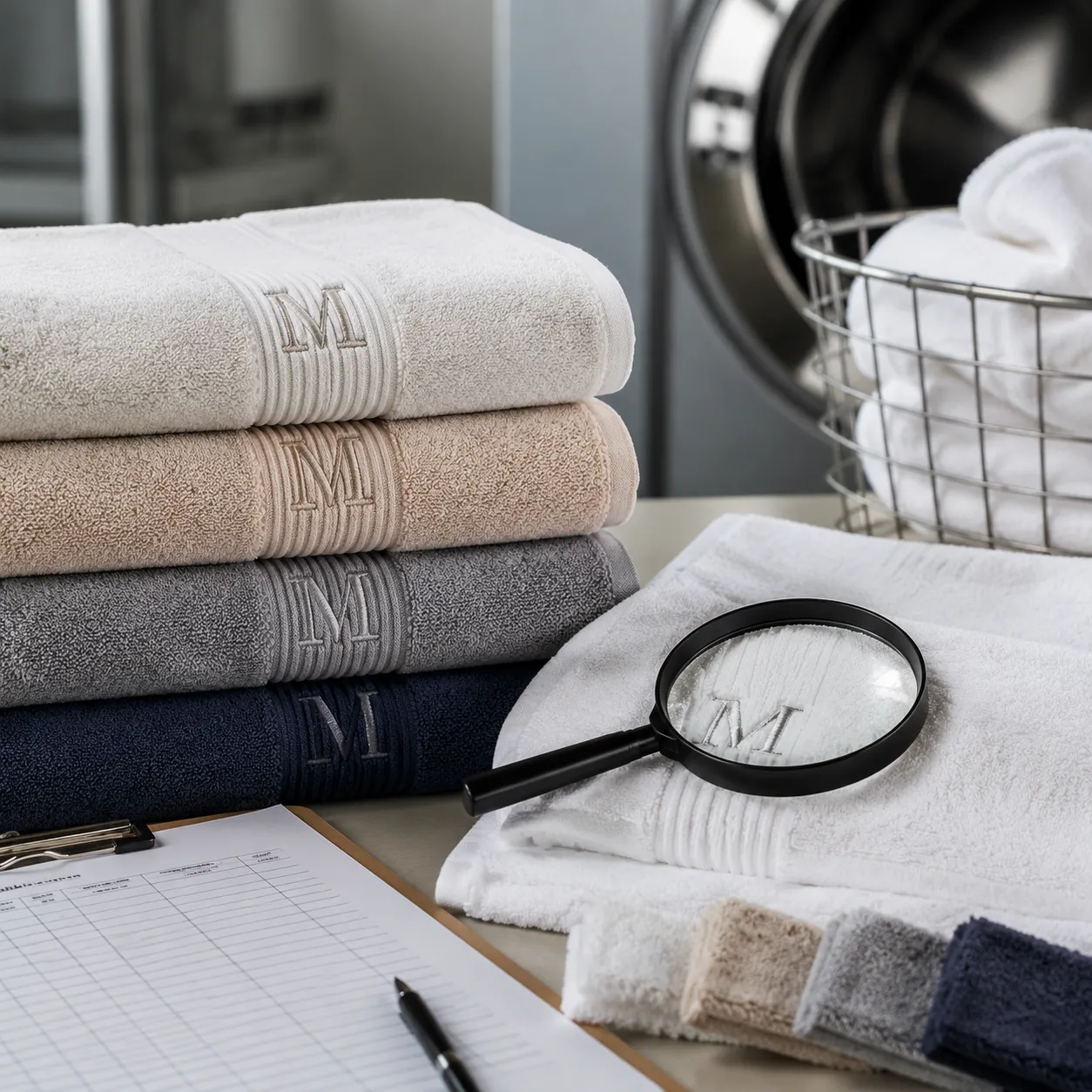
The approval risk is not the first photo
Embroidery usually fails slowly. On day one, the stitches can look sharp, the towel can feel full, and the buyer may approve from a phone picture. After 5 to 10 wash cycles, small weaknesses start to show: satin columns narrow, bobbin tension exposes white thread, the embroidered zone cups, or loops near the motif pull out because the needle damaged the terry ground.
Inside our mill, we separate two questions during approval. First, does the towel construction survive the laundry route? Second, does the monogram survive as a decoration attached to that construction? A 650 GSM bath towel can pass shrinkage and hand-feel targets while the thread color still bleeds onto a white ground. A 500 GSM towel can dry fast and keep size, but pucker around a dense 70 mm crest if the backing is wrong.
For buyers, the mistake is treating the embroidered sample as a design sample only. We treat it as a small production lot. That means we record towel GSM, pile yarn, border construction, thread type, needle size, stabilizer, stitch count, wash chemistry, drying method, and measured results after each checkpoint. This is slower than a photo approval, but it avoids bulk disputes after the first hotel laundry or DTC customer wash.
- Decoration risk: thread bleed, stitch abrasion, broken columns, loose trims, backing exposure, and puckering.
- Towel-body risk: shrinkage, skewed borders, pile shedding, linting, GSM loss, and hard hand-feel after drying.
- Combined risk: embroidery can restrict fabric movement, so the towel shrinks differently around the monogram panel.
- Buyer risk: approving artwork without a laundering rule leaves no clear standard for chargebacks or rework.
Our monogrammed bath towels wash test standard
Our monogrammed bath towels wash test standard is an internal factory protocol, not a universal ISO certificate. We build it from recognized test methods, then add practical pass limits for embroidered terry goods. The exact limits can change by program: a five-star hotel laundry towel needs tougher appearance control than a retail gift towel that is washed at home once every one or two weeks.
For most OEM approvals, we run a 10-cycle wash trial before final sign-off. For hotel, spa, cruise, and athletic club programs, we often recommend 20 cycles on the approved sample set before bulk cutting. We do not claim that 20 lab cycles equals one exact year in a commercial laundry. It is a comparative stress test that helps us catch unstable thread dye, poor backing, high shrinkage, and motif distortion before 500 or 5,000 pieces are made.
| Checkpoint | Reference method or control | Typical internal pass range | Why it matters |
|---|---|---|---|
| Dimensional change | ISO 6330 wash/dry procedure with towel-specific measurement points | Bath towel length and width usually within -3.5% to +1.0% after 10 cycles | Keeps folded stack size and border alignment consistent |
| Embroidery thread colorfastness | ISO 105-C06 washing colorfastness, assessed against adjacent fabric | Grade 4 or better for most white and pale towel grounds | Prevents dark navy, burgundy, or black monograms from staining pile |
| Rubbing at motif | ISO 105-X12 dry and wet rubbing on thread surface | Grade 4 dry and 3-4 wet as a common approval target | Catches surface dye transfer from shiny polyester or rayon thread |
| Puckering and motif distortion | Flat-table measurement plus visual review under D65 light | No severe cupping; motif width change normally under 4% | Protects retail appearance and hotel room presentation |
| Stitch security | Manual inspection after wash, tumble dry, and light pull at trims | No unraveling longer than 3 mm from locked stitch ends | Avoids loose initials after guests or customers use the towel |
These ranges are our working limits for common cotton bath towels, not a promise that every design can hit the same numbers. A 110 mm filled crest at 18,000 stitches on a 480 GSM towel behaves very differently from 28 mm initials at 2,200 stitches on a 620 GSM towel. We confirm the realistic pass range after we see artwork, fabric weight, color, and laundry route.
Build the towel around the laundry route
A monogram is only as stable as the terry base below it. For bath towels, the most common OEM range we produce is 500 to 700 GSM. Below 480 GSM, the towel can dry quickly but may not hold dense embroidery cleanly because the pile is shallow and the ground cloth can show stress marks. Above 720 GSM, the towel feels heavy but takes longer to dry, which can increase energy cost and mildew complaints in poorly ventilated laundry rooms.
For hotel and spa programs, we usually start with combed cotton in the 580 to 660 GSM range. It gives enough pile depth to hide stabilizer edges and enough base weight to resist distortion around the stitched area. For retail gifting, 520 to 600 GSM is often acceptable if the motif is small and the buyer wants lower parcel weight. Zero-twist constructions need extra caution because the soft pile can snag around needle penetrations if the motif is too dense.
| Use case | Common size | GSM range we quote most | Monogram guidance | Risk if under-specified |
|---|---|---|---|---|
| Hotel bath towel | 70 x 140 cm or 76 x 152 cm | 580-680 GSM | Initials or small crest, 35-65 mm high, placed above dobby or border | Border skew and puckering after tunnel drying |
| Spa treatment towel | 70 x 140 cm | 520-620 GSM | Soft thread contrast, avoid very dense fills against skin-contact zones | Thread abrasion from oils and repeated hot washing |
| Retail gift towel | 68 x 137 cm or 70 x 140 cm | 500-600 GSM | Names or initials up to 85 mm wide if stitch count is controlled | High parcel weight or weak motif if cheap base is used |
| Club locker-room towel | 76 x 152 cm | 600-700 GSM | Logo plus member initials should be tested as the largest name length | Long names pull the terry ground unevenly |
If your team is still deciding size and weight, our towel GSM decision framework and towel sizes guide are useful before artwork is finalized. For hotel programs, compare this with the broader hotel towel sourcing guide, because laundry capacity, room count, and replacement reserve affect the right construction.
Embroidery details that change wash results
Two monograms with the same letter height can behave differently because stitch density, underlay, thread, and backing are doing different work. On terry, we normally use a water-soluble topping to hold loops down during stitching. Without topping, pile fibers poke through satin columns and the monogram looks fuzzy after the first wash. Under the towel, a cut-away or tear-away stabilizer must be selected by motif density; too little support causes waviness, while too much support feels stiff after drying.
Thread choice also matters. We use colorfast polyester embroidery thread for hotel and commercial laundry projects because it handles higher alkalinity and mechanical action better than rayon in most towel programs. Rayon can look softer and more lustrous on retail gift items, but we test it carefully if the towel ground is white, cream, pale pink, or light grey.
- Satin columns: keep narrow strokes above roughly 1.5 mm after digitizing, or they can break visually after washing.
- Stitch density: dense fills on terry often need lower density than woven apparel patches because the pile adds bulk.
- Pull compensation: letters should be widened in the stitch file so they do not collapse after laundering.
- Backing edge: stabilizer should not shadow through light-colored towels after tumble drying.
- Trim locking: start and end points need enough lock stitches, especially on script fonts and separated initials.
For buyers comparing decoration methods, embroidery vs sublimation vs jacquard explains where embroidery is the right choice and where a woven or printed solution may be more durable. If your project involves personal names rather than initials, the process in our monogrammed bath towels guide is closer to the artwork approval path.
Sample sequence before bulk cutting
We do not recommend jumping from a digital mockup to bulk embroidery. Even with a familiar towel base, every new monogram size and thread color combination should be sampled. Our minimum order is 500 pcs per design per color, so a wrong approval can tie up real fabric, thread, cartons, and inspection time.
- Confirm towel base: size, GSM, cotton type, ground color, border style, and target laundry route.
- Digitize artwork and set the maximum stitch count allowed for the approved price band.
- Make strike-off embroidery on production-like terry, not only on flat woven fabric.
- Wash 3 to 5 sample towels for the first screening and measure shrinkage, motif change, and thread staining.
- Adjust density, underlay, backing, thread color, or placement if the first wash set shows stress.
- Run final approval samples through 10 cycles, or 20 cycles for higher-risk commercial laundry programs.
- Seal one approved unwashed sample and one approved washed sample for bulk inspection comparison.
Sampling rules should be written into the tech pack. If the buyer only says 'wash tested' without defining cycles, detergent, temperature, and drying method, the factory and the buyer may mean different things. A home-wash DTC brand might expect 40°C washing and low tumble drying. A hotel group may run 60°C washing, alkaline detergent, oxygen bleach, and high mechanical extraction. Those are not the same approval conditions.
A practical sample timeline is 3 to 5 days for yarn or greige confirmation if the base is available, 4 to 7 days for dyeing and finishing small sample lots, 2 to 4 days for digitizing and embroidery strike-offs, then 5 to 12 days for wash testing depending on cycle count and drying method. If a buyer asks us to approve a new bath towel monogram in 48 hours, we can make a visual sample, but we cannot honestly call it a completed wash-test approval.
Pass, fail, or adjust: how we judge samples
Not every imperfect sample should be rejected. Towels are textile products, and laundering changes pile direction, loft, and surface texture. The useful question is whether the change is controlled, repeatable, and acceptable for the selling channel. We classify results as pass, adjust, or fail so the buyer can make a commercial decision instead of reacting to one photo.
| Result | What we see | Factory action | Buyer decision |
|---|---|---|---|
| Pass | Shrinkage inside agreed range, no thread staining, no loose stitch ends, motif still readable | Seal sample and release pre-production approval | Approve bulk if price, carton, and label details are also confirmed |
| Adjust | Minor puckering, slight motif narrowing, backing edge too visible, or thread shade shifts under D65 light | Revise stitch density, backing, placement, or thread lot and test again | Approve only after corrected washed sample is reviewed |
| Fail | Color transfer, unraveling, hard cupping, needle cuts, or severe border distortion | Stop decoration route and rebuild spec | Do not release bulk; change towel base or decoration method |
One defect we watch closely is needle cutting in the ground cloth. It can appear as small ladder-like breaks near dense corners after washing. This is not the same as loose lint. Needle cutting usually points to a wrong needle, excessive density, poor hooping tension, or a towel base that is too light for the design. If we see it on two samples from the same stitch file, we change the file before discussing bulk approval.
Another specific defect is terry loop trapping under satin stitches. The monogram may look raised before washing, but after tumble drying trapped loops can pull sideways and make one side of a letter look hairy. Water-soluble topping reduces this, but digitizing still needs enough underlay to flatten the pile without making the motif board-like.
Pricing impact of testing and decoration
A wash-tested embroidered towel costs more than a blank towel because there are more controlled steps: artwork clean-up, stitch file creation, thread matching, stabilizer selection, machine time, trimming, sample laundry, inspection, and sealed reference samples. The added cost is usually smaller than the cost of replacing towels after customer complaints.
| Order volume | Typical FOB range for 70 x 140 cm | What is included | Notes |
|---|---|---|---|
| 500-999 pcs | USD 5.10-7.40 per pc | 520-620 GSM cotton towel, one-position monogram up to moderate stitch count | MOQ starts at 500 pcs per design per color |
| 1,000-2,999 pcs | USD 4.55-6.65 per pc | Better machine utilization, thread setup spread over more units | Good range for boutique hotel or retail launch |
| 3,000-7,999 pcs | USD 4.05-5.95 per pc | More stable dyeing and embroidery scheduling | Often used by resort groups and club programs |
| 8,000 pcs and above | USD 3.70-5.45 per pc | Bulk yarn, dyeing, embroidery, and carton efficiencies | Final price depends heavily on GSM and stitch count |
For a realistic cost-per-use view, consider a 620 GSM hotel towel with a 52 mm embroidered crest. If the cheaper build lands at USD 4.35 but starts showing distorted crests after 18 commercial washes, the towel cost is about USD 0.24 per visible service cycle before replacement pressure begins. If the tested build costs USD 5.15 and stays presentable through 42 washes in the same laundry route, the towel cost drops to about USD 0.12 per service cycle. That calculation excludes laundry labor and shipping, but it shows why a low first price can be expensive.
Certifications are separate from wash-test performance. We can supply towels under OEKO-TEX Standard 100 Class I, BSCI social compliance, and ISO 9001 quality management. These help verify chemical safety, audit discipline, and process control, but they do not automatically prove that a specific monogram stitch file will survive your laundry. That proof still comes from sample testing against the approved standard.
A case outcome from a resort reorder
A resort buyer came to us after a prior batch of monogrammed bath towels developed wavy crests and navy thread shadowing on white pile. Their towel was close to 560 GSM, 70 x 140 cm, with a 78 mm crest placed 60 mm above the dobby border. The artwork looked balanced, but the stitch file had dense fill areas and a sharp corner where the needle repeatedly hit the same ground yarns.
We rebuilt the program at 630 GSM combed cotton, reduced the crest to 64 mm, changed the fill density, added a more stable underlay, and moved placement 85 mm above the border. We tested polyester thread in two navy shades because the first shade gave slight staining against the white ground after the third 60°C wash. The second shade held at our Grade 4 target under the ISO 105-C06-based review.
The first corrected sample still had light puckering after 10 cycles, so we changed backing weight and reduced stitch count by about 14%. After 20 cycles, the towel body shrinkage measured within the agreed range, the crest width change stayed under our approval limit, and no trim ends opened beyond inspection tolerance. The buyer approved 2,400 pcs for the initial reorder and kept one washed sample at the property for housekeeping comparison. The useful outcome was not just a better towel; it was a written approval rule for the next reorder.
What to send before we quote
A clear tech pack makes pricing and sample timing more accurate. If you only send a logo and ask for a 'durable towel,' we have to make assumptions about GSM, laundry, size, and acceptable appearance change. Those assumptions can move the quote by more than USD 1.00 per towel on embroidered bath programs.
- Artwork file in AI, PDF, EPS, or high-resolution PNG, with target monogram width or height.
- Towel size, GSM target, cotton preference, ground color, and border style.
- Laundry route: home wash, hotel OPL, outsourced commercial laundry, spa oils, or bleach exposure.
- Thread color target using Pantone TCX/TPG, Madeira, Isacord, or physical swatch if available.
- Placement instruction measured from border or towel edge, not only shown on a mockup.
- Packaging needs: belly band, hangtag, barcode label, polybag, carton mark, or plastic-free packout.
For color communication, read our Pantone color matching guide. For building a quote-ready specification, use how to build a towel tech pack. If MOQ is the issue, negotiating towel MOQ without killing margin explains where we can combine production steps and where we cannot.
Our normal production timing after sample approval is 25 to 38 days for cotton bath towels with embroidery, depending on yarn availability, dyeing schedule, stitch count, and order volume. Export carton packing and final inspection usually take 2 to 4 additional days. Air freight can move urgent launch stock, but bath towels are bulky, so sea freight is usually more economical; our container vs air freight guide gives the trade-offs.
Closing rule for buyers
The safest approval file for embroidered bath towels includes three things: the unwashed reference sample, the washed reference sample, and the written test conditions. Without all three, a supplier, buyer, hotel laundry, and end customer can each judge quality differently. With all three, everyone can compare the bulk towel against the same physical evidence.
We are a 220-employee towel mill in Gaoyang, Zhejiang, operating since 2007. We supply more than 80 brand clients across 47 countries and produce about 2.4 million towels annually. For monogrammed programs, our practical advice is simple: do not approve the prettiest embroidery photo; approve the towel that still looks controlled after the wash route it will actually face.
Build a wash-tested monogram towel spec
Send towel size, GSM, artwork, thread colors, and laundry conditions. We will quote from 500 pcs per design per color and advise the right sample wash test before bulk production. WhatsApp: +86 13205717266. Email: [email protected].
Request a towel quote →