What Actually Moves the Price
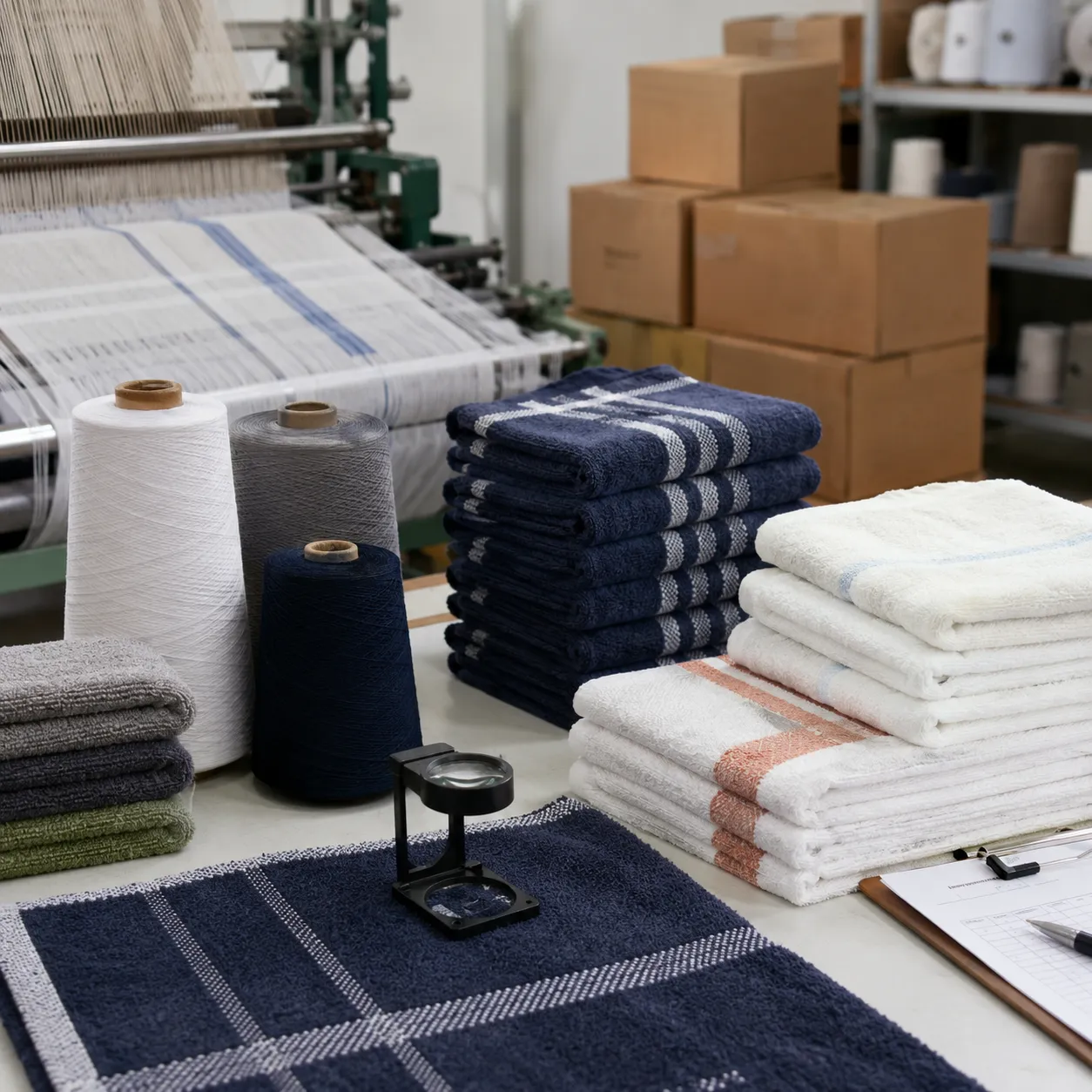
Bar mop towels are simple products only on the surface. A buyer may see a small square towel and expect pricing to behave like a disposable wipe, but our cost sheet is still built from yarn count, GSM, weaving efficiency, edge finishing, dye or optical brightening, packing labor, carton cube, and inspection time. If one of those lines is under-specified, the mill has to choose the cheapest workable assumption, which is usually not what a restaurant operation needs.
For food service, the biggest cost driver is not decoration. It is loss control after repeated washing. A 32×32 cm towel at 390 GSM weighs about 40 g before hemming allowance. If the buyer requests a denser 460 GSM body with reinforced edges, the finished piece moves closer to 49 g. Across 80,000 pcs, that 9 g difference is 720 kg of cotton yarn plus extra dyeing, drying, and freight weight. That is why two quotes that appear only USD 0.05 apart can perform very differently after 60 wash cycles.
| Cost driver | Lower-cost choice | More durable choice | Typical FOB effect |
|---|---|---|---|
| Yarn | Open-end cotton, 21s/1 | Ring-spun cotton, 16s/1 or 21s/2 | Adds USD 0.018-0.045/pc |
| GSM | 320-360 GSM | 390-470 GSM | Adds USD 0.030-0.085/pc |
| Construction | Loose terry loop | Tighter terry or ribbed center stripe | Adds USD 0.012-0.038/pc |
| Edge | Basic overlock | Folded hem or reinforced overlock | Adds USD 0.010-0.026/pc |
| Color | White with optical brightener | Vat-dyed stripe or yarn-dyed ID line | Adds USD 0.015-0.060/pc |
| Packing | Loose bulk carton | Bundled 12 pcs or barcode inner bag | Adds USD 0.008-0.035/pc |
Bar Mop Towel Bulk Pricing Model: FOB Tiers
Below is the pricing structure we would use for a standard cotton bar mop towel program from our Gaoyang production line. These are realistic FOB China bands for plain white or stripe cotton bar mop towels, based on 2026 yarn and labor conditions. Final pricing still depends on exchange rate, confirmed GSM, label requirement, carton packout, and whether the order shares greige fabric with another production lot.
| Order volume | Spec assumption | FOB China price band | Best use case |
|---|---|---|---|
| 500-1,999 pcs | 30×30 cm, 340-380 GSM, white, bulk pack | USD 0.34-0.52/pc | Trial order, small restaurant chain, distributor sample run |
| 2,000-9,999 pcs | 30×30 or 35×35 cm, 360-420 GSM, white or center stripe | USD 0.27-0.43/pc | Regional restaurant group, janitorial supplier, bar supply catalog |
| 10,000-49,999 pcs | 35×35 cm, 390-460 GSM, reinforced edge, carton optimized | USD 0.22-0.36/pc | Commercial laundry program, hotel F&B department, national distributor |
| 50,000-120,000 pcs | Shared yarn lot, fixed carton size, stable repeat spec | USD 0.18-0.31/pc | Contract food service replenishment or private-label wholesale |
| 120,000+ pcs | Dedicated yarn purchase, booked loom time, monthly releases | USD 0.16-0.28/pc | Annual program with forecast and quality lock sample |
Our MOQ remains 500 pcs per design per color. For bar mop towels, we can often keep sampling simple because most buyers choose white, white with a colored center stripe, or natural cotton. The moment a buyer requests six stripe colors in 500 pcs each, pricing changes. The cotton body may be common, but yarn-dyed stripe setup, shade approval, and packing separation all add handling cost.
For restaurant towels, we usually advise buyers to cost by monthly replacement rate, not only by first purchase price. A towel that saves USD 0.04 on day one but loses absorbency after a few bleach cycles is not a saving.
Three Spec Levels We Quote Most Often
The right bar towel depends on where it will be used. A front-bar towel for wiping glassware does not need the same construction as a back-of-house commercial kitchen towel used near oil, sanitizer, and repeated boil wash. We normally quote three levels so procurement can compare cost against failure risk instead of debating one vague sample.
| Spec level | Typical GSM | Construction notes | Expected laundry life | FOB band at 10,000 pcs |
|---|---|---|---|---|
| Economy service | 320-360 GSM | Open-end cotton, basic terry, 3-thread overlock | 25-40 industrial washes | USD 0.22-0.28/pc |
| Standard restaurant | 370-430 GSM | Ring-spun or blended yarn selection, tighter loop, improved corner lock | 45-70 industrial washes | USD 0.27-0.34/pc |
| Heavy-duty kitchen | 440-520 GSM | Denser terry, reinforced edge, optional color ID stripe | 70-95 industrial washes | USD 0.33-0.44/pc |
- Economy service works for low-risk wiping, short promotions, or bundled starter packs where replacement is expected.
- Standard restaurant is the usual balance for restaurant bar towels wholesale orders because it absorbs well without becoming too slow to dry.
- Heavy-duty kitchen makes sense where towels are laundered with aprons, exposed to bleach, or counted as reusable operating assets.
- Avoid undersized specs if the towel must cover bartender hand-wiping, spill pickup, and glass polishing in one SKU. A 25×25 cm towel may look cheaper but often increases pieces used per shift.
For a simple cost-per-use comparison, assume a restaurant group buys 20,000 pcs. An economy towel at USD 0.25 lasting 32 washes costs about USD 0.0078 per wash before freight. A standard towel at USD 0.31 lasting 58 washes costs about USD 0.0053 per wash. Even before counting labor to reorder and sort losses, the stronger towel is roughly 32% lower per use. That does not mean every buyer should buy the heavier towel, but it explains why we ask about laundry process before quoting.
Yarn, Loop Height, and Lint Risk
Cotton bar mop towels are judged harshly because they are used against dark counters, glassware, stainless steel, and uniforms. If the yarn is too weak or the terry loop is too open, lint becomes visible quickly. In production, lint risk is affected by cotton grade, twist, singeing, washing, and whether the towel has been pre-cleaned before packing.
For plain white bulk bar towels, we normally use 21s/1, 16s/1, or 21s/2 cotton yarn depending on target GSM. Open-end yarn can reduce cost, but it has a shorter fiber profile and can shed more during early use. Ring-spun yarn costs more because spinning efficiency is lower, yet it usually gives a cleaner hand feel and better loop retention.
- Loop pull defects happen when long terry loops catch on bottle caps, racks, or rough counter edges. Lower loop height and tighter pile reduce snagging.
- Corner burst usually starts where overlock tension is uneven. We check this after tumble drying because weak corners may look fine before washing.
- Grey shade drift appears when optical brightener is inconsistent across lots. For repeat programs, we keep a retained shade card under D65 light.
- Hard hand feel can come from over-drying or too much finishing chemical. A towel can pass weight inspection and still be rejected by operators if it feels boardy.
One construction quirk matters for bar mops: the center stripe can distort after washing if the stripe yarn shrinkage does not match the base terry. We run a small bulk-prewash on striped samples and measure skew. If the stripe twists more than 4% against the towel edge, we adjust yarn tension or reject the stripe setup before bulk weaving.
Bleach and Laundry Testing Before Price Approval
Bleach safe bar mop towels are not only a dye question. White towels may see chlorine bleach, oxygen bleach, alkaline detergent, hot water, and aggressive tumble drying. Colored stripes or branded labels must survive the same conditions or they become the first visible failure point. Before we lock bulk pricing, we prefer to test the exact wash chemistry that the buyer or laundry partner uses.
| Test item | Method or mill standard | Pass target for restaurant use | Why it affects price |
|---|---|---|---|
| Dimensional change | ISO 6330 wash and tumble dry adaptation | Within -5% length and width after 5 cycles | Controls yarn choice and finishing route |
| Colorfastness to washing | ISO 105-C06 for stripe or dyed towel | Grade 3-4 minimum shade change | May require vat dye or better reactive dye |
| Absorbency | AATCC 79 drop test adaptation | Water drop absorbed within 5 seconds after prewash | Finishing softener must be controlled |
| Seam strength | Internal pull check plus corner abrasion | No open seam after 10 wash-dry cycles | May require reinforced overlock or folded hem |
| pH | ISO 3071 extract test | pH 6.0-8.5 for finished goods | Needed for skin contact and OEKO-TEX review |
OEKO-TEX Standard 100 Class I is available for compliant towel programs, although most restaurant buyers classify these as professional-use textiles rather than infant-contact goods. We still keep chemical control strict because towel residues can contact hands, counters, and glassware. Our factory operates under ISO 9001 procedures and BSCI social compliance, and we keep batch inspection records tied to yarn lot, dye lot, and packing date.
If the buyer asks us to cut USD 0.03 per piece by using a cheaper stripe dye, we will push back when bleach exposure is confirmed. A 40,000 pc order saving USD 1,200 at purchase can become a USD 5,000 replacement issue if the stripe bleeds into white towels during the first month of laundry. The bar mop towel bulk pricing model should show those trade-offs before the PO is placed.
Packing, Carton Cube, and Freight Math
Bar mop towels are heavy for their value. Freight can quietly change the landed cost more than a small yarn adjustment. A 35×35 cm towel at 420 GSM is roughly 51 g before label and packing. With 300 pcs per export carton, the net towel weight is about 15.3 kg. Add poly liner, carton, and humidity allowance, and gross weight often reaches 16.2-16.8 kg.
We normally test packout during sampling because a dense carton can fail drop handling or arrive with compressed, wrinkled towels. If a buyer wants barcode inner packs of 12 pcs, the carton count may drop from 300 pcs to 240 pcs. That raises carton quantity, warehouse handling, and ocean freight cube. For low-value commercial kitchen towels, carton design belongs in the price model, not as an afterthought.
- Confirm finished towel size and GSM after washing, not only before washing.
- Decide whether towels ship loose, bundled by dozen, or in retail-ready inner bags.
- Set carton count based on gross weight limits for the destination warehouse.
- Add desiccant or poly liner only when the route has high humidity risk or long inland storage.
- Print carton marks with PO number, SKU, color stripe, piece count, and gross/net weight.
For LCL orders below 3 CBM, freight and destination charges can be painful compared with the towel value. If the buyer has other towel categories, we often suggest combining bar mops with restaurant towel service programs, hotel hand towels, or gym wiping towels to improve carton utilization. For full-container planning, the freight discussion is closer to the framework in container vs air freight towel orders.
Lead Time and Sampling Calendar
A plain white bar mop towel is faster than a jacquard or embroidered towel, but bulk timing still depends on yarn booking and finishing capacity. For repeat specs using available yarn, sample lead time is usually 5-8 days. For stripe development or special GSM, allow 9-14 days for lab dip, yarn check, sample weaving, washing, and measurements.
| Stage | Typical days | Buyer action needed | Factory output |
|---|---|---|---|
| RFQ review | 1-2 days | Send size, GSM, target price, wash process, packing request | Initial spec comment and price range |
| Counter sample | 5-14 days | Approve hand feel, absorbency, stripe, and edge | Physical sample with weight and shrinkage record |
| Pre-production approval | 3-5 days | Sign off sealed sample and carton plan | PP sample, inspection checklist, production card |
| Bulk production | 18-28 days | Open PO and deposit, confirm shipping marks | Weaving, washing, finishing, packing |
| Final QC and booking | 3-6 days | Approve inspection or third-party schedule | AQL report, carton list, shipment booking |
A normal first order therefore needs 30-45 days from workable RFQ to cargo-ready goods. Repeat orders can run 22-32 days if the yarn, label, and carton remain unchanged. Rush orders are possible only when the spec uses stock greige fabric and standard packing. Air freight is rarely economical for bulk bar towels unless the order is small and the restaurant opening date is fixed.
How We Build the RFQ Sheet
A clear RFQ lets us quote without hiding risk in assumptions. The phrase "bulk bar towels" is not enough because one buyer may mean a thin wipe for a cocktail station and another may mean a heavy back-of-house towel that sees hot wash every night. We prefer one page with measurable lines.
- Size: 30×30 cm, 35×35 cm, 38×38 cm, or buyer sample tolerance after wash.
- GSM: target finished GSM, usually 340-520 GSM for bar mop programs.
- Material: 100% cotton, cotton-rich blend if approved, yarn preference if known.
- Color: white, natural, center stripe, border stripe, or solid dyed shade with Pantone reference.
- Edge: overlock, reinforced overlock, folded hem, or buyer sample match.
- Laundry: home wash, commercial wash, chlorine bleach, oxygen bleach, or outsourced linen service.
- Packing: loose bulk carton, 12-pc bundle, polybag, barcode, carton count, pallet requirement.
- Compliance: OEKO-TEX Standard 100 Class I request, BSCI audit need, ISO 9001 production record, destination labeling.
For buyers building a first towel tech pack, the workflow in build a towel tech pack that mills can quote is useful. If your procurement team is comparing cotton constructions, combed vs zero-twist cotton explained helps clarify why bar mop towels usually favor durability and lint control over plushness.
Negotiation Points That Do Not Damage Quality
There are safe ways to lower price, and there are risky ways. Cutting GSM below the use case, loosening edge stitch density, or switching to untested stripe dye can reduce the FOB number but increase field complaints. Better negotiation focuses on production efficiency.
- Combine white towel volume across branches so the mill can buy yarn in one lot.
- Use one carton size across SKUs where possible to reduce packing changeover.
- Keep stripe colors to one or two operational IDs instead of many small color splits.
- Approve a standard label position or remove labels entirely for back-of-house use.
- Provide a 6-month forecast so we can reserve loom time instead of quoting each order as a one-off.
- Accept mill-standard tolerances: size ±3%, GSM ±5%, and shade within approved bulk range.
For MOQ planning, the same logic applies as in negotiate towel MOQ without killing margin: fewer fragmented SKUs usually beat aggressive pressure on unit price. Our MOQ is 500 pcs per design per color, but the strongest pricing starts when the buyer consolidates to 10,000 pcs or more per spec.
Related reads: Buyers comparing reusable wiping textiles may also find microfiber vs cotton towel comparison useful, especially when deciding between cotton absorbency and microfiber lint control. For restaurant and kitchen categories, see restaurant bar mop towels spec guide and kitchen bar mop towels OEM benchmark.
A Practical Cost Model for Procurement
For procurement teams, the best bar mop towel bulk pricing model is a landed-cost worksheet with wash-life assumptions. FOB price is only the first line. Add inland trucking, ocean freight, duty, destination handling, warehouse labor, shrinkage, and replacement frequency. If the towel is used by a linen service, also include loss charges and sorting labor.
A workable example: a 60-location restaurant group uses 18 towels per location per day and launders every second day. That operating model keeps about 2,160 towels circulating, but a realistic starting stock is closer to 4,800 pcs after backup stock and losses. If a USD 0.29 standard towel lasts 55 washes and freight/duty adds USD 0.07, the landed cost is USD 0.36, or about USD 0.0065 per wash. If a cheaper USD 0.23 towel lands at USD 0.30 but lasts 30 washes, it costs USD 0.0100 per wash. The annual difference can exceed USD 3,000 for that chain without any change in menu, labor, or guest count.
This is why we ask for laundry data before final quote. If your towels are mostly used for dry polishing, we can keep the spec lean. If they sit in sanitizer buckets and run through hot industrial drying, the towel needs a stronger yarn and edge from the start.
Related reads: For broader hospitality towel sourcing, our hotel towels wholesale supplier guide explains supplier comparison beyond unit price. If your program includes fitness or staff wiping towels, sweat towels for gym spec guide gives a useful parallel for wash durability and carton planning.
Need a Bar Mop Towel Cost Sheet?
Send us your size, GSM target, wash process, annual volume, and packing plan. We will return a practical OEM quote with MOQ, FOB tiers, lead time, and QC notes. WhatsApp: +86 13205717266. Email: [email protected].
Request a Quote →