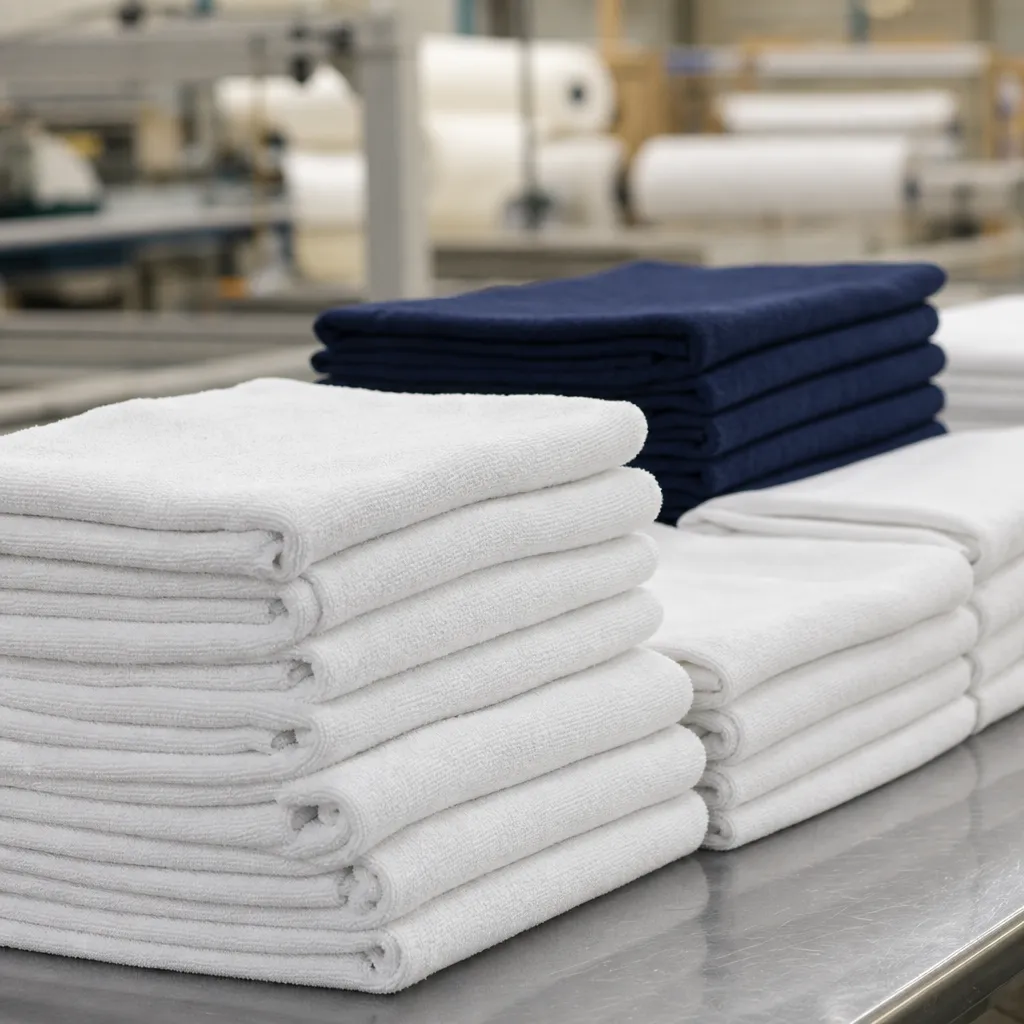
Start with the fabric, because most failures begin there
For this category, the first screen is simple: ask whether the factory is offering warp knit or weft knit coral fleece, and ask for the actual construction on the quotation. Buyers often receive only "80/20 microfiber" on paper, which is not enough. A 200-230 GSM warp knit hair wrap behaves very differently from a 280-330 GSM coral fleece one. Warp knit gives lower snag risk and cleaner dimensional stability; coral fleece gives a fuller hand but can trap heat and produce heavier seam bulk at the button end.
In our own sampling room, the most common hidden issue is yarn fineness mismatch between body fabric and binding or loop fabric. If the body uses finer split microfiber filaments and the loop uses a cheaper, flatter filament, the product passes an arrival glance but fails in use because the closure area stiffens and dries slower than the twist body. That is a category-specific problem you will not catch by asking only for GSM.
| Construction | Typical spec range | What buyers should watch |
|---|---|---|
| Warp knit microfiber | 200-230 GSM, 85/15 or 80/20 polyamide blend | Lower distortion after wash, cleaner embroidery base, less plush visual coverage |
| Coral fleece microfiber | 280-330 GSM, mostly 85/15 polyester/polyamide | Softer hand and higher loft, but more seam thickness and more risk of pile crush in carton |
| Double-layer twist wrap | 2 layers of 180-210 GSM fabric | Higher absorbency, but button area can become too bulky for fine hair users |
- Ask for fabric knitting method, not only composition
- Confirm whether the microfiber is split filament; unsplit yarn lowers real absorbency
- Request finished GSM after dyeing and finishing, because grey-fabric GSM can mislead by 6-10%
A usable microfiber hair towels supplier checklist needs three proofs, not a brochure
We would not approve a new supplier for this item without three pieces of evidence: absorbency data, dimensional stability after wash, and closure durability. Those checks are faster than a factory audit and more revealing for this product. Hair wraps fail in bathrooms and salons through repetition: twist, fasten, wash, repeat. The supplier that understands that will already have a test routine ready.
- Ask for an absorbency test method and result. A practical bench method is water uptake by percentage of fabric mass over 60 seconds; for a retail hair wrap, we are usually comfortable above 240% pickup on finished fabric.
- Ask for wash shrinkage using ISO 6330 domestic washing procedure with measurement before and after 3 cycles. A stable wrap should generally stay within 3.5% in length and width.
- Ask for closure testing. For an elastic loop and button style, request 200-cycle extension and fastening evaluation plus seam slippage review around the narrow end.
If a supplier can show us a color card but cannot show us a wash record, we still do not know the product.
Two details matter here. First, closure failure usually starts in the bartack or in the loop insertion point, not in the button itself. Second, spiral twist shape depends on pattern balance after finishing; aggressive tenter-frame width setting can make the wrap look broad and attractive at packing, then recoil after the first laundry cycle. That is why ISO 5077 dimensional change reporting, or an equivalent measured record tied to ISO 6330 washing, is useful on this item.
The quote is only credible when the supplier names the exact make-up steps
Hair wraps are sewn goods with more variability than a simple square towel. We look for a supplier to state the panel count, edge finish, closure type, and whether the pattern is mirrored or one-way cut. If those fields are blank, the FOB number is only provisional. A microfiber hair towels supplier checklist should force the mill or sewing vendor to say what they are actually making.
| Spec line | Common option | Why it changes cost and risk |
|---|---|---|
| Closure | Resin button + elastic loop / sewn-in hook loop | Button style is slower in sewing but more durable in repeated consumer wash |
| Edge finish | 3-thread overlock / binding | Binding improves shape retention but adds labor and can pucker on coral fleece |
| Branding | Woven label / embroidery / heat transfer | Embroidery on low-GSM warp knit may create drag and local distortion |
| Packout | Individual polybag / paper belly band / bulk carton | Flattened vacuum-style packout can crush plush hand on coral fleece |
A realistic FOB offer from China for this category in 2026 usually lands in a narrower band than buyers expect. For a plain-dyed warp knit wrap around 25 x 65 cm, 210-220 GSM, elastic loop, care label, and bulk export carton, we currently see workable FOB levels around USD 0.88-1.09 at 5,000 pieces, and USD 0.79-0.96 at 20,000 pieces. A coral fleece wrap with button closure, embroidery under 8,000 stitches, and printed insert card is more often USD 1.16-1.48 at 5,000 pieces. Quotes much below that often come back with lower polyamide content, undersized cutting, or weaker closure sewing.
MOQ also needs context. Our standard OEM MOQ is 500 pieces per design per color, but that does not mean every construction can be run efficiently at that level. If the order uses stock dye shades, stock buttons, and one woven label, 500 pieces is workable. If the buyer wants custom dyed elastic, private-label fold card, embroidery, and mixed carton assortments, the true efficient break usually starts closer to 1,500-2,000 pieces per color.
Sample review should focus on twist behavior, not only softness
Soft hand sells the sample; twist behavior decides whether the SKU survives returns. During sample approval we normally wrap the piece on both fine straight hair and thicker textured hair forms, because pattern balance changes how the narrow tail anchors under tension. If the tail is cut too wide near the last third, it looks generous on table display but bunches at the nape during actual wear.
- Check whether the twist stays centered after fastening for 10 minutes
- Measure finished dimensions after one wash and tumble or line dry as intended on care label
- Rub the inner surface against dark knit fabric to see whether loose pile transfers
- Inspect the button back for cracking or sharp burrs that can catch hair
We also recommend weighing sample pieces individually. A pack may average correctly while still hiding big unit variation. For this item, a weight spread above about 5% inside the same sample lot usually means cutting or GSM inconsistency that will show up later as uneven absorbency and inconsistent wrap tension.
Related reads: If your team is still defining fabric direction, compare microfiber vs cotton towel trade-offs and review our GSM decision framework. If the supplier is asking for a brief that is more exact, this tech pack article helps procurement and design use the same sheet.
Decoration is where many buyers accidentally damage performance
Hair towels are not beach towels and they do not tolerate decoration in the same way. Large embroidery on the crown area can reduce stretch and make the wrap sit awkwardly after twisting. Full-surface print is usually limited because many of these wraps use pile or plush faces that do not take the same decoration route as flat microfiber. If branding matters, place it where it does the least harm to drape and absorption.
| Decoration route | Best use on hair wraps | Operational caution |
|---|---|---|
| Woven label | Private label retail and salon resale | Confirm label fold direction so it does not scratch the neck |
| Small embroidery | Spa or giftable retail | Keep to denser base areas; test puckering after wash |
| Heat transfer on flat patch | Promotional programs on warp knit | Requires defined application zone and temperature control |
For buyers comparing methods, our longer breakdown on embroidery, sublimation, and jacquard is useful, but for hair wraps the shortlist is usually just woven label versus small embroidery. We push back on oversized chest-logo thinking here because the product is twisted and folded in use; most of the decoration disappears anyway.
Bulk control should target the two places where rework becomes expensive
Once bulk starts, rework usually concentrates in two areas: the closure station and final trimming. On the closure station, elastic insertion length must stay consistent. A difference of only 8-10 mm changes fastening tension enough that one carton feels fine and the next creates consumer complaints. On final trimming, long microfiber fly ends around overlock seams create the appearance of shedding even when the base fabric is stable.
- Run pilot bulk of 50-100 pieces before full sewing line release
- Approve a sealed sample that includes the exact button, loop length, label position, and carton fold
- Use in-line measurement every 30-50 pieces on the narrow tail width and total length
- Do a wash check from early bulk, not only from pre-production sample
For quality systems, buyers should still verify the factory can document ISO 9001 process control, BSCI social compliance if required by brand policy, and OEKO-TEX STANDARD 100 Class I or the relevant product class for chemical safety claims. We see buyers copy certificate logos into artwork long before checking scope validity. The article on how to read an OEKO-TEX certificate is worth sending to the compliance team before artwork lock.
Lead time is mostly decided by dyeing and trims, not by sewing minutes
Because the product is compact, buyers sometimes assume it can be turned in a week. That only works for stock fabric and stock trims. On a custom run, the timeline usually looks like this: 3-5 days for quote and construction confirmation, 5-7 days for lab dip or stock shade approval, 7-10 days for sample sewing, 18-26 days for bulk production after approval, and 3-5 days for final inspection and booking prep. If custom packaging is printed separately, add another 5-8 days depending on insert card finish.
| Order type | Typical total timeline | Main driver |
|---|---|---|
| Stock color, stock button, bulk pack | 21-28 days | Sewing queue and inspection slot |
| Custom color, woven label, insert card | 30-38 days | Dye approval and packaging print |
| Embroidery + multi-color assortment | 34-43 days | Sampling, thread approval, line balancing |
Freight choice depends more on program timing than carton cube because the item is light. For launch programs, air can make sense on a first 1,000-2,000 pieces while ocean carries the replenishment. Our container vs air freight article gives the trade-off framework if the launch date is fixed.
Use this shortlist before you place deposit
A practical microfiber hair towels supplier checklist can be reduced to a few decisive checks. If the supplier clears these, the project is usually real. If they avoid two or three of them, the low quote is rarely worth chasing.
- They state the exact microfiber construction, blend, and finished GSM
- They can show absorbency and wash-shrinkage records tied to a named method such as ISO 6330
- They specify closure make-up details and can provide a sealed sample with the same trims as bulk
- Their FOB price sits inside a believable range for the requested packout and branding
- Their MOQ matches the actual trim and packaging complexity, not only a headline factory minimum
- They hold current OEKO-TEX, BSCI, and ISO 9001 documentation relevant to the order
For adjacent programs, buyers handling salon resale or spa retail may also want our notes on bleach-resistant salon towels and the different cotton logic behind spa towel programs. Those categories use different fibers, but the approval discipline is similar.
What we need to quote accurately
If you send us a reference photo alone, we can only give a rough budget. To issue a quote that holds through sampling and bulk, we need finished size, fabric construction, GSM target, closure type, branding method, packaging, and forecast quantity by color. Our MOQ is 500 pcs per design per color, and we manufacture under OEKO-TEX STANDARD 100 Class I, BSCI, and ISO 9001 controls. For a live project, send the brief to [email protected] or WhatsApp +86 13205717266.
Send us your hair wrap spec sheet
We can review fabric construction, closure details, MOQ fit, and a workable FOB range before sampling.
Request a quote →