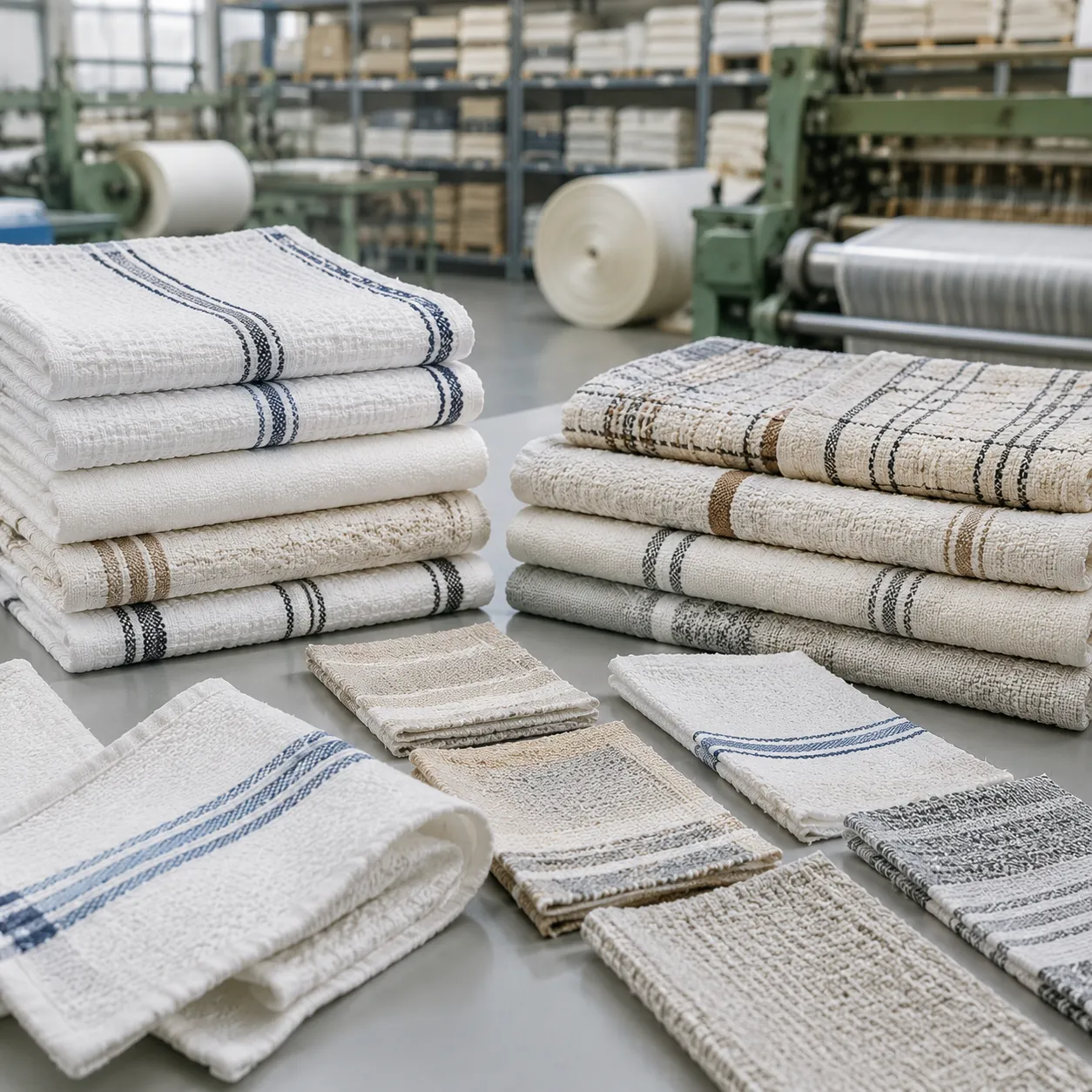
Why Marketplace Bar Mops Are Only a Starting Reference
Search results for utopia towels kitchen bar mops are useful because they show the commercial expectation: white cotton, absorbent terry, usually sold by the dozen, and priced low enough for kitchens to treat them as work tools rather than guest-facing linen. We use that as a benchmark, not as a finished spec. Marketplace descriptions often skip the parts that control wash life: yarn count, loop height, hem construction, shrinkage target, lint release, and whether the towel has been tested after repeated laundering.
For a brand-side buyer, the risk is copying the visible features and missing the hidden ones. A 40 g towel and a 52 g towel may both be called 12×12 inch bar mops online, but they do not behave the same after 30 hot wash cycles. The lighter towel dries fast and costs less. The heavier one wipes more liquid per pass and tolerates rough handling better. If the end customer is a café, both may work. If it is a hotel back kitchen or restaurant towel rental program, the lighter version often leaves lint on glassware and tears earlier at the hem.
We manufacture OEM towels in Gaoyang, Zhejiang with 220 workers, and our normal custom MOQ is 500 pcs per design / per color. For bar mops, most private-label programs start higher because a dozen-pack retail format needs carton efficiency. Still, the same MOQ rule applies when we quote color stripe changes, woven labels, printed belly bands, or polybag artwork.
What to Measure Before You Copy Utopia Towels Kitchen Bar Mops
Before sampling, we ask buyers to define the towel by measured construction, not by competitor name. The phrase utopia towels kitchen bar mops gets us into the right product family, but it does not tell us whether the towel is built for retail resale, janitorial use, food-service rental, or an in-house restaurant program.
| Spec point | Factory measurement we need | Why it matters in use |
|---|---|---|
| Finished size | Common OEM ranges: 30×30 cm, 33×33 cm, 35×35 cm, 40×40 cm | Small towels are cheaper per piece; larger towels cover more surface and fold better for line cooks |
| Finished weight | Approx. 38-70 g per piece depending on size and GSM | Weight controls absorbency, drying time, and carton freight |
| GSM | Typical bar mop range: 300-460 GSM | Below 300 GSM feels like a thin wiping cloth; above 460 GSM dries slower in busy kitchens |
| Yarn | Open-end cotton, ring-spun cotton, or cotton-poly blend | Open-end lowers cost; ring-spun reduces lint and improves hand feel |
| Pile layout | Full terry, ribbed terry, or center-striped dobby effect | Rib structure affects wiping friction and grease pick-up |
| Hem | 2-needle lockstitch, overlock, or folded hem | Hem failure is one of the first visible defects in commercial laundry |
| Whiteness | Optical brightener level and bleach tolerance target | Restaurant buyers often compare whiteness after alkaline detergent washing |
A simple example: a 33×33 cm towel at 360 GSM has a fabric-area weight of about 39 g before allowance for hems and normal processing variation. In production, the finished piece may land around 42-45 g because the hem and pile density are not evenly distributed across the towel. That difference sounds small, but on 24,000 pcs it changes both cotton consumption and sea-freight carton count.
- If the towel is sold as a retail dozen-pack, specify piece weight tolerance, not only GSM. We normally hold ±5% after bulk conditioning.
- If the towel is used by restaurants, specify wash shrinkage after 3 cycles, because a 33 cm towel that becomes 29 cm creates complaints.
- If the towel touches glassware, ask for a lint release check after washing and tumble drying. Dry-room lint is not the same as first-use lint.
- If the towel will be printed or packed for DTC resale, reserve budget for packaging tests and barcode placement, not just towel production.
The Construction Detail Buyers Usually Miss: Rib, Loop, and Ground Yarn
Bar mops look plain, but they are not just miniature bath towels. A bath towel is judged by loft, softness, and hand feel. A kitchen bar mop is judged by whether it wipes oil, absorbs spills, releases soil in washing, and returns to service without a sour smell. Those requirements push the construction in a different direction.
The first detail is the ground yarn. In a terry towel, pile loops do the wiping, but the ground holds the towel together. If the ground is too loose, the towel stretches and twists after laundering. If it is too tight, the towel feels boardy and absorbs slowly. For commercial kitchen towels, we often use a tighter ground than we would use for a hotel face towel of the same GSM.
The second detail is loop height. High loops absorb more liquid, but they snag on prep-table corners, wire shelving, and dish racks. Low loops are more stable, yet they carry less water. For terry bar mops, we usually keep loop height moderate and focus on even shearing-free loops rather than plush volume. We do not recommend zero-twist yarn here. It feels soft in retail packaging, but it sheds more easily under aggressive kitchen washing.
The third detail is rib or stripe design. Some cotton bar mop towels use raised ribs or a center stripe. This is not just decoration. The rib gives friction for wiping stainless steel and counters. But if the rib yarn is too bulky, the towel dries unevenly and can trap grease. We test this in sampling by washing a towel with a small amount of neutral detergent first, then using it on a stainless panel with diluted cooking oil. A towel that feels absorbent with water may smear oil if the pile is too dense.
| Construction option | Best use case | Risk if mis-specified |
|---|---|---|
| 300-330 GSM open-end terry | Low-cost café wiping, promotional kitchen packs | Higher lint and shorter hem life in hot laundry |
| 340-390 GSM ring-spun terry | Retail-quality kitchen towel sets and general restaurant cleaning | Costs more than basic bar mops, but gives better repeat-use feel |
| 400-460 GSM ribbed terry | Back-of-house restaurant towels, bar counters, brewery use | Slower drying if cartons are stored humid or laundry is overloaded |
| Cotton-poly blend, 80/20 or 85/15 | Programs needing faster drying and dimensional stability | Lower absorbency than 100% cotton at the same GSM |
| Bleach-tolerant dyed stripe | Color-coded kitchen zones | Requires dye selection and ISO wash testing, not only Pantone matching |
Testing for Kitchens Is Different From Testing for Guest Towels
For hotel towels, buyers often focus on softness after washing. For commercial kitchen towels, we pay more attention to shrinkage, lint, seam strength, and soil release. A bar mop may be washed with alkaline detergent, oxygen bleach, chlorine bleach in some laundries, and high-temperature drying. We need to know the real laundry environment before promising a wash-life number.
Our standard lab and in-house checks for this product type include dimensional change using ISO 5077 after washing procedures aligned with ISO 6330, colorfastness to washing under ISO 105-C06 for dyed stripes or labels, and seam strength checks based on ISO 13935-2 principles where applicable. For lint, there is no single universal buyer-facing pass number that fits every kitchen towel program, so we normally run a comparative test: sample A against the buyer’s current towel, same wash cycle, same dryer condition, same dark inspection cloth.
- Shrinkage target: for 100% cotton bar mops, we usually set ≤8% after 3 warm wash and tumble cycles; tighter targets require pre-shrinking and a higher price.
- Hem durability: inspect after 10 wash cycles for skipped stitches, seam rolling, and loose yarn at corners.
- Lint control: test after the first wash, not only on greige or fresh-packed towels. First-use lint complaints often come from insufficient washing before packing.
- Whiteness retention: compare the towel after alkaline washing if the customer markets it as restaurant-grade white.
- Odor risk: dense towels packed with residual moisture are rejected in our final QC; cartons are conditioned before sealing.
OEKO-TEX Standard 100 Class I is available for our towel programs when all yarn, dyes, labels, and packaging-contact materials are approved within the scope. For restaurant cleaning towels, some buyers do not require Class I because the towel is not a baby product. We still recommend keeping chemical compliance clean, especially for DTC packs sold through marketplaces. Our factory also operates under BSCI social compliance and ISO 9001 quality management; those certifications do not replace product testing, but they give buyers a framework for audit and traceability.
Price Bands: What We Can Quote in June 2026 Terms
The price bands below are not a universal market promise. They are internal planning ranges we would use in June 2026 for plain white or simple stripe OEM bar mops, assuming normal cotton yarn markets, export cartons, standard sea freight handover, and no special retail packaging beyond basic polybag or carton packing. Final FOB pricing changes with yarn, exchange rate, dye requirements, packaging, and inspection level.
| Order volume | Typical spec assumption | Estimated FOB China band, USD/pc | Notes |
|---|---|---|---|
| 500-1,999 pcs | 33×33 cm, 320-360 GSM, plain white cotton terry | 0.48-0.78 | Works for first sampling or boutique resale, but packaging cost per piece is high |
| 2,000-9,999 pcs | 33×33 or 35×35 cm, 340-400 GSM, white or simple stripe | 0.36-0.62 | Most common range for private-label dozen packs |
| 10,000-29,999 pcs | 35×35 cm, 360-420 GSM, ring-spun or improved open-end cotton | 0.31-0.54 | Better yarn purchasing efficiency and carton utilization |
| 30,000+ pcs | Programmed production, repeated SKU, carton optimized | 0.27-0.49 | Best for distributors, restaurant towel programs, and retail replenishment orders |
For cost-per-use, we avoid pretending that every kitchen launders the same way. Here is a more useful planning method. Suppose a 35×35 cm, 380 GSM ring-spun bar mop costs USD 0.46 FOB at 12,000 pcs and survives 55 service washes before downgrade to rag use. The towel cost is about 0.84 US cents per service wash before freight and handling. A cheaper 310 GSM towel at USD 0.33 that becomes too thin after 28 washes costs about 1.18 US cents per service wash. In that scenario, the cheaper towel costs less at purchase order stage but more in actual wiping cycles.
That calculation is not a claim that every 380 GSM towel lasts 55 washes. It is a decision model. We ask buyers to share the laundry cycle, detergent type, dryer temperature, and acceptance standard for retirement. Then we can build a sample test that reflects the real program instead of guessing from an online listing.
Packaging and Labeling Can Cost More Than Buyers Expect
Bar mops are often bought in dozen packs, and the towel itself is only part of the landed product. A plain export carton for restaurant distribution is cheap. A retail-ready bundle with belly band, UPC sticker, suffocation-warning polybag, carton drop-test requirement, and Amazon-style labeling needs more work. The towel may be simple, but the packaging line becomes the bottleneck.
For dozen packs, we usually fold 12 pcs into a compressed stack, apply a paper belly band or printed insert, then pack by inner carton. If the towel has a thick ribbed construction above 420 GSM, the dozen-pack height increases quickly. That affects master carton size and can push volumetric weight up for air freight or express courier shipments.
| Packing format | Added cost estimate, USD/pc | Operational note |
|---|---|---|
| Bulk pack, 100-200 pcs per carton | 0.01-0.03 | Lowest cost; suitable for distributors and laundries |
| Dozen polybag with warning print | 0.025-0.055 | Good for basic resale; barcode sticker can be applied |
| Dozen paper belly band | 0.04-0.09 | Better shelf look, but band must resist scuffing during transit |
| Custom color box | 0.12-0.28 | Usually not cost-effective unless retail price supports it |
| FBA-style carton labeling and carton weight control | 0.02-0.06 | Requires SKU-level packing instruction before bulk production |
- Provide barcode files as vector artwork, not screenshots.
- Confirm whether the pack count is 6, 12, 24, or bulk carton before we quote.
- Tell us the maximum carton weight allowed by your warehouse; many buyers set 15-18 kg for manual handling.
- If selling online, approve folded-pack photos from pre-production samples because terry height changes pack appearance.
- For private label, woven labels should be tested for edge scratch and wash curl. A stiff label on a wiping towel annoys users.
Decoration: Keep Branding Away From the Wiping Zone
A bar mop is a working towel, so decoration should not reduce wiping performance. Embroidery looks durable on bath towels, but we rarely recommend large embroidery on kitchen bar mops. The stitch area becomes stiff, traps soil, and can scratch delicate bar glassware if metallic thread or dense backing is used. A small woven label, printed belly band, or dyed stripe is usually better.
If the buyer wants a visible brand mark on the towel itself, we prefer a narrow dobby border or yarn-dyed stripe. For a color-coded kitchen system, stripe colors can separate raw prep, bar counter, coffee station, and general cleaning. The technical issue is dye selection. Kitchen towels meet bleach and alkaline detergent more often than spa towels. A stripe that passes normal home laundry may still fade in commercial use.
- Choose the base towel spec first: size, GSM, yarn, and hem.
- Decide whether branding belongs on the towel, the pack, or the carton.
- If using dyed stripes, approve lab dips under the intended wash chemistry.
- Run at least 3 wash cycles before final label and stripe approval.
- Only then lock carton packing, barcode, and case pack.
For a deeper comparison of branding methods, see our guide to embroidery vs sublimation vs jacquard. If the program includes broader hospitality linen, our hotel towels wholesale supplier guide explains how back-of-house towels should be separated from guest-facing towels in specification and costing.
Sampling Timeline and Production Calendar
Kitchen bar mops are faster to develop than jacquard beach towels, but they still need time if the buyer wants repeatable quality. A rushed sample can be made from available yarn and then fail to match bulk production. We prefer to sample with the same yarn type and loom setting planned for bulk whenever the order volume justifies it.
| Stage | Normal timing | What can delay it |
|---|---|---|
| Spec confirmation | 1-3 days | Unclear size after washing, missing pack format, or no target weight |
| Yarn and trim check | 2-5 days | Special dyed stripe, private label material, or OEKO-TEX scope verification |
| Proto sample | 5-8 days | New rib structure or non-standard size |
| Wash test and corrections | 4-7 days | Shrinkage above target, lint complaint, or hem rolling |
| Pre-production sample | 3-5 days after approval changes | Packaging artwork or barcode revision |
| Bulk production | 18-30 days depending on volume | Yarn availability, dyeing schedule, inspection booking |
| Final inspection and packing | 2-4 days | Carton mark errors, moisture conditioning, or AQL recheck |
For a first OEM order, a realistic calendar is 30-45 days from approved pre-production sample to goods ready, not including international freight. Repeat orders can be faster because yarn, carton, and inspection plans are already set. Air freight may solve a late launch date, but bar mops are dense and low unit value, so sea freight is usually the sensible route. Our article on container vs air freight for towel orders gives the trade-offs in more detail.
If your team is still building the documentation, use our towel tech pack guide. It helps avoid the common problem where a buyer asks five mills for pricing but sends each mill a different level of detail, making the quotes impossible to compare.
MOQ, Compliance, and What We Will Push Back On
Our standard custom MOQ is 500 pcs per design / per color, but a practical bar mop program often starts at 2,000-5,000 pcs because the towel price is low and setup time must be spread across enough units. For yarn-dyed stripes, special labels, or custom retail packaging, we may recommend a higher first run. That is not to force volume; it is to prevent packaging and setup cost from becoming larger than the towel margin.
We will push back on specs that look cheap but fail in service. For example, asking for 280 GSM, 100% cotton, bright white, low lint, hot-wash durable, and retail dozen packing at the lowest online price is usually contradictory. At 280 GSM, the towel may be acceptable as a disposable-feeling wiping cloth, but it should not be marketed as a durable restaurant towel. A more honest option is to either raise GSM to 340-380, or keep the lighter towel and position it for short-cycle use.
- MOQ: 500 pcs per design / per color; recommended first commercial run for dozen packs is usually 2,000+ pcs.
- Certifications: OEKO-TEX Standard 100 Class I available by material scope, BSCI social compliance, ISO 9001 quality management.
- Inspection: we can work to AQL 2.5 for major defects and AQL 4.0 for minor defects, or buyer-specific standards.
- Defect modes to define: oil stains, black specks, terry pulls over a set length, hem skip, needle holes, shade variation, odor, and carton moisture.
- Contact for RFQ: WhatsApp +86 13384590853 or email [email protected].
Related reads: for restaurants comparing wiping programs, our restaurant bar mop towels spec guide is useful if your site has access to that reference; for broader towel material decisions, see microfiber vs cotton towel comparison and towel GSM decision framework. Buyers working with mixed gym, spa, or food-service SKUs may also find our MOQ negotiation guide helpful.
If the target is bulk bar towels for restaurants rather than retail packs, we normally simplify the program: no individual polybag, stronger carton, clear wash target, and a lower decoration budget. If the target is online resale, packaging, barcode control, and review-driven hand feel become more important. Both can be made well, but they should not be quoted as the same product.
A Practical Spec We Would Start With
For buyers using utopia towels kitchen bar mops as the benchmark, we would usually begin with one balanced sample rather than three extreme options. A sensible starting spec is 35×35 cm finished size, 360-390 GSM, 100% cotton ring-spun pile with stable ground yarn, white base, folded hem with reinforced corners, and bulk or dozen-pack options. That gives enough absorbency for a restaurant counter while keeping drying time and carton weight under control.
Then we tune from real feedback. If the towel is too slow to dry, reduce GSM or consider an 85/15 cotton-poly blend. If it leaves lint on glassware, improve yarn and add pre-wash processing. If the hem fails, adjust stitch density and corner construction before changing the whole towel. Good OEM development is not about copying a marketplace listing line by line. It is about converting a familiar reference into a controllable production spec.
A bar mop is successful when the kitchen stops noticing it. It wipes, washes, dries, and returns to the shelf without becoming a daily complaint.
Build a Bar Mop Towel Spec That Can Be Quoted
Send us your target size, GSM, pack count, wash conditions, and reference link. We will return a practical OEM spec with MOQ, timing, and June 2026 price assumptions. WhatsApp +86 13384590853 or email [email protected].
Request a Quote →