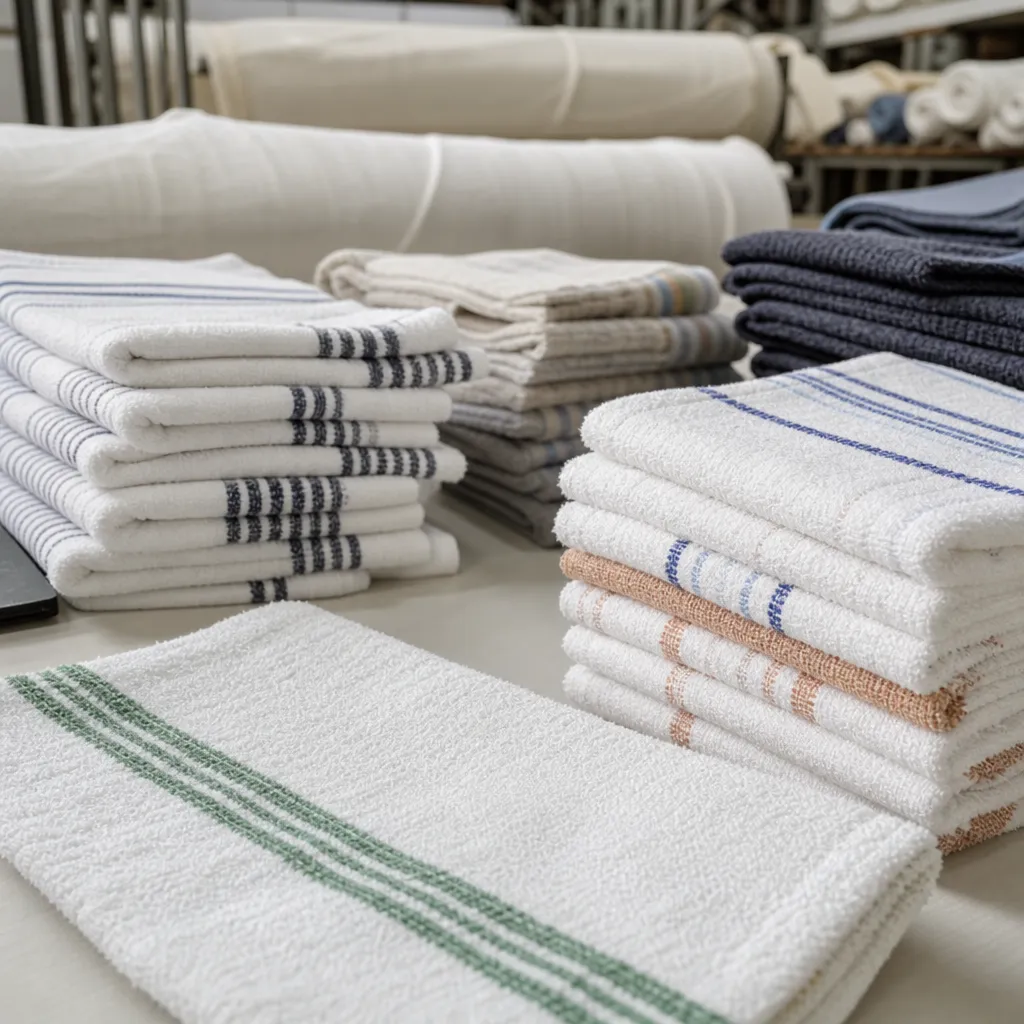
Where bar mop towels fail first
The weak point is usually not the first wipe. It is what happens after 20 to 40 service cycles: edges curl, the center panel loses body, stripes bleed into white ground, or the towel begins leaving lint on black counters and glassware. In restaurant towels wholesale programs, those failures create labor cost before they create visible linen cost.
We manufacture for hotel, gym, spa, beach, and food-service channels, and bar cloths sit closer to industrial wiping than to decorative hospitality linen. A bath towel can be judged by hand feel in a showroom. A bar towel has to be judged after it has touched sanitizer, coffee oils, tomato sauce, detergent alkali, and a hot dryer.
- Edge fraying: usually caused by weak overlock thread, narrow hem allowance, or high dryer temperature after shrinkage.
- Low pickup: common when the towel is too light, too tightly woven, or finished with softener that blocks absorbency.
- Lint transfer: more visible on glassware, dark stone counters, and polished stainless prep surfaces.
- Stripe bleeding: often linked to reactive dye control, rinse discipline, or buyers asking for very dark stripes at the lowest possible price.
- Odor retention: usually a laundering and storage issue, but dense towels that dry slowly make the problem worse.
Our normal MOQ remains 500 pcs per design / per color. For bar programs we often advise 1,500 to 3,000 pcs per SKU because restaurants lose towels quickly and reorder freight can cost more per piece than the towel itself.
The working spec: weight, yarn, and weave
Most cotton bar towels we quote are plain white or white with colored center stripes. The common construction is ring-spun or open-end cotton in a plain or dobby weave. Ring-spun yarn costs more but gives better strength and lower surface fuzz. Open-end yarn is acceptable for budget commercial cleaning towels if the buyer expects a shorter service life.
| Use case | Typical size | GSM range | Construction note | Factory guidance |
|---|---|---|---|---|
| Bar counter wiping | 40 x 40 cm or 45 x 45 cm | 220-280 GSM | Plain weave, tight selvedge or overlock | Good for high-turnover bars where quick drying matters |
| Back-of-house kitchen towels bulk | 40 x 60 cm | 240-320 GSM | Dobby or herringbone weave | Better hand coverage for pans, prep tables, and spill pickup |
| Glass and garnish station | 38 x 64 cm | 200-250 GSM | Smoother yarn, lower pile surface | Specify lint screening; do not claim lint-free for cotton |
| Heavy spill and utility use | 45 x 70 cm | 300-380 GSM | Thicker cotton, reinforced hem | Absorbs more but dries slower in humid kitchens |
For a 40 x 60 cm towel at 280 GSM, the fabric weight is about 67 g before hemming and process loss. After dyeing, finishing, cutting, and sewing, a finished piece normally lands around 70-76 g depending on hem width and shrinkage allowance. That matters because freight quotes are based on cartons, not catalog adjectives.
Buyers sometimes ask for 420 GSM because they associate heavier towels with better value. For bar service, that can backfire. A towel that holds more water also holds more food residue, dries slower, and increases mildew risk if staff toss it into a closed bin between shifts. We prefer to set the weight by station: lighter near glassware, medium at counters, heavier in dish or prep areas.
Sanitizer and wash testing should be written down
A food-service towel touches chemistry all day. If the purchase order only says "white bar towel," the factory cannot know whether the towel will sit in 100 ppm chlorine, 200 ppm quat solution, or an oxygen bleach wash. Those details change dye choice, yarn recommendation, and tolerance for shade movement.
For our pre-production samples, we usually test dimensional change under ISO 6330 using a 60 C wash and tumble dry setting comparable to commercial laundry conditions. For colorfastness on striped bar towels, we reference ISO 105-C06 for washing and ISO 105-X12 for rubbing. If a buyer plans chlorine exposure, we request the target ppm and soak time instead of relying on a vague "bleach resistant" line.
| Parameter | Practical test setting | What we report | Buyer decision |
|---|---|---|---|
| Shrinkage | ISO 6330, 60 C wash, tumble dry, 5 cycles | Length and width change % | Accept 4-7% for cotton utility towels unless exact folded size matters |
| Stripe wash fastness | ISO 105-C06, adjacent multifiber fabric | Staining and color change grade | Use reactive dyed stripes for better repeat orders |
| Rubbing fastness | ISO 105-X12, dry and wet rub | Crocking grade | Important for dark red, navy, black, and forest green stripes |
| Absorbency | AATCC TM79-style drop absorption check after scouring | Seconds to wet-out | Avoid silicone softener if fast pickup is the priority |
| Lint observation | 5 home-laundry pre-washes, then wipe black tile and count visible fibers per 100 cm2 | Internal comparison, not a certification claim | Use smoother yarn and pre-wash for glass-facing stations |
We are careful with sanitizer claims. Cotton can tolerate normal food-service laundering, but long soak times in strong chlorine will weaken cellulose. In our quotation notes, we separate routine wash resistance from continuous chemical exposure. That protects the buyer from overpromising to operators and protects us from building a towel for the wrong environment.
White, stripe, or color-coded sets
White is still the lowest-risk option for restaurant towel programs because it can be sorted easily, inspected for stains, and washed aggressively. Stripes help staff separate bar, prep, and cleaning zones. Full solid colors look clean in a brand deck, but they need more dye control and may show fading sooner under high-alkali laundering.
- Use white towels for general wiping where stain visibility matters.
- Use one or two center stripes when the operator needs station separation without high dye cost.
- Avoid very dark full-body colors for towels that will be exposed to chlorine sanitizer.
- Keep stripe colors consistent across reorders by locking Pantone or lab-dip references.
- Ask the laundry partner whether towels are washed with aprons, napkins, or floor cloths; mixed loads change the real outcome.
For buyers already working through a broader towel line, the color discipline is similar to what we explain in Pantone color matching for custom towels. Lab dips are not only for retail beach towels. They are useful when a restaurant group wants red stripe towels in 30 locations and expects the second shipment to match the first.
We normally discourage embroidery on bar towels. It adds cost, slows production, and creates a raised area that collects residue. If branding is required, a woven stripe, small printed care mark, or carton labeling system is usually more useful than decoration on the towel itself. For buyers comparing methods, embroidery vs sublimation vs jacquard gives the larger decoration context.
A realistic cost model for restaurant programs
Bar towels are price-sensitive, but the cheapest quote often shifts cost into replacement, laundry, and staff frustration. A 54 g open-end cotton towel can look attractive on a spreadsheet; if it twists badly and drops lint after repeated drying, the operator buys it twice.
| Order volume | Budget open-end cotton | Ring-spun cotton stripe | Heavier utility cotton | Typical use |
|---|---|---|---|---|
| 500-999 pcs | USD 0.52-0.74 / pc | USD 0.68-0.96 / pc | USD 0.90-1.28 / pc | Pilot locations, menu launch, small chain |
| 1,000-2,999 pcs | USD 0.43-0.61 / pc | USD 0.57-0.82 / pc | USD 0.78-1.08 / pc | Regional restaurant towels wholesale replenishment |
| 3,000-9,999 pcs | USD 0.36-0.52 / pc | USD 0.49-0.71 / pc | USD 0.68-0.96 / pc | Multi-site restaurant group |
| 10,000+ pcs | USD 0.31-0.46 / pc | USD 0.43-0.64 / pc | USD 0.60-0.86 / pc | Distributor or national food-service program |
These bands assume standard cotton, standard carton packing, and no special retail labeling. OEKO-TEX 100 Class I materials, BSCI-audited production, and ISO 9001 quality management are available in our mill system, but extra documentation, custom polybags, barcode stickers, or private-label cartons add handling cost.
A useful cost-per-use example: suppose a 72 g ring-spun striped towel costs USD 0.62 at 3,000 pcs and remains acceptable for 55 commercial wash cycles. The towel cost is about USD 0.011 per use before laundry. A lighter USD 0.38 towel that is pulled at 22 cycles costs USD 0.017 per use before laundry, even though the invoice looked 39% cheaper. This is why we ask how many turns per week the operator expects.
Packing and loss control matter more than decoration
Food-service buyers lose towels. They are thrown out with prep waste, used for equipment cleaning, taken between locations, or retired early because sorting is poor. Packaging cannot solve all of that, but it can make receiving and issuing easier.
- Dozen packs: common for back-of-house issue and distributor cartons.
- Color stripe by station: blue for bar, green for prep, red for sanitation zones, depending on the operator's HACCP plan.
- Carton marks by outlet: useful for hotel groups or restaurant chains shipping to multiple openings.
- No individual polybag: usually best for utility towels unless retail resale is planned.
- Pre-wash option: adds cost and lead time but reduces first-use lint and shrink surprise.
A common carton for medium-weight towels holds 200 to 300 pcs depending on size and final weight. For a 40 x 60 cm, 280 GSM style, we normally estimate 14-18 kg gross weight per export carton. If a buyer is mixing bar towels with bath mats, gym towels, or robes, we build the packing list by carton dimension so freight forwarders can calculate CBM accurately.
For freight planning, the same logic in container vs air freight for towel orders applies here, but the threshold is different. Bar towels are compact and low unit value, so air freight only makes sense for urgent openings or sample confirmation. Regular replenishment should move by sea or consolidated LCL.
Quality control points before shipment
Our QC team treats restaurant utility towels as functional goods, not showroom pieces. We still check shade, sewing, size, and stains, but the inspection focus is durability and consistency across cartons. A towel that varies 12 g from one carton to another creates complaints because staff feel the difference immediately.
| QC checkpoint | Factory tolerance | Why it matters in service |
|---|---|---|
| Finished size | +/- 3% after finishing | Affects folding, issuing, and shelf count |
| Piece weight | +/- 5% by approved sample | Controls absorbency and buyer's real cost per kg |
| Hem strength | No open seams after manual pull and wash sample review | Prevents edge unraveling in commercial dryers |
| Loose yarn and lint | Visual check plus sample wipe comparison when specified | Reduces complaints from glass and counter stations |
| Metal contamination | Needle detection available on request | Useful for food-service or retail distributor requirements |
For AQL inspection, many buyers use General Inspection Level II with AQL 2.5 for major defects and 4.0 for minor defects. For utility towels, we recommend adding a functional sample wash before final release, especially when the order has colored stripes. A dry inspection table cannot predict every laundry issue.
Certification checks should be current and product-relevant. OEKO-TEX Standard 100 Class I is stricter than many food-service buyers require, but it reassures chains that restricted substances are controlled. BSCI supports social compliance review, and ISO 9001 confirms that the factory has a documented quality management system. For document reading, our guide on how to read an OEKO-TEX certificate explains scope, validity, and certificate holder details.
Production timing from sample to replenishment
Bar towels are simple compared with jacquard beach towels or embroidered hotel programs, but yarn booking, dyeing, sewing, and packing still need calendar time. The fastest orders are repeat white towels with existing yarn and no custom carton work. New stripe colors or pre-wash treatment add steps.
- Spec confirmation: 1-2 days if size, GSM, yarn, and packing are clear.
- Lab dip or stripe approval: 4-7 days for new colors.
- Pre-production sample: 5-9 days for standard cotton constructions.
- Bulk production: 18-28 days after deposit and sample approval for 3,000-20,000 pcs.
- Final QC and packing: 2-4 days depending on carton marking and inspection requirements.
- Sea freight: usually 22-38 days port to port, depending on destination and consolidation.
A new restaurant opening should not leave towels to the final purchasing week. If the operator needs uniforms, aprons, napkins, and bar cloths arriving together, we prefer a 45-60 day working window from approved spec to warehouse receipt. For larger hospitality setups, setting up a hotel linen program in 90 days is a useful planning model even if the towel mix is different.
What to send us for a clean quote
A quote becomes accurate when the towel is defined by use, not by a catalog photo. If you have an existing towel, send piece weight and size after laundering, not only the new sample size. Used towels tell us more about shrinkage, lint, and edge wear than a fresh showroom piece.
- Target size in centimeters or inches, plus acceptable shrinkage after washing.
- Preferred GSM or finished piece weight if you already have a benchmark.
- Yarn preference: open-end cotton, ring-spun cotton, or blended utility fabric.
- Color plan: plain white, center stripe, border stripe, or full solid color.
- Expected laundering: wash temperature, chlorine or quat sanitizer exposure, dryer setting.
- Packing requirement: dozen pack, bulk carton, barcode, carton mark, or location split.
- Annual forecast and first order quantity, with MOQ starting at 500 pcs per design / per color.
Related reads: buyers comparing cotton and synthetic wiping options can use microfiber vs cotton towel comparison before deciding whether bar, glass, or auto-detailing towels belong in the same program. For procurement teams building a broader specification sheet, build a towel tech pack that mills can quote shows the fields that prevent slow back-and-forth.
Related reads: if your program includes gyms, spas, or rental properties as well as food service, compare the laundering assumptions in why gym towels fail after 50 washes and the size logic in towel sizes and dimensions complete guide. The right restaurant towel is usually more utilitarian, with less decoration and tighter control of replacement cost.
Quote restaurant bar towels with factory specs
Send size, GSM target, stripe color, wash chemistry, quantity, and packing needs. Our team will quote MOQ from 500 pcs per design / per color, with realistic production timing and export packing details. WhatsApp: +86 13205717266. Email: [email protected].
Request a Quote →