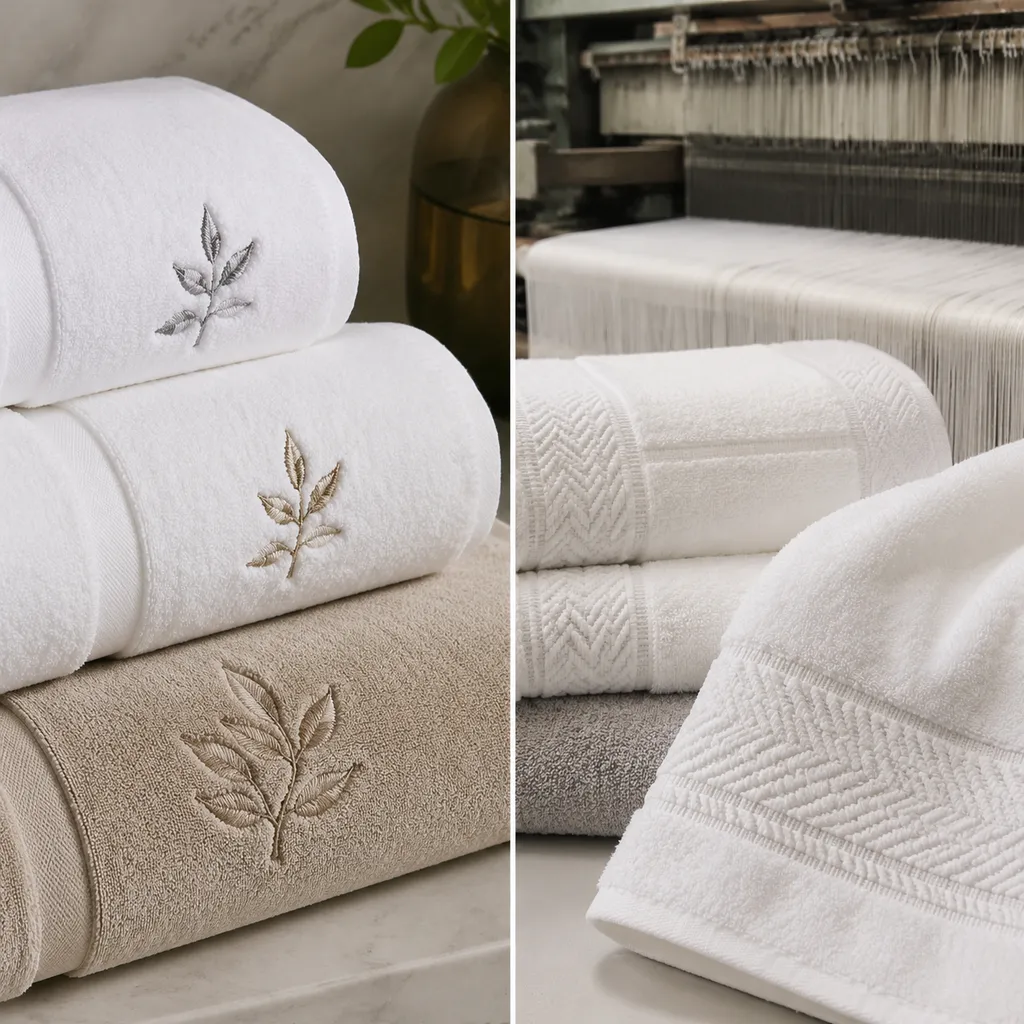
Start With How the Towel Will Be Used
Logo decoration on hotel bath towels has a different job from decoration on retail gift towels. A guest may not notice a logo at check-in, but the laundry team will notice if the decorated area curls, traps detergent, or takes longer to dry. Housekeeping will notice if a crest makes stacking uneven. Procurement will notice if the design cannot be reordered in the same shade six months later.
In our factory, we separate logo decisions into three use cases before we talk about artwork. First, full-service hotels that want subtle branding on 550-700 GSM bath towels. Second, resorts and clubs that want visible pool and room separation across towel categories. Third, boutique properties that want monograms or crests as part of the room design. The right decoration method changes across these use cases.
- Guest-facing bath towels: keep decoration soft, low-profile, and away from the main drying surface where possible.
- Pool or spa issue towels: prioritize identification and theft reduction; the logo can be larger if the towel is not used directly on the face.
- Retail or gift-room towels: visual impact matters more, but we still test wash shrinkage and edge stability.
- Laundry-controlled programs: avoid decorations that catch on tunnel washer perforations or press marks during flatwork finishing.
For cotton bath towels, the most workable base specs are usually 500-650 GSM for daily hotel use and 650-750 GSM for upper-tier rooms where plush hand feel is part of the brand standard. Below 450 GSM, a stitched logo can dominate the towel face. Above 750 GSM, embroidery sinks into the pile unless we adjust stitch height, topping, and placement.
Hotel Bath Towel Logo Decoration Comparison
The table below is how we normally frame a hotel bath towel logo decoration comparison during sampling. It is not a ranking. Each method solves a different problem, and each one creates a different production risk.
| Decoration method | Best fit | Typical logo size | Wash-life expectation | Main risk to control |
|---|---|---|---|---|
| Embroidery | Crests, initials, boutique hotel monograms | 40-120 mm wide | 80-150 commercial washes if thread and backing are correct | Hard hand feel, puckering, thread abrasion |
| Jacquard woven logo | Integrated property name or repeat logo border | 80-450 mm wide | Same as towel body when yarn-dyed correctly | Low contrast, long sampling time, artwork simplification |
| Dobby border logo | Subtle woven text or geometric brand mark | 60-300 mm wide | Same as towel body, usually strong in laundry | Limited detail and color options |
| Woven label | Back neck-style ID, laundry sorting, ownership control | 25-60 mm wide | 60-120 washes depending on label edge and attachment stitch | Label scratchiness, corner lifting |
| Reactive print on flat panel | High-color artwork on special panel or velour area | 100-500 mm wide | 40-90 washes if fixed and soaped correctly | Color bleeding, pile distortion, lower towel softness |
| Heat transfer | Short-run gifts, trial lots, non-core amenities | 50-250 mm wide | 20-50 washes in hotel laundry | Peeling, hand stiffness, poor tunnel-wash survival |
For most room bath towels, we recommend embroidery or a woven-in method. For pool towels, jacquard is often stronger because it avoids raised thread that can snag on lounge chairs. For very small properties ordering 500-1,000 pieces per design, embroidery gives the cleanest balance of MOQ, cost, and sample speed.
A common sourcing mistake is approving decoration on a small hand towel and then applying the same file to a 70 x 140 cm bath towel. The pile height, folding position, and guest contact area are different. We always ask buyers to approve the logo on the final towel size, not just on a fabric swatch.
Embroidery: Sharp, Flexible, But Not Always Soft
Embroidery is the default choice for hotel towel monogramming because it handles initials, crests, and property marks without changing the towel weaving plan. MOQ stays at our normal 500 pcs per design per color, and sample development is usually 7-10 days after artwork and Pantone references are confirmed.
The technical issue is not whether we can stitch the logo. The issue is whether the stitched area feels acceptable after repeated washing. On terry, the pile is uneven under the needle. If the logo has thin serif letters, small gaps fill with loops. If the design has a dense shield or filled circle, the area becomes rigid.
- Use rayon thread when sheen is important, but test abrasion if towels go through harsh commercial drying.
- Use polyester embroidery thread for stronger chlorine and peroxide resistance in most hotel laundries.
- Keep satin stitch columns above 1.2 mm where possible; thinner lines can break visually on high-pile terry.
- Use water-soluble topping on high-loop towels so stitches sit cleanly above the pile.
- Avoid dense filled areas larger than 60 x 60 mm on face-contact bath towels unless the logo is placed near the border.
For embroidered hotel towels, we normally target 7,000-11,000 stitches for a crest around 75 mm wide. A simple two-letter monogram may be 2,800-4,500 stitches. Once a logo moves above 14,000 stitches, cost rises and the towel starts to behave like a decorated textile panel rather than a soft bath towel.
Two defects matter most in bulk production. The first is puckering, caused by excessive thread tension or unstable backing. The second is pile shadow, where compressed loops around the embroidery create a darker halo after drying. We control these through backing selection, hoop pressure, and a 3-wash sample check before bulk approval.
Jacquard and Dobby: Built Into the Towel
Jacquard logo towels are woven with the artwork as part of the towel structure. Instead of adding thread after weaving, we plan the logo in the terry face, border, or body pattern. This gives very good laundry durability because there is no attachment thread to break and no label edge to lift.
The trade-off is artwork discipline. A hotel crest with gradients, tiny date text, and shaded animals will not translate cleanly into terry jacquard. On a dobby border, the limitation is even stricter because the pattern repeat and border height control how much detail can appear. We often redraw logos into one-color or two-tone versions before making the weave file.
| Woven logo option | Construction note | Minimum practical order | Sampling time | Good artwork type |
|---|---|---|---|---|
| Body jacquard | Logo appears in pile direction or height difference across towel face | 1,000-1,500 pcs per size/color | 14-20 days | Large initials, resort names, simple icons |
| Border jacquard | Logo sits in a programmed border area | 1,000 pcs per size/color | 12-18 days | Repeating wordmark or emblem |
| Dobby border | Geometric weave, simpler than jacquard | 800-1,200 pcs per size/color | 10-16 days | Text, stripes, small block shapes |
| Yarn-dyed jacquard | Colored yarns create contrast within woven pattern | 1,500-2,500 pcs per colorway | 18-25 days | High-contrast logos with few colors |
Jacquard works best when the towel program is stable. If your hotel opens one property and may reorder the same towel every quarter, it is worth the setup work. If the logo may change after renovation, or the management company wants different marks for different properties, embroidery is safer.
We test woven logo bath towels for dimensional change under ISO 6330 washing procedures and colorfastness using ISO 105-C06 or AATCC 61, depending on the buyer’s market. Yarn-dyed contrast also needs rubbing checks, especially for navy, charcoal, burgundy, and deep green.
Labels, Transfers, and Printing: Where They Fit
Woven labels are useful when the logo is more about ownership and laundry sorting than guest display. A small side label can identify property, room tier, or linen service contract. It is also lower cost than embroidery when the logo has too much detail for stitching.
The problem is touch. A scratchy label on the towel edge can annoy guests, especially on hand towels and washcloths. For bath towels, we place labels near the hem and use soft edges or end-fold labels. We also run a corner-pull check after washing, because a half-loose label looks worse than no logo.
Reactive printing is possible on special towel structures, especially velour sheared panels or flat woven areas, but it is not our first recommendation for core hotel bath towels. Printed areas can feel flatter and may lose contrast faster under alkaline laundry chemistry. Heat transfer is mainly for short-run event towels, room-opening gifts, or test campaigns. It is rarely the best choice for long-life hotel linen.
- If the towel goes into daily commercial laundry, reject decoration that relies only on adhesive bonding.
- If the logo sits near the hem, confirm it will not disappear into the standard hotel fold.
- If the artwork has more than four colors, compare print against woven label before choosing embroidery.
- If the towel is used in a spa or face-contact setting, rub the decorated area against wet skin during sample review.
Cost by Method and Order Volume
Decoration cost depends on base towel GSM, logo method, artwork complexity, stitch count, yarn color, and packout. A 600 GSM bath towel with a small two-letter monogram has a very different cost curve from a 700 GSM towel with a 420 mm woven resort name across the border.
For reference, our factory base MOQ is 500 pcs per design per color. For jacquard and yarn-dyed programs, we may recommend higher quantities because loom setup and yarn preparation become inefficient below 1,000-1,500 pcs. We are a 220-employee mill in Gaoyang, Zhejiang, with annual towel production around 2.4 million pieces, so we can run small branded programs, but we do not pretend every method works at 500 pcs.
| Order volume | Embroidery added cost | Jacquard added cost | Woven label added cost | Typical FOB finished towel range |
|---|---|---|---|---|
| 500-999 pcs | USD 0.32-0.78/pc | Usually not advised unless simple border | USD 0.10-0.22/pc | USD 4.85-8.40/pc |
| 1,000-2,999 pcs | USD 0.24-0.62/pc | USD 0.38-0.95/pc | USD 0.07-0.18/pc | USD 4.45-7.65/pc |
| 3,000-7,999 pcs | USD 0.18-0.48/pc | USD 0.26-0.70/pc | USD 0.05-0.14/pc | USD 4.10-7.10/pc |
| 8,000+ pcs | USD 0.14-0.39/pc | USD 0.18-0.55/pc | USD 0.04-0.11/pc | USD 3.85-6.75/pc |
The finished towel ranges above assume cotton bath towels around 500-700 GSM with standard export carton packing. Oversized hotel bath sheets, zero-twist yarn, organic cotton, individual belly bands, barcode labels, or gift boxes will change the price. OEKO-TEX Standard 100 Class I certified materials and documented BSCI and ISO 9001 factory controls are available, but the certificate scope must match the yarn, dyeing, and decoration route.
Cost-per-use is where cheap decoration often fails. For example, if a 580 GSM bath towel with a weak transfer costs USD 4.20 and is pulled from service after 38 washes because the logo cracks, the textile cost is about USD 0.111 per use before laundry. A USD 5.35 embroidered version that stays acceptable for 92 washes is about USD 0.058 per use. The invoice is higher, but the linen room replacement cost is lower.
Lead Time and Approval Steps
Logo decoration should not be left until the bulk fabric is already woven. For embroidery, late approval can still be managed if the towel body is finished and packed after stitching. For jacquard, artwork approval must happen before loom planning. A delayed logo file can push weaving slots by one or two weeks during peak hotel replenishment months.
| Step | Embroidery timing | Jacquard or dobby timing | What buyer must approve |
|---|---|---|---|
| Artwork cleaning and digitizing | 2-4 days | 3-6 days | Vector file, thread or yarn colors, logo size |
| Lab dip or thread match | 3-6 days | 5-8 days | Pantone tolerance and lighting condition |
| Pre-production sample | 7-10 days | 12-20 days | Placement, hand feel, shrinkage after wash |
| Bulk production | 25-35 days | 35-50 days | Final PO, carton mark, packing method |
| Final inspection and export documents | 2-4 days | 3-5 days | AQL result, packing list, certificate copies |
For new hotel openings, we prefer a 70-90 day sourcing window from first RFQ to shipment booking. Repeat embroidery orders can be shorter, often 30-45 days after deposit if yarn and towel body specs are unchanged. Repeat jacquard programs are usually 40-60 days because loom allocation still matters.
- Send vector artwork in AI, EPS, or clean PDF format, not only a low-resolution PNG.
- State exact towel size, GSM, yarn preference, and target use: guest room, spa, pool, or retail.
- Confirm whether the logo must align with a fold line, towel border, or label position.
- Approve one washed sample, not only the fresh sample from the embroidery machine.
- Keep the approved physical sample as the production reference, especially for thread color and hand feel.
QC Tests We Use Before Bulk Shipment
A hotel bath towel logo decoration comparison is incomplete without testing. Some defects only appear after heat, water, detergent, and mechanical action. We run decoration checks separately from the normal towel body inspection because a towel can pass GSM, size, and absorbency while still failing logo durability.
For embroidery, we inspect stitch density, back thread trimming, needle cuts, registration, and backing removal. A common hidden issue is needle damage around dense logos. Under tension, small holes can enlarge after tumble drying. For woven methods, we check broken picks, logo edge clarity, and yarn shade consistency between the logo area and the towel body.
- Dimensional change: wash and dry according to ISO 6330 or buyer laundry method; measure size and logo position shift.
- Colorfastness to washing: ISO 105-C06 or AATCC 61 for dyed yarns, embroidery thread, and printed areas.
- Rubbing check: dry and wet crocking review for dark logo colors on light towels.
- Thread pull check: manual tension on embroidery tails and label attachment seams after washing.
- Appearance after 3 cycles: evaluate puckering, label curl, print cracking, and jacquard fuzzing before bulk release.
Our final inspection follows ISO 2859-1 AQL sampling, with decoration defects classified separately. A crooked bath towel logo may not affect absorbency, but it affects guest perception and brand consistency. For hotel programs, we normally treat logo misplacement beyond agreed tolerance as a major defect.
How We Choose for Common Hotel Programs
For a 300-room city hotel buying 4,000 white bath towels at 600 GSM, our likely recommendation is polyester embroidery near the lower border, about 60-80 mm wide, with stitch count under 9,000. It keeps MOQ realistic, allows future reorder flexibility, and does not require a special weaving setup.
For a resort using towels across rooms, spa, and beach club, we may split methods: embroidered room towels, jacquard pool towels, and woven labels for housekeeping control. Mixing methods is not a problem if the buyer keeps color standards and artwork rules consistent. It is often better than forcing one decoration method across every towel type.
For a luxury boutique property with a crest, we usually test two samples: one embroidered crest on a 650-700 GSM combed cotton towel and one dobby or jacquard border version with simplified artwork. The buyer can then compare guest hand feel against visual identity. This avoids approving a beautiful logo that later feels like a patch on the towel face.
Related reads: if your team is still defining the base towel before decoration, start with hotel towel sourcing guide and towel GSM decision framework. For artwork method trade-offs beyond hotel bath towels, see embroidery vs sublimation vs jacquard.
Related reads: buyers preparing an RFQ can use build towel tech pack that mills can quote, and teams checking certification claims should review how to read OEKO-TEX certificate. For monogram-heavy room programs, monogrammed bath towels luxury brand guide is also useful.
RFQ Checklist for Logo Bath Towels
The fastest way to get a reliable quote is to send a complete decoration brief with the towel spec. A logo file alone is not enough. We need to understand towel construction, color limits, laundry conditions, and packing because each of those affects the final decoration method.
- Confirm towel type: bath towel, bath sheet, hand towel, washcloth, pool towel, or spa towel.
- List size and GSM, such as 70 x 140 cm at 580-620 GSM or 80 x 160 cm at 650-720 GSM.
- Attach vector logo and state the required finished logo width in millimeters.
- Tell us the preferred method if already decided: embroidery, jacquard, dobby, woven label, or print.
- Share laundry conditions if known: wash temperature, bleach use, tunnel washer or washer-extractor, and drying method.
- State quantity per size, per color, and per logo. Our MOQ is 500 pcs per design per color.
- Request certificates needed for your market: OEKO-TEX Standard 100 Class I, BSCI, ISO 9001, or buyer-specific audit files.
- Define packing: bulk carton, inner polybag, belly band, barcode, room-set packing, or carton sorting by property.
If the buyer is unsure, we can quote two decoration routes side by side. For example, embroidery for 1,000 pieces and jacquard for 3,000 pieces. That makes the cost and lead-time trade-off visible before sampling money is spent.
LUMA & CO. TEXTILE has supplied 80+ brand clients across 47 countries since 2007. We make the towels in-house and coordinate decoration through our production and QC teams, so the decoration decision is tied back to yarn, GSM, dyeing, finishing, and export packing instead of treated as an afterthought.
Send Us Your Logo Towel Brief
For a hotel bath towel logo decoration comparison on your own artwork, send size, GSM, quantity, logo file, and laundry conditions. WhatsApp: +86 13205717266. Email: [email protected].
Request Decoration Quote →