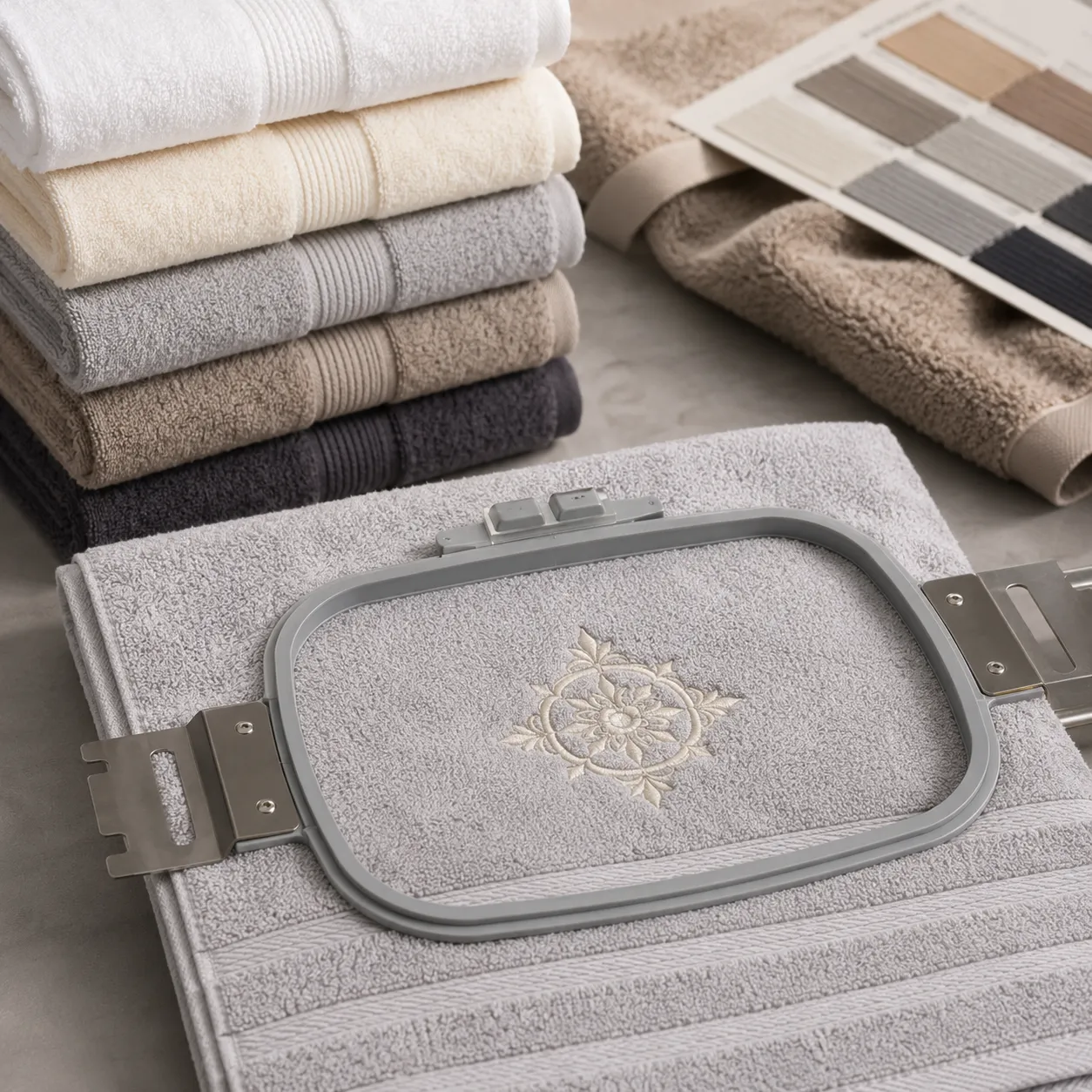
Start with the fabric face, not the logo sketch
The decoration choice on a yoga towel set is controlled first by construction. Most mat towels are either warp-knit or weft-knit microfiber, usually 200-320 GSM, often in an 80/20 or 85/15 polyester-polyamide blend. Some include silicone grip dots on the reverse, corner pockets, or an overlock edge that has to stretch without tunneling. A logo that works on a cotton golf towel can fail here because the surface is smoother, the stretch is different, and the towel is expected to lie flat over a mat.
We normally ask buyers for four facts before discussing artwork: towel size, base fabric weight, whether the back has anti-slip print, and where the product sits in the price ladder. If the towel is 61 × 183 cm around 240 GSM with full-field silicone dots, that already rules out some placements. A bulky embroidery near the edge can create curling after wash and can also interfere with roll packing.
- For hot yoga towels, we usually see lightweight to midweight microfiber in the 220-260 GSM band.
- For a towel + carry pouch set, branding can often move to the pouch or hem label to keep the towel face clean.
- If the set includes silicone grip dots, decoration heat and placement have to be sequenced so the dot print is not crushed in finishing.
The five logo routes we quote most often
For this category, the real options are not endless. In practice we quote five routes: sublimation print, screen print, embroidery, jacquard-knit patterning, and sewn labels or tabs. Heat transfer can appear in mood boards, but on absorbent microfiber it is usually a niche answer rather than the default one. Each route behaves differently once sweat, detergent, rolling, and studio laundering enter the picture.
| Method | Best use | Typical MOQ impact | Main risk on yoga towel sets |
|---|---|---|---|
| Sublimation | Full-color logos, all-over artwork, gradients | Base MOQ usually stays at 500 pcs per design per color | Face hand changes slightly if print load is very heavy |
| Screen print | Simple spot logo on limited colors | Often workable from MOQ 500 with screen charges | Cracking or heavy hand if ink deposit is too thick |
| Embroidery | Small premium mark near hem or corner | Usually cleaner at 700-1,000 pcs if multiple thread colors | Puckering on lightweight knit and slower sewing output |
| Jacquard knit | Integrated repeat branding built into fabric | Commonly 1,000+ pcs because knitting setup is specific | Logo edges soften; fine lines may close up |
| Woven label / folded tab | Discrete branding and size-care identity | Lowest tooling burden; easy from MOQ 500 | Can irritate users if stitched on wrong edge or folded bulky |
Yoga mat towel set logo decoration comparison: what changes after 30 washes
A decoration method should be judged after laundering, not at sample photography stage. On yoga programs we look at three stress points: repeated absorbency exposure, stretch-and-release during mat fitting, and contact with body oils plus studio cleaning chemistry. A logo that looks sharp at shipment can haze, curl, or stiffen by wash cycle 20 if the method was chosen for appearance only.
Our internal screening for microfiber yoga towels usually includes dimensional stability, crocking, and appearance review after repeated home-laundry style cycles. For print programs, we often reference colorfastness testing aligned with ISO 105-C06 for domestic laundering and ISO 105-X12 for rubbing. For absorbency-sensitive claims, we do not market broad promises; we test strike-through and drying behavior on the actual printed area versus the unprinted base because high-coverage graphics can slow wet pick-up on some constructions.
| Method | What usually holds up well | What usually degrades first | How we reduce the risk |
|---|---|---|---|
| Sublimation | Color clarity and edge definition | Slight flattening of plush hand on very dense image zones | Keep key towel zones lighter in coverage; avoid over-saturating sweat-contact area |
| Screen print | Solid small logos if ink film is controlled | Cracking on folds or a rubbery hand | Use fine mesh and smaller logo area; test stretch on edge placements |
| Embroidery | Thread color durability and perceived value | Needle distortion around stitch field | Use low-density stitch count and place near stable hem |
| Jacquard knit | No added surface layer to peel or crack | Lower sharpness on tiny letters | Enlarge artwork and simplify line weight during knit conversion |
| Woven label / tab | Brand consistency across reorder lots | Edge fray or uncomfortable seam feel | Use soft folded-edge labels and lockstitch bar reinforcement |
Why sublimation leads on microfiber yoga programs
If the set uses a suede or brushed microfiber face, sublimation is usually the cleanest route for visible branding. Dye goes into the polyester side rather than sitting as a thick layer on top, so the logo keeps a flatter hand than conventional transfers. This matters when the towel is wrapped around a mat or folded into a retail band.
The strongest use case is all-over art, tonal patterning, or a large brand statement that would be too stiff in ink. We see this often for studio retail launches and DTC drops where the towel design is carrying the visual story of the set. Pricing depends on print coverage, roll width, and whether the set has one or two SKUs under the same artwork family, but for a 61 × 183 cm printed towel at moderate volume, FOB pricing often lands around USD 3.10-4.35 per piece for the towel portion in standard microfiber constructions. A coordinated pouch can add roughly USD 0.42-0.88 depending on fabric and closure. These are planning bands, not fixed offers; exact quotes change with knit spec, packaging, and current dye-paper and freight inputs.
- Best for: full-face branding, gradients, photographic art, tonal brand patterns
- Less suitable for: very dark grounds where exact Pantone matching is critical across polyester and non-poly trims
- Process detail buyers should ask about: print-before-cut vs cut-panel print, because panel nesting affects edge alignment and waste
One technical point that is specific to this category: if the towel also has anti-slip silicone dots, we sequence sublimation first, then cutting, then grip print, then final sewing. Reversing that order can mark the silicone during heat transfer and lead to gloss variation on the back.
Where small screen prints still make sense
Screen printing survives in yoga sets when the brand wants one restrained mark rather than a fashion print. A 1-color or 2-color logo near the bottom hem can cost less than sublimation if the base towel is stock-dyed and the artwork is small. It also avoids converting the whole project into a print-led program when the buyer really just wants quiet branding.
The problem starts when artwork gets larger or the ink film gets heavy. On a towel that needs to absorb sweat from palms and forearms, a dense print in the central body zone can feel wrong in use. It can also show crease memory after rolling. For that reason, we usually cap screen print placements to low-contact areas and keep the logo compact.
| Spot print scenario | Volume band | Indicative FOB add-on per towel | Comment |
|---|---|---|---|
| 1-color small hem logo | 500-1,000 pcs | USD 0.11-0.24 | Good value if base fabric is already dyed to brand color |
| 2-color logo, medium placement | 1,000-3,000 pcs | USD 0.18-0.33 | Watch hand feel and edge cracking after folding tests |
| Metallic or puff effect | 1,000+ pcs | USD 0.29-0.56 | Usually not our first recommendation for functional yoga towels |
A useful factory-floor check here is the tape-lift and fold-line review after curing. We also review whether the printed zone bridges over brushed pile unevenly. On some microfiber faces, an under-cured print will not fail immediately but can start edge-chipping after a few aggressive wash cycles.
Embroidery works only when you make it small and honest
Buyers often ask for embroidery because it feels elevated. On a bath towel, that instinct can be right. On a yoga mat towel, embroidery is a narrow-answer method. If the logo is tiny, placed at the hem, and the fabric is stable enough, it can work well. If the design is broad, densely filled, or placed in a stretch-heavy area, the towel will pucker and the user will see the ridge every time the towel is laid flat.
We normally steer brands toward embroidery only for a discreet mark under about 55 mm width, often on a folded hem band or attached corner tab. Stitch density matters more than thread sheen. We reduce the fill count, use a lighter backing where possible, and test the corner for roll memory. On lightweight microfiber, the wrong backing can leave a hard patch that customers feel immediately.
- Use embroidery for small signature branding, not for slogans.
- Avoid dense satin fills on 220-240 GSM microfiber; they distort the base too easily.
- If the set includes a carry strap or pouch, embroidery may belong there instead of on the towel itself.
Typical embroidery add-on planning can start near USD 0.26 for a very small one-position logo and move above USD 0.70 if there are multiple thread changes or higher stitch counts. Output also slows. A printed towel line can move quickly; embroidery introduces a separate sewing bottleneck, so bulk lead time commonly extends by 3-6 days depending on quantity and machine loading.
Jacquard is cleanest when the brand can simplify
If the towel is being knit specifically for the program, jacquard can be the most integrated-looking method because the branding is in the fabric itself. There is no extra layer, no embroidery mound, and no print film. The trade-off is graphic precision. Fine typography, hairline icons, and sharp diagonal edges do not translate as cleanly as buyers expect from a digital mockup.
This method is more realistic for repeat motifs, tonal logos, or broad geometric branding than for a detailed front-facing emblem. We usually redraw the art into knit language before sampling. That means enlarging counters in letters, thickening line weights, and accounting for how the loop or knit face will visually spread. If the brand team refuses those adjustments, the strike-off stage becomes frustrating.
| Jacquard fit | Works well | Usually disappoints | Lead-time note |
|---|---|---|---|
| Tonal repeat | Monograms, borders, broad icons | Small legal text | Yarn planning and knitting setup add time |
| Two-tone field branding | Lifestyle studio collections | Photo-like graphics | Sampling often takes 7-10 days longer than print |
| Premium gift set | Brand texture story | Sharp multi-color gradients | MOQ is usually higher than print-led options |
For most yoga towel sets, jacquard only makes commercial sense when the order is large enough to absorb setup and when the whole identity is built around the fabric pattern. For a 500-piece launch, it is often a poor fit. For a 3,000-piece studio chain rollout with repeating artwork, it becomes more viable.
The lowest-risk answer is often a label, tab, or packaging mark
Not every logo belongs on the towel face. Some of the strongest yoga programs we ship use a plain towel with brand presence moved to a woven side tab, a printed belly band, a header card, or a coordinated pouch. This keeps the performance surface clean and lowers decoration risk without turning the product generic.
This is especially true for studio-supplied towels, where the buyer cares more about wash life and stacking consistency than overt branding. A soft folded tab near the lower short edge is usually unobtrusive. For retail kits, a branded recycled paper band plus a small woven label can do enough work visually while preserving the hand feel.
- Put the main logo on packaging if the towel is function-first.
- Use a woven tab if the brand only needs discreet identification in use.
- Reserve the towel face for branding only when artwork is central to the sell-through story.
How we advise by buyer scenario
The right answer changes by channel. A boutique yoga brand selling direct online usually values design impact and may accept higher art cost. A chain studio replacing rental towels values wash stability and reorder continuity. A promotional wellness event wants low complexity and quick output. Treating these as the same decoration problem is where many programs go off track.
| Buyer type | Method we usually suggest | Why | Common pushback |
|---|---|---|---|
| DTC yoga brand | Sublimation + branded band | Visual story matters; small runs can still look custom | Wants embroidery because it feels upscale |
| Studio chain / franchise | Woven tab or small spot print | Lower disruption to absorbency and easier repeat orders | Wants large visible logo for in-studio marketing |
| Corporate wellness event | Simple screen print | Fast approval, low setup complexity | Tries to fit too much text into the imprint |
| Premium gift set | Sublimation or jacquard depending volume | Packaging and set presentation carry the value | Underestimates jacquard artwork simplification |
This is also where cost-per-use matters more than unit decoration cost. We have seen buyers save USD 0.12 per towel by choosing a heavier spot print, then spend more through customer complaints because the logo area felt tacky or looked broken after repeated laundering. On a studio program washed four or five times per week, that small saving disappears quickly.
Lead times, approvals, and where delays usually happen
For plain-sewn microfiber yoga sets, bulk timing often runs about 22-30 days after sample and deposit. Decoration changes that. Sublimation usually adds prepress checks and color strike review but keeps production flow efficient once approved. Embroidery adds machine scheduling. Jacquard adds the longest front-end because artwork has to be translated into knitting instructions and then physically sampled.
- Sublimation program: lab color check or strike-off 3-5 days, bulk 24-32 days after approval
- Screen print program: screen prep 3-4 days, bulk 23-29 days if artwork is simple
- Embroidery program: digitizing 2-3 days, sew-out approval 4-6 days, bulk 27-36 days
- Jacquard program: knit artwork conversion 4-6 days, sample 8-12 days, bulk 30-40 days
Related reads: if you are still defining the base product, start with build-towel-tech-pack-that-mills-can-quote, then compare materials in microfiber-vs-cotton-towel-comparison. For a broader decoration overview across categories, see embroidery-vs-sublimation-vs-jacquard.
A short sign-off checklist before you release bulk
The approval file should not stop at artwork. For yoga sets, we want the brand team to sign off on the exact base fabric, the decoration placement measured from a stable seam, the grip-print relationship if there is silicone on the reverse, and a wash-reviewed pre-production sample. That last point is important because a decoration method can look correct on day one and still be the wrong commercial choice.
- Approve the actual fabric construction and GSM, not only a color swatch.
- Mark logo placement from the hem with a measured tolerance, usually in millimeters.
- Review one sample after wash for face feel, edge flatness, and visual drift.
- Confirm whether branding also appears on pouch, band, insert card, or carton label.
- Lock the carton ratio early if the set has multiple components.
Related reads: for MOQ planning, negotiate-towel-moq-without-killing-margin is useful. If your program ships with a kit or needs retail presentation, compare freight choices in container-vs-air-freight-towel-orders. Brands serving yoga and Pilates studios can also review our sector page at yoga-pilates-towels.
Need a decoration recommendation on a yoga set?
Send the towel size, fabric spec, artwork, target price and whether the back uses silicone grip. We will tell you which logo method is workable, what to avoid, and what the timeline likely looks like. MOQ starts at 500 pcs per design per color. Contact us at [email protected] or WhatsApp +86 13205717266.
Request a quote →