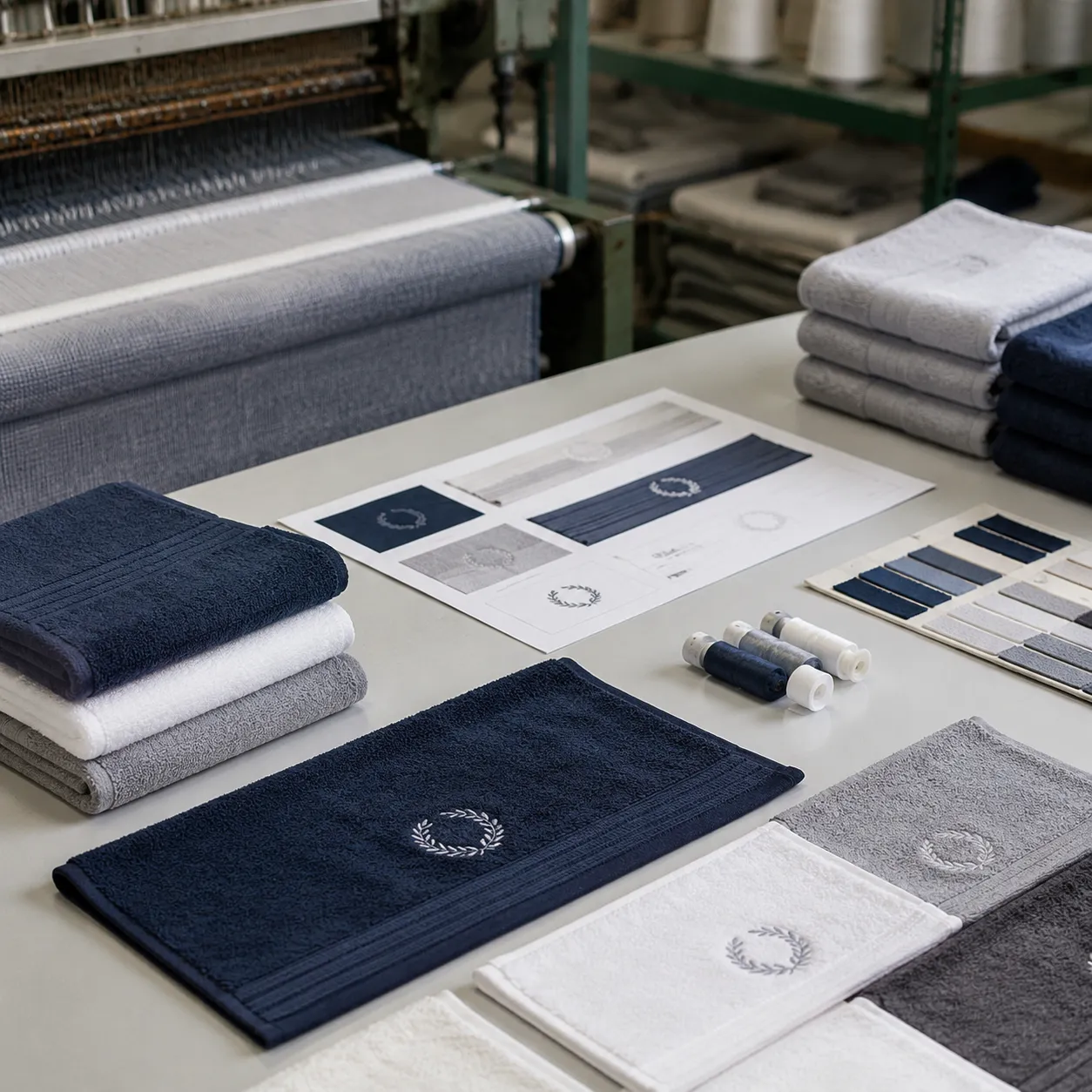
Start with the Use Case, Not the Sketch
The first question we ask is where the towel will live. A powder-room decorative towel for a retail brand does not need the same pile density as a spa treatment-room towel. A hotel hand towel may be washed 120-180 times in a commercial tunnel washer before replacement, while a retail gift towel may be bought for visual impact and light home use. The construction has to match that reality before we talk about thread color or packaging.
For custom hand towels, the wrong starting point is often an image mockup made at 1:1 screen scale. It may show a 90 mm logo, a 45 mm border, and a dense background pattern, but it does not show shrinkage, pile movement, or how terry loops hide thin lettering. In our sampling room we mark artwork against actual towel panels, then check how it reads after wash, tumble dry, and steam pressing.
| Use case | Typical size | GSM range | Construction note | Common risk |
|---|---|---|---|---|
| Hotel bathroom | 40×70 cm or 41×76 cm | 480-620 GSM | Combed cotton terry with stable dobby border | Logo too close to folded edge |
| Spa or salon | 35×75 cm or 40×80 cm | 420-560 GSM | Softer hand feel, low lint after first washes | Color fading from peroxide or disinfectant |
| Retail decorative towel | 38×64 cm or 40×70 cm | 360-520 GSM | Cleaner border area for embroidery or jacquard | Artwork too detailed for pile surface |
| Gym or studio counter towel | 30×60 cm or 35×70 cm | 320-460 GSM | Fast drying, lower bulk per carton | Fabric feels too thin if GSM is cut below use case |
- Commercial laundry: specify higher seam strength, vat-reactive dye, and a balanced pile height rather than only asking for softness.
- Retail display: plan the fold first, because the visible panel may be only 160-220 mm tall after belly banding.
- Decoration-heavy design: reserve a flat dobby or sheared panel if the logo includes small type under 5 mm cap height.
- Cost target: reduce size or packaging before cutting GSM below the job requirement; thin towels usually create more returns than savings.
How We Design Hand Towels for Logo Readability
To design hand towels for OEM production, we separate the design into three zones: pile field, border area, and hem allowance. The pile field gives absorbency and hand feel. The border gives a stable visual line and a good landing area for decoration. The hem allowance controls sewing strength and final rectangular shape. If a buyer sends only a centered logo, we still need to decide which zone carries the brand mark.
Embroidery is still the most common method for logo hand towels, especially hotels, clubs, spas, and gift sets. But embroidery on terry has a rule that surprises new buyers: thin strokes disappear into loops unless we use a knockdown stitch or move the logo to a flatter area. For serif letters, we normally recommend a minimum satin column of 1.2-1.5 mm and a minimum text height of 6-7 mm. Anything smaller should be simplified or changed to woven label, jacquard, or print.
| Decoration method | Best for | Minimum practical detail | Factory setup point | Typical add-on cost |
|---|---|---|---|---|
| Embroidery | Monograms, hotel crests, club logos | 6-7 mm letters on terry | Digitizing file plus stitch test on bulk fabric | USD 0.18-0.62 per pc depending on stitch count |
| Dobby border weave | Subtle stripe, tone-on-tone structure | Simple geometric repeats | Loom setup before weaving; not added later | USD 0.05-0.16 per pc at 2,000 pcs+ |
| Jacquard | All-over pattern or woven logo | Bold shapes, limited fine lines | Yarn-dyed or piece-dyed planning needed | USD 0.22-0.55 per pc depending on size and yarn colors |
| Reactive print | Graphic retail towels, seasonal artwork | Better for flat or sheared surfaces | Color strike-off and crocking test required | USD 0.20-0.48 per pc at normal coverage |
For embroidery approval, we run a physical stitch-out, not only a digital preview. We check needle cutting near the border, loop pull-through, thread shine under warm bathroom lighting, and puckering after one wash. A common defect is a raised logo that feels hard because the backing was left too heavy. Another is a neat-looking sample that becomes wavy after tumble drying because the stitch density fights the terry shrinkage.
Size, Fold, and Border Placement
Hand towel size is not just a merchandising choice. It affects carton loading, drying time, wash cost, and how the logo appears on a towel bar. A 40×70 cm towel at 520 GSM uses about 146 g of fabric before normal processing loss and sewing variation. Moving to 41×76 cm at the same GSM raises fabric weight to about 162 g. That 16 g difference looks small, but on 8,000 pcs it means roughly 128 kg more fabric to dye, dry, carton, and ship.
The border is where many decorative hand towels fail. If the dobby border is too tall, the towel loses absorbent area. If it is too narrow, embroidery feels cramped and the towel looks unfinished. For most 40×70 cm programs we use a 35-55 mm dobby border, with the logo centerline 75-110 mm above the lower hem when the towel is designed to hang vertically. For retail folded towels, we mock the fold before approving logo placement.
- Confirm the towel will hang, stack, roll, or sit under a belly band.
- Mark the visible panel after folding, including the band or label position.
- Place the logo centerline with at least 20 mm clearance from the border edge.
- Run one wash and one tumble cycle before signing off the placement.
- Measure final size after conditioning for 4 hours at room humidity.
For size tolerances, we normally quote ±3% after washing unless the buyer has a tighter internal standard. For higher-control hotel and spa work, we can agree on a narrower finished-size window if the fabric, dye lot, and drying method are locked. If the towel is part of a bath, hand, and washcloth set, align the border ratio across all three pieces rather than copying the exact same border height.
Yarn, GSM, and Hand Feel Choices
A good design brief should specify both GSM and yarn route. GSM tells us fabric mass per square meter, but it does not tell the whole story. A 500 GSM towel with a compact 21s/2 ground and 16s pile feels different from a 500 GSM towel using softer 21s single pile yarn. Combed cotton improves smoothness and reduces short-fiber lint compared with open-end yarn, but it adds cost. Zero-twist can feel plush, but it is not always the best choice for heavy-use hand towels because loop snagging and drying time can increase.
| Spec level | Recommended GSM | Yarn direction | Expected use | Factory comment |
|---|---|---|---|---|
| Value retail | 330-410 GSM | Carded or blended cotton route | Gift, light household use | Keep artwork simple; avoid oversized embroidery |
| Standard brand program | 420-500 GSM | Combed cotton pile, stable ground yarn | Retail, spa, boutique hospitality | Good balance of hand feel and drying speed |
| Hotel commercial | 500-620 GSM | Combed cotton, stronger hem sewing | Repeated laundry and guest use | Control shrinkage and border stability |
| Luxury decorative | 560-680 GSM | Combed or selected long-staple cotton | High-touch bathroom display | Watch carton volume and drying cost |
We push back when a buyer asks for a 300 GSM hotel hand towel with embroidery because the numbers rarely work. For example, a 40×70 cm towel at 300 GSM is about 84 g before finishing. If commercial laundering costs USD 0.09 per wash and the towel loses guest acceptance after 35 wash cycles, laundry alone is USD 3.15 before replacement. A 510 GSM version costing about USD 1.38 more at production may last 95-120 wash cycles in the same environment, which usually makes the cost per accepted use lower.
For a deeper material decision, we often point buyers to combed versus zero-twist cotton and the broader GSM decision framework. If the project includes bath towels too, the sizing logic in towel dimensions guide helps keep the range consistent.
Color Control Before Bulk Dyeing
Color is where beautiful mockups often become expensive corrections. Cotton terry absorbs light differently from paper, polyester thread, and digital screens. We match to Pantone TCX, TPX, or a physical buyer swatch, but we still need a lab dip on the exact cotton route. For logo thread, we match embroidery thread separately because rayon and polyester embroidery have different sheen from dyed cotton.
Our normal approval route is lab dip first, then pre-production sample, then bulk dye. We evaluate color under D65 daylight and TL84 store light when retail display matters. For colorfastness we use ISO 105-C06 for domestic and commercial washing, ISO 105-X12 for rubbing, and ISO 105-E04 when perspiration exposure is relevant for gym or spa towels. OEKO-TEX Standard 100 Class I is available for programs that need baby-safe or skin-contact chemical control.
- White towels: optical brightener level must be confirmed; some hotel groups reject blue-white casts under warm bathroom light.
- Dark towels: specify reactive dye and test wet crocking before approving light embroidery thread.
- Pastel towels: approve against the actual packaging background because kraft bands can make pale shades look dull.
- Two-color sets: run lab dips together so ivory, stone, and sand tones do not drift between sizes.
One construction quirk matters for striped or color-blocked designs: pile yarn and ground yarn may take dye slightly differently. If a border is yarn-dyed and the towel body is piece-dyed, shade control becomes a coordination job, not a single dye-bath decision. This is why we prefer early strike-offs for tonal logo work rather than fixing color after bulk weaving.
QC Tests We Put into the Tech Pack
A design handoff without QC limits is incomplete. The buyer may approve a nice sample, but bulk production needs measurable controls. At LUMA & CO. TEXTILE, our ISO 9001 process uses incoming yarn checks, in-line loom inspection, dye-house shade records, sewing inspection, metal detection for decorated goods, and final AQL inspection. BSCI audit records cover social compliance, and OEKO-TEX documentation supports restricted-substance requests.
For hand towels, we pay special attention to skewed borders and twisted side hems. These are not cosmetic only. A twisted towel hangs badly, stacks unevenly, and makes a centered embroidery look off even when the digitizing is correct. We check diagonal distortion after washing and compare border parallelism against the lower hem. On embroidery orders, we also inspect thread tails, backing trimming, and needle-hole stress around dense fill areas.
- Shrinkage: normally target within 5% length and width after agreed wash method; tighter limits need pre-shrunk planning.
- Absorbency: check wet-out behavior after finishing because excessive softener can slow absorption.
- Seam strength: use reinforced lockstitch or overlock plus hem stitch depending on towel weight.
- Linting: run wash observation for dark colors, especially black, navy, charcoal, and wine.
- Decoration alignment: measure logo center from hem and side edge, not by visual judgment only.
If your internal standard uses AATCC methods, tell us early so we can align the test plan. Many North American buyers ask for AATCC 61 washing, while European buyers often reference ISO 105. Both can be valid, but mixing them after sample approval creates avoidable delays.
Pricing Bands and MOQ Reality
Our MOQ is 500 pcs per design per color. That number is not a sales slogan; it is tied to loom setup, dye-house minimums, cutting loss, embroidery setup, and carton printing. Below 500 pcs, the fixed work does not disappear. It just gets divided across fewer towels, so the unit price becomes unattractive.
| Order volume | Typical FOB price range | Decoration included? | Best-fit buyer |
|---|---|---|---|
| 500-999 pcs | USD 1.85-3.10 per pc | Simple embroidery or plain dyed towel | Boutique hotel, trial retail drop, spa launch |
| 1,000-2,999 pcs | USD 1.46-2.58 per pc | Embroidery, dobby stripe, or basic label | Regional hospitality group or DTC brand |
| 3,000-7,999 pcs | USD 1.18-2.22 per pc | More room for custom color and packaging | Multi-property program or seasonal retail run |
| 8,000 pcs+ | USD 0.98-1.92 per pc | Better amortization of yarn dyeing and setup | Chain rollout, club network, wholesale program |
These bands assume common hand towel sizes from 35×70 cm to 41×76 cm, cotton terry from 360-620 GSM, and standard export cartons. Heavy embroidery, custom woven labels, individual polybags, FSC paper bands, or special color cartons change the quote. Air freight can also distort the economics because towels are bulky. For freight planning, container versus air freight gives a useful baseline.
A practical way to control cost is to standardize the base towel and vary only embroidery color or label. If every colorway uses a different GSM, border, yarn, and package, the factory has to treat them like separate programs. That raises sampling time and lowers production efficiency.
Sampling and Production Timeline
A normal OEM hand towel timeline is 7-10 days for lab dip or thread matching, 10-14 days for a physical sample after artwork and construction are locked, and 25-38 days for bulk production after deposit and sample approval. Jacquard or special border development can add 6-12 days because loom setup and yarn planning happen before the first finished towel exists.
- Send size, GSM target, color reference, logo file, and packaging concept.
- We return a quote and flag any artwork risk such as thin lines or poor border clearance.
- Lab dips, thread cards, or strike-offs are prepared for approval.
- A pre-production sample is made on the closest bulk route possible.
- Bulk fabric is woven, dyed, finished, cut, sewn, decorated, inspected, and packed.
- Final inspection report, carton marks, and shipment documents are prepared before dispatch.
Rush orders are possible only when the design uses existing yarn, stock thread colors, and a simple decoration route. If the towel needs custom Pantone dye, jacquard weaving, and printed retail packaging, compressing the calendar usually increases defect risk. We would rather say this early than ship a late-looking product on time.
For buyers building the first spec sheet, build a towel tech pack that mills can quote is the most useful internal link to start with. For decoration trade-offs, compare embroidery, sublimation, and jacquard. If the color is brand-critical, read Pantone color matching for custom towels before approving artwork.
A Factory-Ready Brief Checklist
The cleanest projects arrive with decisions separated into must-have and flexible items. If the logo size is fixed, tell us. If the GSM can move by 30 GSM to hit a price point, tell us that too. We can usually improve the towel when we know which parts protect the brand and which parts protect the budget.
- Base towel: finished size, GSM range, cotton route, pile style, border height, hem preference.
- Decoration: logo file in AI, PDF, or EPS; stitch color or Pantone reference; placement from hem and side edge.
- Color: Pantone TCX/TPX, physical swatch, or approved shade standard with lighting condition.
- Compliance: OEKO-TEX Standard 100 Class I, BSCI, ISO 9001 records, and any buyer-specific restricted substance list.
- Packing: folded size, belly band, woven label, barcode, carton quantity, carton mark, and pallet requirement.
- Commercials: target volume, delivery window, destination port, and whether the MOQ is per color or total program.
We manufacture in Gaoyang, Zhejiang, with 220 employees and annual output around 2.4 million towels. Our factory has supplied 80+ brand clients across 47 countries since 2007. For this product type, the best briefs are not the longest ones. They are the briefs that make fabric, decoration, testing, and packing decisions clear enough for sampling without five rounds of preventable questions.
Send Us Your Hand Towel Brief
For OEM custom hand towels, share size, GSM, logo file, color reference, quantity, and delivery country. We will check decoration risk, MOQ fit, pricing band, and sample timing. WhatsApp: +86 13384590853. Email: [email protected].
Request a Quote →