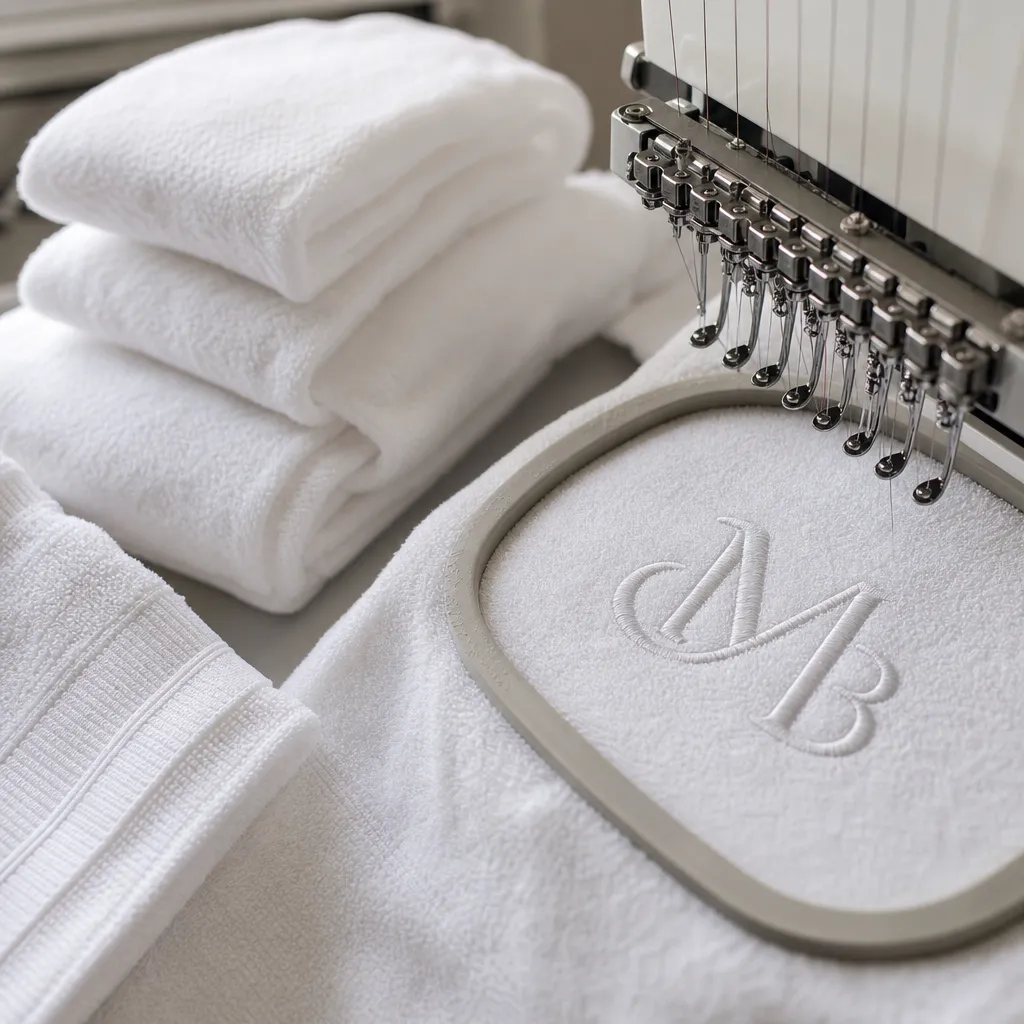
Why Monogram Hand Towels Fail First at the Stitch Edge
Hand towels carry less surface area than bath towels, so every embroidery choice is more visible. A 2 mm shift in placement may disappear on a 70 x 140 cm bath towel, but it looks careless on a 40 x 70 cm hand towel folded beside a basin. The most common failures we see are not dramatic: fuzzy satin borders, puckering around the first letter, thread tails after tunnel washing, or a monogram that looks too heavy for the towel GSM.
For monogram hand towels, we usually start by asking three questions before quoting: how the towel will be displayed, how it will be laundered, and whether the monogram is decorative, operational, or brand-critical. A boutique hotel may need a tone-on-tone crest that survives commercial laundry. A gift brand may accept a softer retail wash environment but need cleaner packaging. A spa group may want initials, room category, or treatment line names separated by color.
- Display position: folded edge, hanging loop view, basin stack, treatment tray, or retail belly band.
- Laundry route: in-house 60 C wash, outsourced tunnel laundry, guest domestic wash, or spa bleach exposure.
- Decoration role: guest-facing branding, room classification, retail personalization, or event gifting.
- Design tolerance: single initials can work at 12-18 mm height; crests usually need 28-45 mm to keep inner details open.
Base Towel Specs Before We Digitize
Embroidery sits on top of the fabric, but the base towel decides how stable the stitched area will be. A loose, high-pile towel can swallow narrow letter strokes. A very dense towel can make the embroidery feel stiff if the stitch count is too high. For embroidered hand towels, we normally recommend a terry face with a controlled pile and a border that gives the machine a stable landing zone.
| Use case | Common size | Recommended GSM | Construction note | Typical unit weight |
|---|---|---|---|---|
| Hotel bathroom hand towel | 40 x 70 cm | 480-560 GSM | 16/1 or 21/2 cotton yarn with compact dobby border | 134-157 g |
| Spa treatment hand towel | 35 x 75 cm | 430-520 GSM | Softer pile, lower twist yarn, avoid oversized embroidery | 113-137 g |
| Retail gift hand towel | 30 x 50 cm | 450-600 GSM | Cleaner border for packaging and monogram visibility | 68-90 g |
| Club or event wash towel | 35 x 60 cm | 380-470 GSM | Quicker drying, smaller monogram, stronger hem lock | 80-99 g |
For most hospitality orders, 500-540 GSM gives enough hand feel without making the embroidered zone bulky. If the design uses a filled crest or dense script, we may reduce pile height in the embroidery zone by moving the monogram to a dobby border or recommending a flatter weave panel. That small construction adjustment costs less than correcting thousands of puckered towels after bulk production.
Monogram Size, Placement, and Thread Count
Digitizing is where buyers often lose money without noticing. A logo file that looks clean on a screen may become 9,000 stitches on a small towel, which slows production and hardens the fabric. We digitize from the final towel size, not from a generic logo file. On a 40 x 70 cm towel, the best monogram width is usually 45-75 mm for initials and 60-95 mm for a small hotel crest.
| Monogram type | Recommended finished size | Expected stitch count | Risk if pushed smaller | Better adjustment |
|---|---|---|---|---|
| Two-letter serif initials | 45-65 mm wide | 1,800-3,200 stitches | Filled counters close after washing | Simplify serif tips or use 40 wt thread |
| Three-letter script | 55-80 mm wide | 2,400-4,600 stitches | Thin joining strokes sink into pile | Add underlay and widen hairlines |
| Small hotel crest | 65-95 mm wide | 5,000-8,500 stitches | Inner shield detail becomes muddy | Remove micro text and use fewer color breaks |
| Single logo mark | 35-55 mm wide | 1,200-2,800 stitches | Edges look uneven on high pile | Use satin border with light tatami fill |
Placement should be locked before sample approval. Our standard tolerance is plus or minus 3 mm from the approved position for hand towels, measured from the towel edge after relaxation. For folded hotel presentation, we often place the monogram 80-110 mm above the lower hem. For hanging presentation, we confirm whether the towel is hung vertically or folded over a rail because the visible face changes.
- Approve the final towel size and shrinkage target before embroidery sampling.
- Confirm monogram width in millimeters, not only as a percentage of the artwork file.
- Choose thread color under the same light used in the property or retail display.
- Run one wash test before bulk if the towel will enter commercial laundry.
- Seal the position with a marked production sample, including distance from hem and side edge.
Thread, Stabilizer, and Wash Testing
For cotton terry, we use 40 wt polyester embroidery thread for most hotel and spa programs because it resists alkaline detergent and high-temperature tumble drying better than rayon. Rayon gives a softer sheen for retail gift towels, but we avoid it for outsourced hotel laundries unless the buyer accepts shorter visual life. For tonal monograms, the difference between thread and towel should usually be 1-2 Pantone steps, not an exact match, otherwise the initials disappear after pile bloom.
Two factory details matter here. First, we use a water-soluble topping on high-pile terry so the stitches sit cleanly above the loops during embroidery. Second, we select cut-away or tear-away backing based on towel weight and monogram density. A dense crest on a 480 GSM towel needs more backing support than a single initial on a dobby band. Removing too much stabilizer can distort the first wash; leaving too much can irritate the hand feel.
- Colorfastness to washing: ISO 105-C06, usually targeting grade 4 or above for thread shade change.
- Rubbing fastness: ISO 105-X12, checked when dark thread sits on white or ivory cotton.
- Dimensional change: ISO 6330 domestic wash method for retail programs, or buyer-specified commercial wash simulation.
- Restricted substances: OEKO-TEX Standard 100 Class I is available for baby-safe and skin-contact towel programs.
- Factory compliance: BSCI social audit and ISO 9001 quality management documentation can be supplied with the order file.
Decoration Choices: Initials, Crests, and Operational Marks
Not every custom hand towel needs the same kind of monogram. For hotels, the cleanest route is often a small crest or initials in the lower third, using one or two thread colors. For retail gifting, the buyer may want individual personalization after bulk production. That changes the workflow: either we produce blank towels with a stable border for local personalization, or we embroider a fixed monogram at the mill for better unit cost.
Operational marks deserve more attention than they get. Some hotel groups ask us to embroider suite level, spa line, or floor-service codes using discreet symbols. This helps linen sorting, but we keep these marks away from the guest-facing monogram area. A 12 mm internal code near the care label can reduce sorting errors without making the towel look like inventory equipment.
| Decoration route | Best for | MOQ impact | Cost impact | Factory note |
|---|---|---|---|---|
| Fixed monogram embroidery | Hotels, clubs, spa chains | 500 pcs per design / per color | Lowest at bulk scale | Best consistency across towels |
| Individual name embroidery | Retail gifting, VIP programs | Usually batched by name list | Higher handling cost | Needs longer pre-production file control |
| Jacquard woven initials | Large repeat programs | Often 1,000+ pcs | Higher yarn setup cost | Good for tone-on-tone but less flexible |
| Heat transfer label | Internal coding only | 500 pcs per design / per color | Low to medium | Not ideal for guest-facing luxury hand feel |
If the buyer wants a very small crest with micro text, embroidery may not be the right method. We will usually suggest removing the text, increasing the crest, or moving to woven label treatment. That is not a design compromise for its own sake; it prevents the bulk order from looking worse than the PDF approval.
Pricing Bands by Volume and Stitch Density
Pricing changes with towel size, cotton grade, GSM, stitch count, thread colors, packaging, and testing requirements. The bands below are realistic FOB China ranges we use for early budgeting before final artwork review. They assume cotton terry hand towels, standard export carton packing, OEKO-TEX compliant materials, and fixed monogram embroidery at one position.
| Order volume | Simple initials, 1 color | Crest or script, 2 colors | Dense crest, 3-4 colors | Notes |
|---|---|---|---|---|
| 500-999 pcs | USD 1.45-2.10 | USD 1.75-2.65 | USD 2.30-3.35 | MOQ starts at 500 pcs per design / per color |
| 1,000-2,999 pcs | USD 1.18-1.82 | USD 1.48-2.25 | USD 1.95-2.85 | Better embroidery line efficiency |
| 3,000-7,999 pcs | USD 0.98-1.55 | USD 1.26-1.95 | USD 1.68-2.45 | Carton packing and thread setup spread out |
| 8,000+ pcs | USD 0.86-1.38 | USD 1.08-1.72 | USD 1.45-2.12 | Best for hotel group rollouts or retail replenishment |
A cheap towel can look acceptable in the first carton and still fail the program. One recent costing discussion compared a 390 GSM hand towel with a 6,200-stitch crest at USD 1.22 against a 510 GSM version with a simplified 3,900-stitch crest at USD 1.64. The lower-priced towel distorted after 25 commercial washes and needed replacement around month four. The higher-priced option was still usable after 72 washes, which put the textile cost at about USD 0.023 per use instead of roughly USD 0.049 per use. That is the number procurement should care about.
Sampling and Production Timing
A smooth monogram program is usually decided before the first needle runs. We need vector artwork, towel size, GSM target, Pantone or thread reference, placement sketch, packaging request, and any certification documents required by the buyer. If the design includes a crest, we prefer an editable AI, PDF, or SVG file rather than a low-resolution PNG.
- Day 1-2: artwork check, stitch estimate, towel construction recommendation, and initial quote.
- Day 3-5: thread matching, digitizing, and embroidery swatch on similar terry fabric.
- Day 6-10: full towel sample weaving or stock-base sample embroidery, depending on program requirements.
- Day 11-14: wash review, measurement check, and sample revision if the stitch edge or placement needs adjustment.
- Day 15-35: bulk towel weaving, dyeing, embroidery, trimming, inspection, packing, and carton marking for typical 500-5,000 pc orders.
- Day 36-45: larger or multi-color hotel programs, especially when lab dips, custom labels, or third-party inspection are added.
Air freight can rescue a launch date, but it is rarely kind to towel economics. Hand towels are lighter than bath sheets, yet a 5,000 pc embroidered order still occupies meaningful carton volume. For timeline planning, we prefer to solve approvals early and ship by sea unless the buyer is topping up a smaller VIP or opening kit.
Quality Control Points We Check Before Packing
Our QC team checks both towel performance and embroidery appearance. For monogram work, the inspection cannot stop at GSM and size. We check thread trimming, backing residue, needle marks, shade consistency, placement, and whether the embroidery has caused localized shrinkage. On dark towels with light thread, we also check lint contamination around the stitched area before folding.
- Finished size tolerance normally held within plus or minus 3% after relaxation, unless the buyer sets a tighter spec.
- Embroidery position checked against the approved sample using edge-to-center measurement points.
- Thread tails trimmed to avoid snagging in laundry, with extra attention to script lettering joins.
- Carton shade separation used when multiple dye lots or thread lots are involved.
- AQL inspection commonly set at AQL 2.5 for major defects and AQL 4.0 for minor defects, adjusted by buyer agreement.
One defect mode specific to embroidered terry is loop pull around the monogram boundary. It happens when needle penetration, topping tension, or hoop pressure disturbs the pile. We test this during sampling by brushing the pile after wash and checking whether loops stand unevenly around the satin edge. If they do, the fix may be lower stitch density, a different backing, or moving the design to a dobby border.
Certification and Compliance Documents Buyers Ask For
For skin-contact towels, certification is not a decorative extra. LUMA & CO. TEXTILE can provide OEKO-TEX Standard 100 Class I material documentation, BSCI audit information, and ISO 9001 quality management records for qualified orders. For hotel groups, we also prepare packing lists by property, carton labels, and SKU-level item sheets so the receiving team can reconcile cartons without opening every box.
If the towel is for children's gifting, wellness retail, or airline amenity use, confirm restricted substance requirements at quotation stage. Thread, towel dye, backing, and any packaging components may all be reviewed. This matters because a towel can be OEKO-TEX compliant while a special ribbon, printed band, or non-standard thread has not yet been cleared for the same claim.
- Minimum order quantity: 500 pcs per design / per color for fixed monogram production.
- Factory profile: 220 employees, operating since 2007 in Gaoyang, Zhejiang, China.
- Annual output: about 2.4 million towels across hotel, beach, gym, spa, golf, and promotional programs.
- Export history: 80+ brand clients across 47 countries.
- Contact for quote files: WhatsApp +86 13205717266 or email [email protected].
How to Brief Our Team Without Rework
The strongest briefs are short but specific. Send the final artwork, intended towel use, target price, estimated annual quantity, and any must-pass test standards. If you are comparing monogram hand towels across suppliers, ask each mill to quote the same GSM, same finished size, same stitch count assumption, and same packing method. Otherwise the cheapest line item may simply be a smaller towel or a lower-density embroidery file.
For related sourcing decisions, see our notes on monogrammed bath towels, embroidery vs sublimation vs jacquard, and Pantone color matching for custom towels. These are useful when your hand towel program needs to match bath linen, robes, slippers, or retail packaging.
If you are still defining the towel itself, start with the towel GSM decision framework, the complete towel size guide, and how to build a towel tech pack. For hospitality rollouts, the hotel linen 90-day roadmap gives a practical approval sequence.
Quote Monogram Hand Towels With Factory Specs
Send artwork, towel size, GSM target, quantity, and delivery market. We will return stitch guidance, MOQ, FOB pricing, sample timing, and compliance notes.
Request a Quote →