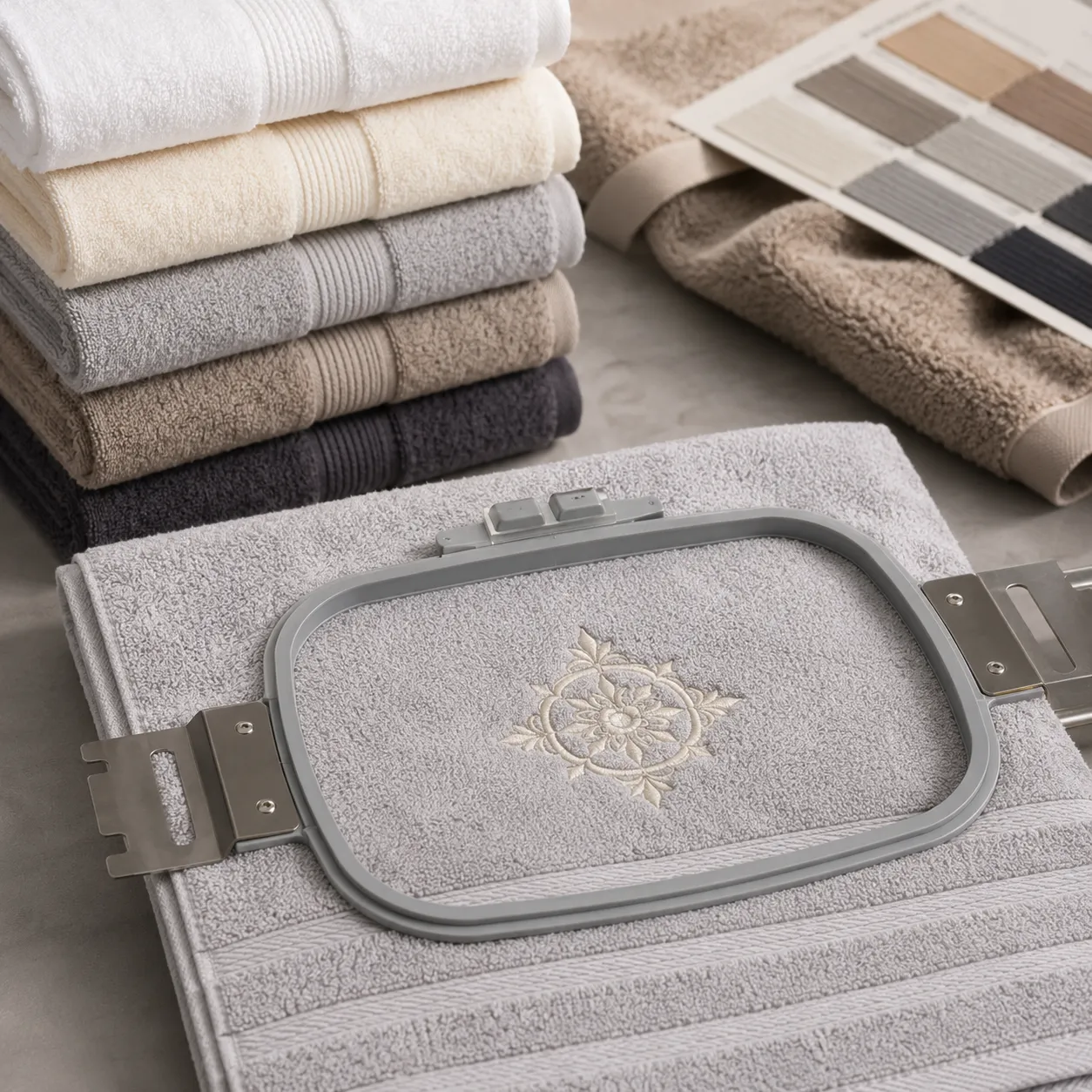
Start with the embroidery, not the towel
For plain dyed hand towels, buyers usually begin with GSM and cotton type. For embroidered programs, that order often creates bad quotes. We price the decoration first because a small 2-letter crest at 5,800 stitches behaves very differently from a 9 cm script monogram with satin borders at 14,200 stitches. Both may look "small" on artwork, but the machine minutes, thread consumption, trimming time, and reject risk are not close.
In practical terms, the monogram hand towels cost breakdown starts with five lines: base towel FOB, embroidery run cost, backing and topping, extra handling after embroidery, and final packout. If one of those lines is missing from a supplier quote, it usually reappears later as a surcharge or as quality drift in bulk.
| Cost line | What changes it | Typical share of unit cost |
|---|---|---|
| Base towel | GSM, yarn, border construction, dyeing | 46%-63% |
| Embroidery run | Stitch count, color changes, machine time | 18%-34% |
| Backing/topping | Water-soluble film, cut-away or tear-away backing | 3%-7% |
| Handling & finishing | Hooping, thread trimming, repressing, refolding | 6%-11% |
| Packing | Polybag, belly band, barcode, carton method | 5%-12% |
The base towel sets the floor price
We normally see monogrammed hand towel programs in 430-600 GSM. Below 400 GSM, embroidery starts to telegraph more clearly through the ground fabric, especially on darker shades where the backing edge can print through after finishing. Above 600 GSM, the face pile can swallow detail unless the design is simplified or the pile is sheared flatter in the logo zone.
For a standard 30×50 cm hand towel in 100% cotton, ring-spun construction, dobby border, the FOB base towel usually lands around USD 0.72-0.96 at 3,000-5,000 pcs per color. If the buyer moves to combed yarn, tighter weight tolerance, and softer reactive dyeing on pale retail shades, the same towel can shift to USD 0.98-1.24 before embroidery. A zero-twist style can look attractive on shelf, but for monograms it needs careful stabilization because needle penetration can create local distortion on plush pile. We explain that issue in combed-vs-zero-twist-cotton-explained.html.
- 430-460 GSM works for promotional or guest vanity use where the logo is light and shelf price matters.
- 480-540 GSM is the most stable range for hotel retail and boutique gifting because the embroidery sits cleanly without making the towel too heavy.
- 560-600 GSM can work for luxury programs, but only if the monogram is bold enough to read over higher pile.
| Base towel spec | MOQ | FOB unit before embroidery |
|---|---|---|
| 30×50 cm, 430 GSM, ring-spun cotton, plain header | 3,000 pcs | USD 0.72-0.84 |
| 30×50 cm, 500 GSM, ring-spun cotton, dobby border | 3,000 pcs | USD 0.81-0.96 |
| 30×50 cm, 550 GSM, combed cotton, dobby border | 5,000 pcs | USD 0.98-1.11 |
| 35×75 cm, 500 GSM, combed cotton, retail hand towel | 5,000 pcs | USD 1.28-1.49 |
Stitch count is only half the embroidery cost
Buyers often ask only for price by stitch count. We can quote that way, but it is incomplete. The same 10,000 stitches can run cheaply on a compact block monogram with one thread color, then become expensive if the design has frequent thread trims, narrow satin columns, or metallic thread that forces lower machine speed. On terry, the underlay also matters. We often add edge-run underlay plus a water-soluble topping film so the pile does not swallow the monogram. That extra control is what keeps serif letters readable after washing.
Our embroidery floor usually prices by machine-minute reality, not by artwork romance. A 6 cm monogram with 1 color and 6,200-7,400 stitches is normally in the USD 0.19-0.28 range per towel at 3,000 pcs. A fuller crest or script mark at 11,000-13,500 stitches often runs USD 0.31-0.46. If the design uses 3 colors, jump stitches, and close registration on terry loops, it can move above USD 0.50 because our operators must slow the run and trimming increases.
| Embroidery style | Typical stitches | FOB add-on at 3,000 pcs |
|---|---|---|
| 2-3 initials, block font, 1 color | 6,200-7,400 | USD 0.19-0.28 |
| Script monogram, 1 color | 8,500-10,200 | USD 0.24-0.34 |
| Boutique crest, 2 colors | 11,000-13,500 | USD 0.31-0.46 |
| Detailed emblem, 3 colors | 14,000-17,500 | USD 0.44-0.62 |
- Color changes add stop-start time even when the stitch count stays flat.
- Small enclosed counters in letters like A, R, and P are harder to keep open on terry than on flat fabric.
- Dense fill areas can pucker the towel face if the underlay is not balanced against pile height.
Backing, topping, and hooping are where cheap programs fail
This is the line many importers underestimate. On hand towels, we commonly use water-soluble topping film over the pile so stitches stay visible instead of sinking into loops. Under the logo, we select either a soft tear-away or a cut-away backing depending on fabric weight and wash requirement. If the towel is for hotel retail or gift use, we usually avoid heavy stiff backing because it leaves a noticeable hand feel patch.
The process step that matters most is hooping position. A monogram placed too near the dobby border can distort because the border tension and pile tension are different. We usually keep the embroidery center at least 5.5-7.0 cm above the border line on a 30×50 cm towel. That distance is not arbitrary; it reduces tunnel effect where the fabric draws inward across the border after washing.
For quality control, we check decoration against the approved placement template and test appearance after one wash using ISO 6330 domestic washing procedure. If the buyer wants retail consistency on dark shades, we also check color change and staining under ISO 105-C06 because embroidery thread and ground towel sometimes age differently in wash chemistry.
- Soft tear-away backing is cheaper, but on lower GSM terry it can leave shape instability after repeated washing.
- Cut-away backing improves logo stability, though it adds material and trimming labor.
- Water-soluble topping is a small cost line, usually only a few cents, but it prevents the fuzzy buried-logo look that causes most sample complaints.
Placement and fold direction change labor more than buyers expect
A centered monogram on an open towel is the simplest path. Trouble starts when the buyer wants the logo to present perfectly after retail folding, or to sit on the right corner only when the towel hangs on a ring. Those requests are valid, but they add handling. Operators need a placement jig, and finishing staff need a folding SOP so every piece presents the same way in packout.
We have seen projects where the artwork itself was easy, but the labor jumped because each towel had to be folded logo-out, inserted into a recycled board sleeve, then carton-packed by monogram letter. The decoration was not the expensive part. The presentation was.
- Open towel is checked for skew and border alignment before hooping.
- Embroidery center point is marked from a placement template, not by eye.
- After embroidery, thread tails are trimmed and the backing area is flattened.
- Towel is steamed or repressed if the logo zone shows hoop shadow.
- Final fold is done to match retail or hospitality presentation standard.
Packaging can add USD 0.08 or USD 0.42 depending on the brief
In a plain wholesale program, packout may be simple bulk carton packing with size sticker only. In a monogrammed line, packaging usually becomes brand-facing. A single PE bag with suffocation warning and carton assortment control might add USD 0.08-0.12. A printed belly band, barcode label, logo insert card, and logo-out fold can move that to USD 0.18-0.29. If the product is gift boxed, costs rise again because carton cube grows and packing speed drops.
For hotel retail and spa boutique orders, the most expensive mistake is mixed presentation across cartons. We recommend listing fold direction, barcode side, and assortment ratio directly in the tech pack. If you need help writing those fields, build-towel-tech-pack-that-mills-can-quote.html covers the format buyers should send.
| Packout style | Typical add-on | Common risk |
|---|---|---|
| Bulk packed, no individual bag | USD 0.03-0.06 | Logo abrasion in transit |
| Individual PE bag + size label | USD 0.08-0.12 | Low shelf impact |
| Belly band + barcode + logo-out fold | USD 0.18-0.29 | Manual fold inconsistency |
| Gift box + insert card | USD 0.34-0.42 | Higher cube and freight cost |
What the full unit economics look like by volume
Below is a realistic FOB example for a boutique retail hand towel program: 30×50 cm, 500 GSM, ring-spun cotton, reactive dyed, 1-color monogram at about 8,900 stitches, water-soluble topping, soft backing, individual PE bag with branded belly band. These are planning ranges, not a blanket quote, but they show where the money sits.
| Order volume | Estimated FOB unit | Notes |
|---|---|---|
| 500 pcs per design/color | USD 1.56-1.78 | MOQ edge, lower machine efficiency, higher setup absorption |
| 1,500 pcs | USD 1.34-1.52 | Better embroidery utilization |
| 3,000 pcs | USD 1.23-1.41 | Stable bulk range for private label |
| 8,000 pcs | USD 1.11-1.29 | Best spread of setup and packing labor |
This is where we push back gently on buyers who want very small runs with multiple initials. If you split 1,000 towels into ten monogram variants, you are not buying one program. You are buying ten short embroidery runs plus assortment complexity. In many cases, it is cheaper per saleable unit to run one shared crest for the first launch, then add individualized monograms after reorder data proves the style.
If the artwork changes faster than the towel spec, the embroidery floor becomes your cost center, not the weaving room.
Lead time depends on approvals more than production days
A typical monogram hand towel order does not take long to make, but it can take a long time to approve. For repeat base towels with new embroidery, we usually need 3-5 days for strike-off and placement sample, 7-10 days for revised approval if artwork changes, and 18-28 days for bulk after deposit and final sample signoff. If the base towel color is newly dyed, add 6-9 days for lab dip and bulk dyeing queue.
Embroidery programs slow down when the buyer approves artwork on a flat PDF but not on actual pile fabric. Terrylike surfaces spread thread edges differently from paper proofs. We always recommend a sewn strike-off. For color-sensitive projects, align embroidery thread and towel shade against PANTONE reference plus physical towel base, not screen view only. Our pantone-color-matching-custom-towels.html article explains where towel dye and thread color can visually separate.
- Sample strike-off: 3-5 days
- Revised sample after comments: 4-7 days
- Bulk towel prep and embroidery scheduling: 18-28 days
- Carton consolidation and export booking: 3-6 days
The buyer checklist we wish every RFQ included
Most quote delays happen because embroidery RFQs are visually clear but technically incomplete. We can estimate from artwork, but we quote tighter and with fewer later adjustments when the buyer provides the production variables up front.
- Finished towel size and tolerance, for example 30×50 cm ±3%
- Target GSM and cotton type, such as 500 GSM ring-spun or 550 GSM combed
- Ground color and whether it is matched to a Pantone reference
- Monogram placement from border edge in cm
- Artwork width in cm, not only a PDF file
- Expected stitch style if known: satin, fill, outline, appliqué not recommended on terry
- Packing method: bulk, polybag, belly band, gift box
- Order split by design and color to test MOQ reality
Related reads: for decoration trade-offs, see embroidery-vs-sublimation-vs-jacquard.html. If you are balancing low runs against margin, negotiate-towel-moq-without-killing-margin.html is useful. For size planning across bath, hand, and washcloth sets, use towel-sizes-dimensions-complete-guide.html.
Where we see claims after delivery
The top failure modes are consistent across branded hand towel programs. First is logo sink-in, where insufficient topping or low contrast thread makes the monogram disappear into the pile. Second is puckering, usually caused by dense stitches on light GSM towels or over-tight hoop tension. Third is placement drift, especially when the logo is measured from an uneven hem instead of a controlled border line. Fourth is backing show-through on dark towels after laundering.
These are preventable with clear approval gates. We recommend pre-bulk signoff on one washed sample, one unwashed sealed sample, and a placement standard kept at the line. If the order is for hospitality resale, we also suggest checking restricted substances documentation under OEKO-TEX Standard 100 Class I and supplier social compliance under BSCI, while the factory system itself should run under ISO 9001 controls. Buyers often ask us to include those records with offer documents.
Related reads: if your program sits closer to hotel retail, hotel-towels-wholesale-supplier-guide.html helps frame the vendor side. If you want to compare embroidery programs with woven branding, monogrammed-bath-towels-luxury-brand-guide.html and designing-for-jacquard-pattern-brief.html are good next steps.
Need a usable monogram hand towel quote
Send the towel size, GSM, artwork width, placement, and packout. We will break pricing into base towel, embroidery, handling, and packaging so you can see what is driving the number. MOQ starts at 500 pcs per design per color. Contact us at [email protected] or WhatsApp +86 13205717266.
Request a Quote →