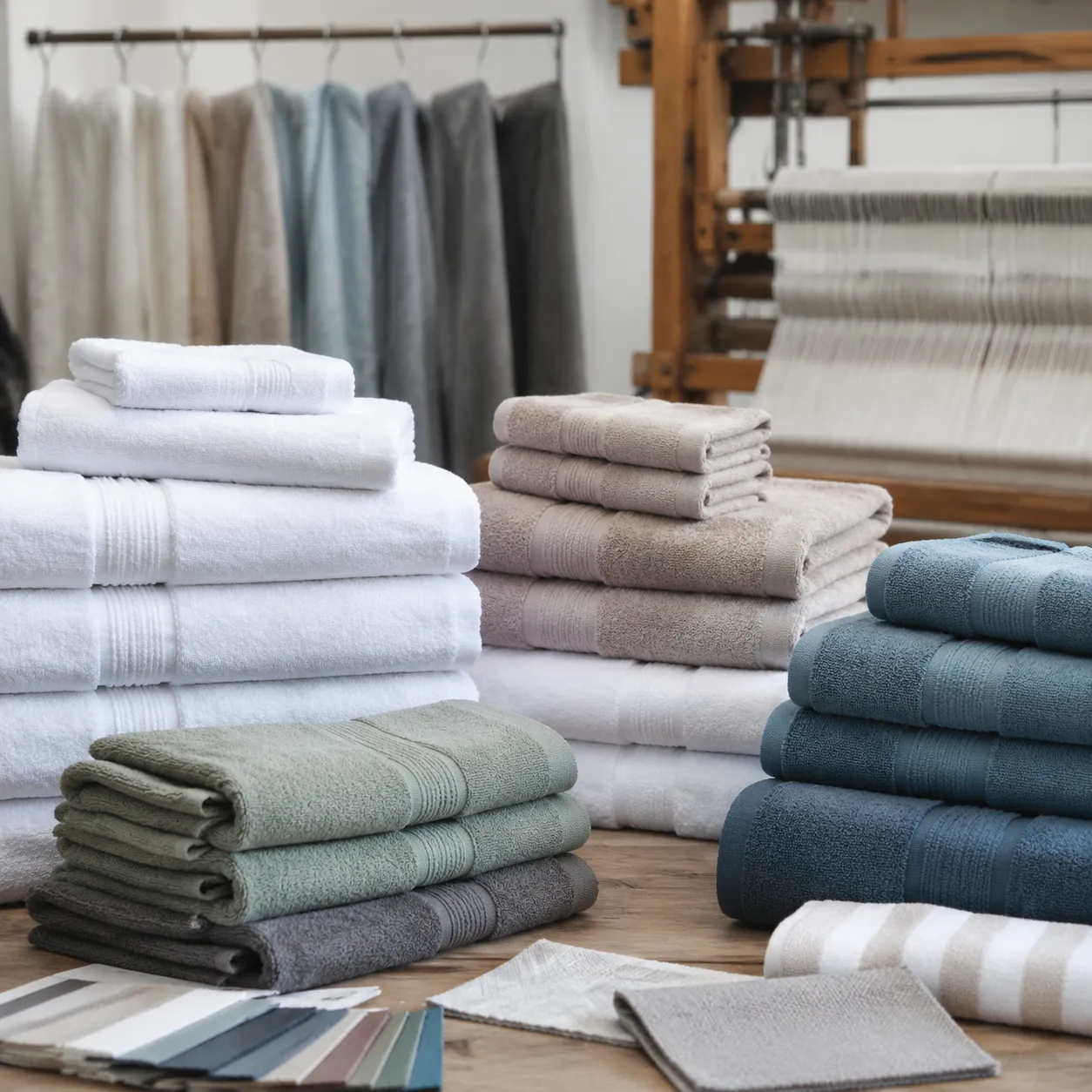
Why microfiber beach towel QC fails differently
Microfiber beach towels are not inspected like cotton terry beach towels. A cotton towel usually fails on pile loss, GSM drift, weak hems, or color bleeding. A microfiber beach towel can pass those basic checks and still fail because of print ghosting, poor absorbency after softener residue, edge binding torque, or sand retention inside the brushed face.
In our mill, we treat microfiber beach programs as a print-and-performance product, not only a textile product. Most orders use 160-260 GSM polyester/polyamide microfiber, often 80/20 or 85/15 blend, with single-sided sublimation or reactive-style disperse print. The hand feel is lighter than terry, but the QC file is usually longer because the surface is a decoration surface and a functional drying surface at the same time.
- Print risk: sublimation paper movement can create double shadows around logos and fine lines.
- Cutting risk: microfiber panels stretch slightly under stack cutting, so size drift often appears on the diagonal.
- Sewing risk: over-tight edge binding causes corner curl after wash, especially on 70 × 150 cm and larger sizes.
- Performance risk: residual finishing oil or too much hydrophilic softener can reduce first-use absorption.
- Packing risk: tight roll packing can transfer dark print onto pale areas if the fabric is not fully heat-set and cooled.
That is why a useful microfiber beach towels QC inspection guide must combine lab tests, line checks, and final AQL inspection. A visual-only inspection misses too many problems.
Microfiber Beach Towels QC Inspection Guide
For brand buyers, we suggest building the inspection plan from the defect modes backward. Start with the guest complaint you cannot accept, then turn it into a measurable checkpoint. For example, “print looks cheap” is not a QC standard. “No visible ghosting beyond 1.5 mm on logo edges when viewed at 60 cm under D65 light” is something our QC team can actually inspect.
| Inspection area | Factory control point | Buyer acceptance target | Common failure mode |
|---|---|---|---|
| GSM and weight | ISO 3801 fabric mass check from cut sample | ±5% from approved sample or contract spec | Thin hand feel, uneven drying performance |
| Printed face | D65 light booth visual check plus bulk-to-sample comparison | Delta E normally under 1.5-2.0 for brand-critical colors | Banding, ghosting, muted Pantone match |
| Size and squareness | Flat table measurement after relaxation | Length/width ±2 cm; diagonal difference under 2.5 cm for large beach size | Skewed towel after wash or display folding |
| Edge stitching | Seam pull and visual seam density check | No skipped stitches over 2 cm; seam density 8-11 SPI depending binding | Puckered border, open seam after laundry |
| Absorbency | Drop test and timed wet-out after wash | Water drop wet-out usually under 5 seconds after one wash | Repellent surface caused by finishing residue |
| Colorfastness | ISO 105-C06 washing and ISO 105-X12 rubbing | Grade 4 or higher for most commercial programs | Print transfer, dull logo after laundry |
For a standard OEM order, our internal QC file includes approved pre-production sample, signed print strike-off, bulk fabric test report, inline sewing report, metal detection record where required, and final pre-shipment report. For large resort or retail programs, we add carton drop checks and barcode scan verification.
Set the inspection lot before cutting starts
A common buyer mistake is asking for final inspection only after all towels are packed. By that stage, we can sort visible defects, but we cannot economically correct heat-transfer shade variation across 8,000 pieces. The inspection lot should be defined before cutting, especially when one PO has several prints or sizes.
- Confirm the approved artwork file, including scale, bleed, Pantone or digital reference, and logo position tolerance.
- Lock the fabric roll allocation by design so one design is not split across incompatible dye lots.
- Approve the print strike-off after heat setting, not before, because shade can shift slightly after curing.
- Run first-article inspection on 20-30 pieces before the sewing line continues.
- Keep retained samples from the first 100 bulk pieces for final comparison.
For beach programs, we normally recommend splitting inspection by design and colorway, not only by total PO quantity. A 12,000-piece order with six prints should not be treated as one blind lot. If one print has a heavy dark ground and another is mostly pale, their colorfastness and transfer risks are different.
| Order type | Recommended QC lot split | Sampling logic | Factory note |
|---|---|---|---|
| Single print, 500-1,500 pcs | One lot per size | ANSI/ASQ Z1.4 general level II | Suitable for first order or small club run |
| Two to four prints, 2,000-6,000 pcs | One lot per print family | AQL 2.5 major / 4.0 minor | Prevents one weak artwork from hiding inside total pass rate |
| Retail set, 6,000-20,000 pcs | Lot by SKU, then carton audit by PO line | AQL plus barcode and packout scan | Needed when hangtag, sleeve, or polybag differs |
| Resort annual program | Initial bulk lot plus reorder comparison lot | Retained master sample at mill and buyer office | Controls shade drift between seasonal reorders |
Visual inspection: print, nap, and edge behavior
Visual inspection for microfiber beach towels should be slower than for plain cotton. The surface catches light differently depending on brushing direction. We check under a D65 light source, then rotate the towel 180 degrees because some streaks only appear when the nap faces the inspector.
The most common sublimation defects are paper creases, white pin lines, blurry logo borders, and panel misregistration. On large towels, a 2 mm ghost line around a small icon may be acceptable for a promotional giveaway, but not for a resort retail towel sold in the gift shop. The tolerance needs to be written before production.
- White crease line: caused by fold or dust between fabric and transfer paper; usually appears as a sharp unprinted line.
- Ghost edge: caused by paper movement during press opening or conveyor shift; most visible on dark logos.
- Panel shade band: caused by uneven heat or inconsistent paper tension across the print width.
- Nap streak: appears when brushing or sanding pressure is uneven; often visible only from one direction.
- Corner curl: caused by binding tension or unbalanced fabric shrinkage after wash.
For rolled private-label beach towels, we also inspect the first visible outside face after rolling. If the main logo disappears into the roll, the retail presentation fails even when the towel itself passes technical inspection. This is one reason packaging approval should use bulk-size samples, not only one lab sample.
Lab tests buyers should require, not assume
A supplier saying “colorfastness is good” is not enough. For export orders, we normally attach test method names so the buyer, third-party inspector, and factory QC room are reading the same standard. OEKO-TEX Standard 100 Class I confirms restricted-substance safety, but it does not replace performance testing for wash, rubbing, or absorbency.
| Test | Method we commonly use | Typical target | Why it matters |
|---|---|---|---|
| Colorfastness to washing | ISO 105-C06, 40°C program depending claim | Grade 4 or above staining and color change | Protects printed graphics during resort laundry |
| Colorfastness to rubbing | ISO 105-X12 dry and wet crocking | Dry grade 4; wet grade 3-4 or better | Prevents transfer to swimwear and bags |
| Fabric mass | ISO 3801 | 160-260 GSM depending spec, ±5% tolerance | Controls hand feel and drying weight |
| Dimensional change | ISO 6330 wash procedure, measured after 3 cycles | Shrinkage within 3% for most microfiber beach specs | Prevents misshapen towels after guest use |
| Absorbency wet-out | Internal drop test after one wash | Under 5 seconds for hydrophilic finish | Confirms the towel dries skin, not only looks smooth |
| Seam strength | Internal seam pull or buyer lab equivalent | No seam opening under normal manual pull | Reduces edge failures in laundry carts |
Colorfastness testing beach towels is especially important when the artwork has saturated navy, red, black, or tropical green next to white ground. We prefer to test the worst-risk print zone, not a random pale corner. If the lab cuts only the lightest area, the report can look clean while the real risk remains untested.
Our current certifications include OEKO-TEX Standard 100 Class I, BSCI, and ISO 9001. For baby, family resort, or airline amenity use, buyers often request the OEKO-TEX certificate number and product class review. We recommend reading the scope carefully; our article on how to read an OEKO-TEX certificate explains what to check before using the logo in your own compliance file.
AQL settings for final pre-shipment inspection
For final inspection, most international buyers use ANSI/ASQ Z1.4 or ISO 2859-1 sampling. We usually see AQL 2.5 for major defects and AQL 4.0 for minor defects on commercial towel programs. Some retail chains require AQL 1.5 for major defects, but that raises sorting cost and can extend the final inspection window by 1-2 days.
Major defects are problems that affect saleability, function, safety, or brand presentation. Minor defects are small appearance issues that do not affect use. The classification needs to be agreed before the inspector arrives; otherwise one inspector may call a faint nap shade line major while another calls it minor.
- Critical defect: needle fragment, contamination, mold, incorrect restricted-substance label, or wrong fiber claim.
- Major defect: wrong size beyond tolerance, obvious print ghosting, open seam, heavy stain, wrong logo placement, failed barcode, or mixed SKU in carton.
- Minor defect: loose thread under 3 cm, slight fold mark, small shade variation within approved limit, or non-facing hangtag angle.
- Packout defect: wrong carton mark, missing silica gel when specified, incorrect roll band, unreadable shipping label, or carton weight outside agreed range.
For beach towels sold through retail, packout defects can cost more than a sewing defect. If a carton contains two roll-band designs mixed together, the warehouse may reject the carton even though every towel inside is technically usable. That is why we inspect carton markings, scan codes, inner pack count, and gross weight during final QC.
Cost, MOQ, and the price of extra QC
Our MOQ is 500 pieces per design per color. For microfiber beach towels, the cost is driven by GSM, fabric blend, print coverage, towel size, sewing style, packaging, and inspection level. A plain 160 GSM travel-beach towel is a different product from a 240 GSM double-faced resort towel with full-surface artwork and retail belly band.
| Volume and spec | Typical FOB China price band | QC scope included | Notes |
|---|---|---|---|
| 500-999 pcs, 160-180 GSM, simple sublimation | USD 2.35-3.10 per pc | Inline check plus final internal inspection | Best for event or trial retail drop |
| 1,000-2,999 pcs, 180-220 GSM, full print | USD 2.05-2.85 per pc | Strike-off, bulk GSM check, AQL final inspection | Common DTC brand range |
| 3,000-7,999 pcs, 200-240 GSM, custom packaging | USD 1.82-2.55 per pc | Lot split by design, carton audit, retained samples | Better for resort retail or beach club program |
| 8,000+ pcs, 220-260 GSM, multi-SKU program | USD 1.68-2.35 per pc | Expanded pre-shipment inspection and packout verification | Price depends heavily on artwork yield and carton plan |
Cheap microfiber can look attractive on the first quotation. The problem is cost-per-use. In one recent 5,200-piece resort inquiry, the buyer compared a 165 GSM towel at USD 1.94 with a 215 GSM towel at USD 2.46. The cheaper option saved USD 2,704 on the PO, but after our wash bench showed corner curling and slower absorption by cycle 12, the resort estimated replacement after one season. The heavier version was projected to last two summer seasons, so the towel cost per guest-use cycle was lower even though the PO price was higher.
If you need a low price, we would rather adjust packaging, reduce artwork coverage, or simplify the edge finish than remove QC tests. Skipping colorfastness or absorbency checks saves very little compared with the cost of a rejected shipment.
Production timeline and inspection gates
A realistic microfiber beach towel program usually needs 28-45 days after sample approval, depending on fabric availability and print capacity. Urgent orders can be faster, but only if the artwork is approved, packaging is simple, and the buyer accepts air freight or partial shipment. For new programs, we prefer not to compress the strike-off and wash-test stage.
- Artwork and tech pack review: 1-2 days if files include size, GSM, print placement, packaging, and test requirements.
- Lab dip or digital strike-off: 4-7 days depending color complexity and buyer response time.
- Pre-production sample: 5-9 days after strike-off approval.
- Bulk fabric preparation and printing: 8-16 days for most 500-8,000 piece runs.
- Cutting, sewing, trimming, and inline QC: 5-10 days depending size mix.
- Final inspection, carton audit, and shipping documents: 2-4 days.
- Sea freight booking and departure: usually 7-14 days to secure space in peak beach season.
The timeline changes when packaging becomes complex. A rolled towel with printed belly band, barcode sticker, care label, and carton assortment plan may add 4-6 days because each component needs approval. If your launch date is fixed, build the carton specification early. Our article on container vs air freight towel orders is useful when deciding whether to split the shipment.
What to put in the buyer QC file
A microfiber towel inspection checklist should be short enough for the factory floor and detailed enough for a third-party inspector. We like one master QC file with annexes: approved sample photos, artwork file, test requirements, packaging layout, and AQL defect list. Long email threads are not a QC system.
- Approved towel size with tolerance, including diagonal squareness tolerance for large formats.
- Target GSM, blend, fabric construction, and whether the face is suede, brushed, waffle, or terry-style microfiber.
- Artwork file name, color reference, print scale, logo placement tolerance, and acceptable ghosting limit.
- Wash, rubbing, shrinkage, absorbency, and seam test methods with target grades.
- AQL plan, defect classification, carton marking rules, and retained-sample requirement.
- Packaging details: roll diameter, belly band position, polybag thickness if used, carton count, gross weight limit, and barcode location.
Related reads: if you are still deciding whether microfiber is the right material, compare it with cotton in microfiber vs cotton towel comparison. For size planning before inspection tolerances are written, use towel sizes dimensions complete guide and the broader GSM logic in towel GSM decision framework.
Related reads: for beach-specific sourcing, we also recommend beach towels in bulk buyers guide, beach club resort towel program, and build towel tech pack that mills can quote. These help connect the inspection file to the RFQ, not only the final shipment.
How we handle failed inspection findings
A failed inspection is not always a rejected order. The decision depends on defect type, quantity, and whether the issue can be corrected without creating a new problem. Loose threads can be trimmed. Mixed carton assortments can be repacked. A weak sublimation shade across the whole production lot cannot be fixed by sorting.
Our process is to quarantine the affected cartons, identify whether the defect is random or systemic, then produce a corrective action note. For systemic issues, we trace the fault back to print roll, heat press shift, sewing line, or packaging station. For random issues, we sort by the same defect definition used in the AQL report so the buyer and factory are not arguing from different standards.
For orders above 3,000 pieces, we recommend holding 1-2% extra bulk fabric or finished goods until final approval. It gives room to replace defects without reopening the whole production line. For small 500-piece custom runs, that buffer is harder because fabric and print setup costs are spread across fewer pieces, so the inspection standard must be realistic from the start.
LUMA & CO. TEXTILE has produced custom towels since 2007 with a 220-person team in Gaoyang, Zhejiang. We supply 80+ brand clients across 47 countries and make about 2.4 million towels per year. For microfiber beach programs, send your size, GSM, artwork, packaging plan, target market, and inspection requirement to [email protected] or WhatsApp +86 13205717266. We will tell you where the spec is safe and where it is likely to create claims.
Build a safer microfiber beach towel QC file
Send us your artwork, GSM target, order quantity, and inspection standard. We will return a practical OEM quote with MOQ, price band, sample timing, and QC gates.
Request a QC-based quote →