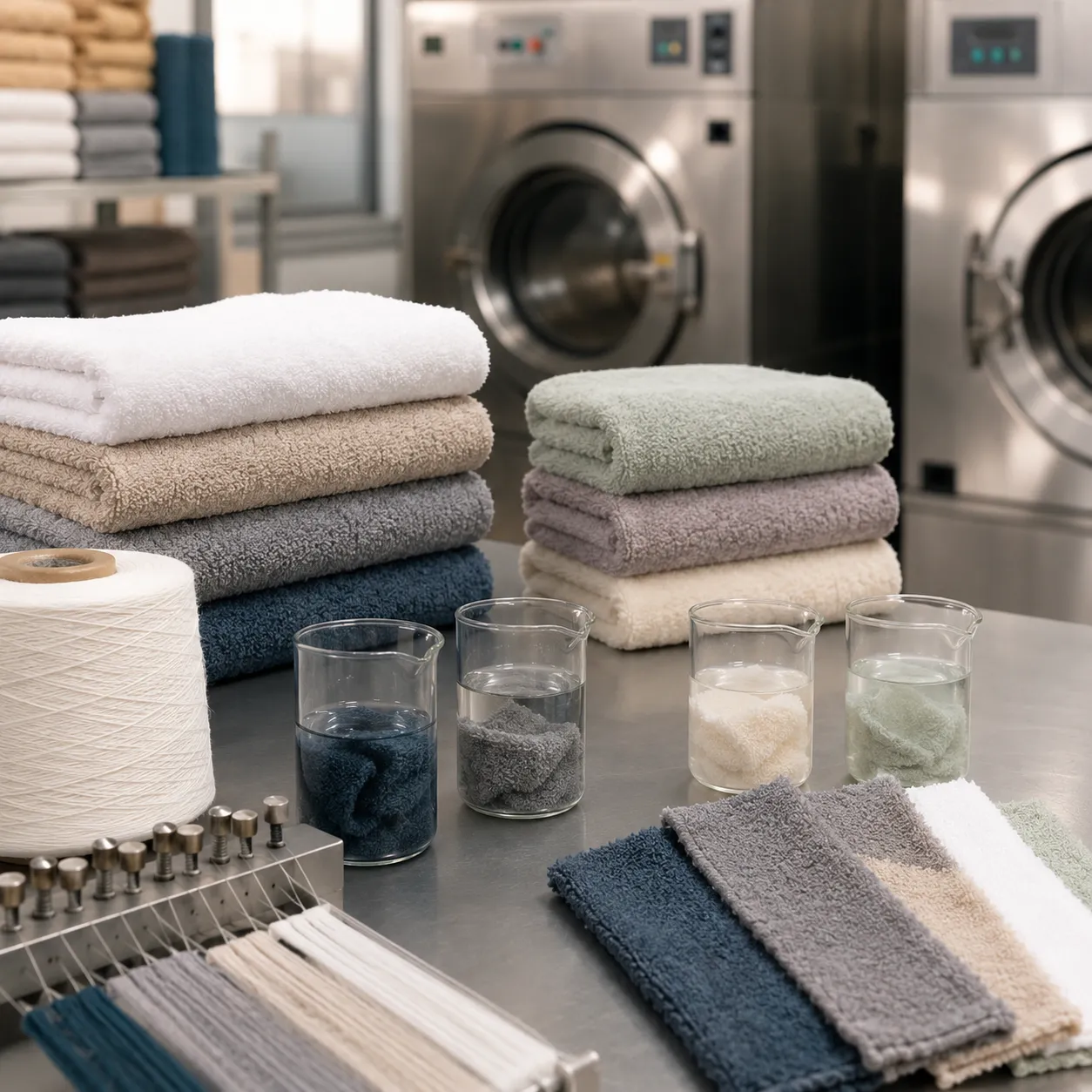
Why Small Runs Still Need a Wash Standard
Low MOQ does not mean low risk. Our MOQ is 500 pcs per design / per color, and at that quantity most buyers cannot absorb a 12% defect rate, because there is no large inventory buffer. If 70 towels from a 600-piece run twist, bleed, or shrink beyond the label claim, the brand sees the issue immediately.
We use the same certification framework for small and larger orders: OEKO-TEX Standard 100 Class I for restricted substances, BSCI for social compliance, and ISO 9001 for quality management process control. Those certificates do not replace physical laundering checks. They tell you the factory system and chemical safety baseline; they do not tell you whether a 420 GSM hand towel will still measure square after 10 hotel-style wash cycles.
For a small batch, the wash test is also a costing tool. A buyer may save USD 0.18 per pc by dropping from combed cotton to carded cotton on a 50×100 cm towel, but if lint complaints force replacement of 85 pieces, the saving disappears. On a 700-piece order, that USD 126 material saving can become USD 310-420 in replacement towel cost before courier charges and staff time.
- Shrinkage: measured after controlled laundering and tumble drying, not estimated from yarn count alone.
- Color movement: checked on the towel face and on adjacent multifiber fabric for staining risk.
- Pile stability: assessed by lint, snagging, loop pull, and hand-feel change after repeated wash cycles.
- Decoration survival: embroidery puckering, jacquard edge distortion, print cracking, and label fraying are checked separately.
The Low MOQ Towels Wash Test Standard We Use
Our low moq towels wash test standard is a practical factory protocol built from ISO and AATCC methods, then adjusted for the towel’s actual end use. A spa facial towel, a golf cart towel, and a hotel bath towel should not all be judged by the same number of cycles or drying condition.
For most OEM programs, we run a pre-production wash on approved sample fabric before bulk cutting. For repeat orders, we run inline lot checks if the cotton lot, dye shade, GSM, or decoration method changes. The important point is sequence: wash testing should happen before the entire batch is cut, hemmed, embroidered, and packed.
| Test area | Reference method we use | Typical pass target | Why it matters |
|---|---|---|---|
| Dimensional change | ISO 6330 domestic wash procedure with ISO 5077 measurement | Bath and gym towels: within ±5%; flat-weave hammam: within ±7% | Controls shrinkage claim and carton fit |
| Colorfastness to laundering | AATCC 61 or ISO 105-C06 depending on buyer market | Grade 4 minimum for shade change; Grade 3-4 minimum for staining | Prevents dye transfer onto white laundry or robes |
| Absorbency recovery | Internal drop test after conditioning plus wash comparison | Water drop absorbed within 3-5 seconds for cotton terry after first wash | Catches silicone softener overuse |
| Lint shedding | Internal dark-panel rub and dryer screen weight check | No visible fiber balls after cycle 3; dryer lint trend declining | Important for gyms, hotels, and car-care towels |
| Twist and skew | Flat measurement after tumble dry relaxation | Side seam skew below 3 cm on 70 cm width | Prevents towels looking defective after folding |
One construction quirk we check closely is border behavior. A dobby border can shrink differently from the terry field because the yarn tension and weave structure are not the same. If the border is too tight, the towel develops a bowed edge after drying. This defect does not always show in the first sample before washing.
How Many Cycles Are Enough?
We do not recommend using one universal number. A promotional towel may only need 3 accelerated wash cycles to validate bleeding and basic shrinkage. A hotel replenishment program should see at least 10 cycles before approval, and some hospitality buyers ask for 20-cycle comparison panels when they are changing suppliers.
For low MOQ orders, we balance test confidence against launch timing. A full 20-cycle test can take 8-12 working days depending on drying and conditioning time. If a buyer needs goods in four weeks, we usually run an early 3-cycle gate before bulk cutting, then a 10-cycle retained-sample test while production continues. If the 3-cycle result is weak, we stop before the expensive decoration stage.
| Buyer use case | Recommended wash gate | Typical GSM range | Main failure we watch |
|---|---|---|---|
| Gym sweat towel | 5 cycles before bulk; 10-cycle retained panel | 320-450 GSM cotton terry or 220-280 GSM microfiber | Odor retention, lint on black apparel, edge curl |
| Hotel bath towel | 10 cycles before bulk approval | 500-700 GSM ring-spun or combed cotton | Shrinkage, loop pull, border bowing |
| Beach club towel | 5 cycles plus chlorine-rinse check if poolside | 380-520 GSM velour or terry | Shade fading, velour face roughening |
| Spa facial towel | 10 cycles with warmer-temperature review | 360-500 GSM cotton terry or waffle | Hand-feel loss, oil staining, seam twisting |
| Promotional rally towel | 3 cycles before production packing | 260-360 GSM cotton or blended terry | Dye bleeding and logo distortion |
Cycle count should match the claim you will make. If a DTC brand says “built for 50 washes,” a 3-cycle internal test is not enough evidence. We can run extended testing, but buyers should add 10-14 days to the approval calendar and budget for additional lab handling.
- Approve yarn, GSM, size, color, and decoration artwork before laundering samples are made.
- Wash one control sample and keep one unwashed control from the same cutting.
- Measure length, width, border position, GSM, and weight before washing.
- Run the agreed wash cycles with recorded detergent, water temperature, load weight, and drying method.
- Condition samples for at least 4 hours before final measurement and photos.
Shrinkage, GSM Loss, and the Numbers Buyers Should Read
Shrinkage is not only a size issue. It changes perceived thickness, weight per carton, folding shape, and the way embroidery sits on the towel. A 45×90 cm hand towel that shrinks to 42.8×86.5 cm may still be usable, but if the retail belly band was designed tight, packing becomes slow and inconsistent.
GSM can move after washing because residual processing chemicals are removed and the pile opens. We record towel weight and dimensions separately. A towel can look heavier by GSM after shrinkage even if the actual piece weight dropped slightly. Buyers should ask for both figures, not only the final GSM.
| Specification point | Pre-wash example | After 5 cycles | How we interpret it |
|---|---|---|---|
| Size | 50.2×101.0 cm | 48.1×97.2 cm | Length shrinkage 3.8%, width shrinkage 4.2%; acceptable for gym use |
| Piece weight | 213 g | 207 g | 2.8% loss; mostly processing residue and loose fiber |
| Calculated GSM | 420 GSM | 443 GSM | Higher GSM caused by area shrinkage, not added substance |
| Dobby border width | 5.0 cm | 4.6 cm | Border shrinkage acceptable if not bowing |
| Hem twist | 0 cm | 1.4 cm offset | Acceptable below 2 cm for this size |
The defect mode we reject quickly is progressive distortion. If shrinkage is 3.5% after the first cycle and stays near 4.2% by cycle five, that is manageable. If it moves from 3.5% to 6.8%, the towel is still relaxing or the finishing was unstable. For those cases we adjust pre-shrink finishing, yarn tension, or size allowance before bulk cutting.
Colorfastness Is Not Just Dye Bleeding
Buyers often look for visible bleeding in the wash water. That is useful, but it is not enough. A towel can pass a simple bucket soak and still stain adjacent pale fabrics during warm machine laundering. For export orders, we prefer AATCC 61 for U.S.-market programs or ISO 105-C06 for European-style documentation.
Dark navy, burgundy, forest green, and saturated black usually need the closest attention. Reactive dye on cotton performs well when fixed and washed off correctly, but rushed soaping after dyeing leaves unfixed dye in the pile. That dye may not appear until the towel is washed with detergent and friction.
- Shade change: compare washed and unwashed samples under D65 light, not only office lighting.
- Staining: check acetate, cotton, nylon, polyester, acrylic, and wool strips on multifiber fabric.
- Crocking risk: test dry and wet rubbing for deep shades, especially velour beach towels.
- Chlorine sensitivity: for pool and spa buyers, test realistic exposure rather than promising bleach resistance on standard reactive shades.
For salon and pool programs, we push back when buyers ask for a deep fashion color and chlorine-safe performance at the same low price. Bleach-stable vat dye or special fiber systems cost more and may limit shade range. If the use case includes peroxide, benzoyl peroxide, or chlorine, build that into the test request at the start. Our guide on salon bleach-proof towel sourcing goes deeper into this problem.
Decoration Adds Its Own Wash Risks
A towel that passes fabric washing can still fail after logo work. Embroidery adds thread, backing, and local tension. Jacquard changes the weave structure. Sublimation on microfiber has excellent graphic detail, but the base fabric has a different lint and hand-feel profile than cotton. We test decoration as part of the finished product, not only the blank towel.
Embroidery puckering is one of the most common small-order complaints. It happens when the terry fabric shrinks but the embroidery thread and stabilizer shrink differently. For a 9,000-stitch chest-style logo on a hand towel, we often reduce density, change underlay, or use a softer cutaway backing if the first wash causes rippling around the mark.
| Decoration type | Wash-test focus | Typical extra cost at 500-999 pcs | Factory note |
|---|---|---|---|
| Embroidery | Puckering, thread bleed, backing edge feel | USD 0.22-0.75 per pc depending on stitch count | Polyester thread usually washes better than rayon for towel programs |
| Jacquard | Pattern distortion and float snagging | USD 0.35-0.90 per pc plus loom setup share | Works best above 800-1,000 pcs when pattern repeat is stable |
| Reactive print | Color migration and hand-feel change | USD 0.28-0.65 per pc by coverage | Needs proper steaming and washing-off |
| Sublimation microfiber | Print edge sharpness after laundering | USD 0.18-0.48 per pc by size | Only for polyester microfiber, not cotton terry |
| Woven label or hang loop | Label fray, loop pull strength | USD 0.06-0.18 per pc | Loop seam must be tested under wet load |
For decoration decisions, compare embroidery vs sublimation vs jacquard before locking the artwork. If your buyer packet is still incomplete, our tech pack guide shows the details a mill needs to quote and test correctly.
Pricing Impact for Low MOQ Wash Validation
Wash testing is not a large cost compared with a failed launch, but it is not free. The price depends on towel size, number of cycles, whether third-party lab paperwork is required, and how many colorways or decoration versions need separate evaluation. For small orders, the mistake is testing only the easiest color and assuming the dark shade will behave the same.
| Order volume | Typical towel unit price band | Internal wash validation cost | Lead time impact |
|---|---|---|---|
| 500-799 pcs | USD 1.35-4.80 per pc depending on size and GSM | USD 55-140 per color / construction | Adds 2-5 working days |
| 800-1,499 pcs | USD 1.18-4.35 per pc | USD 45-120 per color / construction | Adds 2-5 working days |
| 1,500-3,999 pcs | USD 0.96-3.90 per pc | Often absorbed for repeatable specs; third-party extra | Adds 3-7 working days if extended |
| 4,000+ pcs | USD 0.82-3.45 per pc | Usually built into QC plan for approved programs | Adds 3-10 working days by protocol |
Third-party lab reports are useful for chain retailers, hotel groups, and compliance teams, but they add cost and calendar time. A basic external dimensional and colorfastness report may run USD 120-260 per fabric/color set in China, while a broader package with absorbency, fiber composition, and pH can reach USD 350-620. We normally recommend internal gate testing first, then external testing only after the construction is stable.
Related reads: use towel GSM decision framework when balancing absorbency and drying speed, and how to read an OEKO-TEX certificate when your compliance team needs document checks beyond wash performance.
Production Timing: Where Testing Fits
A realistic low MOQ towel order is not made in a straight line from payment to shipping. The wash test must be placed early enough to change something. If testing happens after packing, the only options are discount, rework, or remake.
- Tech pack review and quotation: 1-2 working days if size, GSM, color, artwork, and packing are clear.
- Lab dip or yarn shade approval: 3-7 working days for cotton reactive dye; longer for difficult dark shades.
- Pre-production sample and wash gate: 5-9 working days depending on cycle count and decoration.
- Bulk weaving, dyeing, finishing, and sewing: 12-22 working days for most 500-3,000 pc cotton orders.
- Decoration, final inspection, packing, and carton marking: 4-8 working days.
- Export booking and document preparation: 3-6 working days before vessel or air handover.
For a fresh custom towel, a practical schedule is 25-40 days after all approvals. Repeat orders with no construction or color changes can run faster, often 18-28 days. Air freight can shorten transit, but it cannot fix a skipped wash test. For shipping choices after production, see container vs air freight towel orders.
If a buyer needs launch goods quickly, we suggest narrowing variables. Use one proven towel base, one color, one decoration method, and standard packaging. Testing one stable construction is faster and more reliable than testing five new colorways with separate labels and retail sleeves.
What to Put in Your PO and QC File
The purchase order should name the wash standard, not simply say “good quality.” That phrase is not inspectable. A clear PO lets our QC team check the same targets the buyer expects, and it gives both sides a practical way to resolve borderline results.
- State the wash method: ISO 6330, AATCC 61, ISO 105-C06, or an agreed internal protocol.
- Define cycle count and drying method: line dry and tumble dry can produce different shrinkage results.
- List pass/fail limits for length, width, shade change, staining, lint, and decoration appearance.
- Require retained samples: one unwashed control and one washed approval sample per color.
- Confirm who pays for third-party lab testing and whether it is needed before bulk production or before shipment.
For hotel and institutional buyers, we also recommend keeping a sealed shipment sample from the first carton. If a laundry later reports unexpected shrinkage, you can compare their returned towel against the retained sample and the wash log. This helps separate manufacturing issues from laundry chemistry problems such as high alkalinity, chlorine overdose, or dryer over-temperature.
Related reads: buyers building repeat programs should review negotiating towel MOQ without killing margin, hotel towel sourcing guide 2026, and why gym towels fail after 50 washes. These connect MOQ, construction, and laundering life instead of treating them as separate decisions.
Our Practical Recommendation
For most first-time low MOQ programs, we recommend a 5-cycle internal wash gate before bulk cutting and a 10-cycle retained-sample record before shipment. For hotel, spa, and rental programs, move directly to 10 cycles before bulk approval if the launch calendar allows it. For promotional towels with short event life, 3 cycles may be enough if colorfastness and decoration stability are the main risks.
The low moq towels wash test standard should be written into the tech pack, quotation, and QC checklist. It protects the buyer, but it also protects the mill from unclear expectations. If the towel is expected to survive hot commercial laundry, say so before yarn, GSM, dye, and finishing are selected.
LUMA & CO. TEXTILE has 220 employees and has operated since 2007, supplying 80+ brand clients across 47 countries with annual production around 2.4 million towels. We can support small custom runs from 500 pcs per design / per color, but we will still ask for the right wash validation when the use case requires it. Contact us on WhatsApp at +86 13384590853 or email [email protected] with your size, GSM, color, decoration, and target wash claim.
Set a Wash Test Before Bulk
Send your towel spec and intended laundry condition. We will suggest a practical wash protocol, timing, and low MOQ quote before production starts.
Request a Wash-Test Quote →