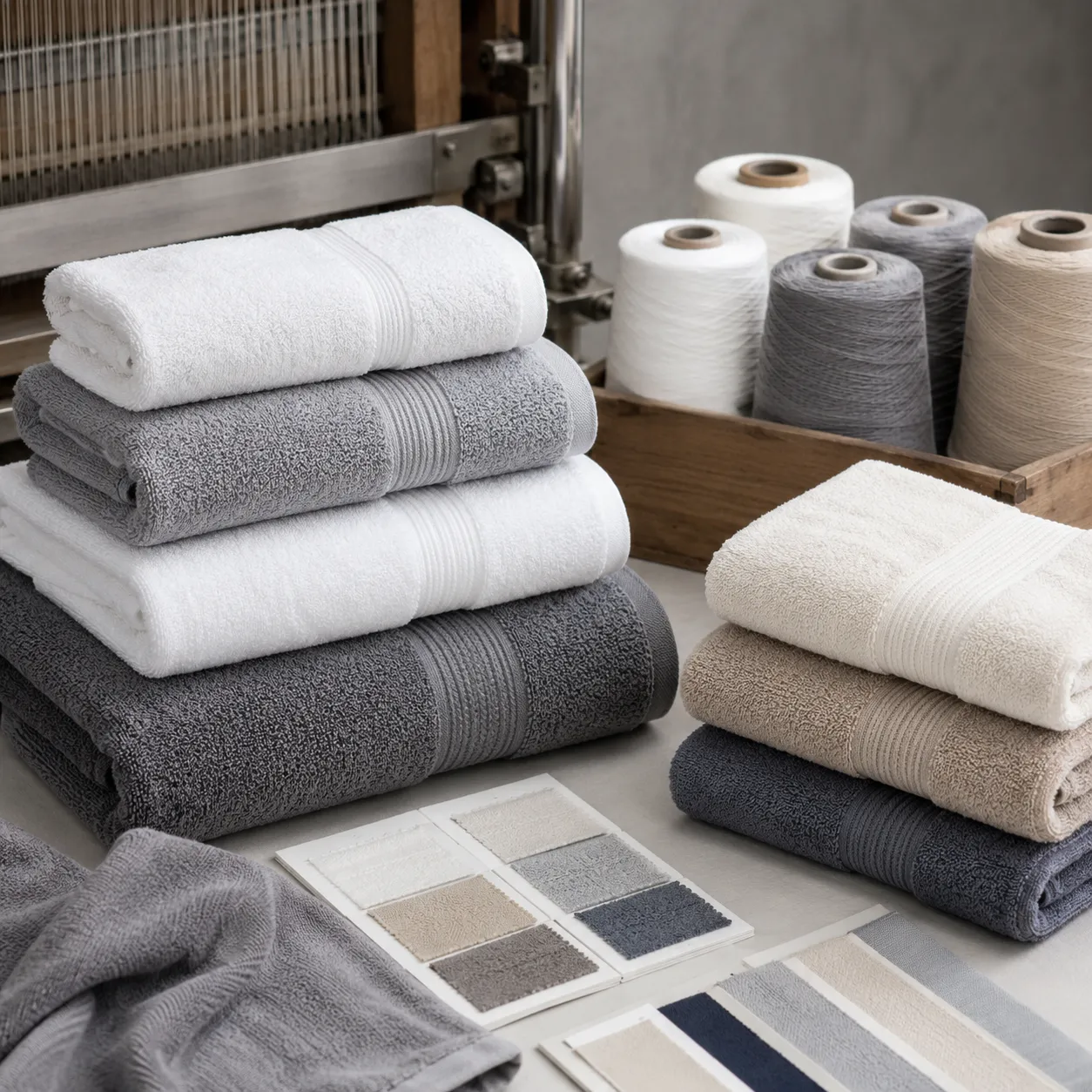
Start with the lot definition, not the top sample
The inspection should be run against the shipped lot, not against the salesman sample or strike-off sitting in email history. For a bulk order, define the lot by PO number, colorway, size, decoration method, and shipment date. If one PO contains 70×140 cm towels and 80×160 cm towels, inspect them as separate lots even if the artwork is the same. Mixing them hides variation in weight, print scale, and carton count.
For bulk acceptance we use ANSI/ASQ Z1.4 single sampling, General Inspection Level II. Critical defects accept 0. Major defects accept on AQL 2.5. Minor defects accept on AQL 4.0. That gives the buyer a fixed rule instead of a vague discussion at the end of the day.
| Lot size | Sample size code | Pieces to inspect | Major accept/reject | Minor accept/reject |
|---|---|---|---|---|
| 501-1,200 | J | 80 | 5 / 6 | 7 / 8 |
| 1,201-3,200 | K | 125 | 7 / 8 | 10 / 11 |
| 3,201-10,000 | L | 200 | 10 / 11 | 14 / 15 |
| 10,001-35,000 | M | 315 | 14 / 15 | 21 / 22 |
- Treat needle contamination, mildew odor, wrong fiber content label, and carton count shortage as critical defects.
- Treat visible print ghosting, size out of tolerance, weight below tolerance, broken overlock, severe skew, and failed absorbency as major defects.
- Treat loose thread tails under 25 mm, slight shade variation inside tolerance, and minor edge waviness as minor defects.
The fabric benchmarks need fixed numbers
Most claims on microfiber beach towels start with fabric that was approved too loosely. The construction is usually 80/20 polyester-polyamide warp knit or 85/15 for lower cost programs. If the order is sold as sand-resistant and quick-dry, the fabric weight and brushing level matter more than pile height because there is no cotton loop to hide inconsistency.
| Spec line | Bulk standard | Pass limit | Test / method |
|---|---|---|---|
| Fiber content | 80/20 or buyer-approved blend | Within ±3 percentage points | Lab composition test |
| Finished GSM | 200-320 GSM common range | Nominal ±5% | ISO 3801 |
| Cut size | As PO | Length/width ±2.0 cm | Steel tape after conditioning |
| Skew / bow | Printed towel | Max 3% across width | AATCC 179 visual grid |
| Moisture content before packing | Dry packed goods | Max 8.0% | Conditioned weight check |
| Handfeel | Soft brushed face if approved | No resin-hard panels or fused streaks | Panel touch + visual |
For a 75×150 cm printed towel sold at 260 GSM, the finished piece weight target is 292.5 g. The pass band at ±5% is 277.9-307.1 g after standard conditioning. Anything below the lower limit is major because buyers do not sell a towel by appearance alone; they sell coverage, absorbency, and pack value.
- Take GSM swatches from three carton levels: top, middle, and bottom pallet positions.
- If the fabric is one-side brushed, confirm the brushed face is consistent and not alternating by batch.
- Reject any roll-lot showing calendar shine bars from excess heat pressure across the face.
Print inspection is where most false passes happen
Sublimated microfiber can look bright even when the transfer is unstable. We check both image accuracy and process defects. A beach design with large sky gradients often hides banding in warehouse light, while a repeating stripe exposes even 2 mm tracking drift. The inspector has to compare against approved artwork at full scale, not a phone image.
| Print point | Acceptance limit | Defect class | How to check |
|---|---|---|---|
| Artwork placement | Center deviation max 5 mm | Major | Measure from hem to key motif |
| Color difference to approved standard | Average ΔE00 ≤ 2.0, spot max 3.0 | Major | Spectro on 3 key colors |
| Ghosting / double image | Not allowed if visible at 60 cm | Major | Lay flat under D65 light |
| White specks / transfer skips | Each ≤ 1 mm, total max 5 per towel | Minor above limit major if on logo | Visual count |
| Banding | No continuous band over 15 cm | Major | Visual on solid and gradient zones |
| Scorch / yellowing | Not allowed | Major | Visual front and reverse |
Two process quirks deserve specific attention. First, edge cooling after transfer can lock in a stiff frame around the towel, which later causes roping after wash. Second, on high-coverage dark artwork, insufficient transfer pressure leaves a gray cast on the reverse side seam allowance. Neither issue appears in a cropped product photo, but both generate retail returns.
If the logo area passes but the gradient beach background shows banding from platen temperature swing, the towel still fails. End users see the whole face, not the logo only.
Sewing faults must be judged by failure risk, not by tidiness alone
Microfiber beach towels are often hemmed with 4-thread overlock plus cover stitch or turned hem depending on cost level. The common weak point is not just loose thread; it is seam torque after wash, especially on long side hems where differential feed was not balanced.
| Sewing checkpoint | Acceptance limit | Defect class |
|---|---|---|
| Open seam | 0 allowed | Major |
| Skipped stitches | 0 allowed on perimeter | Major |
| Needle cut / yarn rupture | 0 allowed | Major |
| Overlock bite depth | Min 3 mm captured fabric | Major below limit |
| Hem width variation | Nominal ±2 mm | Minor |
| Thread tails | Max 2 tails over 15 mm per towel | Minor |
Run a seam pull check on 10 pieces from the inspection sample. Grip 100 mm wide sections by hand and apply a firm pull along the long hem and at both corners. Any seam opening over 3 mm, any popped cover stitch, or any corner unraveling is major. We also look for heat-fused needle holes, which can happen when dull needles build friction on dense brushed microfiber.
- Corners must be square within 1.0 cm diagonal difference.
- Long edges must lie flat with no spiral roping over 2.5 cm lift when the towel is placed on a flat table.
- If the order includes a hanger loop, loop pull strength must hold 7 kg for 10 seconds without tearing.
Absorbency and drying cannot be checked by guesswork
Quick-dry microfiber is often marketed with broad claims, but inspection needs a fixed screen. We use a simple incoming functional check plus one lab reference. For the line check, place 0.20 mL of water on the printed face and 0.20 mL on the reverse, both at room temperature. Wetting time must be 5 seconds or less on each side. If either side beads beyond 5 seconds, the piece fails as major.
For confirmation testing, use AATCC 79 on conditioned samples. The wetting result should be 6 seconds or less. That threshold is tight enough to catch over-softener, silicone contamination, or incomplete scour before printing. We have seen failed lots where the artwork was excellent but the finish chemistry left the towel sliding water instead of taking it in.
- Condition three pieces for 24 hours.
- Test one area near the center, one near the border, one on the reverse.
- Record each reading separately; do not average out a failed spot.
- If one of the three towels fails in two positions, classify the lot for expanded checking.
Wash durability should be checked before the cartons are closed
A pre-shipment wash trial is the easiest place to catch edge curl, print fade, and post-wash shrinkage. For bulk beach programs we use a 5-cycle screen at 40°C with tumble dry low unless the buyer states another care instruction. Five cycles are enough to expose unstable transfer and sewing tension without delaying shipment by a week.
| Post-wash property | Acceptance limit after 5 cycles | Method |
|---|---|---|
| Dimensional change | Length and width each within 4% | ISO 5077 |
| Color change | Grade 4 minimum | ISO 105-C06 |
| Color staining on adjacent fabric | Grade 3-4 minimum | ISO 105-C06 |
| Print cracking or face abrasion | 0 allowed | Visual against control |
| Edge roping | Max 3.0 cm lift on long side | Flat table check |
There is a process detail buyers often miss: brushed microfiber can show apparent color loss after wash even when the dye is stable, simply because the nap direction changes. That is why the control towel and washed towel must be viewed with the pile stroked in the same direction. Otherwise good goods get rejected for the wrong reason.
Related reads: microfiber-vs-cotton-towel-comparison.html, beach-club-resort-towel-program.html, and towel-gsm-decision-framework.html.
Packaging errors can turn a clean lot into a chargeback
Microfiber towels are lightweight, so factories sometimes overpack cartons to reduce freight cost per piece. That creates crushed folds, transfer offset if goods were packed warm, and carton burst during handling. Inspection has to include count accuracy and transit readiness, not only the towel itself.
| Packing point | Acceptance limit | Defect class |
|---|---|---|
| Piece count per carton | Exact PO count only | Major |
| Carton gross weight | Max 16.0 kg unless buyer-approved | Major |
| Carton size variance | Within ±1.5 cm each dimension | Minor |
| Barcode / shipping mark | Exact match to packing list | Major |
| Polybag warning / suffocation text if required | Present and legible | Major |
| Carton drop performance | No burst after 1 corner, 3 edges, 6 faces at 60 cm | Major |
- Open at least one carton per pallet position to catch mixed labels or count drift.
- Check for warm-pack transfer offset by unfolding the first and middle pieces from sealed cartons.
- If towels are belly-banded for retail, verify the band does not leave a compression line wider than 8 mm on the face.
Classify the defects that actually trigger claims
A useful inspection sheet should separate cosmetic irritation from commercial failure. We map defect severity to real downstream outcomes: return risk, relabel labor, retailer markdown, or product-use failure.
- Critical: mildew smell, foreign sharp object, wrong care label, carton shortage, incorrect country of origin marking.
- Major: GSM below tolerance, size below tolerance, visible print drift, failed absorbency, open seam, post-wash shrinkage beyond limit, barcode mismatch.
- Minor: isolated thread tail, one small white pin dot outside artwork focus area, light fold pressure mark that recovers within 24 hours.
One detail specific to sublimated microfiber: platen contamination can leave a faint yellow rectangle around repeated motifs. If visible at 60 cm under D65 light, count it as major even when the artwork itself is centered. That defect is not generic printing noise; it tells you the transfer paper or press blanket condition was unstable during the run.
What to write into the purchase order so QC is enforceable
Inspection gets smoother when the PO already contains measurable limits. A short technical attachment saves more time than a long email thread after production. The towel description should include finished size, GSM tolerance, fiber blend, print method, hem construction, wash test method, carton count, and AQL rule.
- State the finished dimension as after sewing and finishing, not greige cut size.
- State GSM tolerance as ±5% max and refer to ISO 3801.
- State colorfastness to washing as ISO 105-C06 grade 4 minimum for change.
- State dimensional stability as ISO 5077 max 4% after 5 cycles at the care label setting.
- State inspection standard as ANSI/ASQ Z1.4, General Level II, AQL 2.5 / 4.0, critical 0.
Related reads: build-towel-tech-pack-that-mills-can-quote.html, pantone-color-matching-custom-towels.html, and container-vs-air-freight-towel-orders.html.
A practical timing window for inspection and rework
For a run of 3,000-8,000 printed towels, fabric knitting and dyeing or greige prep usually take 12-18 days, printing 5-7 days, sewing 4-6 days, packing 2-3 days. A pre-shipment inspection should be booked when at least 80% of goods are packed and 100% are finished. Earlier than that, the sample tells you line status, not shipment status.
If the lot fails on major defects and rework is possible, common corrections take fixed time: thread trimming 1-2 days, repacking 1 day per 400 cartons, re-press for light fold set 1 day, replacement sewing for open seams 2-4 days, partial reprint 5-8 days if fabric reserve exists. Buyers should not accept a vague promise that the factory will 'check again tomorrow'; tie the corrective action to the specific failed point and a dated reinspection plan.
For planning purposes, bulk FOB pricing for printed microfiber beach towels generally lands around USD 2.10-2.95 per piece at 1,000 pcs for 75×150 cm in the 230-270 GSM range, and USD 1.78-2.55 at 5,000 pcs, depending on blend ratio, print coverage, hem style, and packaging. The inspection rule should stay the same whether the towel is at the low or high end of that band.
Need a measurable towel QC sheet before bulk?
Send the target size, GSM, artwork method, and carton plan. We can help turn it into a line-by-line acceptance sheet with test methods, production timing, and fixed pass-fail values. MOQ is 500 pcs per design per color. Certifications available include OEKO-TEX 100 Class I, BSCI, and ISO 9001. Contact us on WhatsApp +86 13205717266 or email [email protected].
Request QC spec help →