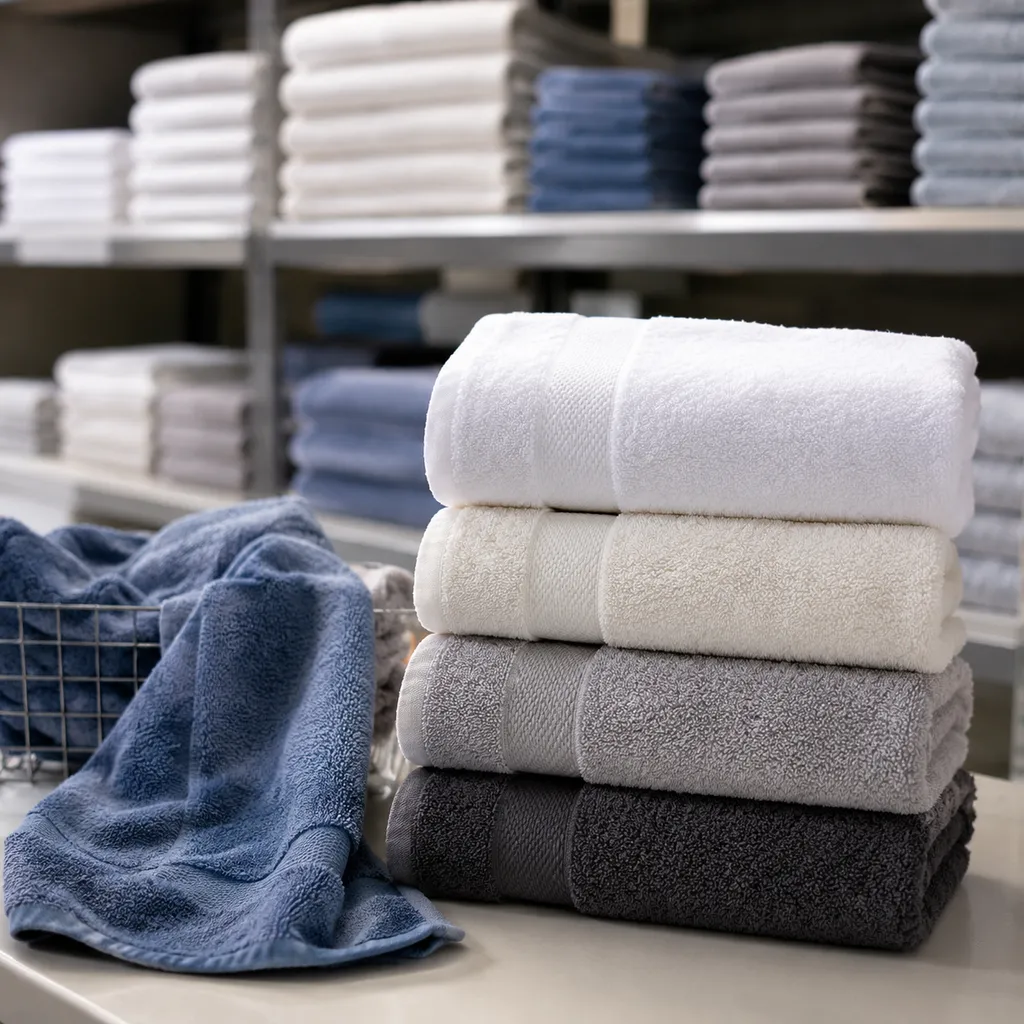
Start With Operating Role, Not Total Pieces
The first sourcing decision is the operating role of each towel line. A hotel bath towel, a gym sweat towel, a spa hand towel, and a retail logo towel may share a color direction, but they do not share the same construction logic. Each line needs its own finished size, fabric mass target, border treatment, sewing method, decoration requirement, packout, and inspection risk map.
A request for wholesale towels should be organized as a SKU schedule, not as a paragraph. The schedule lets suppliers quote the same commercial object and gives the buyer a record to compare against samples, purchase orders, inspection reports, and shipment documents. Without that record, a low offer can hide a smaller towel area, plain bulk packing, simplified border, missing decoration work, or a delivery term that excludes a cost the buyer assumed was included.
| Buying scenario | Main sourcing risk | Control before quote comparison |
|---|---|---|
| Hotel bath, hand, and washcloth replenishment | Different sizes are treated as one quality instead of separate SKUs. | List each size and use case with its own construction, finished dimensions, packaging, and inspection points. |
| Retail logo launch | Artwork approval is separated from the towel construction and unit presentation. | Approve decoration on the production towel plus label, fold, barcode, and carton layout. |
| Club or gym replenishment | A reorder looks similar but changes shade, border width, loop height, or pack count. | Compare against the retained sample, SKU revision, color reference, and carton instruction. |
| Promotional order | Price is compared before logo method, color split, and delivery term are fixed. | Freeze artwork, quantity by design and color, packing, destination, and delivery basis before ranking offers. |
PO Control Map for towels in bulk wholesale
For towels in bulk wholesale, the buyer's job is to convert commercial interest into a controlled purchasing packet. Assign a SKU code to every size, color, decoration variant, and packaging variant that changes cost or acceptance. A white 70 cm x 140 cm bath towel and a navy 50 cm x 90 cm hand towel are not interchangeable lines, even if both are cotton terry. A plain towel and an embroidered version of the same base towel also need separate approval because embroidery can affect pile compression, backing visibility, and inspection criteria.
A good quote sheet names the target construction and the buyer-controlled assumptions beside each SKU. If the buyer wants a coordinated family, state the coordination requirement, then still define the construction for every SKU. Instructions such as match hotel quality or same as bath towel do not define border proportion, finished weight, label placement, or carton count.
- Separate quantity by SKU, design, and color; a combined total is not enough for MOQ, dyeing, decoration, or packout planning.
- State finished dimensions, measurement points, target GSM, fiber composition, terry face expectation, border width, hem type, and label position.
- Attach artwork revision, logo scale, placement from a defined edge, color references, and decoration method.
- Define unit fold, polybag policy, inner count, master-carton count, carton marks, barcode data, destination, and delivery term.
- Identify which sample, file, and specification revision will govern production if later comments conflict.
For buyers building the worksheet from scratch, the towel tech pack format is a practical base. A reference photo can support the discussion, but it cannot specify pile density, shrinkage behavior, border geometry, or how a logo location will be measured.
Turn GSM and Size Into Checkable Math
GSM is a mass-per-area target, not a complete towel specification. Two towels with similar GSM can differ in yarn approach, pile height, ground structure, border density, and finishing. The towel GSM decision framework is useful for setting a starting point, but the signed sample and construction sheet should decide what the buyer is actually approving.
Use area math as a planning check only. As a specification example, a 70 cm x 140 cm towel at 500 GSM has an area of 0.98 m2 and an approximate fabric mass of 490 g before tolerance, trims, labels, embroidery, moisture condition, or construction variation. A 50 cm x 90 cm towel at 450 GSM has an area of 0.45 m2 and an approximate fabric mass of 202.5 g. These are not quoted product weights. The final sample, signed specification, and formal quote control.
| Field | What to specify | Why it matters |
|---|---|---|
| Finished size | Length, width, measurement condition, point of measurement, and tolerance. | Area drives fabric consumption, folded size, carton volume, and weight checks. |
| Fabric mass | Target GSM, conditioning requirement, test method if required, and acceptable tolerance. | GSM without method and tolerance can create disputes at sample or inspection stage. |
| Terry face | Loop character, face side, pile appearance standard, and treatment of pulled loops. | Uneven pile, long pulls, loose loops, or sparse areas are common visible defects in bulk towel lots. |
| Border and hem | Dobby or jacquard area, border width, hem size, sewing thread, and corner finish. | Borders can wave, skew, or shrink differently from the terry field. |
| Decoration | Embroidery, print, jacquard, or other method with artwork version and placement rule. | Decoration changes process route, sample gate, defect definitions, and cost. |
For cotton-based lines, composition alone is incomplete. Buyers comparing combed, zero-twist, or other cotton yarn choices should connect the yarn decision to an approved physical sample. The cotton yarn approval guide explains why the discussion should be tied to handle, loop appearance, and laundering expectations rather than a fiber label only.
Find the Assumption Behind a Low Offer
A low unit price can be legitimate, but only after the scope is clear. One offer may assume a smaller finished towel. Another may reduce GSM, remove a dobby border, pack loose cartons instead of retail units, exclude testing, or quote a delivery term that leaves freight and destination costs outside the unit price. Procurement should identify which assumption changed and whether that change is acceptable for the program.
Low cost is not automatically a defect. A simple towel with plain packing can be correct for some applications. Problems start when a buyer compares that quote with a decorated, labeled, inspected, distribution-ready towel as if both offers covered the same scope.
| Changed assumption | How it affects the offer | PO control |
|---|---|---|
| Finished size reduced | Less towel area lowers fabric consumption and may reduce carton cube. | State finished size, measurement condition, and tolerance for each SKU. |
| GSM or yarn route changed | Handle, absorbency, drying behavior, and apparent pile density may shift. | Approve the construction sample and record GSM target with method and tolerance if required. |
| Border simplified | A decorative border, jacquard area, or wider hem can add weaving and sewing complexity. | Define border type, width, shrinkage expectation, and acceptable skew or waviness. |
| Packout simplified | Loose bulk packing can quote lower than labeled, folded, barcoded, or inner-packed units. | Approve fold, label position, inner count, master-carton count, marks, and barcode data. |
| Logo route excluded | Embroidery, print, or jacquard work may be costed separately or not costed at all. | Attach artwork version, decoration method, placement rule, and approval sample reference. |
Approve Samples by Gate
A sample gate should answer a release question. A lab dip or color submission answers color direction. A construction sample answers size, pile, border, hand, and sewing. A decorated sample answers logo method, placement, puckering, color, reverse-side appearance, and backing. A packaging sample answers fold, label visibility, barcode position, inner-pack logic, and carton handling.
Smaller towel formats magnify layout choices. A border that looks proportional on a bath towel may dominate a hand towel. A logo placed by visual estimate may sit too close to a hem after folding. A care label that works on a large towel can look crowded on a washcloth. Each SKU needs its own sample approval or a written reason why one approval covers a limited shared feature such as color only. For logo programs, the custom logo towel decoration guide helps separate embroidery, print, and woven-logo decisions before sample approval.
- Approve the SKU specification, color reference, artwork file, and packaging instruction before asking for the production-representative sample.
- Review the sample against measurable fields: dimensions, GSM method, border size, sewing, decoration placement, and unit presentation.
- Record comments with revision numbers so later artwork or packing changes do not overwrite the approved construction.
- Freeze the inspection plan before bulk release, including lot definition, defect classes, sample plan, and concession authority.
If a property must be tested, name the method and conditions. ISO 105-C06 is used for colorfastness to domestic and commercial laundering, and ISO 105-X12 is used for colorfastness to rubbing. The contract should state the applicable method edition, procedure, required rating, sample preparation, and whether testing applies before or after a defined wash sequence. A phrase such as wash tested is not an executable requirement.
Write Inspection Terms Before Shipment
For towels in bulk wholesale, inspection terms belong in the PO before production release. The inspector should receive the same reference set used for quoting and sampling: signed SKU schedule, approved sample reference, artwork revision, packaging instruction, test plan if required, delivery term, and defect classification. This prevents the common split where procurement approved one standard, production worked from another, and inspection receives only a product name.
For ISO 2859-1, the contract must define the lot, inspection level, sampling scheme, AQL by defect class, and switching rules before its tables determine sample size or acceptance. The standard does not decide what counts as critical, major, or minor for a towel order. That judgment must be written into the buyer's acceptance rules.
- Critical defects may include safety, regulatory, or order-blocking issues defined by the buyer's contract.
- Major defects may include wrong size outside tolerance, wrong color, incorrect logo, unacceptable shade break, missing label, severe sewing failure, or wrong carton assortment.
- Minor defects may include limited visual variation that does not affect use and falls within the agreed tolerance.
- Concessions should name the affected lot, quantity, defect, acceptance reason, and any commercial or corrective action.
Normalize Quotes Before Awarding
Supplier comparison should start after every offer has been mapped to the same SKU matrix, quantity by design and color, construction, decoration, packaging, testing responsibility, inspection stage, destination, and delivery term. Do not compare a fabric-only quote with a packed, logoed, distribution-ready SKU. Do not compare one quote that includes carton marks and barcode labels with another that treats packaging as later discussion.
Pricing and production timing vary by construction, decoration, order quantity, packaging, delivery term, and destination. Without a signed specification and formal quote, a public price band is not reliable. The safer approach is to identify cost drivers: towel area, GSM, yarn and construction choices, dyeing and color splits, decoration method, artwork complexity, unit packaging, carton configuration, testing, inspection, and freight basis.
LUMA & CO. TEXTILE is a Zhejiang-based custom OEM towel manufacturer operating since 2007. MOQ starts at 500 pcs per design / per color. That quantity rule does not combine several designs or colors into one interchangeable total, and it does not confirm that every construction, decoration method, or packaging plan is suitable. Use the MOQ negotiation guide to frame color and quantity decisions, then request a formal quote against the final SKU matrix.
Freight also deserves early attention because terry goods can be bulky relative to unit value. The container versus air freight guide can help compare logistics logic, but the actual plan depends on carton dimensions, shipment volume, delivery term, destination, and carrier arrangements.
Build the PO File That Survives Handoff
The purchase order should point to controlled attachments rather than relying on one product name and a unit price. Attach the SKU matrix, specification sheets, sample approval record, artwork files, packaging instruction, delivery term, and inspection plan. State which document controls if the sample, artwork, and written sheet appear inconsistent.
- List each SKU with quantity by color, construction, finished dimensions, GSM target, decoration, unit pack, carton pack, and delivery term.
- Name the approved sample identifier and the specification revision that governs production.
- Define required test methods, pass criteria, retest rules, and approval responsibility where testing is part of the order.
- Set inspection lot definition, sampling protocol, defect classifications, AQLs if applicable, report format, and concession authority.
- Include carton marks, barcode data, assortment rules, destination, and required shipment document references.
For blank towels for embroidery, the PO should still define decoration readiness. Confirm the usable logo zone, pile height, backing visibility, stitch-density expectation, placement tolerance, and whether a border or hanging loop restricts the embroidery area. A blank towel that has never been checked for embroidery may not behave like an embroidery-ready towel.
Certification references also need document control. LUMA & CO. TEXTILE names OEKO-TEX Standard 100 Class I, BSCI, and ISO 9001 on its public site. Buyers who need certification evidence should request current documents and verify issuing body, document number, validity, named holder, and scope for the intended requirement. The OEKO-TEX certificate guide explains how to review a certificate without assuming it covers a specific product, material, order, or facility.
The practical route for towels in bulk wholesale is to separate the SKUs, make construction measurable, approve evidence in stages, and compare offers on the same commercial basis. That gives procurement a defensible PO file and gives production and inspection a clear standard to execute.
Request a Wholesale Towel Quote
Send SKU quantities, construction targets, colors, decoration files, packaging requirements, destination, and delivery term to request a formal quote.
Request a Quote →