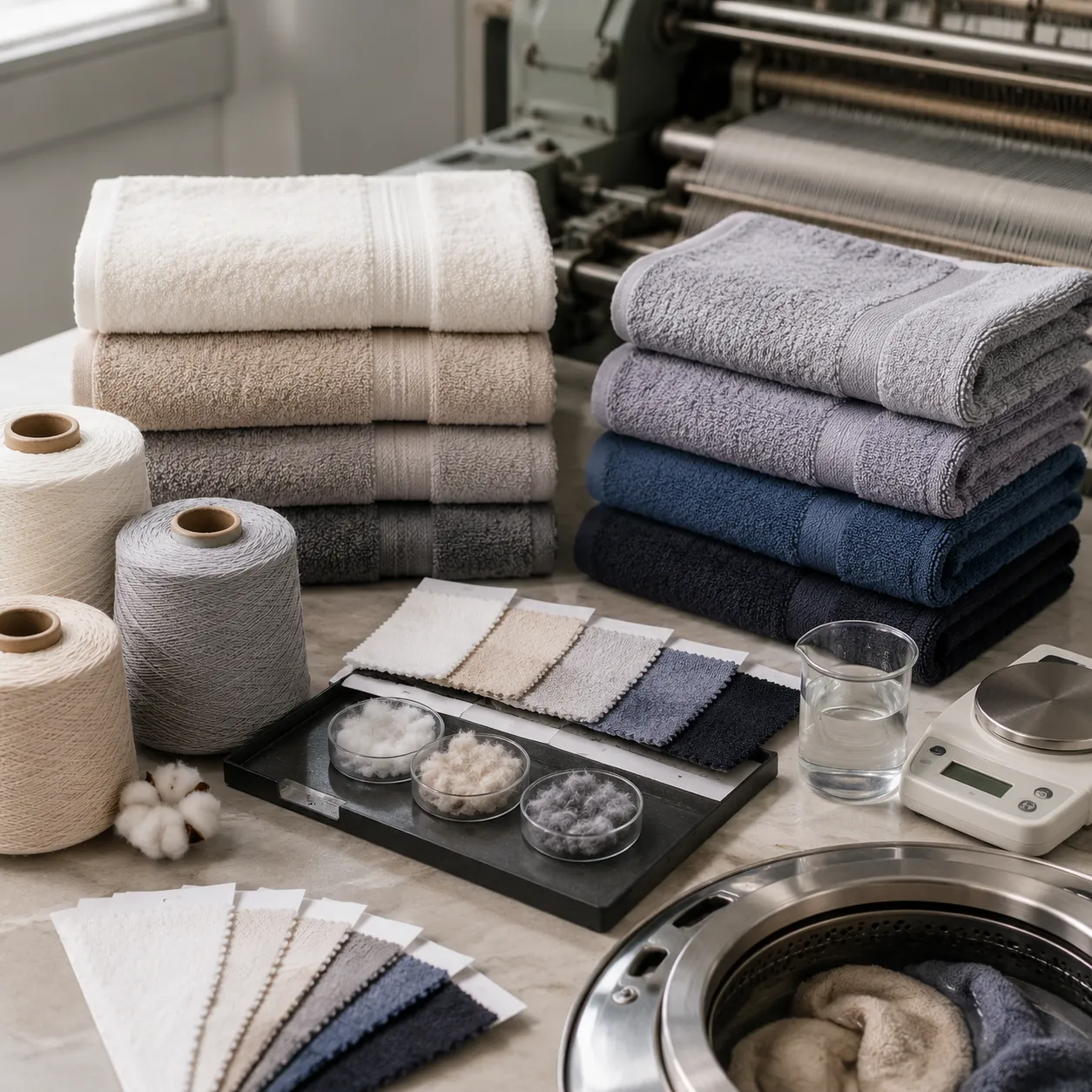
Why Yarn Choice Must Be Approved Before Bulk
Combed cotton and ring spun cotton are often discussed as if they are competing towel grades. In the mill, they are not the same category. Ring spinning is a yarn-making method that twists fibers into a stronger, smoother yarn than open-end spinning. Combing is an additional preparation step that removes shorter fibers and aligns the longer staple before spinning. A towel can be ring spun without being combed, or it can be made from combed ring spun cotton.
This distinction matters during sampling because the buyer may ask for “ring spun” expecting low lint, then reject the first wash because short fibers release in the dryer. Or they may ask for “combed cotton” but set a price target that only supports carded ring spun yarn. We prefer to settle this in the sample room, not after 12,000 pieces are woven.
For standard OEM cotton towels, our MOQ is 500 pcs per design / per color. At that quantity, yarn choice already affects cone purchase, dye lot planning, and weaving efficiency. If the sample approval is vague, the bulk batch can pass size and GSM checks but still fail the buyer’s handfeel expectation.
| Yarn route | What changes in the towel | Typical GSM range we quote | Best use case |
|---|---|---|---|
| Carded ring spun cotton | Good strength, fuller cotton feel, moderate lint in early washes | 400-600 GSM | Gym, mid-market hotel, promo bath programs |
| Combed ring spun cotton | Cleaner surface, lower lint, smoother touch after tumble dry | 450-700 GSM | Hotel bath, spa, DTC retail towels |
| Combed cotton with low twist | Softer hand, higher absorbency, slower drying if too dense | 500-750 GSM | Luxury bath sheets, spa robes, high-touch guest towels |
| Open-end cotton blend | Lower cost, rougher face, higher lint risk | 320-450 GSM | Utility towels where softness is not the approval driver |
Combed Cotton vs Ring Spun Towels Sample Approval Process
Our combed cotton vs ring spun towels sample approval process starts with a written decision on what the buyer is actually comparing. If the buyer wants carded ring spun against combed ring spun, we keep the weave construction, pile height, border, dye shade, and finishing recipe as close as possible. If too many variables move at once, the final decision becomes a handfeel argument rather than a controlled sample review.
For a controlled comparison, we normally prepare two lab dips or small production samples using the same size, such as 50 × 90 cm hand towels or 70 × 135 cm bath towels, and the same target GSM. We allow a normal GSM tolerance of ±5% before wash and check post-wash shrinkage separately. For higher-end hospitality programs, we tighten visual sorting because pile streaks and border waviness are easier to notice on combed yarn.
- Confirm the reference towel or target spec: size, GSM, yarn route, color, logo method, and packing style.
- Make yarn availability check before sample weaving, especially for combed cotton above 600 GSM or special dyed shades.
- Produce strike-off or pre-production sample with recorded loom setting, pile ratio, border construction, and finishing temperature.
- Wash test the sample using the buyer’s laundry condition or our default 40 °C ISO 6330 domestic cycle.
- Measure GSM, dimensional change, lint release, colorfastness, and visual defects after drying.
- Approve a sealed sample with signed tolerance limits, not only a photo or courier note.
For towel sample testing, we mark the approved sample with date, batch number, yarn route, size, GSM, Pantone or lab dip reference, and decoration file version. We keep one sealed set in our sample cabinet and send one to the buyer. This avoids a common dispute: the buyer approves a soft showroom sample, then the bulk QC team compares against a different internal swatch.
The Tests We Run Before Asking for Sign-Off
We do not ask a buyer to approve combed cotton towels or ring spun cotton towels only by touching them once. Cotton pile changes after scouring, dyeing, softener application, tumble drying, and the first few laundry cycles. A sample that feels excellent before washing may shed heavily after drying if the short fiber content is high or the pile twist is too loose.
For cotton towel comparisons, we usually run a practical approval test package. It is not as heavy as a full retail compliance program, but it catches the problems that most often appear in bulk: shrinkage, lint shedding, edge distortion, shade drift, and poor absorbency after finishing.
| Approval item | Common method or reference | Factory target for approval | Why it matters |
|---|---|---|---|
| Dimensional change | ISO 6330 wash procedure with line or tumble dry recorded | Bath towel: within -6% length and -5% width after 3 cycles | Controls guest-facing fit and carton count after laundering |
| Colorfastness to washing | ISO 105-C06 | Grade 4 or above for most dyed cotton towels | Prevents shade loss and staining in hotel laundry |
| Colorfastness to rubbing | ISO 105-X12 dry and wet crocking | Dry 4, wet 3-4 minimum for medium shades | Important for dark navy, charcoal, terracotta, and spa colors |
| Absorbency | AATCC 79 drop test or internal sink time check | Water drop absorbed within 5 seconds after prewash | Detects excess softener or waxy finishing residue |
| Lint observation | Dryer filter weight check after controlled wash | Buyer-specific limit, typically 0.25-0.45 g per towel for hand sizes | Compares short fiber release between yarn routes |
One topic-specific defect we watch closely is pile direction shadowing. Combed yarn has a cleaner surface, so light reflects more evenly. If the loom tension is not stable, the towel can show bands that look like shade variation even when the dye lot is correct. Another defect is border grin-through, where the ground yarn shows at the decorative border because the pile density is too low beside the dobby section. These are construction issues, not cotton marketing issues.
- For white hotel towels, we check whiteness consistency after peroxide bleaching and optical brightener level, because combed yarn can make yellow cast easier to see.
- For dark gym or spa towels, we check wet crocking more strictly because sweat, oil, and disinfectant residues increase transfer risk.
- For embroidered samples, we wash after stitching to see whether pile pull-through exposes the ground fabric around dense satin stitches.
- For jacquard towels, we compare face and reverse clarity because combed yarn can sharpen the motif but also reveal uneven tension.
Handfeel Is Not Enough: Measure Pile Behavior
Buyers often rub two samples across the palm and choose the softer one. We understand that reaction, but handfeel alone can mislead. A 560 GSM carded ring spun towel with slightly higher pile may feel bulkier than a 540 GSM combed towel in the first meeting. After five hotel laundry cycles, the combed towel may look cleaner and release less lint, while the fuller carded version may still be acceptable for a gym that replaces stock every 8-10 months.
In our sample room, we look at pile height, yarn twist, loop density, and finishing. A low-twist combed towel can feel soft but snag more easily if used on pool loungers, locker hooks, or treatment carts. A tighter ring spun towel may feel less plush but survive heavier wash chemistry. This is why the approval file should record the use case before the buyer signs the final sample.
| Buyer situation | Better sample direction | What to approve in writing | Risk if ignored |
|---|---|---|---|
| Five-star hotel bath towel | Combed ring spun, 600-680 GSM | Shrinkage, whiteness, low lint, border flatness | Guest complaints after first laundry month |
| Fitness studio sweat towel | Carded or combed ring spun, 380-480 GSM | Fast drying, edge strength, colorfastness to sweat | High loss rate and mildew odor in carts |
| Spa facial or treatment towel | Combed cotton, 420-550 GSM | Softness after wash, no harsh edge seam, clean white shade | Skin-contact complaints and visible staining |
| Retail DTC bath towel | Combed ring spun, 550-700 GSM | Handfeel, packaging compression recovery, lint after wash | Returns from first-use lint and shade mismatch |
For more on choosing weight before yarn route, see our towel GSM decision framework. If size is still open, the complete towel dimensions guide helps buyers prevent carton and shelf-fit mistakes before samples are made.
Cost Difference and Cost-Per-Use Reality
Combed cotton costs more because the combing process removes short fibers. The yarn yield is lower, but the remaining fiber alignment is better. In normal 2026 quoting, a 500 GSM 70 × 140 cm carded ring spun bath towel for a 3,000-piece order may land around USD 3.65-4.25 per piece FOB Ningbo, depending on color, border, and packing. A comparable combed ring spun version often falls around USD 4.35-5.10.
That gap is real, but it should be judged against use cycles. For a boutique hotel replacing towels after roughly 85 commercial washes, a USD 4.70 combed towel costs about 5.5 cents per use before freight and laundry. If a cheaper USD 3.95 ring spun towel is retired after 58 washes because of linting, edge curl, or guest complaints, the textile cost becomes 6.8 cents per use. The cheaper invoice can become the higher operating cost.
| Order volume | Carded ring spun cotton towel | Combed ring spun cotton towel | Typical sample lead time |
|---|---|---|---|
| 500-999 pcs per color | USD 4.85-5.70 | USD 5.55-6.45 | 10-14 days after spec confirmation |
| 1,000-2,999 pcs per color | USD 4.20-4.95 | USD 4.95-5.85 | 9-13 days if yarn is in stock |
| 3,000-7,999 pcs per color | USD 3.65-4.25 | USD 4.35-5.10 | 8-12 days for standard colors |
| 8,000+ pcs per color | USD 3.35-3.95 | USD 4.05-4.75 | 7-11 days, subject to dye schedule |
These are realistic FOB bands, not fixed offers. A navy towel with reactive dye, embroidery, belly band, and individual polybag will not price the same as a white dobby bath towel in bale packing. Certification paperwork also matters: OEKO-TEX Standard 100 Class I components, BSCI audit status, and ISO 9001 process records add control, but they do not remove the need for physical sample approval.
Approval Tolerances We Put on the Sample Sheet
The strongest sample approval files are boring. They do not rely on adjectives like soft, luxury, or hotel grade. They define tolerances. If the signed sheet says 500 GSM, we need to know whether the buyer accepts 475 GSM after finishing or only 490 GSM minimum. If the towel is 70 × 140 cm, we need a post-wash tolerance, not just the cut size.
- GSM tolerance: normally ±5% for cotton terry, tighter only when the buyer accepts higher sorting cost.
- Size tolerance before wash: usually ±2 cm for bath towels and ±1 cm for hand or face towels.
- Shrinkage target: often within -6% length and -5% width after three ISO 6330 wash cycles.
- Shade tolerance: visual match to approved lab dip under D65 light, with spectrophotometer reading used when requested.
- Lint limit: agreed by towel size and dryer method, because a bath sheet naturally releases more fiber mass than a washcloth.
For the combed cotton vs ring spun towels sample approval process, we also add a yarn note to the sealed file. The note states whether the approved piece is carded ring spun, combed ring spun, or another cotton route. Without that line, purchasing teams may later compare a bulk towel against a reference that the factory cannot reproduce at the quoted cost.
Decoration must be locked at the same time. Embroidery density, thread color, backing, and placement can change the way a towel drapes after washing. For decoration trade-offs, our embroidery vs sublimation vs jacquard guide explains why the right logo method depends on pile height and end use. For color approval, use the process in our Pantone color matching guide.
Sampling Timeline From Tech Pack to Bulk
A normal sample approval path takes 18-30 days before bulk production starts. The fastest approvals happen when the buyer sends a complete tech pack with size, GSM, yarn route, Pantone, logo artwork, packaging, and test expectations. If the buyer sends only a photo and asks us to “match quality,” we can still begin, but the first sample becomes a discovery step rather than an approval sample.
- Day 1-2: review the tech pack, confirm MOQ, quote range, and possible yarn route.
- Day 3-5: prepare lab dip or confirm stock yarn and greige availability.
- Day 6-12: weave and finish the first sample or strike-off.
- Day 13-16: run wash, shrinkage, absorbency, and visual inspection checks.
- Day 17-22: courier samples to buyer and collect comments.
- Day 23-30: revise if needed, seal the approved sample, and open bulk material planning.
Bulk timing after approval is usually 25-40 days for cotton terry towels, depending on order size, dyeing capacity, decoration, and packing. A 500-piece sample-to-bulk order can sometimes move faster, but a 20,000-piece hotel program with multiple sizes and colors needs more planning. If the towel is part of a full linen launch, our 90-day hotel linen roadmap gives a safer calendar.
For buyers still building the first specification, we recommend using our tech pack guide for towel mills. It reduces back-and-forth because it separates fixed requirements from preferences that can be adjusted for cost.
Common Reasons Samples Fail Approval
Most failed samples are not caused by bad weaving. They fail because the approval target was not clear enough. For example, one buyer may describe ring spun cotton as “soft but durable,” while another expects a smoother retail touch that actually requires combed yarn and a different finishing recipe. If both buyers use the same phrase, the mill still needs two different samples.
- The buyer approves an unwashed sample, then rejects bulk after laundering because pile compacts or lint appears.
- The sample uses combed yarn, but the purchase order only says ring spun cotton, creating a cost and quality mismatch.
- The towel passes GSM but feels thin because the pile-to-ground ratio is wrong for the size.
- The logo sample is approved separately from the towel sample, so embroidery puckering appears only in bulk.
- The carton packout compresses high-pile towels too tightly, causing slow recovery on retail shelves.
One practical factory check is the black cloth rub test for white and light towels after tumble drying. We rub the dry towel against a clean dark cotton cloth to observe loose fiber transfer. It is not a replacement for a formal lint method, but it gives merchandisers and buyers a fast visual signal. For darker shades, we reverse the check with a white cloth and combine it with ISO 105-X12 crocking.
If a buyer wants to reduce cost, we first adjust size, GSM, border complexity, or packing before downgrading the yarn. For example, moving a bath towel from 620 GSM to 580 GSM may save more cleanly than switching from combed to carded yarn while keeping a luxury handfeel promise. That is a better conversation to have at sample stage than after deposit.
What We Need From Buyers Before Sampling
To make the sample approval useful, we ask buyers to send a reference towel whenever possible. A photo cannot show yarn twist, pile recovery, or post-wash lint. If the reference is from a hotel room, retail shelf, gym cart, or spa treatment bed, tell us that too. The use environment changes the right construction.
- Target towel type and size, such as 30 × 50 cm face towel, 50 × 90 cm hand towel, or 70 × 140 cm bath towel.
- Target GSM range, or permission for us to recommend one based on use case.
- Yarn preference: carded ring spun, combed ring spun, zero twist, bamboo blend, or open to factory recommendation.
- Laundry condition: domestic wash, hotel tunnel wash, chlorine exposure, tumble dry temperature, and expected wash count.
- Logo method, artwork file, placement, thread colors, and whether the decoration must pass wash approval.
- Packing requirement: bale pack, carton pack, belly band, barcode, individual bag, or retail box.
Our factory is OEKO-TEX Standard 100 Class I certified for applicable towel programs, BSCI audited, and ISO 9001 certified. These systems help control inputs and process records, but they do not replace buyer approval of the physical towel. The signed sample remains the production reference for weaving, dyeing, finishing, decoration, packing, and final inspection.
For hospitality buyers comparing cotton routes across a full program, the hotel towel sourcing guide is a useful companion. For buyers deciding whether microfiber belongs in the same program, read microfiber vs cotton towel comparison before mixing materials in one approval cycle.
Our Practical Recommendation
Use combed ring spun cotton when the towel must look clean after repeated laundering, when lint complaints are expensive, or when the customer touches the towel directly against the face or body. Use carded ring spun cotton when budget is tighter, the program turns over faster, or the towel is mainly functional and washed in controlled batches. Do not approve either option from the invoice wording alone.
For the combed cotton vs ring spun towels sample approval process, the buyer should approve three things together: the physical towel, the tested tolerances, and the commercial route that can be repeated in bulk. If one of those is missing, the sample is only a nice swatch, not a production standard.
At LUMA & CO. TEXTILE, we produce OEM towel programs from 500 pcs per design / per color, with annual output around 2.4 million towels and export experience across 47 countries. For a controlled sample comparison, send the target spec, reference photos, and wash requirements to [email protected] or WhatsApp +86 13205717266. We will tell you if the cheaper yarn route can meet the approval standard, or if it will create a complaint after the first laundry cycle.
Build a Yarn-Controlled Sample Set
Send your towel size, GSM target, reference photos, and laundry condition. We will quote carded ring spun and combed ring spun options with testable approval limits.
Request Sample Quote →