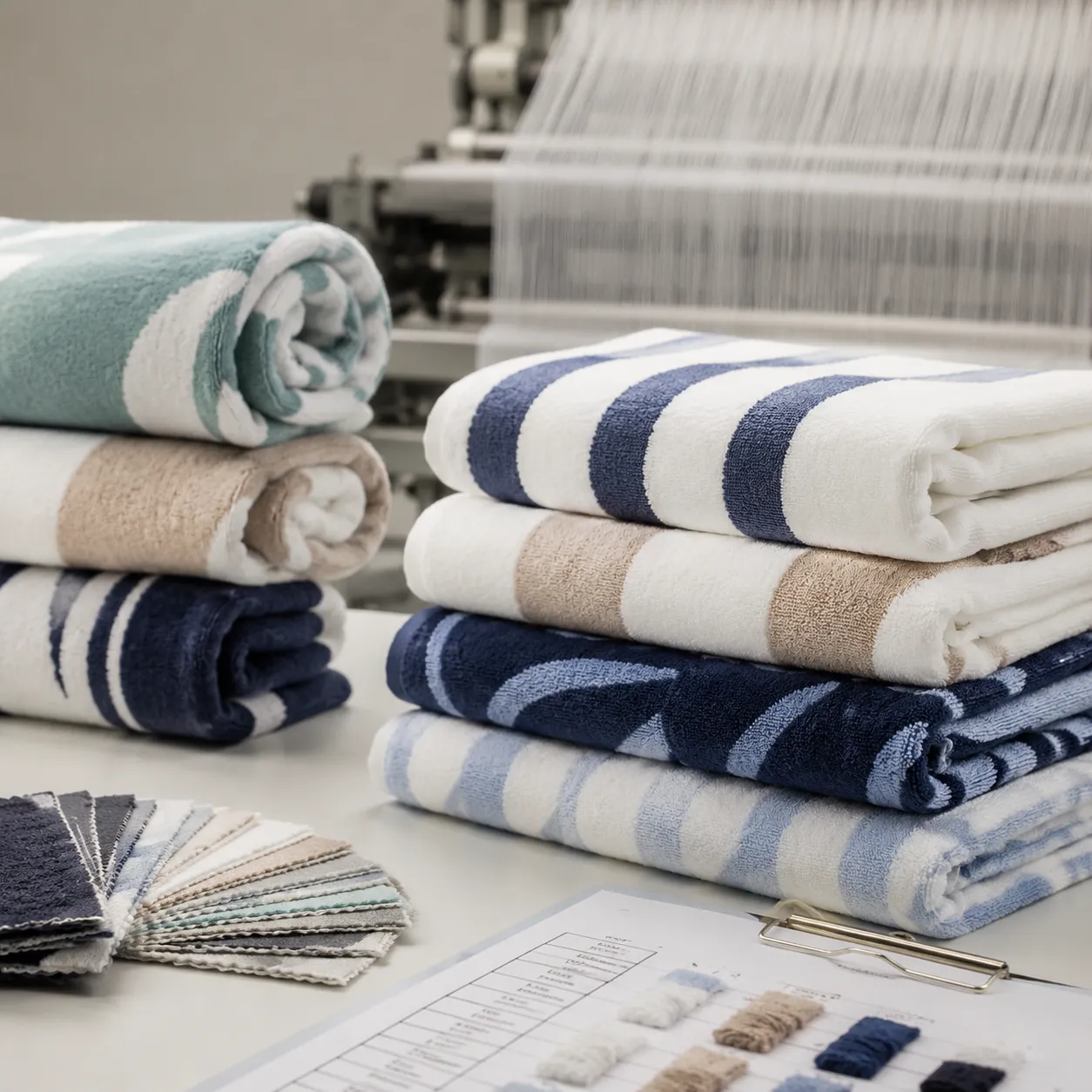
Why Beach Towels Fail Differently Than Bath Towels
Beach towels live a harder life than most bath towels. They see sunscreen oil, salt, pool chlorine, sand abrasion, high UV exposure, and commercial drying temperatures. A hotel bath towel usually fails through pile thinning or hand-feel loss. A beach towel often fails first at the border, print surface, label seam, or color contrast between yarn-dyed and printed areas.
In our mill, we separate beach towel durability checks from ordinary bath towel checks because the risk profile is different. A 500 GSM terry beach towel may feel stable in the sample room, but if the border is too tight or the hem sewing density is low, it can twist after 12-15 wash and tumble cycles. A flat-woven hammam towel at 330 GSM may dry fast, but if the fringe knot is loose, it will not survive rental-laundry handling.
For procurement teams, the standard should answer four practical questions: how many laundry cycles the towel must pass, which defects are acceptable, which test methods are used, and how the approved sample is protected from silent changes during bulk production.
| Beach towel type | Typical GSM | Main durability risk | Best use case |
|---|---|---|---|
| Terry beach towel | 420-600 GSM | Loop snagging, border wave, color loss | Resorts, beach clubs, cruise decks |
| Velour printed towel | 380-520 GSM | Print fading, sheared face pilling | Retail, promotional beach programs |
| Jacquard beach towel | 450-650 GSM | Pattern distortion, yarn float snag | Luxury resorts, brand merchandise |
| Hammam / flat weave | 260-380 GSM | Fringe unraveling, dimensional skew | Spa beach kits, travel retail |
| Microfiber beach towel | 220-320 GSM | Heat glazing, edge curl, sublimation migration | Quick-dry travel, surf, fitness beach kits |
Custom Beach Towel Wash Durability Standard We Use
Our baseline custom beach towel wash durability standard is built around controlled laundry cycles, dimensional measurement, colorfastness checks, seam inspection, and appearance grading. It is not a single pass-or-fail wash. A towel can keep its color but still fail because the hem opens, the shape skews, or the logo edge becomes unreadable.
For most resort and retail programs, we recommend a 20-cycle internal wash trial before bulk approval. For rental pools, cruise lines, or beach clubs using industrial laundries, we push the test to 30 cycles. For low-cost event towels used once or twice, a lighter 5-cycle check may be enough, but we still test shrinkage and rubbing fastness because poor dye migration can stain bags, loungers, or guest clothing.
| Test item | Reference method or mill control | Common passing limit |
|---|---|---|
| Dimensional change | ISO 6330 wash procedure with flat measurement after conditioning | Within -5% length and -4% width for terry; within -6% for flat weave |
| Colorfastness to washing | ISO 105-C06, compared against grey scale | Grade 4 minimum for solid dyed cotton; grade 3-4 for reactive printed zones |
| Colorfastness to rubbing | ISO 105-X12 dry and wet crocking | Dry grade 4, wet grade 3-4 depending on dark shade |
| Pile or face appearance | Internal 20-cycle photo board comparison | No obvious bald patches, matting bands, or severe surface fuzz |
| Seam and hem strength | Manual seam pull plus post-wash inspection | No open seam over 8 mm; no loose chain thread longer than 15 mm |
| Pilling tendency | ISO 12945-2 adapted for towel face where needed | Grade 3-4 minimum for velour and microfiber face fabrics |
We keep the approved sample, pre-wash measurement sheet, post-wash photos, and bulk shade card in the order file. For repeat orders, those records are often more useful than a buyer’s comment such as “same as last year,” because yarn batch, dye lot, and finishing tension can all change if not locked.
The Five Defects Buyers Should Name in the PO
A purchase order that says “wash durable” is too loose for factory QC. It gives the mill no measurable target and gives the buyer no clean basis for rejection. We prefer to name the actual defect modes, especially when the towel has a logo, yarn-dyed border, fringe, or printed artwork.
- Border wave: the woven dobby or jacquard border shrinks differently from the pile body, causing a rippled edge after drying.
- Torque or skew: the towel no longer folds square because yarn twist, weaving tension, or finishing tension was not balanced.
- Wet crocking: dark reactive dye or pigment print transfers when rubbed wet, a common issue on navy, black, burgundy, and saturated green beach towels.
- Hem burst: the lockstitch or chain stitch opens after tumble drying, usually from low stitch density, weak sewing thread, or poor corner back-tack.
- Logo readability loss: embroidery sinks into high pile, sublimation blurs on brushed microfiber, or velour print fades unevenly after repeated washing.
These defects are topic-specific because beach towels often combine a large surface area with high color contrast. A 90×170 cm towel with a deep navy ground and white logo has more visible risk than a plain white bath towel. If the towel is used on pool chairs, even a small edge curl becomes obvious when staff stack 300 pieces in the morning.
Wash Cycles: 5, 20, or 30 Is a Sourcing Decision
The correct wash count depends on how the towel earns money. A retail beach towel sold as a summer accessory does not need the same laundering life as a resort towel that rotates through a commercial laundry twice per week. Over-testing a giveaway towel wastes budget. Under-testing a club towel creates replacement cost and operational complaints.
| Program type | Recommended wash test | Target service life | Notes for buyers |
|---|---|---|---|
| One-season event or promo towel | 5 cycles | 3-8 guest uses | Focus on color transfer, linting, and print adhesion |
| DTC retail beach towel | 10-15 cycles | One consumer season or more | Check shade stability and edge shape after home laundering |
| Resort pool or beach towel | 20 cycles | 60-90 controlled uses | Include tumble drying because deck towels are rarely line dried |
| Beach club rental towel | 30 cycles | 90-130 laundry turns | Add seam inspection and corner abrasion review |
| Cruise or waterpark towel | 30 cycles plus spot chlorine check | 80-120 laundry turns | Specify barcode or woven label durability if used for tracking |
We do not promise a towel will look new after 100 washes. That is not how cotton pile behaves. What we can define is a realistic acceptable condition after a set number of cycles: still square enough to fold, still absorbent, still safe in color transfer, and still carrying the brand mark clearly.
Related reads: for choosing the base product before testing, see beach towels in bulk buyer guide, beach club resort towel program, and towel GSM decision framework.
GSM, Yarn, and Construction Choices That Affect Durability
GSM is not a durability guarantee by itself. A poorly balanced 620 GSM towel can twist more than a correctly woven 480 GSM towel. Still, GSM controls yarn mass, drying load, carton weight, and perceived value, so it belongs in the wash standard.
For cotton beach towels, our practical range is 380-650 GSM. Below 380 GSM, terry towels can feel thin after finishing and may lose too much body after repeated drying. Above 650 GSM, drying cost rises and the towel can become slow to turn in resort laundry. For hammam towels, 280-360 GSM is normal because the construction is flat weave, not loop pile.
- 420-480 GSM terry: good for promotional resort sales, outdoor event towels, and budget beach kits where freight weight matters.
- 500-560 GSM terry or velour: balanced range for resort programs needing better hand feel without excessive drying time.
- 580-650 GSM jacquard or luxury terry: suitable for higher-end beach clubs, but border tension and tumble-dry shrinkage must be tested carefully.
- 260-380 GSM hammam: fast drying and compact, but fringe security and skew control are more important than pile retention.
- 220-320 GSM microfiber: quick dry and printable, but heat setting and edge binding determine whether it curls or glazes.
Yarn choice also changes wash behavior. Combed cotton reduces short-fiber lint compared with carded cotton, which matters when towels are washed with guest robes or light-colored linen. Ring-spun yarn gives stronger loop integrity than open-end yarn at the same GSM. Zero-twist feels soft in bath towels, but for beach use we are cautious because sand abrasion and high tumble heat can flatten the pile faster.
Decoration Has Its Own Wash Risk
Beach towel decoration is where many durability claims break. A blank towel may pass 20 washes, while the same towel with a large embroidery or pigment print fails visually. We review decoration after washing, not only after production.
| Decoration method | Wash durability concern | Factory control point | Typical added cost at 1,000 pcs |
|---|---|---|---|
| Embroidery | Thread abrasion, puckering, pile sink | Backing choice, stitch density, logo size under 120×80 mm for heavy fills | USD 0.28-0.85 per towel |
| Reactive print on cotton | Shade loss, print edge bleeding | Steaming and washing-off control, ISO 105-C06 check | USD 0.45-1.10 per towel |
| Pigment print | Hand-feel stiffness, cracking | Binder ratio and curing temperature | USD 0.30-0.75 per towel |
| Jacquard woven logo | Float snagging, border distortion | Yarn tension map and weave repeat review | USD 0.60-1.40 per towel |
| Sublimation on microfiber | Dye migration, edge blur | Heat press temperature, fabric pre-shrink, artwork resolution | USD 0.35-0.95 per towel |
For embroidered beach towels, we check the back side after drying because trapped sand and laundry friction can lift loose backing. For jacquard towels, we look at long floats around curved logo shapes; floats longer than about 7-9 mm are easier to snag in commercial wash loads. For printed velour, the sheared face must be even before printing, or the artwork will appear patchy after the first few cycles.
Related reads: decoration decisions are covered in embroidery vs sublimation vs jacquard, while artwork tolerances are easier to control when buyers follow pantone color matching custom towels and build towel tech pack that mills can quote.
How We Run a Beach Towel Wash Trial
A useful beach towel wash test is boring and repeatable. We do not wash one sample casually and call it approved. For each construction, color, and decoration route, we mark pre-wash measurements, photograph the towel under the same light, and keep a control sample unwashed.
- Cut or select three production-representative samples, not hand-improved showroom pieces.
- Condition samples for at least 4 hours in the QC room before measuring length, width, weight, and visible border alignment.
- Wash using ISO 6330-based settings or the buyer’s laundry formula if supplied, including detergent dosage and water temperature.
- Tumble dry at the agreed heat setting, because air drying hides many edge-curl and shrinkage problems.
- Record dimensions after 1, 5, 10, 20, and sometimes 30 cycles, then grade color, seams, decoration, lint, and handle.
- Compare against the sealed approval sample and decide whether bulk can proceed, needs adjustment, or requires a new construction sample.
The most common adjustment after a failed trial is not changing everything. We may reduce finishing tension, adjust border yarn count, increase stitch density from 9 stitches per inch to 11-12, change sewing thread, or revise print curing. If the problem is wet crocking on a dark reactive shade, we may add washing-off time and recheck ISO 105-X12 rather than switching the whole towel program.
Bulk Pricing and MOQ for Wash-Durable Beach Towels
Wash durability is not free because stronger yarn, tighter sewing, controlled dyeing, and extra sample testing add cost. Our MOQ is 500 pcs per design per color. That MOQ is workable for many club and resort programs, but complex jacquard or multi-color printed towels price better when the order reaches 1,500-3,000 pcs because loom setup, screens, strike-off work, and lab testing spread across more units.
| Order volume | Common spec | FOB China target price | Typical lead time after approval |
|---|---|---|---|
| 500-799 pcs | 420-480 GSM terry, simple embroidery or woven label | USD 4.10-6.40 per pc | 24-32 days |
| 800-1,499 pcs | 500-560 GSM terry or velour, reactive print or medium logo | USD 3.65-5.85 per pc | 28-36 days |
| 1,500-2,999 pcs | 520-600 GSM jacquard or printed resort towel | USD 3.25-5.30 per pc | 32-42 days |
| 3,000-5,999 pcs | Custom yarn-dyed border, private label packout | USD 2.95-4.85 per pc | 38-48 days |
| 6,000+ pcs | Program order across 2-4 colorways | USD 2.70-4.45 per pc | 45-60 days |
A low initial quote can become expensive if it produces early replacements. For example, a 500 GSM resort towel at USD 3.05 that loses shape after 28 laundry turns costs about USD 0.109 per turn before freight. A better-balanced 540 GSM towel at USD 4.15 that remains acceptable for 84 turns costs about USD 0.049 per turn. Even if the second towel adds USD 1.10 upfront, the cost per usable laundry turn is less than half.
For buyers comparing offers, ask whether the quoted price includes a wash trial, shade approval, and post-wash measurement report. If a supplier quotes only from size and GSM, they may not have priced the control work needed for a reliable custom beach towel wash durability standard.
Certification and Audit Records That Support the Standard
Certification does not replace wash testing, but it supports the sourcing file. We hold OEKO-TEX Standard 100 Class I, BSCI audit records, and ISO 9001 quality management certification. For beach towels, OEKO-TEX is especially useful when the towel touches skin after sunscreen, sweat, and seawater exposure, but it does not tell you whether a hem will survive 30 tumble cycles.
ISO 9001 matters because it requires controlled procedures, traceability, corrective action, and inspection records. In practice, that means we can connect a failed wash test to yarn lot, dye lot, loom record, sewing line, and finishing batch. BSCI is relevant for social compliance, especially for hotel groups and retail brands that require supplier audit documentation before issuing a PO.
- Ask for the current OEKO-TEX certificate number and product scope, then check whether it covers the fiber and dye class used.
- Keep the sealed sample and bulk carton sample from the same production lot, not from an earlier showroom batch.
- Require AQL inspection terms for visual defects; many buyers use AQL 2.5 for major defects and 4.0 for minor defects.
- Define whether lab testing is mill-internal, third-party, or both for large retail programs.
- Include care-label wording in the approval file, because guest or consumer misuse can create false durability complaints.
For certificate review, buyers can use how to read OEKO-TEX certificate. If the order is part of a wider resort launch, setting up hotel linen program 90 day roadmap is also useful for calendar planning.
What to Put in the RFQ Before Sampling
The strongest durability standard starts with a clear RFQ. We can quote faster and sample more accurately when the buyer defines the laundry environment, not only the towel artwork. A beach towel used in a private villa is very different from one issued at a waterpark counter 600 times per day.
- Target size after wash, such as 90×170 cm or 100×180 cm, with tolerance stated as plus or minus 3%.
- Construction target: terry, velour, jacquard, hammam, or microfiber, with GSM range rather than one rigid number if hand feel is still under review.
- Laundry method: home wash, hotel laundry, tunnel washer, chlorine exposure, tumble temperature, and expected turns per month.
- Decoration file: vector artwork, Pantone references, logo size, placement, and whether color matching is before or after wash.
- Pass criteria: shrinkage limit, colorfastness grade, seam opening limit, pilling grade, and required wash-cycle count.
- Compliance needs: OEKO-TEX Standard 100 Class I, BSCI, ISO 9001 records, carton labeling, barcode, or private-label packaging.
Sampling normally takes 7-12 days for simple dyed terry towels, 12-18 days for jacquard or reactive print strike-offs, and 15-22 days when custom packaging and labels are included. Bulk production after sample approval usually takes 28-48 days depending on volume and decoration. Ocean freight adds another 18-35 days depending on destination port; air freight is possible for launch gaps but rarely economical for heavy 500+ GSM beach towels.
We operate from Gaoyang, Zhejiang with about 220 employees and annual output around 2.4 million towels. Our role in the durability conversation is practical: we want the towel to pass the wash standard agreed at the beginning, because replacing failed beach towels after a season costs both sides more than testing properly before production.
Build a Wash-Tested Beach Towel Spec
Send us your size, GSM target, logo method, laundry conditions, and required wash cycles. We can quote from 500 pcs per design per color and advise the right test plan. WhatsApp: +86 13205717266. Email: [email protected].
Request a durability quote →