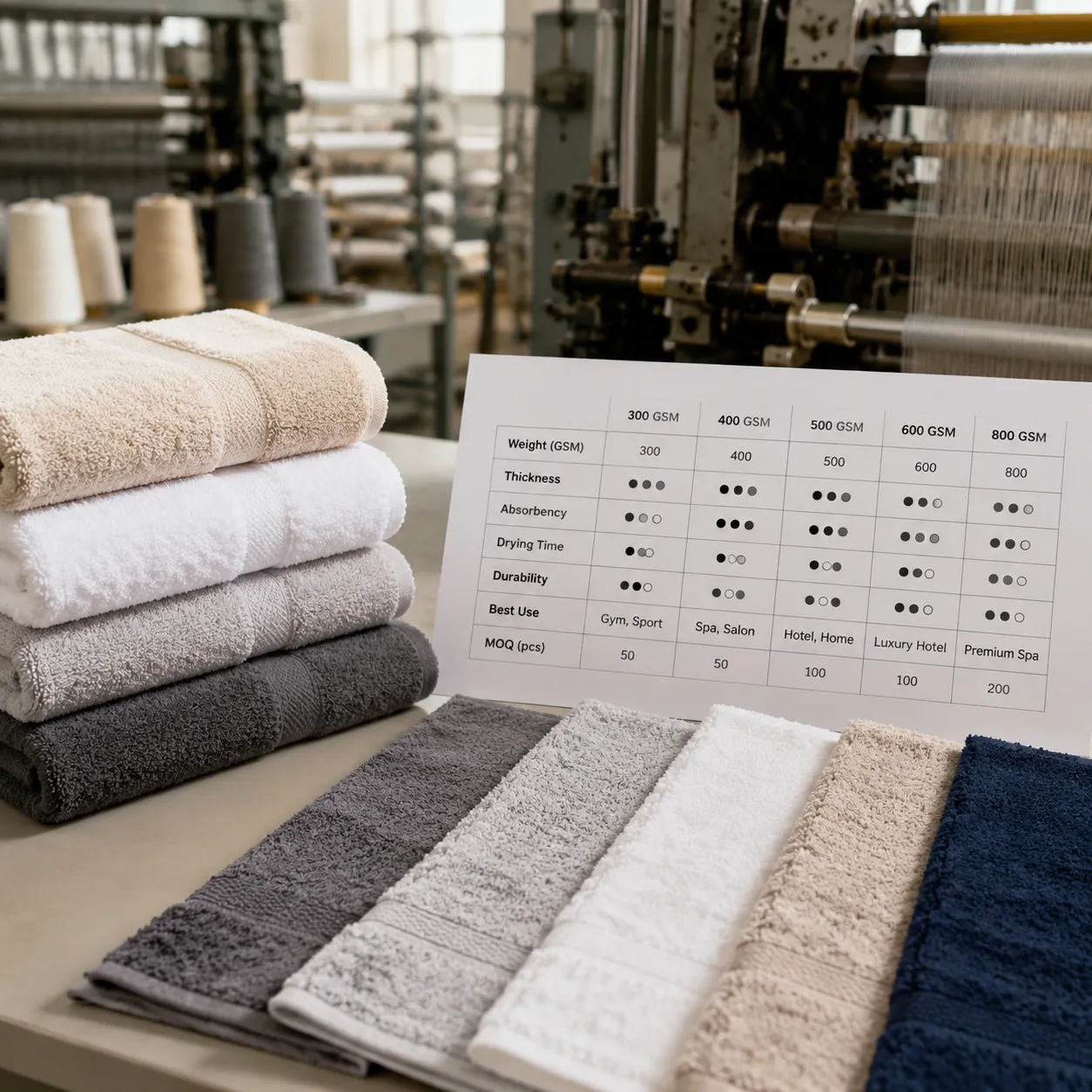
Why GSM Choice Changes More on Small Runs
GSM means grams per square meter. It is simple to define but not simple to buy, especially at 500 to 1,200 pieces per design or per color. On a large hotel program, a mill can spread yarn setup, dye bath tuning, edge trial waste, and QC sorting across many cartons. On a low MOQ order, those same setup costs sit inside fewer pieces, so a 60 GSM change can move the landed cost more than buyers expect.
At LUMA & CO. TEXTILE, our practical MOQ is 500 pcs per design / per color. We run small batch programs for boutique hotels, gym brands, resort shops, event merch, and DTC towel labels, but we do not treat GSM as a decorative choice. It decides yarn consumption, loom speed, dye penetration, drying time, freight class, and how many towels fit into a carton without crushing the pile.
For low moq towels gsm comparison work, we usually start with three numbers: target use, towel size, and wash environment. A 400 GSM gym towel that survives 80 commercial washes can be a better purchase than a 520 GSM towel that stays damp in a locker room. A 620 GSM bath towel can feel correct in a guest room, while the same GSM is too slow for a high-turnover beach club laundry.
| Use case | Typical size range | Practical GSM band | What buyers usually notice first |
|---|---|---|---|
| Gym sweat towel | 30×80 cm to 40×90 cm | 330-450 GSM | Fast drying and low lint matter more than plush pile |
| Hotel hand towel | 35×75 cm to 40×80 cm | 450-560 GSM | Edge stability and repeated wash appearance |
| Retail bath towel | 65×130 cm to 70×140 cm | 500-680 GSM | Hand feel, shelf weight, and perceived value |
| Pool or resort towel | 75×150 cm to 90×170 cm | 430-600 GSM | Absorbency balanced against laundry turnaround |
| Promo towel | 30×30 cm to 50×100 cm | 280-420 GSM | Unit cost, print clarity, and carton count |
Low MOQ Towels GSM Comparison by Product Type
The table below is the first internal filter we use before quoting. It is not a fixed rule, because construction changes the result. A compact 480 GSM dobby towel can feel firmer than a loose 540 GSM terry towel. A zero-twist cotton towel can feel bulky at lower GSM but may shed more in harsh laundering if the pile height and twist are not controlled.
For small batch towel order planning, we advise buyers to compare GSM together with finished piece weight. A 50×100 cm towel at 420 GSM uses about 210 g of fabric before allowance for hemming and process variation. A 75×150 cm towel at 500 GSM uses about 563 g before trims and packing. That difference affects not only fabric cost, but also carton CBM and ocean freight allocation.
| Towel category | Entry GSM we accept | Balanced GSM for OEM orders | Heavy GSM we quote carefully | Factory note |
|---|---|---|---|---|
| Face towel / washcloth | 300-360 | 380-450 | 500+ | Small pieces curl if the border and hem are too light for the pile |
| Gym towel | 330-380 | 390-460 | 500+ | Above 480 GSM, drying complaints increase in busy gyms |
| Hand towel | 400-450 | 470-560 | 600+ | Good dobby tension prevents wavy side seams after washing |
| Bath towel | 450-520 | 540-650 | 700+ | Heavy bath towels need longer drying and larger cartons |
| Beach towel | 360-430 | 450-560 | 620+ | Printing method and sand release often matter more than pile height |
| Spa towel | 430-500 | 520-620 | 680+ | Oil residue and warmer storage require stable dye and low lint |
- Below 350 GSM: suitable for giveaway, travel, or light-use microfiber alternatives, but cotton terry can feel thin if the yarn count is not adjusted.
- 380-460 GSM: common for gym, promo, and fast-dry hospitality programs where laundry speed is part of the business case.
- 500-600 GSM: the middle band for many hotel, spa, and retail bath towel orders because it balances hand feel and operating cost.
- 650 GSM and above: best reserved for controlled-use luxury programs, retail gifting, or low-frequency laundering where drying time is not the main constraint.
The Hidden Cost Is Not Only Cotton Weight
A buyer may calculate GSM as raw cotton consumption and stop there. We calculate the full route: yarn cost, weaving efficiency, dye pickup, finishing shrinkage, inspection sorting, carton quantity, and freight. Higher terry towel GSM usually slows loom output because pile loops need more yarn feed and more stable tension. It also increases risk during dyeing because dense pile can trap unfixed dye or show center-to-edge shade variation if the liquor ratio is pushed too low.
For example, on a 1,000-piece order of 50×100 cm cotton towels, moving from 390 GSM to 470 GSM adds roughly 40 g per towel before finished packing. That is about 40 kg more fabric across the order, plus extra dye and drying energy. The unit price movement may look small, but freight and drying cost at the buyer's laundry keep accumulating after the towels arrive.
| Order profile | GSM band | Estimated FOB unit price at 500 pcs | Estimated FOB unit price at 2,000 pcs | Estimated FOB unit price at 8,000 pcs |
|---|---|---|---|---|
| 30×80 cm gym towel, solid dyed | 350-410 GSM | USD 1.05-1.42 | USD 0.88-1.18 | USD 0.74-0.99 |
| 40×80 cm hand towel, dobby border | 460-540 GSM | USD 1.58-2.25 | USD 1.34-1.86 | USD 1.12-1.55 |
| 70×135 cm bath towel, combed cotton | 520-620 GSM | USD 5.10-7.20 | USD 4.45-6.30 | USD 3.95-5.55 |
| 80×160 cm beach towel, yarn dyed stripe | 420-520 GSM | USD 6.20-8.90 | USD 5.40-7.75 | USD 4.85-6.95 |
These bands are realistic for OEM cotton terry programs with standard color depth and normal packaging. They change with dark reactive dye, yarn-dyed construction, jacquard patterning, embroidery, hangtags, barcode stickers, and individual polybags. OEKO-TEX Standard 100 Class I material control also adds discipline to chemical selection; we do not replace certified auxiliaries with cheaper substitutes to save a few cents on a low MOQ run.
How We Test GSM Before Bulk Approval
A sample towel can mislead if it is weighed before full relaxation. Terry fabric changes after washing because loops open, residual finishing agents rinse away, and shrinkage pulls the structure tighter. For a reliable towel GSM chart, we test after conditioning and, when the program requires it, after wash cycles.
- Cut a representative fabric specimen away from thick hems, dobby borders, embroidery, and labels.
- Condition the specimen under standard lab atmosphere before weighing when formal testing is requested.
- Measure area accurately; for internal checks we use a calibrated GSM cutter for fabric panels where possible.
- Weigh on a digital balance with 0.01 g readability for small specimens.
- Calculate GSM and compare against the approved tolerance, normally ±5% for low MOQ custom terry unless the buyer's specification is tighter.
For formal reference, buyers may specify ISO 3801 for mass per unit length and mass per unit area of textile fabrics. For dimensional change after domestic washing, ISO 6330 is the common washing procedure reference, while ISO 5077 covers determination of dimensional change. We also run absorbency checks using internal drop and sink observations, because two towels with identical GSM can behave differently if pile twist, softener level, or finishing temperature changes.
One construction quirk we watch closely is border compression. If a low MOQ bath towel uses a heavy pile but a narrow dobby border, the border can pucker after tumble drying. The defect is not always visible in the pre-production sample. It appears after the second or third wash when the terry field shrinks differently from the flat woven band.
Choosing GSM by Laundry Reality
A towel used in a hotel room, a CrossFit gym, and a marina shower area may all be called a bath towel by the buyer, but the laundry load is different. Before we recommend GSM, we ask how often the towel is washed, whether it is tumble dried, whether bleach or peroxide is used, and whether towels sit damp in bins before washing. This is where many overbuilt low MOQ programs fail.
- High-turnover gym laundry: choose 350-430 GSM for sweat towels and avoid over-softening, which can reduce water pickup and increase odor retention.
- Boutique hotel rooms: 540-620 GSM bath towels are usually safe if housekeeping has enough par stock and dryer time.
- Beach club pool decks: 450-540 GSM works better than very heavy pile when towels are collected wet with sunscreen and sand.
- Spa treatment rooms: 500-600 GSM is common, but colorfastness and oil-release performance matter as much as weight.
- Retail gifting: 580-700 GSM can be justified when shelf feel is more important than daily industrial laundering.
Cost-per-use also depends on loss rate. A small hotel buying 720 bath towels at 600 GSM might pay around USD 5.85 FOB per piece. If the towels survive 95 guest-use wash cycles before downgrade, the textile cost is about USD 0.062 per use before freight and laundry. If the same property buys a 470 GSM towel at USD 4.35 but downgrades it after 48 cycles because edges twist and pile flattens, the textile cost is about USD 0.091 per use. Lower GSM helped the first invoice and hurt the operating budget.
Cotton, Yarn Twist, and Why GSM Can Lie
GSM measures weight, not quality. A towel can be heavy because it uses coarse yarn, dense ground, long pile, or inefficient construction. It can also feel soft because of finishing chemistry rather than durable fiber quality. That is why our low moq towels gsm comparison always includes yarn and construction notes.
Combed cotton removes shorter fibers, so the towel usually sheds less lint and keeps a cleaner surface after washing. Carded cotton can be acceptable for promotional or budget gym towels, but we set expectations on linting and surface fuzz. Zero-twist cotton gives a lofty hand feel at moderate GSM, yet it is not our first recommendation for harsh commercial laundries that run high heat and aggressive mechanical action.
| Construction choice | How it affects GSM perception | Best fit | Risk to control |
|---|---|---|---|
| Combed cotton terry | Feels cleaner and more stable at the same GSM | Hotels, spas, retail towels | Higher yarn cost |
| Carded cotton terry | Can meet target weight at lower cost | Promo and budget utility towels | More lint and rougher surface after washing |
| Low-twist terry | Feels fuller without pushing GSM too high | Retail and guest bath programs | Pile snagging if loops are too long |
| Jacquard terry | Pattern changes local density and hand feel | Brand patterns and resort towels | Uneven shrinkage if design has large solid zones |
| Velour sheared face | Prints well and feels smooth | Beach and gift towels | Shearing loss and lower absorbency on the face side |
A specific defect we reject during production is pile starvation near the side hem. It happens when the terry feed is set too lean to hit a lower price target. The towel may still pass average GSM, but the side area feels flat and wears early. For brand buyers, that is worse than a towel that is honestly 20 GSM lighter but evenly built.
Sampling Rules for 500-Piece Programs
Low MOQ does not mean skipping development controls. It means we choose controls that protect the buyer without making sampling more expensive than the order. For most custom towel programs, we prepare yarn or fabric options, lab dip where needed, one pre-production sample, then bulk production after written approval. If decoration is involved, embroidery strike-off, jacquard CAD, or print proof is added.
- Confirm size, GSM range, cotton type, color standard, decoration, label, and packing in the tech pack.
- Quote two GSM options rather than five; too many variations slow sampling and increase decision noise.
- Make one physical sample in the closest available construction or actual yarn when timing allows.
- Wash the sample at least once before final approval for shrinkage, lint, and hand feel.
- Lock tolerance in writing: size tolerance, GSM tolerance, shade tolerance, and carton packing method.
Typical timing is 5-7 days for a plain solid-color desk sample if suitable yarn is available. Lab dips take 4-6 days after receiving Pantone TCX, TPX, or a physical swatch. A pre-production sample with custom border or embroidery usually takes 8-12 days. Bulk production for low MOQ towels is normally 18-28 days after sample and deposit approval, with an extra 5-9 days if yarn dyeing, complex jacquard, or individual retail packing is required.
Our factory certifications include OEKO-TEX Standard 100 Class I, BSCI social compliance, and ISO 9001 quality management. Certificates do not choose GSM for you, but they reduce risk around chemical safety, documented inspection, and process consistency. Buyers can also review how to read an OEKO-TEX certificate before comparing suppliers.
Freight and Carton Math Buyers Forget
A towel that looks affordable FOB can become expensive when carton weight and volume are ignored. Higher GSM increases net weight, but fluffy towels also consume space. If the carton is over-compressed, pile recovery suffers. If it is too loose, the buyer pays for air.
For example, a 40×80 cm hand towel at 500 GSM usually packs 80-100 pieces per export carton depending on hem thickness and label placement. A 70×140 cm bath towel at 620 GSM may pack only 20-24 pieces per carton if we want to avoid hard compression marks. A resort towel at 85×165 cm with a jacquard logo can drop to 12-16 pieces per carton. These packing differences influence whether LCL sea freight, courier, or air freight makes sense.
- Ask for estimated carton dimensions during quotation, not after production is finished.
- Compare FOB price together with kg per carton and CBM per carton.
- Avoid vacuum packing cotton terry for retail towels unless the recovery test is approved.
- For urgent replenishment, lighter GSM can reduce air freight cost, but only if it still passes use requirements.
- If the order will scale later, keep carton packing consistent so warehouse receiving data does not change every drop.
Related reads: if the order is close to shipment planning, our guide to container vs air freight towel orders explains when air freight destroys margin. For specification writing, use build a towel tech pack that mills can quote before asking three factories to compare GSM.
What We Recommend by Buyer Scenario
We do not recommend one GSM band for every brand. The right answer depends on whether the towel earns revenue, supports a service experience, or functions as merchandise. Below are the ranges we quote most often when the buyer has no legacy specification.
- DTC bath towel launch at 500-1,000 pcs per color: start with 560-620 GSM combed cotton, then test one higher-weight option only if the target retail price can absorb it.
- Boutique gym or pilates studio: use 380-430 GSM for sweat towels, with a stable hem and colorfast reactive dye rather than chasing a plush hand.
- Small hotel opening order: choose 520-600 GSM for bath towels and 460-530 GSM for hand towels, then set par stock so dryer time is not overloaded.
- Beach club retail towel: consider 430-520 GSM cotton velour or terry-jacquard depending on artwork; sand release and folding size matter.
- Event or promo towel: 300-380 GSM can work, but only with clear expectations on absorbency and lifespan.
For buyers comparing cotton against microfiber, the GSM ranges are not directly interchangeable. Microfiber at 280 GSM can absorb and dry differently from cotton at 420 GSM. We explain the trade-offs in microfiber vs cotton towel comparison. For bath programs, towel GSM decision framework and towel sizes dimensions complete guide help narrow the spec before sampling.
If decoration is part of the order, GSM affects the result. Embroidery can sink into long pile unless the stitch density, backing, and placement are adjusted. Jacquard logos need enough ground stability to hold sharp edges. Printed velour needs controlled shearing so artwork does not look patchy. Our comparison of embroidery vs sublimation vs jacquard is useful before locking artwork.
Our Practical Quoting Checklist
A useful low moq towels gsm comparison should end in a quote the mill can actually produce. If a buyer sends only a photo and says "make it thick but cheap," we will ask for more information before pricing. Guessing creates re-sampling, and re-sampling is slow for small orders.
- Send target towel type, finished size, quantity per color, and country of delivery.
- State the use environment: hotel laundry, retail sale, gym member use, pool deck, spa room, or event giveaway.
- Choose a GSM target band, not one exact number, unless you already have a tested standard.
- Provide color reference: Pantone, lab dip target, or physical towel sample.
- Confirm decoration method, label, hangtag, barcode, and packing requirement.
- Tell us whether certifications are required on the invoice or product file: OEKO-TEX 100 Class I, BSCI, ISO 9001, or buyer-specific compliance documents.
Our standard MOQ is 500 pcs per design / per color. For simple solid towels we can often quote within 24-48 hours if the specification is complete. For jacquard, yarn-dyed stripe, or decorated towel sets, we usually need 2-3 working days to check yarn availability, loom suitability, and packing cost. Production runs in our 220-employee mill in Gaoyang, Zhejiang, where we have supplied 80+ brand clients across 47 countries since 2007, with annual output around 2.4M towels.
A final note from the mill floor: do not buy the heaviest towel your budget allows unless the laundry model supports it. For small orders, the best GSM is the one that survives real use, fits the carton plan, and can be reordered without changing the hand feel.
Need a GSM Quote for 500+ Towels?
Send size, use case, target GSM band, color, and decoration notes. We will compare practical options with FOB pricing, sample timing, and carton estimates. WhatsApp: +86 13384590853 or email [email protected].
Request GSM Comparison Quote →