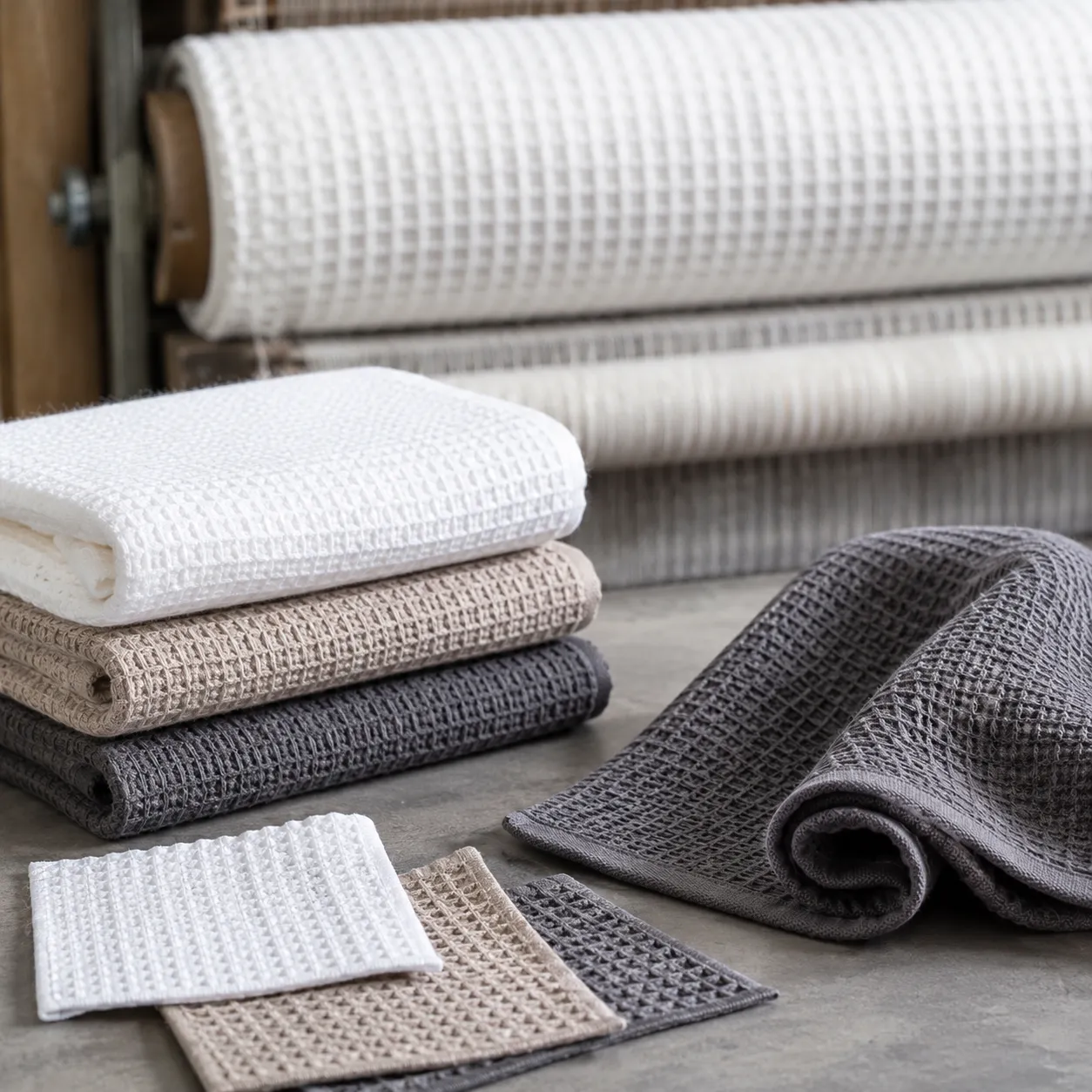
Where the weave earns its keep
The structure is the point. The raised cells trap air, the open pockets dry faster than a dense looped towel, and the fabric folds down into a smaller carton cube. For buyers that care about shelf presentation, laundry turn time, or freight per case, that matters more than a soft marketing story. In a guest set or treatment room basket, the cloth sits flatter than terry and looks tidier after folding.
| Use case | Typical size | Target GSM | Why it fits |
|---|---|---|---|
| Hotel guest cloth | 30 x 30 cm | 180-220 | Low bundle volume, easy to stack in amenity trays |
| Spa hand cloth | 34 x 74 cm | 240-280 | Balanced hand feel for treatment rooms and steam areas |
| Kitchen service cloth | 40 x 60 cm | 200-240 | Good for back-of-house wiping and bar spills |
| Retail gift cloth | 32 x 32 cm | 220-260 | Merchandises cleanly with a band or belly wrap |
- Best for: programs that need a quick-dry hand and a neat fold
- Not ideal for: buyers who want plush loft or bath-sheet absorbency
- Also worth noting: the weave shows dye and seam problems faster than plain terry, so QC needs to be tighter
A small piece can still be useful. A 35 x 70 cm cloth at 260 GSM comes out around 64 g before label and packaging, which is light enough for spa carts but substantial enough to feel intentional in the hand.
How we specify waffle weave cloth for bulk orders
We start with yarn behavior, not artwork. If the yarn is too thick, the cells collapse and the fabric turns boardy after laundering. If the yarn is too soft or too open, the fabric loses definition and the edges start to ripple. For lighter cloths, we usually stay in the 21s range. For a denser spa grade, we move toward 16s so the cell walls hold shape without becoming heavy.
| Detail | Standard we prefer | Why it matters |
|---|---|---|
| Yarn | Combed ring-spun cotton, 16s-21s | Keeps fuzz down and cell walls cleaner |
| Finish | Pre-shrunk, lightly washed | Helps control first-wash tightening |
| Hem | Double-turned 8-10 mm with dense lockstitch | Reduces edge curl and tunneling |
| Color | Reactive dye for core shades | Holds color better than low-cost pigment options |
| Allowance | 3%-5% cut allowance on size | Gives room for natural closing of the cells |
We also watch the finish recipe. A soft-hand wash can improve drape, but too much resin makes the cloth feel stiff and can seal the surface so the first towel-down feels weaker than the spec sheet promised. If the order is for a dark color, we extend the prewash and shade check because waffle pockets can hold dye unevenly across the face and the back.
GSM and size pairs that stay balanced
The right combination is usually not the heaviest one. A smaller size at a moderate GSM often works better in service than a thick piece that takes longer to dry and costs more to ship. If the cloth lives in a housekeeping cart, the fold and dry time matter as much as absorbency. If it is going into a retail set, the hand feel and the visual grid of the weave matter more than raw bulk.
| Size | GSM | Approx. finished weight | Where it fits |
|---|---|---|---|
| 30 x 30 cm | 180-220 | 16-20 g | Tray cloth, guest set, powder room |
| 34 x 74 cm | 240-280 | 60-71 g | Spa hand cloth or treatment-room piece |
| 40 x 60 cm | 220-260 | 53-62 g | Back-of-house cloth, bar service, amenity pack |
| 40 x 80 cm | 280-340 | 90-109 g | Heavier spa grade or a retail gift format |
- Choose the size first, because the fold and carton count drive merchandising and freight.
- Set GSM second, because the weave needs enough substance to keep the cells open after washing.
- Decide whether the cloth must feel crisp or soft, since that changes yarn selection and finish.
- Only then lock the color, because dark shades and special finishing can move the price faster than the weave itself.
If the program is mainly for guest amenities, we usually stay below 240 GSM. If it sits in a spa cart or massage room, 240-300 GSM is a safer band. Once buyers go past that, the cloth starts behaving more like a small towel than a utility wipe, and the carton weight moves up quickly.
What the QC room checks after washing
The first issue we look for is not color, it is geometry. Waffle cells can tighten unevenly, which creates a slight skew that does not show on the sewing table but becomes obvious after a hot wash. We also check the hem line, because a weak stitch bite can turn into a tunnel or corner pull once the fabric has gone through wash and tumble.
| Test | Method | Pass signal |
|---|---|---|
| Dimensional change | ISO 6330 and ISO 5077 | Stays within the agreed shrinkage band with no corner twist |
| Colorfastness | ISO 105-C06 | No visible bleed onto adjacent cloth or liner |
| Appearance after wash | In-house visual check on a flat board | Cells remain open and the hem stays flat |
| Absorbency | Timed water-drop test | Water spreads fast instead of beading on the face |
| Stitch pull | Internal corner pull check | No yarn slip at the hem or label point |
- Cell collapse after the first hot cycle
- Hem tunneling that makes the edge wave
- Shade drift between sample and bulk lots
- Corner seam slip when the cloth is folded straight from the dryer
We do not sell on a wash-count slogan. For buyer approval, the useful question is whether the cloth keeps its shape, hand, and dye stability under the buyer's own laundry method. That is why we prefer ISO-based checks and a sample wash in the destination process when the program is large enough to justify it.
What moves the quote up or down
The fabric is only one line in the quote. Shade depth, packing style, and finishing method can move the unit cost as much as GSM. A white cloth with a simple hem is not the same purchase as a deep navy piece with woven labels, folded insert cards, and retail banding. The pricing bands below are the ranges we usually see on current FOB quoting for standard cotton builds, before freight and duty.
| Order size | 30 x 30 cm 220 GSM FOB | 34 x 74 cm 260 GSM FOB | Notes |
|---|---|---|---|
| 500-2,999 pcs | USD 0.72-1.05 | USD 1.18-1.72 | Setup cost is visible at this level |
| 3,000-9,999 pcs | USD 0.58-0.84 | USD 0.96-1.38 | Usually the best band for private label |
| 10,000+ pcs | USD 0.49-0.71 | USD 0.82-1.18 | Best when color and packing stay standard |
- Reactive dark shades usually add USD 0.05-0.12 per piece.
- Woven labels or sewn brand tabs add about USD 0.03-0.06.
- Folded retail bands or belly wraps add about USD 0.06-0.14.
- Individual polybags usually add USD 0.03-0.08, depending on film and print.
The common mistake is to ask for a heavy cloth, a deep shade, and retail-ready packing, then expect the lowest price band. Those choices all have a cost. If the order is for a housekeeping supply chain, keeping the color simple and the packing loose often gives a better landed cost than trying to make the item look retail before it reaches the shelf.
What to send with an RFQ
Our standard MOQ is 500 pcs per design per color. Sample lead time is usually 5-7 days, and bulk production is typically 22-30 days after sample approval. We work under ISO 9001 procedures, and we can support OEKO-TEX STANDARD 100 Class I and BSCI documentation when the fiber, color, and order scope fit the certification path. If you already have a tech pack, send it with build-towel-tech-pack-that-mills-can-quote.html; if not, the seven fields below are enough to quote without guessing.
- Finished size, plus the tolerance you can accept after wash.
- Target GSM and whether you want 100% cotton or a blended build.
- Color reference, ideally Pantone, lab dip, or a physical strike-off.
- Hem style, label style, and any retail packing requirement.
- Destination market and whether the cloth must meet a specific certification file.
- First order quantity and the rough annual forecast.
- Target delivery window, including whether air freight is even on the table.
If the cloth is headed into a hotel or spa program, tell us how it will be laundered. A guest amenity cloth that goes through domestic wash is not the same as a treatment-room piece that sees hot laundry and tumble drying every day. That one detail changes shrinkage allowance, finish choice, and how tightly we cut the cell grid.
When another fabric is the better call
This weave is useful, but it is not the answer to every towel brief. If you need stronger lint control for glass or polished paint, a microfiber program is usually a better fit. If you need deep plush and a heavier bath hand, terry is still the safer choice. If the program is bleach-heavy or built around harsh salon chemistry, another cotton spec will usually hold up better over time.
- Choose microfiber when lint control is the top priority and the cloth must release debris cleanly.
- Choose terry when absorbency and loft matter more than low bulk.
- Choose a different cotton construction when the laundry room uses aggressive chemistry.
- Choose a lighter GSM if freight and carton volume matter more than a dense hand feel.
For adjacent decisions, microfiber-vs-cotton-towel-comparison.html covers the fiber tradeoff, while spa-towel-program-treatment-room-specs.html is the closest read if the end use is a treatment room instead of a general amenity set.
Related reads: if you are still choosing weight and format, towel-gsm-decision-framework.html, towel-sizes-dimensions-complete-guide.html, and combed-vs-zero-twist-cotton-explained.html cover the adjacent calls without repeating the same brief.
For hotel and spa sourcing specifically, hotel-towel-sourcing-guide-2026.html, waffle-weave-towels-spa-buyer-specs.html, and build-towel-tech-pack-that-mills-can-quote.html are the most useful follow-ups.
Request a factory quote
Send size, GSM, color, finish, packing, and target market to [email protected] or WhatsApp +86 13384590853. We will reply with a quote and timing.
Get Pricing →