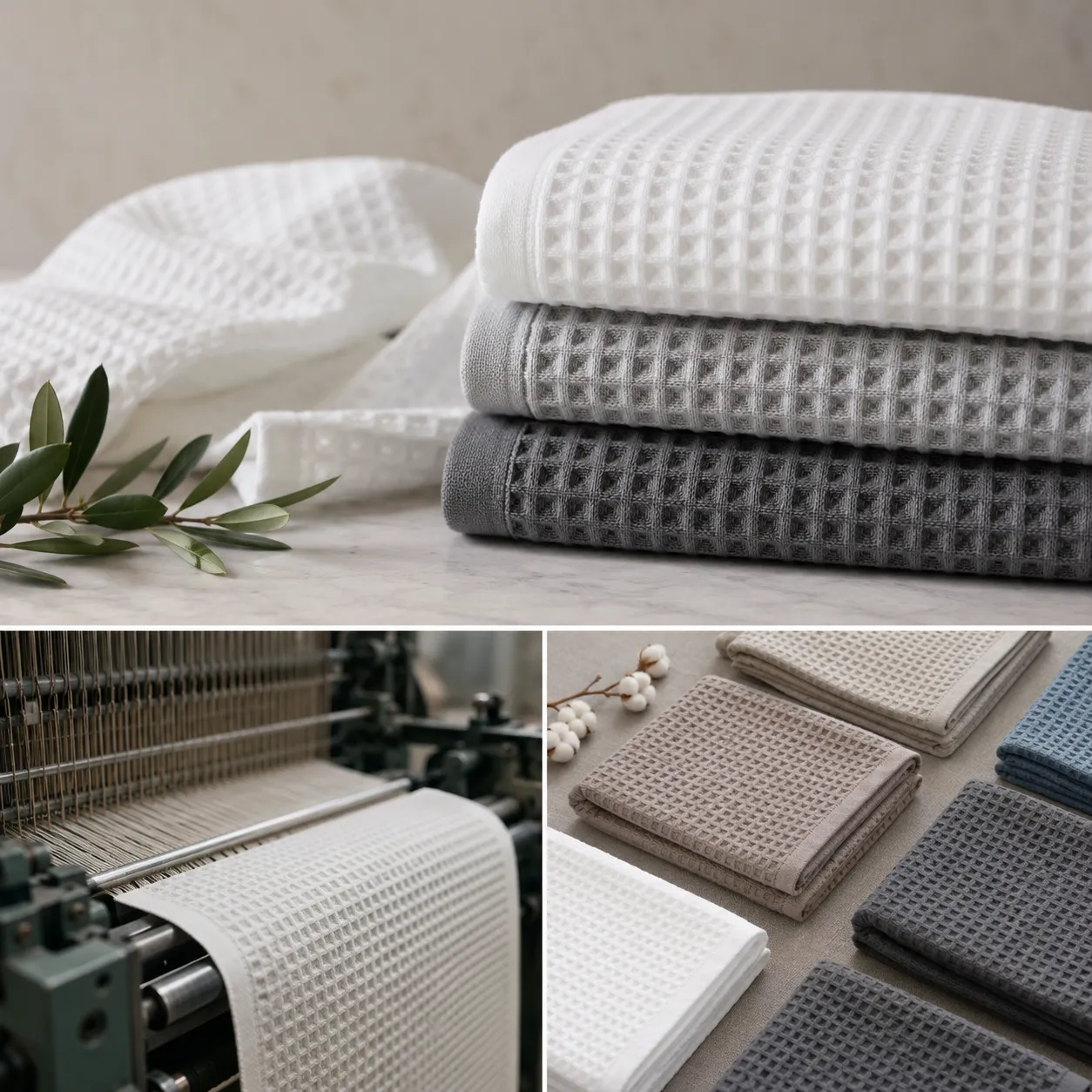
Why Waffle MOQ Behaves Differently
Waffle bath towels are not just lighter terry towels with a different surface. The honeycomb structure is built by controlled float and tuck movement in the weave, so the fabric relaxes heavily after wet finishing. On our lines, a cotton waffle towel that measures 76 × 150 cm off the loom can finish closer to 70 × 140 cm after desizing, washing, tumble relaxation, and final drying. That shrinkage is part of the product, not a defect, but it changes MOQ planning.
For terry towels, MOQ is usually driven by yarn dye lot, border setup, and decoration. For waffle, the first constraint is greige fabric efficiency. If a buyer wants five colors at 120 pieces each, we are not really running 600 towels. We are running five separate dye lots, five cutting checks, five shade records, and usually five label inventories. The actual handling cost can exceed the yarn cost.
Our factory MOQ is 500 pcs per design / per color. We can discuss mixed-size or mixed-label programs, but the negotiation has to protect the real production flow. If we push the quantity too low, the buyer may save USD 200 on the PO and lose USD 900 later through shade variation, dimensional claims, or air freight for replacements.
| MOQ driver | What changes in waffle towels | Negotiation room |
|---|---|---|
| Greige fabric | Honeycomb repeat must relax evenly; narrow runs waste more fabric at cutting | Moderate if size is standard |
| Dyeing | Small lots show higher shade drift because absorbency is uneven before relaxation | Low below 300 pcs per color |
| GSM control | Finished GSM rises after shrinkage; off-loom weight is not the buyer-facing spec | Moderate if tolerance is realistic |
| Labeling | Private woven labels require separate receiving, counting, and needle check | High if same label is shared |
| Packing | Waffle towels compress well, but folded thickness varies after tumble drying | High if carton packout is flexible |
Waffle Weave Bath Towel MOQ Negotiation Guide
For waffle weave bath towel MOQ negotiation guide work, we start by separating the order into what must be unique and what can be shared. A hotel group may need three room categories, but it may not need three yarn specs. A DTC brand may want four colorways, but it may be able to use one care label and one carton mark. Those choices decide whether the MOQ is workable.
A practical first order is usually 500 to 1,200 pcs per color if the towel uses solid dyed cotton waffle, 240-360 GSM finished weight, and a standard bath size such as 70 × 140 cm or 76 × 152 cm. Below 500 pcs per color, the price can still be quoted in some cases, but we treat it as a small production run rather than normal bulk.
- Easiest to negotiate: one color, one size, stock yarn, printed care label, no embroidery
- Possible with surcharge: two colors sharing one label and one carton mark
- Risky below MOQ: four or more custom colors with separate labels
- Usually not efficient: custom yarn shade, custom size, and personalized packaging at 500 pcs total
- Best compromise: launch one core color first, then add seasonal shades after laundry approval
If your team is still defining towel size, review towel dimensions by use case before asking mills for concessions. Size changes alter cutting yield, hem fold, carton count, and finished weight. A 72 × 145 cm waffle towel may look like a small adjustment, but it can push fabric utilization down if it does not match the loom width and post-wash shrinkage ratio.
The Minimums We Can Actually Control
MOQ is not one number. It is a stack of minimums: yarn purchase, loom setup, dyeing vat load, sewing allocation, label management, packing material, and QC documentation. A buyer can sometimes reduce one layer by simplifying another. That is why we ask for the full program view, not just the lowest first PO quantity.
| Program type | Recommended starting MOQ | What we keep fixed | What can flex |
|---|---|---|---|
| Hotel waffle bath towel | 500 pcs per color | Size, GSM, cotton yarn, label position | Carton quantity and bale packing |
| Spa retail/private label | 800-1,000 pcs per color | Brand label, hangtag, shade standard | Inner polybag or belly band |
| DTC launch test | 500 pcs one color | Finished size, GSM, wash test method | Packaging artwork after sample |
| Multi-property rollout | 1,500-3,000 pcs total | Construction and care label | Color split by property |
| Promotional waffle towel | 1,000 pcs per artwork | Logo method and carton mark | GSM within agreed band |
For waffle bath towels wholesale buyers, the strongest negotiation point is forecast visibility. If you can place 600 pcs now and share a written replenishment plan for 1,800 pcs over the next 120 days, we can sometimes produce greige fabric more efficiently and hold part of the material for repeat dyeing. We will still not promise perfect color matching months apart without a lab dip and bulk shade record, but planning reduces waste.
A low MOQ towel supplier may say yes to 100 pcs per color, but ask what construction they are using. Often it is stock waffle fabric cut from rolls, not a controlled OEM towel program. That may be fine for a photo shoot. It is not safe for hotel laundry if the towel must survive 80-120 wash cycles under alkaline detergent and tumble heat.
Color Splits Are the Real Negotiation
Most MOQ discussions are really color split discussions. A 2,000-piece order in one white shade is easy to run. The same 2,000 pcs split into eight earthy colors becomes a different job. Each color needs lab dip approval, bulk dye tracking, shade band tolerance, and separate inspection. Waffle also shows light differently because the raised cells create shadow; a small ΔE difference can look larger on the folded towel than on a flat lab swatch.
For solid dyed cotton waffle weave towels, we normally target a color tolerance around ΔE 1.0-1.5 for controlled brand programs, measured against the approved standard with a spectrophotometer. For natural, stone, oatmeal, and clay tones, visual approval under D65 light is still important because waffle texture can exaggerate undertone shifts. Dark charcoal and navy need more attention to crocking and lint visibility.
- Approve one core color first, usually white, natural, or light grey.
- Run the first wash test on that color before adding seasonal shades.
- Keep the same woven label across all colors for the first PO.
- Use carton labels to separate SKUs instead of custom inner packaging for every shade.
- Ask the mill to quote the surcharge for each color below 500 pcs rather than hiding it in the unit price.
| Color plan | Mill-side view | Likely MOQ result | Buyer risk |
|---|---|---|---|
| 1 color × 1,000 pcs | Efficient dyeing and sewing | Normal bulk pricing | Low |
| 2 colors × 500 pcs | Acceptable if same label and size | Normal or small surcharge | Low-medium |
| 4 colors × 250 pcs | Four shade lots and more QC time | MOQ surcharge likely | Medium |
| 6 colors × 150 pcs | Sampling-style handling inside bulk | High surcharge or refusal | High |
| White 700 pcs + two accents 150 pcs | Core color efficient, accents inefficient | Quote separately | Medium-high |
If the towel is for a resort or spa, avoid launching too many atmospheric colors at once. Sand, mushroom, fog, mineral, and taupe sound distinct on a mood board, but they become operationally hard to control when housekeeping replaces towels by room floor or treatment zone. For hospitality programs, fewer shades usually mean lower claims.
GSM, Shrinkage, and the Hidden Cost
Waffle towel GSM should be specified as finished GSM after washing and relaxation, not greige GSM. Common finished weights are 220-260 GSM for quick-dry travel or spa wraps, 280-340 GSM for hotel waffle bath towels, and 360-420 GSM for heavier retail bath towels. Above 420 GSM, the towel may feel substantial, but dry time increases and the honeycomb pockets can flatten after repeated tumble drying.
One technical detail we watch closely is cell collapse at the hem. If the hem is folded too wide or sewn with too much needle tension, the honeycomb structure compresses into a hard band. That makes the towel curl after laundering. Another defect is skewed waffle boxes, usually caused by uneven width tension during finishing. AQL inspection can catch obvious skew, but the better control is relaxation testing before cutting.
For wash validation, we use ISO 6330 domestic washing as a reference for dimensional change, and we can adapt cycles for hotel laundry if the buyer provides temperature, detergent pH, and drying method. For colorfastness, ISO 105-C06 or AATCC 61 can be specified depending on the market. OEKO-TEX Standard 100 Class I applies to our certified articles when the yarn, dyes, sewing thread, and labels are all within the approved scope.
- Finished GSM tolerance: normally ±5%, tighter only with higher inspection cost
- Dimensional change target: often within -7% to -10% after first full relaxation, depending on construction
- Hem width: usually 1.5-2.5 cm for waffle bath towels to reduce curling
- Sewing thread: color-matched polyester is common; cotton thread can shrink differently
- Lint behavior: lower than open-end terry, but dark colors still need lint check after tumble drying
If your procurement team is comparing waffle towel GSM against terry GSM, use the framework in our GSM decision guide. A 320 GSM waffle towel and a 500 GSM terry towel are not substitutes in hand feel, laundry load, or drying time. The waffle product competes on quick dry and texture, not plush pile height.
Pricing Bands by Volume
The price of a honeycomb bath towel OEM order depends on cotton grade, finished GSM, size, dye color, packaging, and whether labels are stock or custom. The bands below are realistic FOB China ranges for a 100% cotton waffle bath towel around 70 × 140 cm to 76 × 152 cm, finished 280-360 GSM, with standard sewing and one woven brand label. They are not valid for oversized throws, garment-washed finishes, or complex retail gift packaging.
| Order volume | FOB China unit band | Typical conditions | MOQ note |
|---|---|---|---|
| 500-799 pcs | USD 4.35-5.80 | One color, simple label, standard carton | Entry OEM quantity |
| 800-1,499 pcs | USD 3.95-5.20 | One or two colors, shared packaging | Better sewing efficiency |
| 1,500-2,999 pcs | USD 3.55-4.70 | Stable dye lots, planned inspection | Good for hotel rollout |
| 3,000-5,999 pcs | USD 3.20-4.25 | Forecasted yarn and carton purchase | Best balance for private label |
| 6,000+ pcs | USD 2.95-3.90 | Program pricing, repeat specs | Requires firm schedule |
For a cost-per-use view, consider a 320 GSM waffle towel at USD 4.40 FOB that survives 95 hotel laundry cycles before it becomes too tired for guest-facing rooms. The towel cost is about USD 0.046 per use before freight and laundry. A lighter USD 3.30 version that starts curling at 45 cycles costs about USD 0.073 per use, even though the purchase price looked lower. This is why we push back when a buyer asks us to remove too much yarn from a towel that will enter commercial laundry.
Private label waffle towels can also carry hidden costs. A belly band may add USD 0.08-0.16 per piece. A rigid gift box can add USD 0.45-0.95 per piece and reduce carton efficiency. If the order is 500 pcs, packaging setup may distort the landed cost more than the towel itself. For first orders, we usually recommend sewn label plus export carton unless retail shelf presentation is mandatory.
Sample Approval Before You Negotiate Hard
Do not negotiate the final MOQ before the sample is technically approved. Waffle samples can be misleading if they are measured before full relaxation. We have seen buyers approve a towel because it looked generous at sample stage, then complain when bulk finished smaller after correct washing. The sample record must state whether dimensions are pre-wash, after one wash, or after three cycles.
- Confirm finished size and finished GSM, not only loom-state measurements.
- Approve lab dip or white standard under D65 and store the physical swatch.
- Run at least one ISO 6330 wash and tumble dry cycle before signing off.
- Check hem curling after the towel rests flat for 12 hours.
- Record label placement from the finished edge, not from the cut edge.
A proper sample approval process usually takes 7-10 days for available yarn and standard white, 12-18 days for custom dyed samples, and longer if the buyer needs a new woven label. Bulk lead time after deposit is commonly 30-45 days for 500-3,000 pcs, and 45-60 days for larger multi-color programs. Add 7-14 days for sea freight booking preparation, export documents, and carton inspection scheduling.
Related reads: If your team is preparing the RFQ, use how to build a towel tech pack and how to negotiate towel MOQ without killing margin. For certification review, see how to read an OEKO-TEX certificate.
How to Ask for a Lower MOQ
The best way to lower MOQ is to remove uncertainty for the factory. If we understand the repeat potential, the fixed spec, and the packaging plan, we can quote more intelligently. If the buyer only asks, “What is your lowest MOQ?” the answer stays close to the standard rule because the production risk is unknown.
- Share a 6-month forecast: even if the first PO is small, forecast helps yarn and greige planning
- Reduce SKU count: keep one size and one label while testing colors
- Accept standard carton packing: avoid per-SKU retail packaging until repeat order
- Use mill standard white or natural: custom color is the main MOQ pressure point
- Approve realistic tolerances: waffle texture needs room for dimensional and GSM movement
For example, a boutique hotel buyer wanted 900 pcs split across white, sage, and cocoa. Instead of forcing 300 pcs per color at the same unit price, we proposed 600 pcs white at USD 4.05 and 150 pcs each accent shade at USD 5.18 because those colors carried separate dyeing and inspection time. The blended towel cost was USD 4.43. That was cleaner than hiding the surcharge and arguing later about why reorders had different pricing.
Another option is staged approval. We can sample three colors, bulk one color first, and keep the other two colors approved for later. This works well for spa and wellness brands that need photography assets before committing inventory. It is less suitable when a hotel opening requires all room types live on the same date.
Commercial Terms That Protect Both Sides
A good MOQ agreement should be written into the quotation and PO. It should not sit only in a WhatsApp message. The PO should state size, finished GSM, construction, color standard, label, packing, inspection method, certification requirement, and allowed quantity tolerance. For small runs, we normally ask buyers to accept a shipment tolerance around ±3% because cutting and sewing yield cannot land exactly on a round number every time.
Our factory operates under ISO 9001 quality management, BSCI social compliance, and OEKO-TEX Standard 100 Class I certification for eligible materials and processes. Those standards do not make an unrealistic MOQ easy, but they do create traceability. If the buyer changes thread, label supplier, dye recipe, or packaging after sample approval, we need to check whether the change affects compliance scope and production timing.
- Deposit: usually 30% after sample approval, balance before shipment or against copy documents depending on account history
- MOQ: 500 pcs per design / per color for controlled OEM production
- Inspection: internal QC plus buyer inspection if scheduled before carton sealing
- AQL: commonly general inspection level II, AQL 2.5 for major defects and 4.0 for minor defects
- Documents: commercial invoice, packing list, certificate copies, and test reports if ordered
For freight planning, waffle towels are useful because they compress more efficiently than high-pile terry. However, do not assume carton count from a terry towel program. Waffle thickness changes after tumble drying and resting. We confirm carton dimensions after bulk folding trial, then choose sea, rail, or air based on launch date. If timing is tight, compare the trade-offs in container versus air freight for towel orders.
A Practical First-Order Structure
For most new waffle towel programs, we recommend a simple first PO: one bath size, one finished GSM target, one core color, one sewn brand label, and export carton packing. If the towel passes laundry and guest feedback, expand to hand towel or robe-style wrap in the second order. This protects the buyer from overbuying unproven SKUs and protects the mill from inefficient micro-runs.
A workable launch structure might be 1,000 pcs white waffle bath towels at 300-330 GSM, 70 × 140 cm finished, with a woven label and no retail packaging. After 30-45 days of use, the buyer can review shrinkage, dry time, guest comments, and laundry loss. If the result is good, the second PO can add 500 pcs natural and 500 pcs grey while keeping the same construction.
Related reads: For hotel towel sourcing basics, see hotel towel sourcing guide 2026. If you are comparing waffle against other cotton constructions, read combed vs zero twist cotton and microfiber vs cotton towel comparison.
MOQ negotiation works when the buyer simplifies the first production run instead of asking the factory to absorb every small-lot cost.
If you send us a spec sheet, include target finished size, GSM range, color standard, expected wash environment, label artwork, packing preference, and first-year forecast. We will tell you plainly where the MOQ can move and where it cannot. For waffle weave towel minimum order discussions, that honesty is more useful than a low number that fails in bulk.
Plan a Waffle Towel MOQ
Send your size, GSM, color split, label plan, and target delivery date. We will return a factory-side MOQ and pricing view. WhatsApp: +86 13205717266 or email [email protected].
Request MOQ Review →